

Calumet Invite Produces Northern Stars
September 18, 2013
By Geoff Kimmerly
Second Half editor
The Calumet Invitational dates back roughly 30 years as an annual staple of the cross country schedule for schools at the northernmost tip of Michigan's Upper Peninsula.
A creative move by the Copper Kings last year added some statewide prestige to the event.
 Last week, for the second season, Calumet ran the series of races at Keweenaw Mountain Lodge, a resort near Copper Harbor and the northern bank of the Keweenaw Peninsula.
Calumet is the northernmost high school in Michigan. And moving this race another 35 miles northeast more or less guaranteed it's the northernmost event run in the state.
"We figured it was pretty safe. We're the northernmost school in the state, and you can only go four more miles and you're in Lake Superior," Calumet athletic director Sean Jacques said. "Nobody else is going to do anything more north than that."
A total of 10 schools were represented this fall in the races for boys and girls varsity, junior varsity and middle schoolers.
Jacques said the event formerly was run at a golf course in Calumet. But a few years ago, Calumet graduate and former Copper Kings cross country runner Dan Harri moved home from Florida to become general manager at the Mountain Lodge (he's also a renowned chef and has owned restaurants in Miami with Hall of Fame Dolphins coach Don Shula).
Harri had asked a few times about bringing a cross country or golf event to the lodge. Jacques told him last year they'd give it a try, so Harri set up a course that includes golf course, a couple of bridges, trails and finishes with a climb on the No. 1 fairway. It also provides various points for fans to watch runners go by, not always available on other courses.
"We were looking for a little bit of a change, and it's a beautiful course," Jacques said. "We thought if people were willing to make the extra drive, it would be really nice."
Calumet won the boys race this season, just ahead of runner-up Houghton. Houghton's girls were victorious, followed by the host Copper Kings.
Click to read more about this year's event from the Houghton Mining Gazette.
Michigan's claim to an NFL evolution
As part of its NFL preview this month, Sports Illustrated reported on one of the most significant developments for offenses over the last few decades – the silent snap count, which is used regularly by visiting teams because offensive linemen can’t hear the quarterback calling for the ball over the clamor of the home crowd.
And the article explained that the silent snap count might’ve gotten its start at one of Michigan’s smallest high schools – Flint’s Michigan School for the Deaf.
Offensive linemen during the 1980s were feasted on by pass rushers like Lawrence Taylor and Bruce Smith, who built record sack totals by blasting past blockers who seemed a step slow. Turns out, that was true. Defensive players were getting an edge by attacking as soon as they saw the ball move. But blockers (especially offensive tackles), focused instead on the defensive ends and linebackers lined up across from them, and didn’t have the luxury of watching the ball – and since they also couldn’t hear the snap count, started each play a step behind.
Enter the silent count. The quarterback signals to the center that he is ready to receive the ball (with a pat on the back, by raising a foot, etc.). The center then raises his head, and after a predetermined count of at least one second snaps the ball without a sound. This means an offensive tackle doesn’t have to listen for a snap count – he just counts after seeing the center get set.
The SI report recognized longtime offensive line coach Howard Mudd as the guru of the silent snap count. But Mudd recalled a conversation he’d had while working for the Seattle Seahawks with another coach, the late Andy MacDonald, who also had coached early in his career at a school for the deaf in Michigan.
The article doesn’t mention Michigan School for the Deaf by name. But it seems to make sense that the Tartars were the first to use the now-revolutionary count. MacDonald – who played at Central Michigan University and went on to coach at Michigan State and four other colleges and also for the Buffalo Bills – grew up in Flint and attended Flint Northern before playing for the Chippewas from 1950-53. The historical web site Michigan-football.com has results for Flint’s Michigan School for the Deaf dating to 1950, making it a decent assumption that MacDonald might’ve gotten in a little early coaching experience at the school down the road from his home.
Click for the SI story and go to page 4 for the mention of Michigan’s school.
Michigan mourns trooper, running standout
The law enforcement community is mourning the death of Michigan State Police trooper Paul Butterfield, who was shot Sept. 9 during a traffic stop in Mason County. He also was a well-known distance runner during the 1980s and the MHSAA Class A cross country champion running for Bridgeport in 1987.
According to a Ludington Daily News report, Butterfield continued running after high school at the University of Tennessee, and also competed at the 1989 Pan American Junior Games in Argentina.
Butterfield was stationed in Hart after previously serving in Manistee, and lived in Mason County. He also had served in the U.S. Army. Click to read more from the Ludington Daily News.
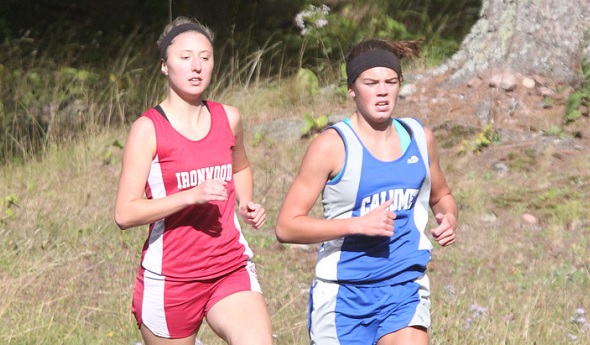
PHOTO: Calumet's Chelsea Jacques (right) won this season's Calumet Invitational with a time of 21:08.06, just ahead of Ironwood's Jessica Gering at 21:46.16. (Photo courtesy of Calumet athletic department.)
Preview: Parade of Champions Set to Feature Several New Standouts
By
Geoff Kimmerly
MHSAA.com senior editor
March 13, 2025
We’ve become accustomed to frequent favorites often finishing at the top of our three MHSAA Lower Peninsula Boys Swimming & Diving Finals.
But changing leaderboards could be the theme of this weekend’s meets.
Although Ann Arbor Pioneer in Division 1 and Bloomfield Hills Cranbrook Kingswood in Division 3 are returning champions and ranked No. 1 in their respective divisions, both could face stronger competition this time. A possible first-time champion appears most in play in Division 2, as top-ranked Detroit U-D Jesuit and No. 2 Byron Center are both seeking first team Finals titles.
Individually, only four 2024 champions will swim this weekend – guaranteeing plenty more opportunities for new stars to climb the podium.
Preliminaries at all three Finals sites begin at noon Friday, with Saturday championship events starting at noon as well. Both days of all three meets will be streamed live and viewable with subscription on MHSAA.tv. For information on purchasing tickets, plus psych sheets, dive orders and more, visit the Boys Swimming & Diving page – and see below for a glance at several team and individual contenders to follow.
Division 1 at Holland Aquatic Center
Reigning champion: Ann Arbor Pioneer
2024 runner-up: Saline
2025 top-ranked: 1. Ann Arbor Pioneer, 2. Northville, 3. Detroit Catholic Central.
Pioneer has won four straight Division 1 championships, last year by just 30 points ahead of rival Saline, with Detroit Catholic Central finishing third and Northville fourth and just 49 points separating those top four teams. Pioneer enters this weekend with all three relays and 10 individual entries seeded to score plus a diver competing. Northville, the runner-up in 2022, is seeking its first championship since 1973 and sending three relays and 15 entries seeded to score and a diver, and DCC is seeking its first team title and sending three relays and eight individual entries seeded to score. Pioneer and Saline shared the Southeastern Conference Red title this winter, and Saline is ranked No. 4 and also could make the big move sending all three relays and 16 individual entries seeded to score, plus three divers.
Elijah Almeida, Ann Arbor Pioneer sophomore: He swam the 100-yard breaststroke during his Finals debut a year ago and returns as the top seed in that race (56.99), sixth-seeded in the 100 butterfly (51.91) and likely to swim on top-seeded 200 freestyle and medley relays.
Sam Campbell, Milford junior: He’s seeded first in the 100 backstroke (49.45) and third in the 200 freestyle (1:40.64) and is expected to swim on two top-seven seeded relays.
Owen Stevens, Zeeland senior: He’s won the 200 individual medley and 500 freestyle championship the last two seasons. He is seeded first in both the IM at 1:49.54 and 500 at 4:28.69 and likely to swim on two top-11 relays.
Brady Stenson, Northville junior: He finished fourth in the 500 and seventh in the 200 freestyle last season and returns as the top seed in the 200 (1:39.30) and second in the 500 (4:31.40) and is expected to swim on two top-seven relays.
Camren Turowski, Detroit Catholic Central sophomore: The top seed in the 50 (20.69) and 100 freestyles (45.25) is also expected to swim on two top-three seeded relays. He finished second in the 50 and swam on two championship and one runner-up relay in 2024.
Diego Valdes, Saline senior: Last season’s fourth-place finisher in the IM and runner-up in the butterfly also swam on two top-three relays. He returns as the top seed in the butterfly (49.97) and 11th seed in the IM and is expected to swim on two top-four seeded relays.
Ann Arbor Pioneer 200 freestyle relay: The anticipated lineup of Almeida, senior Brighton Han and juniors Edward Zhang and Henry Baumhover enter with a top-seeded time of 1:25.91, with the meet record 1:23.25 swam in 2021.
Riley Brimm, Utica Eisenhower senior: He finished 15th in Division 1 diving last season but enters this weekend after posting the highest score in any Division 1 Regional qualification meet, 452.45.
Division 2 at Oakland University
Reigning champion: Birmingham Groves
2024 runners-up: Farmington, Birmingham Seaholm
2025 top-ranked: 1. Detroit U-D Jesuit, 2. Byron Center, 3. Birmingham Seaholm.
Last year’s finish certainly was among the most incredible in MHSAA Finals history, as Groves repeated as champion with 245 points but Farmington and Seaholm tied for second both with 244. The list of favorites is a little different this time, as Jesuit is expected to move up from fourth last year and Byron Center could also make a jump after finishing eighth. The Cubs are seeking their first Finals title and finished runners-up in 2022 and 2023, and they enter this weekend with all three relays and 15 individual entries seeded to score and three divers competing. Byron Center is seeking its first top-two Finals finish and also will bring a sizable lineup of three relays and 16 individuals seeded to score, and three divers. Seaholm most recently won Division 2 in 2021 and will look to three relays and eight individuals seeded to score, with one diver competing.
Will Cicco, Rochester Hills Stoney Creek senior: The top seed in the 200 (1:39.21) and 500 freestyles (4:31.02) is likely to also swim on two top-seven seeded relays.
Patrick Mackillop, Detroit U-D Jesuit senior: Last year’s third-place finisher in the breaststroke and 12th-place finisher in the IM is seeded first in the breaststroke (55.86), 10th in the IM and expected to swim on two top-four seeded relays.
Josh Martin, Mattawan senior: He’s seeded first in the butterfly (49.03) and fifth in the 50 (21.30) and will swim on two relays after finishing third in both the butterfly and 50 last winter.
Charlie McCuiston, Detroit U-D Jesuit sophomore: He debuted last season with a third place in the 200 freestyle and eighth place in the breaststroke, and will return as the top seed in the 100 free (45.57), second seed in the 200 free (1:40:60) and likely to swim on those two top-four relays with Mackillop.
Quinn O’Neill, Birmingham Seaholm sophomore: The reigning champion in the 500 also finished seventh in the 200 free last year. He’s seeded eighth in the 500 and 11th in the 200 this time but is also expected to swim on top-seeded 200 medley and 400 freestyle relays.
Elliott Rijnovean, Birmingham Seaholm junior: He won the butterfly and backstroke last season and also swam on the winning 200 medley and third-place 400 freestyle relays. He’s seeded first in the backstroke (49.35), fourth in the butterfly (50.73) and expected to swim on the same top-seeded relays with O’Neill.
Evan Tack, Detroit U-D Jesuit senior: Last year’s runner-up in the 200 freestyle and third-place finisher in the backstroke is seeded first in the IM (1:50.84) by more than five seconds and second in the butterfly (49.50). He’s also expected to swim on second-seeded 200 medley and 400 freestyle relays.
Lucas Witham, Grand Rapids Forest Hills Central junior: He finished fifth in the 50 and eighth in the 100 freestyle last season, and is seeded first in the 50 (20.83), second in the 100 (46.18) and will likely swim on two top-nine seeded relays.
Birmingham Seaholm 200 medley relay: The lineup of Rijnovean, O’Neill, senior Emmett Knudsen and junior Finn Murray enters with a seed time of 1:31.42, two seconds faster than the field and also faster than the meet record of 1:31.85 swam in 2022.
Farmington 200 freestyle relay: The anticipated group of seniors Jack Tomlinson, Luke Morden and Paul DeMartini and junior Joshua Luo has a top-seeded time of 1:25.13 and could approach the meet record of 1:23.72 swam in 2022.
Jack Olivier, Byron Center senior: He finished fourth in diving last season and posted this year’s highest Division 2 Regional qualifying score of 505 points.
Division 3 at Eastern Michigan University
Reigning champion: Bloomfield Hills Cranbrook Kingswood
2024 runners-up: East Grand Rapids
2025 top-ranked: 1. Bloomfield Hills Cranbrook Kingswood, 2. Holland Christian, 3. East Grand Rapids.
It’s been Cranbrook first and EGR second the last two seasons, and the Cranes will pursue a third-straight title with three relays and 19 individual entries seeded to score, plus a diver in the mix. East Grand Rapids won the previous two titles before this Cranbrook run and will look to pile points with three relays and 11 individuals seeded to score, and a strong group of three divers competing. Holland Christian is another regular, most recently champion in 2018 and 2019, runner-up in 2021 and 2022 and third place a year ago. The Maroons will seek to contend with three relays and 15 individuals seeded to score, and a similarly highly-touted pair of divers.
Sam Harper, Plainwell junior: He finished fourth in the 500 freestyle last season and is seeded first in that race (4:39.61) and second in the 200 free (1:44.70).
Jack Langeland, Hamilton junior: He’s seeded first in the 200 (1:44.11) and fifth in the butterfly (52.56) and could swim on two top-three seeded relays. He finished 11th in the 200 and 12th in the butterfly last season.
Basilio Ledesma, Holland Christian senior: He finished sixth in the 50 and fourth in the butterfly in 2024 and returns as the top seed in the 100 free (47.53), fourth seed in the 50 (21.78) and expected to swim on the second-seeded 200 medley relay.
Kade Opsal, Adrian junior: He finished fifth in the 50 and 10th in the backstroke and swam on two high-placing relays last season. He’s seeded first in both the backstroke (50.20) and 50 (21.0) this weekend and will likely swim on two seventh-seeded relays.
Levi Rozema, Holland Christian senior: He’s seeded first in the breaststroke (57.64) and sixth in the IM (2:01.72) and is likely to swim on two second-seeded relays. He finished third in the breaststroke and 11th in the IM last year, also swimming on the third-place medley relay.
Liam Smith, Otsego junior: He’s won three Finals championships over his first two seasons – two in the butterfly and last year in the IM as well. He’s seeded first in the IM (1:52.44) and second in the butterfly (50.37) and will likely swim on two top-10 seeded relays.
Ethan Xu, Bloomfield Hills Cranbrook Kingswood sophomore: He and Smith may be racing repeatedly as he’s seeded second in the IM (1:54.99) and first in the butterfly (49.64) and may also swim on top-seeded medley and 400 freestyle relays. He finished fifth in the IM and eighth in the 500 last season.
Rowan Bishop, East Grand Rapids senior: Last season’s fourth-place diver scored 524.65 points at his Regional qualifier to set the pace for all of Division 3.
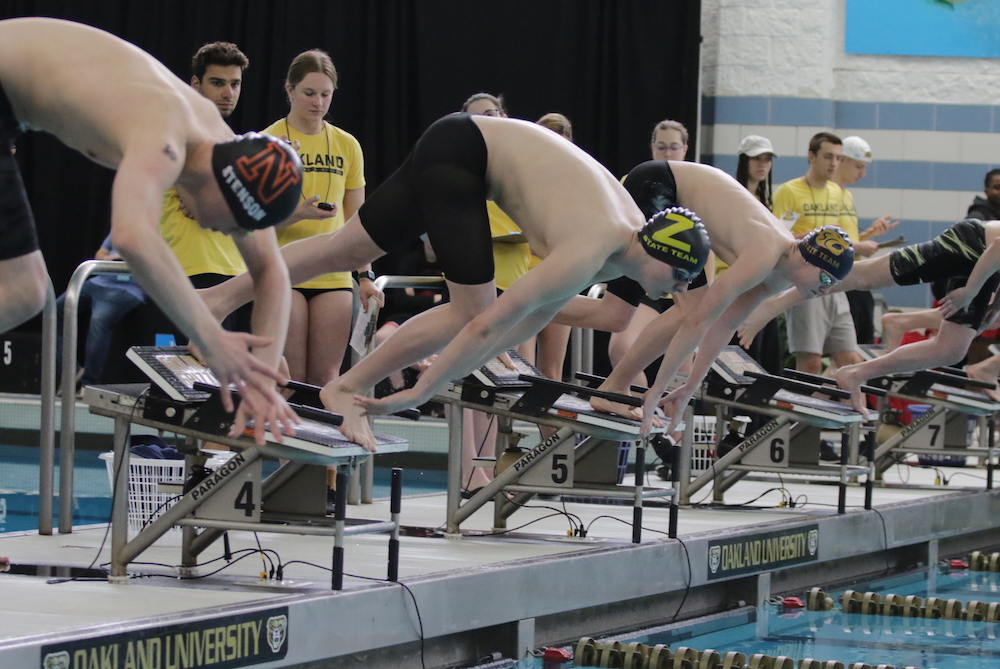
PHOTO Division 1 swimmers including Zeeland's Owen Stevens and Northville's Brady Stenson launch to begin a 500 freestyle race at last season's Finals. (Click for more from High School Sports Scene.)