

Calumet Invite Produces Northern Stars
September 18, 2013
By Geoff Kimmerly
Second Half editor
The Calumet Invitational dates back roughly 30 years as an annual staple of the cross country schedule for schools at the northernmost tip of Michigan's Upper Peninsula.
A creative move by the Copper Kings last year added some statewide prestige to the event.
 Last week, for the second season, Calumet ran the series of races at Keweenaw Mountain Lodge, a resort near Copper Harbor and the northern bank of the Keweenaw Peninsula.
Calumet is the northernmost high school in Michigan. And moving this race another 35 miles northeast more or less guaranteed it's the northernmost event run in the state.
"We figured it was pretty safe. We're the northernmost school in the state, and you can only go four more miles and you're in Lake Superior," Calumet athletic director Sean Jacques said. "Nobody else is going to do anything more north than that."
A total of 10 schools were represented this fall in the races for boys and girls varsity, junior varsity and middle schoolers.
Jacques said the event formerly was run at a golf course in Calumet. But a few years ago, Calumet graduate and former Copper Kings cross country runner Dan Harri moved home from Florida to become general manager at the Mountain Lodge (he's also a renowned chef and has owned restaurants in Miami with Hall of Fame Dolphins coach Don Shula).
Harri had asked a few times about bringing a cross country or golf event to the lodge. Jacques told him last year they'd give it a try, so Harri set up a course that includes golf course, a couple of bridges, trails and finishes with a climb on the No. 1 fairway. It also provides various points for fans to watch runners go by, not always available on other courses.
"We were looking for a little bit of a change, and it's a beautiful course," Jacques said. "We thought if people were willing to make the extra drive, it would be really nice."
Calumet won the boys race this season, just ahead of runner-up Houghton. Houghton's girls were victorious, followed by the host Copper Kings.
Click to read more about this year's event from the Houghton Mining Gazette.
Michigan's claim to an NFL evolution
As part of its NFL preview this month, Sports Illustrated reported on one of the most significant developments for offenses over the last few decades – the silent snap count, which is used regularly by visiting teams because offensive linemen can’t hear the quarterback calling for the ball over the clamor of the home crowd.
And the article explained that the silent snap count might’ve gotten its start at one of Michigan’s smallest high schools – Flint’s Michigan School for the Deaf.
Offensive linemen during the 1980s were feasted on by pass rushers like Lawrence Taylor and Bruce Smith, who built record sack totals by blasting past blockers who seemed a step slow. Turns out, that was true. Defensive players were getting an edge by attacking as soon as they saw the ball move. But blockers (especially offensive tackles), focused instead on the defensive ends and linebackers lined up across from them, and didn’t have the luxury of watching the ball – and since they also couldn’t hear the snap count, started each play a step behind.
Enter the silent count. The quarterback signals to the center that he is ready to receive the ball (with a pat on the back, by raising a foot, etc.). The center then raises his head, and after a predetermined count of at least one second snaps the ball without a sound. This means an offensive tackle doesn’t have to listen for a snap count – he just counts after seeing the center get set.
The SI report recognized longtime offensive line coach Howard Mudd as the guru of the silent snap count. But Mudd recalled a conversation he’d had while working for the Seattle Seahawks with another coach, the late Andy MacDonald, who also had coached early in his career at a school for the deaf in Michigan.
The article doesn’t mention Michigan School for the Deaf by name. But it seems to make sense that the Tartars were the first to use the now-revolutionary count. MacDonald – who played at Central Michigan University and went on to coach at Michigan State and four other colleges and also for the Buffalo Bills – grew up in Flint and attended Flint Northern before playing for the Chippewas from 1950-53. The historical web site Michigan-football.com has results for Flint’s Michigan School for the Deaf dating to 1950, making it a decent assumption that MacDonald might’ve gotten in a little early coaching experience at the school down the road from his home.
Click for the SI story and go to page 4 for the mention of Michigan’s school.
Michigan mourns trooper, running standout
The law enforcement community is mourning the death of Michigan State Police trooper Paul Butterfield, who was shot Sept. 9 during a traffic stop in Mason County. He also was a well-known distance runner during the 1980s and the MHSAA Class A cross country champion running for Bridgeport in 1987.
According to a Ludington Daily News report, Butterfield continued running after high school at the University of Tennessee, and also competed at the 1989 Pan American Junior Games in Argentina.
Butterfield was stationed in Hart after previously serving in Manistee, and lived in Mason County. He also had served in the U.S. Army. Click to read more from the Ludington Daily News.
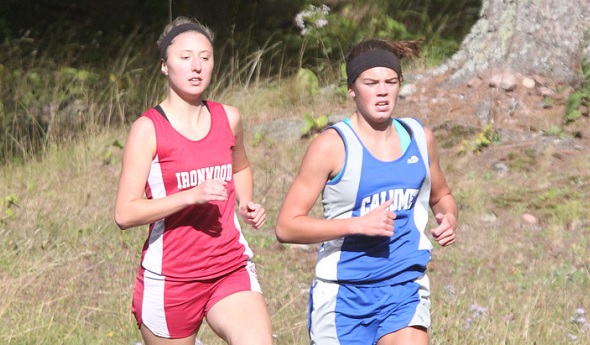
PHOTO: Calumet's Chelsea Jacques (right) won this season's Calumet Invitational with a time of 21:08.06, just ahead of Ironwood's Jessica Gering at 21:46.16. (Photo courtesy of Calumet athletic department.)

Record Girls Tournament Attendance Drives MHSAA Spectatorship Past 1.4 Million Again
By
Geoff Kimmerly
MHSAA.com senior editor
December 18, 2024
A record number of spectators at girls postseason events pushed Michigan High School Athletic Association attendance during the 2023-24 school year past 1.4 million fans for the second straight, with the total of 471,651 spectators for girls competitions breaking the previous all-time best set in 2014-15.
Total, MHSAA tournament events drew 1,449,574 spectators at competitions for which admission is charged – just over a half-percent decrease from 2022-23 but still the second highest overall postseason attendance over the last seven years. Attendance at MHSAA boys tournament events during 2023-24 was 1,008,070, a three-percent decrease from the year before. The MHSAA annually tracks attendance for all sports except golf, skiing and tennis, as single tickets are not sold for those sports.
Record spectator turnout for the Softball and Track & Field Tournaments drove the girls overall increase. Softball set an overall tournament record with 49,636 fans, besting the previous record set just the year before by nearly 2,000, and also set an individual-round record with 4,935 fans at Quarterfinals. Track & Field – with girls and boys competing together – drew a record 42,899 spectators overall, and a Regional record of 25,661. Both track totals bested previous records set during the 2020-21 school year.
Several more sports saw attendance increases during 2023-24. Girls basketball overall postseason attendance was up significantly and for the third-straight year, this time to 158,126 fans for a nine-percent increase from 2022-23. The Individual Wrestling Tournament drew 48,237 fans, an eight-percent increase from the previous season, and set records at the District (13,308) and Regional (11,089) levels. Overall attendance for competitive cheer (29,297, up 12 percent), girls lacrosse (5,627, up six percent), boys lacrosse (17,107, up less than one percent) and boys swimming & diving (6,116, up 33 percent) all were up as well from 2022-23.
Competitive cheer’s increase was keyed in part by record attendance at the District level (14,528). Baseball Districts (36,553), Boys Lacrosse Quarterfinals (3,021) and Girls Diving Regionals (879) also set records.
Football remains the most-attended MHSAA Tournament sport and drew 363,563 spectators for its playoff series – a decrease of nearly five percent from the previous year but including the highest attendance during the Semifinal rounds (32,596) since 2012-13. Boys basketball attendance again ranked second at 280,800 fans, down four percent from the previous year but with increases for the Regional and Quarterfinal rounds. Girls basketball remained third for overall attendance and first among girls sports, followed again by volleyball – which drew 113,239 fans, only 313 fewer than the year before as postseason attendance in that sport has seen less than a percentage point change year to year over the last three seasons.
The MHSAA is a private, not-for-profit corporation of voluntary membership by more than 1,500 public and private senior high schools and junior high/middle schools which exists to develop common rules for athletic eligibility and competition. No government funds or tax dollars support the MHSAA, which was the first such association nationally to not accept membership dues or tournament entry fees from schools. Member schools which enforce these rules are permitted to participate in MHSAA tournaments, which attract more than 1.4 million spectators each year.