

Calumet Invite Produces Northern Stars
September 18, 2013
By Geoff Kimmerly
Second Half editor
The Calumet Invitational dates back roughly 30 years as an annual staple of the cross country schedule for schools at the northernmost tip of Michigan's Upper Peninsula.
A creative move by the Copper Kings last year added some statewide prestige to the event.
 Last week, for the second season, Calumet ran the series of races at Keweenaw Mountain Lodge, a resort near Copper Harbor and the northern bank of the Keweenaw Peninsula.
Calumet is the northernmost high school in Michigan. And moving this race another 35 miles northeast more or less guaranteed it's the northernmost event run in the state.
"We figured it was pretty safe. We're the northernmost school in the state, and you can only go four more miles and you're in Lake Superior," Calumet athletic director Sean Jacques said. "Nobody else is going to do anything more north than that."
A total of 10 schools were represented this fall in the races for boys and girls varsity, junior varsity and middle schoolers.
Jacques said the event formerly was run at a golf course in Calumet. But a few years ago, Calumet graduate and former Copper Kings cross country runner Dan Harri moved home from Florida to become general manager at the Mountain Lodge (he's also a renowned chef and has owned restaurants in Miami with Hall of Fame Dolphins coach Don Shula).
Harri had asked a few times about bringing a cross country or golf event to the lodge. Jacques told him last year they'd give it a try, so Harri set up a course that includes golf course, a couple of bridges, trails and finishes with a climb on the No. 1 fairway. It also provides various points for fans to watch runners go by, not always available on other courses.
"We were looking for a little bit of a change, and it's a beautiful course," Jacques said. "We thought if people were willing to make the extra drive, it would be really nice."
Calumet won the boys race this season, just ahead of runner-up Houghton. Houghton's girls were victorious, followed by the host Copper Kings.
Click to read more about this year's event from the Houghton Mining Gazette.
Michigan's claim to an NFL evolution
As part of its NFL preview this month, Sports Illustrated reported on one of the most significant developments for offenses over the last few decades – the silent snap count, which is used regularly by visiting teams because offensive linemen can’t hear the quarterback calling for the ball over the clamor of the home crowd.
And the article explained that the silent snap count might’ve gotten its start at one of Michigan’s smallest high schools – Flint’s Michigan School for the Deaf.
Offensive linemen during the 1980s were feasted on by pass rushers like Lawrence Taylor and Bruce Smith, who built record sack totals by blasting past blockers who seemed a step slow. Turns out, that was true. Defensive players were getting an edge by attacking as soon as they saw the ball move. But blockers (especially offensive tackles), focused instead on the defensive ends and linebackers lined up across from them, and didn’t have the luxury of watching the ball – and since they also couldn’t hear the snap count, started each play a step behind.
Enter the silent count. The quarterback signals to the center that he is ready to receive the ball (with a pat on the back, by raising a foot, etc.). The center then raises his head, and after a predetermined count of at least one second snaps the ball without a sound. This means an offensive tackle doesn’t have to listen for a snap count – he just counts after seeing the center get set.
The SI report recognized longtime offensive line coach Howard Mudd as the guru of the silent snap count. But Mudd recalled a conversation he’d had while working for the Seattle Seahawks with another coach, the late Andy MacDonald, who also had coached early in his career at a school for the deaf in Michigan.
The article doesn’t mention Michigan School for the Deaf by name. But it seems to make sense that the Tartars were the first to use the now-revolutionary count. MacDonald – who played at Central Michigan University and went on to coach at Michigan State and four other colleges and also for the Buffalo Bills – grew up in Flint and attended Flint Northern before playing for the Chippewas from 1950-53. The historical web site Michigan-football.com has results for Flint’s Michigan School for the Deaf dating to 1950, making it a decent assumption that MacDonald might’ve gotten in a little early coaching experience at the school down the road from his home.
Click for the SI story and go to page 4 for the mention of Michigan’s school.
Michigan mourns trooper, running standout
The law enforcement community is mourning the death of Michigan State Police trooper Paul Butterfield, who was shot Sept. 9 during a traffic stop in Mason County. He also was a well-known distance runner during the 1980s and the MHSAA Class A cross country champion running for Bridgeport in 1987.
According to a Ludington Daily News report, Butterfield continued running after high school at the University of Tennessee, and also competed at the 1989 Pan American Junior Games in Argentina.
Butterfield was stationed in Hart after previously serving in Manistee, and lived in Mason County. He also had served in the U.S. Army. Click to read more from the Ludington Daily News.
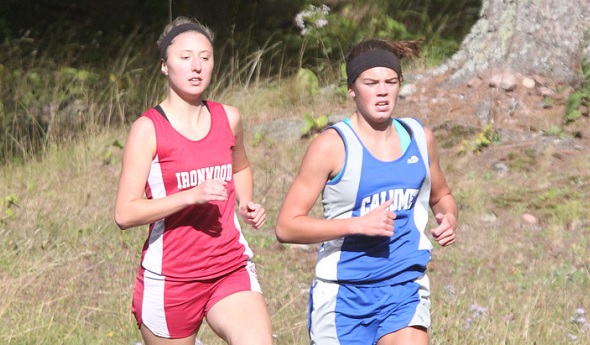
PHOTO: Calumet's Chelsea Jacques (right) won this season's Calumet Invitational with a time of 21:08.06, just ahead of Ironwood's Jessica Gering at 21:46.16. (Photo courtesy of Calumet athletic department.)
In the Long Run: Only 15 Rushers Share State Record with 99-Yard Scoring Sprint
By
Steve Vedder
Special for MHSAA.com
August 26, 2024
Jakob Price remembers the defense forcing him into a subtle change of plans at the line of scrimmage, then about a dozen seconds later finishing his run into the MHSAA record book.
It's a rare story that only 15 football players in MHSAA history can tell, most involving similar circumstances. A couple of key blocks, the opening of but a sliver of a hole, a fortuitous breakdown on defense including a broken tackle or two, capped, in many cases, by simple luck.
When it comes to a rusher busting loose on a 99-yard run, there is much that has to fall into place. In the case of Price, a sophomore at Muskegon when he became the last player to make that rare record-tying dash on Oct. 8, 2021, it was all the above.
"I remember we ran what we called a "power 6" and I hit the line hard," Price said. "I saw that the hole off the center was clogged, and I thought I was going to get hit, but I made a move. Three guys had a shot at me, but someone took out the tackle with a block and I saw nothing but green. It was almost a safety, but then this hole opened up and I was gone."
 In comparison, for instance, there have been 81 players who've thrown for at least six touchdowns in a game. But only 15 players in Michigan history have snatched a handoff and sped 99 yards to pay dirt. It's a wide cast of characters that stretches from one player who has played in 12 major league baseball games to another who collected three times as many receiving yards as rushing and whose previous longest run had been a modest 25.
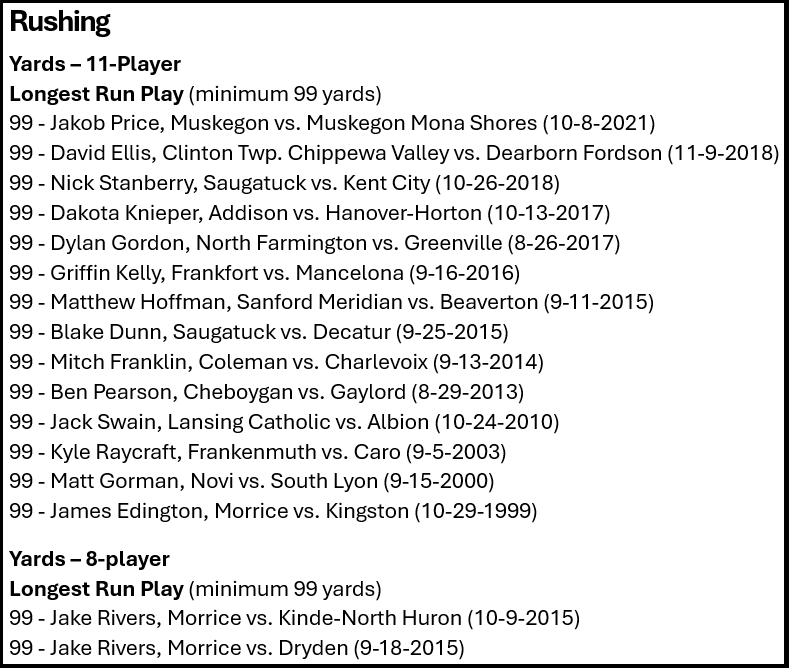
The first 99-yard run chronicled in the MHSAA record book was by James Edington of Morrice, who raced 99 yards against Kingston on Oct. 29, 1999. Edington's run was one of his last during an outstanding four-year career that included being named all-state three times. He remembers the play, which came late in a playoff game, being an inside trap where he broke at least two tackles. Edington said the play wasn't designed for anything more than to keep the defense from notching a safety.
"I was just trying to get out of the end zone, get us some room," said Edington, who remembers having 4.7 speed in the 40-yard dash. "I remember it was at the end of the game and I was so tired. I was a two-way player who rarely came off the field. I know that in a 99-yard run the blocks have got to be there when the defense hits the box. I knew if I could just get past this linebacker, there was a lot of green grass in front of me."
Morrice, coincidentally, also is the only program to have a 99-yard runner in 8-player football. Morrice switched from 11 to 8-player with the start of the 2014 season, and Jake Rivers made the 99-yard sprint twice in 2015.
Saugatuck coach Bill Dunn is the only coach to have two players on the list, including his son Blake, on Sept. 25, 2015, against Decatur.
From a coaching standpoint, Bill Dunn said there is nothing like a crushing 99-yard burst to change a game's momentum. When a team is clinging to the ball at its 1-yard line, the possible outcomes are seemingly dark – from surrendering a safety to a punt that puts the opposition in prime position to score.
"A lot of things have to happen in a 99-yard run," Dunn said. "There can absolutely be luck. And it can be a backbreaker. You got a team at the 1-yard line, and the defense knows it's going to get good field position with a punt. But instead you get a guy who breaks one for 99."
 Blake Dunn, now a prospect in the Cincinnati Reds system, was an all-state sprinter in high school as part of earning 16 varsity letters across four sports. Dunn said he made a "mid-line read" after the fullback dove into the line. The defense collapsed on him, Dunn cut back against the grain and was off to the races.
"Our fullback dove down the mid-line, and my read crashed down to him," said Dunn, whose 101 career touchdowns are fourth in state history while his 6,954 rushing yards rank eighth.
"When I followed my blocks through the hole, there was a bunch of open grass. I think there might have been a linebacker that almost tripped me up from the backside, but nobody was able to get me and then 99 yards later it ended in a touchdown. It was pretty cool fun in the moment and fun to look back on it now."
Kyle Raycraft of Frankenmuth made his 99-yard run against Caro on Sept. 5, 2003. Like many of his brethren’s stories, Raycraft, who remembers running for more than 200 yards and three or four touchdowns in the game, said the play came down to a couple of blocks, shaking off potential tacklers, and having daylight in front of him.
"I went up the middle and got good blocking at the line and broke a couple tackles," said Raycraft, also an all-state sprinter and currently an emergency room doctor in Sault Ste. Marie. "I really didn't think that much of it at the time. I think it got us the lead at a key time and that was exciting, but I didn't think it was so rare. There's been a lot of high school football and only (15) kids have done this, so that's a pretty short list."
Matthew Hoffman of Sanford Meridian, by his own admission, wasn't particularly fast. So speed played a minimal part in his run Sept. 11, 2015, against Beaverton.
Hoffman ran track in the spring, but not as a sprinter; he ran distances. His piece of football history was more a result of getting a couple of key blocks, breaking through the line, making a cut and finding running room along the sideline.
"I broke to the line and swerved to the left to the sidelines," said Hoffman, now a certified rescue boat operator working on the Gordie Howe International Bridge for the Bridging North America company. "I was quick and shifty and I'd get a few breakaways, but I wasn't fast. I think the defense was looking for me on the right side, and it was a counterplay to the left. The offensive line did a great job on that play.
 "It was exciting, but (instead of records) it was more it just happened so quickly. People met me in the end zone after the play was over, but then we were just focused on defense and the next play."
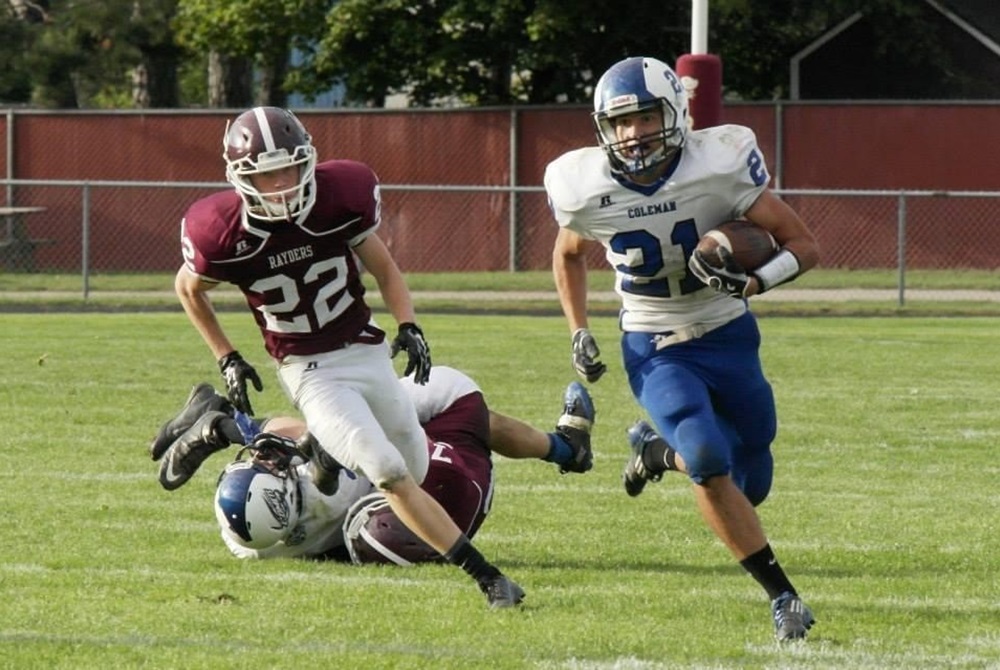
Coleman's Mitch Franklin has another different slant on his 99-yard story. He was primarily a receiver who recorded 1,014 yards at that position as opposed to around 300 as a running back. But on Sept. 13, 2014, against Charlevoix, Franklin took advantage of a rare handoff after a quarterback sneak had netted virtually no gain on first down.
"Best blocking we had all year. A hole opened up, I stiff-armed a guy and just ran," said Franklin, a former Gladwin County sheriff’s deputy. "I remember I was fortunate to run on our right side where we had bigger guys. It was fortunate that we caught the defense off guard. I think it was about our first power run that game and a lot of fortunate things had to happen.
"One of the things I remember is our principal patting me on the back and telling me what a good run it was."
While the members of the select 99-Yard Club may have different memories as to how they successfully dashed from their team's 1-yard line into the other team's end zone, their goals were the same: Just somehow move their team from the shadow of their own goalposts into more favorable territory.
And one last goal, recalled Franklin.
"Hey, you just don't want to make that long drive home with a big, fat ‘L,’” he said. "You want to win the game. That's what was important."
The MHSAA is continuously adding to its record books, and there is no deadline for an accomplishment to be submitted. Find directions to do so and the football record books in full at this link.
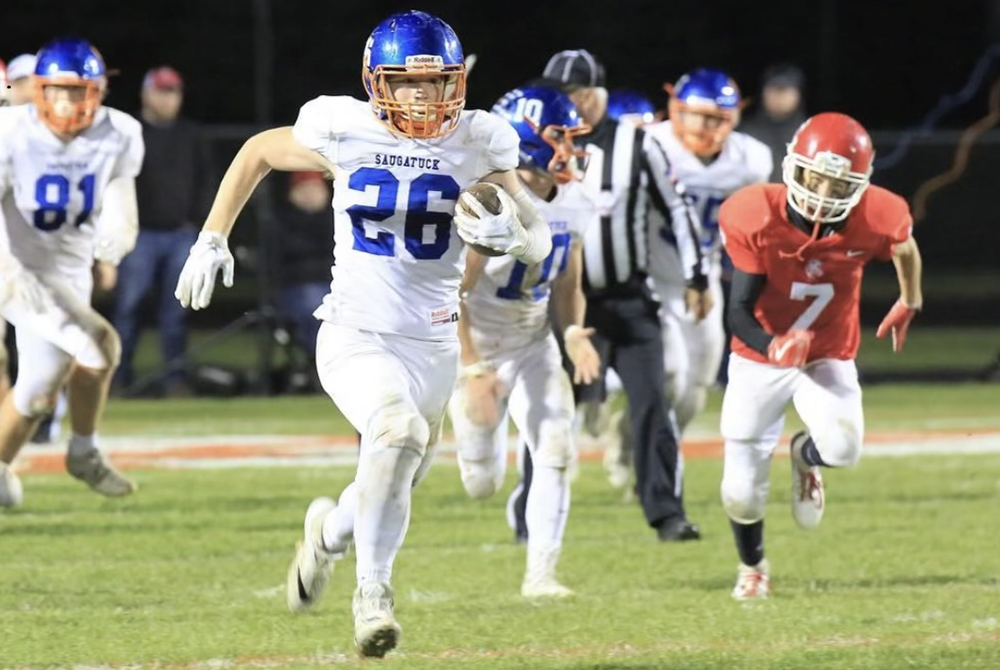
PHOTOS (Top) Coleman's Mitch Franklin (right) turns upfield during a 99-yard scoring run against Charlevoix on Sept. 13, 2014. (Middle) Muskegon's Jakob Price (left) makes a move on the way to a 99-yard touchdown run against Muskegon Mona Shores in 2021. (Below) Saugatuck's Nick Stanberry breaks away for a 99-yard TD run against Kent City in 2018. (Photos provided by Franklin, Price and the Saugatuck football program.)