

Calumet Invite Produces Northern Stars
September 18, 2013
By Geoff Kimmerly
Second Half editor
The Calumet Invitational dates back roughly 30 years as an annual staple of the cross country schedule for schools at the northernmost tip of Michigan's Upper Peninsula.
A creative move by the Copper Kings last year added some statewide prestige to the event.
 Last week, for the second season, Calumet ran the series of races at Keweenaw Mountain Lodge, a resort near Copper Harbor and the northern bank of the Keweenaw Peninsula.
Calumet is the northernmost high school in Michigan. And moving this race another 35 miles northeast more or less guaranteed it's the northernmost event run in the state.
"We figured it was pretty safe. We're the northernmost school in the state, and you can only go four more miles and you're in Lake Superior," Calumet athletic director Sean Jacques said. "Nobody else is going to do anything more north than that."
A total of 10 schools were represented this fall in the races for boys and girls varsity, junior varsity and middle schoolers.
Jacques said the event formerly was run at a golf course in Calumet. But a few years ago, Calumet graduate and former Copper Kings cross country runner Dan Harri moved home from Florida to become general manager at the Mountain Lodge (he's also a renowned chef and has owned restaurants in Miami with Hall of Fame Dolphins coach Don Shula).
Harri had asked a few times about bringing a cross country or golf event to the lodge. Jacques told him last year they'd give it a try, so Harri set up a course that includes golf course, a couple of bridges, trails and finishes with a climb on the No. 1 fairway. It also provides various points for fans to watch runners go by, not always available on other courses.
"We were looking for a little bit of a change, and it's a beautiful course," Jacques said. "We thought if people were willing to make the extra drive, it would be really nice."
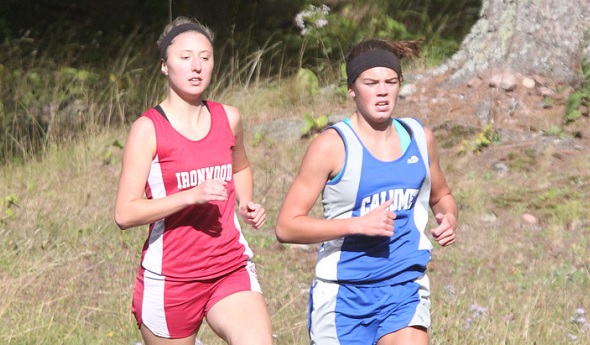
Calumet won the boys race this season, just ahead of runner-up Houghton. Houghton's girls were victorious, followed by the host Copper Kings.
Click to read more about this year's event from the Houghton Mining Gazette.
Michigan's claim to an NFL evolution
As part of its NFL preview this month, Sports Illustrated reported on one of the most significant developments for offenses over the last few decades – the silent snap count, which is used regularly by visiting teams because offensive linemen can’t hear the quarterback calling for the ball over the clamor of the home crowd.
And the article explained that the silent snap count might’ve gotten its start at one of Michigan’s smallest high schools – Flint’s Michigan School for the Deaf.
Offensive linemen during the 1980s were feasted on by pass rushers like Lawrence Taylor and Bruce Smith, who built record sack totals by blasting past blockers who seemed a step slow. Turns out, that was true. Defensive players were getting an edge by attacking as soon as they saw the ball move. But blockers (especially offensive tackles), focused instead on the defensive ends and linebackers lined up across from them, and didn’t have the luxury of watching the ball – and since they also couldn’t hear the snap count, started each play a step behind.
Enter the silent count. The quarterback signals to the center that he is ready to receive the ball (with a pat on the back, by raising a foot, etc.). The center then raises his head, and after a predetermined count of at least one second snaps the ball without a sound. This means an offensive tackle doesn’t have to listen for a snap count – he just counts after seeing the center get set.
The SI report recognized longtime offensive line coach Howard Mudd as the guru of the silent snap count. But Mudd recalled a conversation he’d had while working for the Seattle Seahawks with another coach, the late Andy MacDonald, who also had coached early in his career at a school for the deaf in Michigan.
The article doesn’t mention Michigan School for the Deaf by name. But it seems to make sense that the Tartars were the first to use the now-revolutionary count. MacDonald – who played at Central Michigan University and went on to coach at Michigan State and four other colleges and also for the Buffalo Bills – grew up in Flint and attended Flint Northern before playing for the Chippewas from 1950-53. The historical web site Michigan-football.com has results for Flint’s Michigan School for the Deaf dating to 1950, making it a decent assumption that MacDonald might’ve gotten in a little early coaching experience at the school down the road from his home.
Click for the SI story and go to page 4 for the mention of Michigan’s school.
Michigan mourns trooper, running standout
The law enforcement community is mourning the death of Michigan State Police trooper Paul Butterfield, who was shot Sept. 9 during a traffic stop in Mason County. He also was a well-known distance runner during the 1980s and the MHSAA Class A cross country champion running for Bridgeport in 1987.
According to a Ludington Daily News report, Butterfield continued running after high school at the University of Tennessee, and also competed at the 1989 Pan American Junior Games in Argentina.
Butterfield was stationed in Hart after previously serving in Manistee, and lived in Mason County. He also had served in the U.S. Army. Click to read more from the Ludington Daily News.
PHOTO: Calumet's Chelsea Jacques (right) won this season's Calumet Invitational with a time of 21:08.06, just ahead of Ironwood's Jessica Gering at 21:46.16. (Photo courtesy of Calumet athletic department.)

Referee Camaraderie: Bloopers, 'Nerding' Out, Lots of Laughs Create Powerful Bond
By
Pam Shebest
Special for MHSAA.com
February 13, 2024
KALAMAZOO — When it comes to blooper highlights, four MHSAA hockey officials don’t hesitate to share their miscues.
 One of them, Bob Corak, even has his pratfalls set to music on an internet site called Zebras with Pucks.
Laughter is the sound of the day when the four gather every Tuesday after their yoga class at Nisker’s Char-Grill & Slap Shot Hockey Bar in Kalamazoo.
The camaraderie between Corak, Corey Butts, Nick Schrippa and Nat Swanson is evident, but the tone gets more serious once the talk turns to officiating.
“We’ve all played, we’ve all coached to some extent, but officiating is just what speaks to us,” Schrippa said. “That’s our niche.
“Every player on the ice has a fan in the stands. Every player on the ice has support on the bench. We’re the only support we have in the arena. We’re the only ones we can lean on. We’re kind of on an island.”
Most times the friends are part of different four-man crews made up of two referees and two linesmen for South Central High School Hockey League games. But that just gives them more to talk about when they get together on Tuesdays.
 “We spend an hour every Tuesday with Bob’s wife (Susan) just kicking the crap out of us and then come to (Nisker’s) to debrief,” Schrippa said. Susan Corak runs Be Well Yoga and Fitness in Kalamazoo.
"We never talk about the workout. Somebody will bust out a phone and we’ll go over a video and we’ll talk about a situation, talk about rule differences,” he continued. “We are nerds to the nth degree, and that’s just how we’re wired.”
Yoga is a good way to keep in shape, the four friends agree.
“I’m a little older than most of the referees I meet,” said Corak, who retired after 35 years with Pfizer in information technology. "It keeps me limber, keeps me in shape to an extent, not a lot of cardio but the strength is there that we get from yoga, especially the core, plus injury prevention.
“If I’m not skating, I’m officiating or I’m working the books for the association (Kalamazoo Ice Hockey Officials Association).”
Corak assists in the scheduling, billing, etc., leading Schrippa to quip: “Remember when Bob said he did information technology? We take full advantage of that. He is, in fact, the glue that holds a lot of our shenanigans together. He really is.”
Referees vs. Linesmen
Butts and Corak prefer wearing the referees’ armbands, while Schrippa and Swanson like working the lines.
“’I’m a smaller guy,” said Butts, who has been officiating for 14 years. “Linesmen typically tend to be 6-foot-5. When you’re smaller than most of the players, it doesn’t work out well.
“I like the freedom to be able to get out of the way. It’s a high traffic area as a linesman.”
When not spending evenings officiating, Butts is the penalty box timekeeper for the ECHL Kalamazoo Wings home games. His day job as a third-party examiner for the state of Michigan means he gives driving tests, and that leads to some interesting conversations.
“I’ve given most of (the players) their driver’s licenses,” he said. “I’ve had a group of players in the middle of a high school hockey game, getting ready to drop the puck at the start of the third period, and they’re trying to schedule a driver’s test for the next day. I’m like, ‘Guys, not now. Talk to me after work.’”
 Swanson is the newest of the quartet, moving to the area three years ago from Syracuse, N.Y., where he started officiating at age 11.
He is a pilot in the U.S. Air Force International Guard in Battle Creek flying MQ-9 Reaper Drones.
“I like refereeing better (than being a linesman) because I like managing the game and look at the big picture,” Swanson said. “Sometimes it’s great to be a linesman because they get to communicate with the players, crack jokes and sometimes throw the referee under the bus, ‘Yeah, I agree that was a terrible call. But you’ve got to move on.’”
All four also officiate college and youth hockey, which can lead to a dilemma.
“Those are all different rule books, so we don’t have to know just one set of rules,” Schrippa said. “None of them are what you see on TV.
“While we have a couple hundred people in the building who are yelling at us that we got it wrong because that’s what they saw on ESPN, that’s not how it works. So not only do we have to know the rules, we have to know the differences in the rules.”
With mentorship programs available, some current prep players are also officials for younger leagues.
“They’re learning, we’re teaching them,” Corak said. “We have games with them as officials, then we’ll officiate their games when they play for their schools.”
Swanson added: “I think that makes them better players because they understand the rules, where they can bend rules and where they can’t.”
 That is what led Schrippa to officiating.
“(Late referee) Mike Martin was officiating a game and pulled me aside,” he said. “I was 22 years old and he asked if I wanted to become a ref.
“‘(Heck) you’ve broken all the rules,’ he told me. ‘You probably know most of them already. He wasn’t wrong. I talked to a couple friends who had done it, and they talked me into doing it 29 seasons ago. I fell in love with it.”
Fun with bloopers
All four laugh as they regale each other with their funniest and most embarrassing moments.
For Schrippa, it was the college game where he made his refereeing debut.
“I was given the rookie lap,” he said. “I was jazzed. I came out of the gate, turned left, went around the back of the net, got to the blue line, caught a toe pick and Supermanned, slid from the blue line to the top of the next faceoff circle and was soaked because the ice hadn’t set yet.
“I got a standing ovation from the few hundred fans that were in the rink. Both my linesmen were doubled over laughing. It was a very cold first period.”
Something similar happened to Swanson.
 “I was taking a hot lap, not seeing they’ve got a carpet out for somebody, hitting the carpet and Supermanning,” he recalled. “Then having a linesman watch you do it as there’s a few hundred people in the stands and give a big washout sign.”
Butts and Swanson had moments that actually delayed the start of a game.
For Butts, “I forgot my pants because I washed them separate and my wife had to bring them to me, and we could not start the game until my pants arrived,” he said, while the others laughed and nodded in agreement.
Swanson actually found himself at the wrong rink one time.
“I’m like, ‘Where is everybody?’” he said. “My phone starts ringing. ‘Hey dude, game starts in 15 minutes. You going to be here? Uh, yes, in 20.’’’
The four agree most officials go through highs and lows, funny times and embarrassing times, and that’s one thing that brings them all together.
“What’s unique about what we do is I could meet another official from Sweden tomorrow who I’ve never met before, and within minutes we’ve already got that relationship,” said Schrippa, who is the Southwest Michigan communications representative for the Michigan Department of Transportation (MDOT).
“That’s something we all share, we all know that feeling, we all understand that bond and it just takes a second. It’s so neat, it’s powerful.”
 Pam Shebest served as a sportswriter at the Kalamazoo Gazette from 1985-2009 after 11 years part-time with the Gazette while teaching French and English at White Pigeon High School. She can be reached at [email protected] with story ideas for Calhoun, Kalamazoo and Van Buren counties.
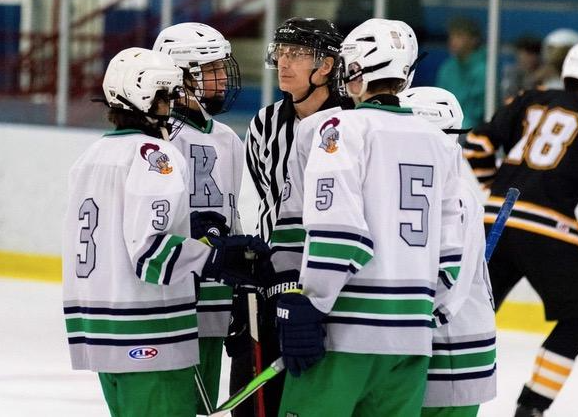
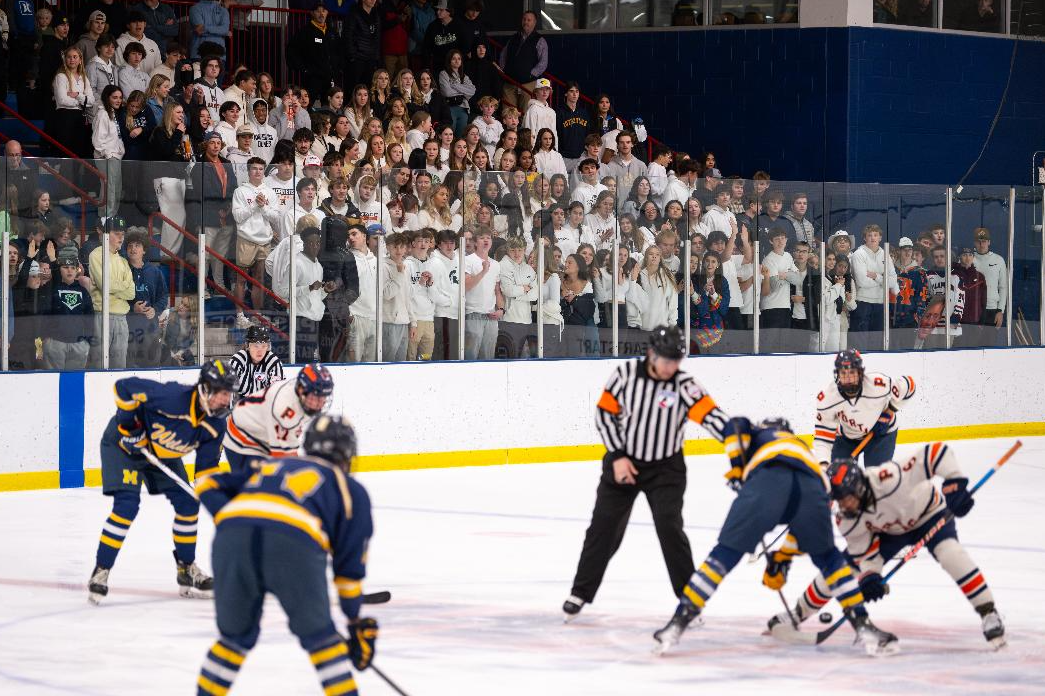
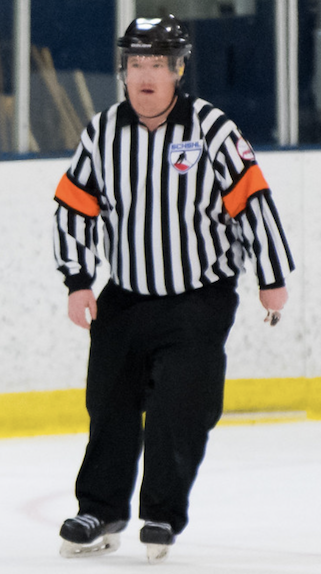
PHOTOS (Top) MHSAA hockey officials, from left: Nick Schrippa, Bob Corak, Nat Swanson and Corey Butts get together recently for one of their weekly hangouts. (2) Schrippa makes a call. (3) Corak, center, confers with a group of players. (4) Swanson prepares to drop the puck. (5) Butts monitors the game action. (Top photo by Pam Shebest; following photos provided by respective officials.)