

Calumet Invite Produces Northern Stars
September 18, 2013
By Geoff Kimmerly
Second Half editor
The Calumet Invitational dates back roughly 30 years as an annual staple of the cross country schedule for schools at the northernmost tip of Michigan's Upper Peninsula.
A creative move by the Copper Kings last year added some statewide prestige to the event.
 Last week, for the second season, Calumet ran the series of races at Keweenaw Mountain Lodge, a resort near Copper Harbor and the northern bank of the Keweenaw Peninsula.
Calumet is the northernmost high school in Michigan. And moving this race another 35 miles northeast more or less guaranteed it's the northernmost event run in the state.
"We figured it was pretty safe. We're the northernmost school in the state, and you can only go four more miles and you're in Lake Superior," Calumet athletic director Sean Jacques said. "Nobody else is going to do anything more north than that."
A total of 10 schools were represented this fall in the races for boys and girls varsity, junior varsity and middle schoolers.
Jacques said the event formerly was run at a golf course in Calumet. But a few years ago, Calumet graduate and former Copper Kings cross country runner Dan Harri moved home from Florida to become general manager at the Mountain Lodge (he's also a renowned chef and has owned restaurants in Miami with Hall of Fame Dolphins coach Don Shula).
Harri had asked a few times about bringing a cross country or golf event to the lodge. Jacques told him last year they'd give it a try, so Harri set up a course that includes golf course, a couple of bridges, trails and finishes with a climb on the No. 1 fairway. It also provides various points for fans to watch runners go by, not always available on other courses.
"We were looking for a little bit of a change, and it's a beautiful course," Jacques said. "We thought if people were willing to make the extra drive, it would be really nice."
Calumet won the boys race this season, just ahead of runner-up Houghton. Houghton's girls were victorious, followed by the host Copper Kings.
Click to read more about this year's event from the Houghton Mining Gazette.
Michigan's claim to an NFL evolution
As part of its NFL preview this month, Sports Illustrated reported on one of the most significant developments for offenses over the last few decades – the silent snap count, which is used regularly by visiting teams because offensive linemen can’t hear the quarterback calling for the ball over the clamor of the home crowd.
And the article explained that the silent snap count might’ve gotten its start at one of Michigan’s smallest high schools – Flint’s Michigan School for the Deaf.
Offensive linemen during the 1980s were feasted on by pass rushers like Lawrence Taylor and Bruce Smith, who built record sack totals by blasting past blockers who seemed a step slow. Turns out, that was true. Defensive players were getting an edge by attacking as soon as they saw the ball move. But blockers (especially offensive tackles), focused instead on the defensive ends and linebackers lined up across from them, and didn’t have the luxury of watching the ball – and since they also couldn’t hear the snap count, started each play a step behind.
Enter the silent count. The quarterback signals to the center that he is ready to receive the ball (with a pat on the back, by raising a foot, etc.). The center then raises his head, and after a predetermined count of at least one second snaps the ball without a sound. This means an offensive tackle doesn’t have to listen for a snap count – he just counts after seeing the center get set.
The SI report recognized longtime offensive line coach Howard Mudd as the guru of the silent snap count. But Mudd recalled a conversation he’d had while working for the Seattle Seahawks with another coach, the late Andy MacDonald, who also had coached early in his career at a school for the deaf in Michigan.
The article doesn’t mention Michigan School for the Deaf by name. But it seems to make sense that the Tartars were the first to use the now-revolutionary count. MacDonald – who played at Central Michigan University and went on to coach at Michigan State and four other colleges and also for the Buffalo Bills – grew up in Flint and attended Flint Northern before playing for the Chippewas from 1950-53. The historical web site Michigan-football.com has results for Flint’s Michigan School for the Deaf dating to 1950, making it a decent assumption that MacDonald might’ve gotten in a little early coaching experience at the school down the road from his home.
Click for the SI story and go to page 4 for the mention of Michigan’s school.
Michigan mourns trooper, running standout
The law enforcement community is mourning the death of Michigan State Police trooper Paul Butterfield, who was shot Sept. 9 during a traffic stop in Mason County. He also was a well-known distance runner during the 1980s and the MHSAA Class A cross country champion running for Bridgeport in 1987.
According to a Ludington Daily News report, Butterfield continued running after high school at the University of Tennessee, and also competed at the 1989 Pan American Junior Games in Argentina.
Butterfield was stationed in Hart after previously serving in Manistee, and lived in Mason County. He also had served in the U.S. Army. Click to read more from the Ludington Daily News.
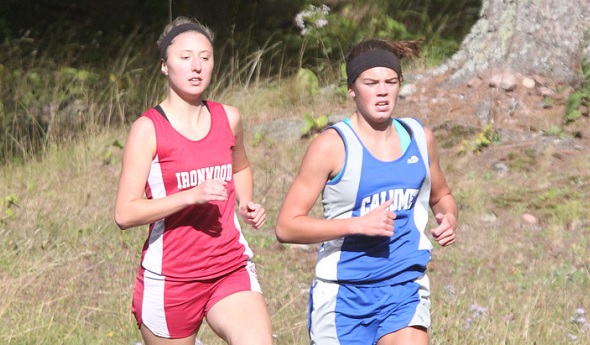
PHOTO: Calumet's Chelsea Jacques (right) won this season's Calumet Invitational with a time of 21:08.06, just ahead of Ironwood's Jessica Gering at 21:46.16. (Photo courtesy of Calumet athletic department.)
Lapeer West 4-Time Finals Winner Set to Build Champions at Oklahoma
By
Paul Costanzo
Special for MHSAA.com
July 5, 2023
Roger Kish has a habit of accomplishing great things in a short amount of time.
 He won an MHSAA Individual Wrestling Finals title as a freshman at Lapeer West, his first of four.
He was an NCAA finalist as a sophomore at Minnesota.
He was a Division I head wrestling coach at North Dakota State University at 27.
So, it should come as little surprise that before hitting his 40th birthday, Kish is now in charge of one of the nation’s most storied college wrestling programs.
Kish, 39, was recently named the head coach at Oklahoma, a program that has won seven national titles and produced 67 individual champions in its history.
“It’s something I’m very grateful for, and I’m certainly humbled to walk the same halls of some of the Oklahoma greats,” the 2003 Lapeer West graduate said. “Being able to lead this program is nothing short of a dream come true. The administration is great, and in terms of the support system that’s in place, what they have at Oklahoma is second to none.”
Kish takes over a Sooners program fighting to get back into the conversation as one of the nation’s best. His time at NDSU portends well for that, as he had the Bison as high as No. 12 in the country a year ago, the highest ranking in program history.
NDSU also defeated Oklahoma in a Big 12 dual meet, and finished 24th at the NCAAs, with a program record 25.5 points.
“Roger knows what it takes to build a championship-caliber program, and he’s done just that at North Dakota State, with many of his wrestlers having won conference titles and earning All-American honors,” Oklahoma Director of Athletics Joe Castiglione said in a release. “His coaching philosophy aligns with our approach at Oklahoma, and I know he’ll guide our wrestling program toward achieving the standards we’ve set for ourselves.”
Had you told a teenage Kish this would be his future as he was racking up the second-most wrestling victories in state history, he wouldn’t have believed it. Not because it was too ambitious, but because coaching wasn’t even on his radar.
In fact, it wasn’t something he was considering even as he was becoming a two-time All-American at Minnesota.
 “I would be lying to say that I wanted to be a high school or college wrestling coach, career-wise,” Kish said. “I had other plans.”
Those other plans were to either continue wrestling beyond college, explore a career in mixed martial arts, or become a chiropractor.
It was all on the table for him as his collegiate career came to a close, but an injury and the long recovery process that followed opened up a new avenue for Kish.
“When I had my surgery, I was off the mats for a lot of time, but I was still able to be on the mats, not as a competitor, but in a way that I could help some of my younger teammates,” he said. “I wanted to be able to give back to those guys that had helped me. That’s where it all began.”
He had been accepted into the chiropractic program at Northwestern Health Sciences University in Bloomington, Minn. But he chose to put that off to continue his recovery for a possible mat return, and to serve as a graduate assistant for the Gophers.
The following year, he was asked to join Bucky Maughan’s coaching staff at North Dakota State, and his career as a coach took off.
“Throughout that year (at Minnesota), I really enjoyed helping out those young guys,” Kish said. “I took an opportunity from Bucky Maughan, because he needed a bigger guy to train with those bigger guys. It seemed like the best route in the moment, so I took it and never looked back. I was an assistant for two seasons, and built really good relationships with stakeholders in the athletic department. Following two seasons under Bucky Maughan, he retired after 46 seasons, and the position opened up. They did a national search, and I think the relationships I had built with stakeholders, and the immediate success of the program in the two seasons I was part of it, led to a great opportunity for me to take over at North Dakota State.”
Kish built a strong program in his 12 seasons at the helm, compiling a 108-70 record. During his time, the Bison moved from the Western Wrestling Conference to the Big 12 and didn’t skip a beat. NDSU is 33-26 in its time in the Big 12, including a 6-2 mark this past season, which was good enough for fourth place during the regular season.
NDSU has sent 21 wrestlers to the NCAA Championships over the past four seasons, with nine becoming All-Americans.
While it’s now in the corner and not in the center of the mat, Kish and wrestling success have long been synonymous.
Kish was 117-27 at Minnesota, placing second in the nation as a sophomore and third as a junior. He also won a Big Ten title at 184 pounds as a sophomore.
He was 252-2 in his high school career, with both losses coming during his freshman season. The 252 wins are second in MHSAA history only to 260 won by Justin Zeerip of Hesperia. Kish was unbeaten in his last 223 matches, placing him third all-time for consecutive wins behind Zeerip and Brent Metcalf of Davison (228).
In 2003, Kish became the 11th wrestler in MHSAA history to win four individual titles. At the time, nobody had won them at higher weights, as Kish won at 160, 171, 189 and 189.
“For me, it probably didn’t feel as big in the moment as it probably did for other people,” Kish said. “For me, it was the expectation to win it as a freshman. My own father said, ‘I don’t know if he’s going to get out of the Regional.’ I took it very personal and serious. But I didn’t think of how hard it was to do in the moment. I’m in awe of how talented these (more recent four-timers) are. Doing it today is seemingly a lot more challenging.”
Wrestling has long been a family experience for Kish, as his father, Roger Kish Sr., coached alongside Hall of Famer John Virnich at Lapeer West.
Kish’s older brother James was a two-time Finals champion who wrestled at North Carolina and amassed 215 career high school victories.
“I was fortunate enough to have a father who gave a tremendous amount of care to the sport and was always trying to keep my brother and I busy throughout our youth,” Kish said. “He always had us in some sort of activity. It probably also stemmed from having an older brother that was a couple years older than myself. I was always a little bit bigger, and he was a little more agile. We were always competitors – call it a brother thing. That allowed each of us to excel in sports, having one another to compete with.”
Kish also played football at Lapeer West and was a starting varsity linebacker as a freshman.
“Wrestling was my passion,” Kish said. “I loved playing football, but it was what I did to take a break from wrestling. It allowed some different facets to cultivate in terms of building relationships and recognizing different factors that helped motivate individuals. … Understanding being on a team, and relying on and trusting other people to help you succeed, whether that’s your teammates or your coaches.”
As someone who made the most of his time in high school athletics, and now remains close to them in a recruiting aspect, Kish is fully aware of how important they are for students.
“Having an outlet for young kids to be active and learn the traits that will help them later in life – the discipline and the humility of wins and losses, the work ethic that’s necessary, understanding what goals are and how to achieve those goals, dreaming a little bigger than what’s realistic – is good for kids,” Kish said. “Athletics is a great platform to do that. Wrestling is a great platform to do that. To help them grow as young men and women, that’s extremely important.”
Made in Michigan is powered by Michigan Army National Guard.
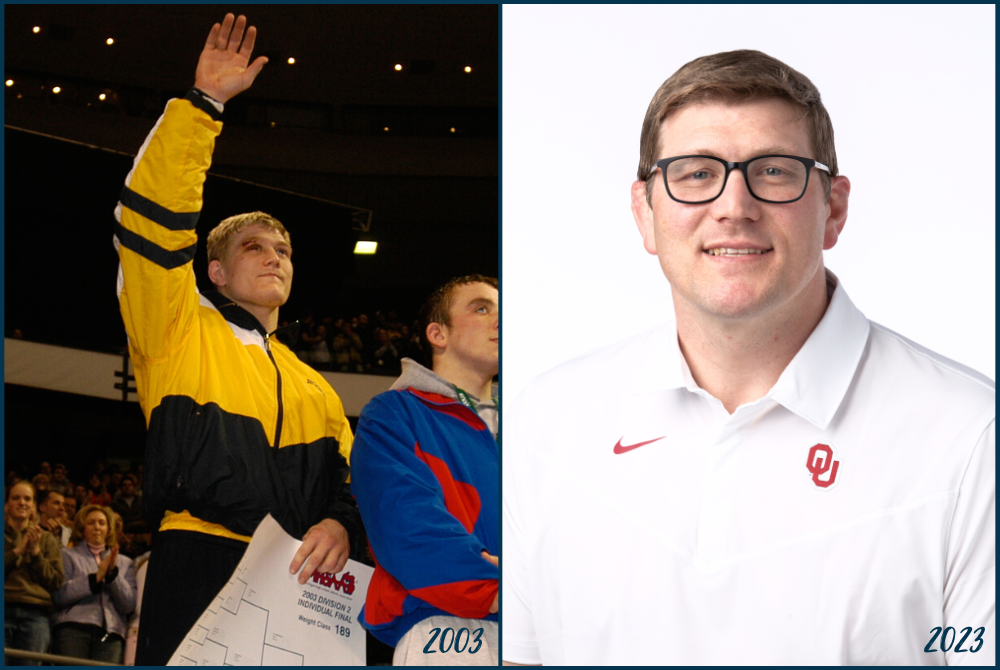
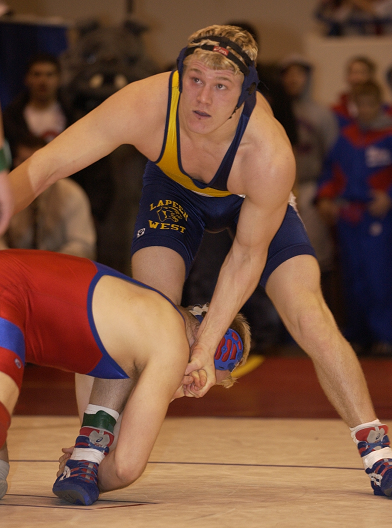
PHOTOS (Top) Roger Kish stands atop the MHSAA champions podium in 2003, and was hired as Oklahoma’s head coach in May. (Middle) Kish helps Lapeer West to the Division 2 team runner-up finish with this match against Mason as a senior. (Lapeer West photos from MHSAA archives; Oklahoma photo courtesy of University of Oklahoma athletic department.)