

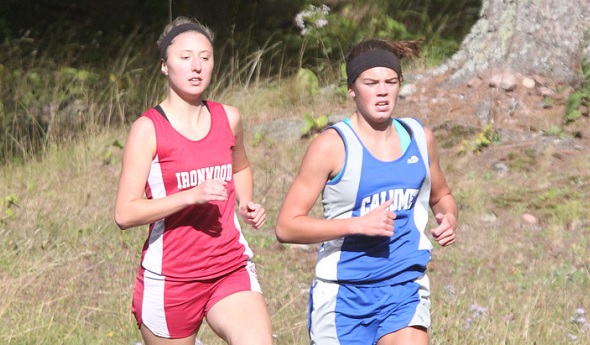
Calumet Invite Produces Northern Stars
September 18, 2013
By Geoff Kimmerly
Second Half editor
The Calumet Invitational dates back roughly 30 years as an annual staple of the cross country schedule for schools at the northernmost tip of Michigan's Upper Peninsula.
A creative move by the Copper Kings last year added some statewide prestige to the event.
 Last week, for the second season, Calumet ran the series of races at Keweenaw Mountain Lodge, a resort near Copper Harbor and the northern bank of the Keweenaw Peninsula.
Calumet is the northernmost high school in Michigan. And moving this race another 35 miles northeast more or less guaranteed it's the northernmost event run in the state.
"We figured it was pretty safe. We're the northernmost school in the state, and you can only go four more miles and you're in Lake Superior," Calumet athletic director Sean Jacques said. "Nobody else is going to do anything more north than that."
A total of 10 schools were represented this fall in the races for boys and girls varsity, junior varsity and middle schoolers.
Jacques said the event formerly was run at a golf course in Calumet. But a few years ago, Calumet graduate and former Copper Kings cross country runner Dan Harri moved home from Florida to become general manager at the Mountain Lodge (he's also a renowned chef and has owned restaurants in Miami with Hall of Fame Dolphins coach Don Shula).
Harri had asked a few times about bringing a cross country or golf event to the lodge. Jacques told him last year they'd give it a try, so Harri set up a course that includes golf course, a couple of bridges, trails and finishes with a climb on the No. 1 fairway. It also provides various points for fans to watch runners go by, not always available on other courses.
"We were looking for a little bit of a change, and it's a beautiful course," Jacques said. "We thought if people were willing to make the extra drive, it would be really nice."
Calumet won the boys race this season, just ahead of runner-up Houghton. Houghton's girls were victorious, followed by the host Copper Kings.
Click to read more about this year's event from the Houghton Mining Gazette.
Michigan's claim to an NFL evolution
As part of its NFL preview this month, Sports Illustrated reported on one of the most significant developments for offenses over the last few decades – the silent snap count, which is used regularly by visiting teams because offensive linemen can’t hear the quarterback calling for the ball over the clamor of the home crowd.
And the article explained that the silent snap count might’ve gotten its start at one of Michigan’s smallest high schools – Flint’s Michigan School for the Deaf.
Offensive linemen during the 1980s were feasted on by pass rushers like Lawrence Taylor and Bruce Smith, who built record sack totals by blasting past blockers who seemed a step slow. Turns out, that was true. Defensive players were getting an edge by attacking as soon as they saw the ball move. But blockers (especially offensive tackles), focused instead on the defensive ends and linebackers lined up across from them, and didn’t have the luxury of watching the ball – and since they also couldn’t hear the snap count, started each play a step behind.
Enter the silent count. The quarterback signals to the center that he is ready to receive the ball (with a pat on the back, by raising a foot, etc.). The center then raises his head, and after a predetermined count of at least one second snaps the ball without a sound. This means an offensive tackle doesn’t have to listen for a snap count – he just counts after seeing the center get set.
The SI report recognized longtime offensive line coach Howard Mudd as the guru of the silent snap count. But Mudd recalled a conversation he’d had while working for the Seattle Seahawks with another coach, the late Andy MacDonald, who also had coached early in his career at a school for the deaf in Michigan.
The article doesn’t mention Michigan School for the Deaf by name. But it seems to make sense that the Tartars were the first to use the now-revolutionary count. MacDonald – who played at Central Michigan University and went on to coach at Michigan State and four other colleges and also for the Buffalo Bills – grew up in Flint and attended Flint Northern before playing for the Chippewas from 1950-53. The historical web site Michigan-football.com has results for Flint’s Michigan School for the Deaf dating to 1950, making it a decent assumption that MacDonald might’ve gotten in a little early coaching experience at the school down the road from his home.
Click for the SI story and go to page 4 for the mention of Michigan’s school.
Michigan mourns trooper, running standout
The law enforcement community is mourning the death of Michigan State Police trooper Paul Butterfield, who was shot Sept. 9 during a traffic stop in Mason County. He also was a well-known distance runner during the 1980s and the MHSAA Class A cross country champion running for Bridgeport in 1987.
According to a Ludington Daily News report, Butterfield continued running after high school at the University of Tennessee, and also competed at the 1989 Pan American Junior Games in Argentina.
Butterfield was stationed in Hart after previously serving in Manistee, and lived in Mason County. He also had served in the U.S. Army. Click to read more from the Ludington Daily News.
PHOTO: Calumet's Chelsea Jacques (right) won this season's Calumet Invitational with a time of 21:08.06, just ahead of Ironwood's Jessica Gering at 21:46.16. (Photo courtesy of Calumet athletic department.)

Rep Council Adjusts, Expands Out-of-State Competition Opportunities at Spring Meeting
By
Geoff Kimmerly
MHSAA.com senior editor
May 12, 2023
Substantial changes to the rules governing out-of-state competition by Michigan High School Athletic Association member schools were among the most notable actions taken by the MHSAA’s Representative Council during its annual Spring Meeting, May 6-7 in Gaylord.
The Spring Meeting of the 19-member legislative body of the Association’s more than 1,500 member schools is generally the busiest of its sessions each year. The Council considered 31 committee proposals and dealt with a variety of eligibility rule, postseason tournament and operational issues.
The most far-reaching changes approved by the Council shifts the MHSAA rules regarding competitions against out-of-state opponents. Moving forward, MHSAA member schools may continue to compete against teams from Illinois, Indiana, Ohio, Minnesota, Wisconsin and Ontario – but also may compete against teams from elsewhere in the United States as long as those competitions take place in Michigan, one of those five contiguous states or Ontario. The Council voted to remove the allowance for MHSAA member schools to travel up to 300 miles to play an out-of-state opponent; MHSAA member schools still can compete against those opponents, but competition must take place in Michigan or one of the states/province listed above. Any event including schools from outside of Michigan or those contiguous states/province must receive approval by the MHSAA and each state high school association with a team involved in order for MHSAA member schools to be allowed to participate.
In an effort to strengthen the undue influence regulation, the Council approved a change making it a violation for coaches or their representatives to connect via social media with students from another high school or with a student prior to ninth grade who has not yet enrolled in a high school or participated in an athletic practice or competition as a high school student. Violations of this rule include connecting via social media with a “follow,” “friend request” or “direct message” to a student. The Council also expanded the portion of the undue influence regulation that doesn’t allow coaches and representatives to visit prospective athletes and their families at the families’ homes to not allow them to visit athletes and families at “other locations” as well.
The Council approved an expansion in the use of video to determine penalties when there is a bench-clearing situation or other incident where team members enter the area of competition during an altercation. MHSAA staff, based on video evidence, will be allowed to assess additional penalties including ejections and suspensions to team members, coaches and other staff who enter those areas to participate or engage in such an altercation.
Concerning specific sports, changes to three stand out from several adopted by the Council.
The Council approved three Bowling Committee recommendations affecting postseason competition in that sport. The first reorganizes Regional competition to eight sites, with each qualifying the top two teams and top seven singles for both girls and boys competitions to the Finals (instead of the previous six sites qualifying three teams and 10 singles for both girls and boys). The Council also approved a proposal to change the Team Finals match play to a head-to-head, best-of-five Baker game format. Finally, the Council approved a proposal to adopt the Phantom II oil pattern for all MHSAA Tournament competitions.
In girls volleyball, the Council approved a Volleyball Committee recommendation to begin seeding the top two teams in each District beginning with the 2024-25 school year. As is done currently with girls and boys basketball and girls and boys soccer, the top-two seeded teams in each District will be placed on opposite sides of the bracket, guaranteeing they will not play each other before the District Final. Seeding will be determined using the Michigan Power Rating (MPR) formula which takes into account regular-season success and strength of schedule. MPR is used to seed Districts in the same way in basketball and soccer.
In wrestling, the Council approved a Wrestling Committee recommendation adding two regular-season dual meets to the allowed number of wrestling contest dates. These must be dual meets and may not be converted into three-team (tri) or four-team (quad) meets. Teams and individuals now will be allowed 16 days of competition with no more than eight of those days allowed for tournament-type events where a wrestler competes more than twice.
Here is a summary of other notable actions taken by the Representative Council at the Spring Meeting, which will take effect during the 2023-24 school year unless noted:
Regulations
• The Council approved a classification-related change for the MHSAA’s smallest member schools, allowing them to request participation of eighth and seventh-grade students, based on the high school’s enrollment. Schools with fewer than 125 students (instead of the previous 100) may request an MHSAA Executive Committee waiver to use eighth-grade students in all sports except football, ice hockey and wrestling. Schools with fewer than 75 students (instead of the previous 50) may make the same request to use seventh and eighth-grade students in all sports except those three. Schools requesting a waiver must show cause and rationale for those students’ participation.
Sports Medicine
• The Council approved a Sports Medicine Advisory Committee proposal requiring middle school head coaches to have valid, current CPR certification. Similar to the high school requirements for head coaches at all levels, this addition at the middle school level will ensure each team has at least one coach at each level present who is CPR-certified. This requirement will take effect with the 2024-25 school year, and schools will attest to its completion by the established deadline for each season.
Officials
• The Council approved an Officials Review Committee recommendation adjusting the minimum requirements for postseason consideration in wrestling, competitive cheer and soccer. In wrestling, officials must receive 75 coaches ratings (instead of the previous 100) to be considered for working a postseason meet. In girls competitive cheer, judges must be members in good standing of a Local Approved Association. In soccer, officials must work a minimum of five regular-season games (down from the previous 10) to be considered for the postseason.
• The Council also approved a Committee recommendation increasing the amount paid when an official arrives on site prior to a competition before receiving notice that competition has been canceled due to an “act of God” including weather that results in unplayable conditions. In these situations, officials will receive one-half of the contract fee (instead of the previous one-third).
Sport Matters
• For baseball, the Council approved a change to when trophies will be awarded to Regional champions. Those trophies will be presented to both Regional champions after the Quarterfinal is concluded, as Regional Finals and the ensuing Quarterfinal are played at the same site on the same day and both Quarterfinal participants will have earned a Regional championship earlier that day.
• In addition to the Regional and Finals changes for bowling explained above, the Council also approved a Bowling Committee proposal seeking common start dates for practice and competition for Lower and Upper Peninsula teams. For the 2023-24 season, bowling teams in both peninsulas will begin practice Nov. 9 and competition Nov. 25. Previously, Upper Peninsula teams were allowed to begin their seasons slightly earlier – this past season four days sooner for practice and a week earlier for competition than their Lower Peninsula counterparts.
• The Council also approved a start date change in girls competitive cheer, proposed by the Competitive Cheer Committee, moving the practice start date to the second Monday before Thanksgiving. This shortens the season by one week, but also allows a more comfortable gap between the fall sideline cheer and winter competitive cheer seasons. This change will take effect with the 2024-25 school year.
• Also in cheer, the Council approved a Committee recommendation that adjusts the restricted period at the end of competitive cheer season to the Monday following Memorial Day, which will allow athletes to try out for sideline cheerleading for the upcoming season after the completion of the majority of spring-sport competitions.
• Additionally, the Council approved an exception to the MHSAA’s all-star regulation that will allow for individual competitive cheer and sideline cheer athletes to participate in an event that is “all-star” in name only as long as the selection components of the event comply with MHSAA regulations.
• In cross country and track & field, the Council approved Cross Country/Track & Field Committee recommendations to eliminate a pair of uniform-related rules adaptations designating the types of head attire that previously could be worn during cross country races and body adornments that previously were allowed to be worn during competitions in both sports.
• In golf, the Council approved a Golf Committee recommendation to require athletes to participate in at least four competitions for the high school team prior to representing that athlete’s school team in an MHSAA postseason golf competition. Those four regular-season competitions may be 9 or 18-hold events.
• A Council action in gymnastics will better define how athletes are assigned a division for the individual portion of the MHSAA Finals. Athletes are assigned either Division 1 or Division 2 based on past experience and skill level – Division 1 for those with the most – and the Council approved the allowance of the Xcel levels of Sapphire and Diamond to be part of the determining criteria. Athletes who have previously competed in a non-school event at either of these levels would be required to compete in the Division 1 level for MHSAA postseason competition.
• In tennis, the Council approved a Tennis Committee recommendation allowing in the Lower Peninsula for a No. 1 doubles pair from a non-qualifying team to advance from Regional to Finals competition if that pair finishes first or second at the Regional and the No. 1 singles player from that team also has qualified for the Finals individually by finishing first or second in Regional play. (Upper Peninsula tennis does not play a Regional.)
• The Council approved a Swimming & Diving Committee recommendation restructuring how qualifying times for Finals are determined in an effort to provide more entries in swimming events at the championship level. Moving forward, qualifying times will be determined based on the past five years of MHSAA race data, but also will account for past numbers of qualifiers in each swim race; qualifying times will be shifted to allow for more athletes to advance to the Finals in events where fields have not been full over the previous five seasons.
• The second swimming & diving recommendation approved by the Council assigned specific breaks during Finals competitions. During Friday preliminaries (swam in the Lower Peninsula only), 10-minute breaks will be placed between the 200-yard medley relay and 200 freestyle races, and between the 200 freestyle relay and 100 backstroke, with a 15-minute break between the 50 freestyle and 100 butterfly. The same 10-minute breaks will be mandated for Saturday Finals competitions, with a 15-minute break during Finals coming between the conclusion of diving and 100 butterfly races.
• For girls volleyball, the Council also approved a Volleyball Committee recommendation to permit the Michigan Interscholastic Volleyball Coaches Association (MIVCA) a 3-minute on-court presentation during the MHSAA Finals to recognize that season’s Miss Volleyball Award winner. The presentation will take place between the second and third sets of the Division 1 championship match.
Junior High/Middle School
• The Council voted to make permanent cross country and track & field competitions that have been conducted at a Regional level as part of a pilot program during the 2021-22 and 2022-23 school years. The Council also voted to expand the number of sites per Junior High/Middle School Regional to allow for large-school (Divisions 1 and 2) and small-school (Divisions 3 and 4) meets for each of the eight Zones. Each participating junior high and middle school will be classified for its Regional meet based on the enrollment of the high school with which the junior high/middle school is connected.
The Council also reviewed reports on membership, with 750 senior high schools and 767 junior high/middle schools in 2022-22 plus 63 elementary schools with 6th-grader participation; cooperative programs, with 376 high school programs for 692 teams during 2023-23; eligibility advancement applications, which totaled three; the use of Educational Transfer Forms, of which there were 127; school violations, attendance at athletic director in-service workshops and Coaches Advancement Program sessions; officials’ registrations, rules meetings attendance and officials reports submitted for the past three sports seasons. The Association’s $13.3 million budget for the 2023-24 school year also was approved.
The Representative Council is the 19-member legislative body of the MHSAA. All but five are elected by member schools. Four members are appointed by the Council to facilitate representation of females and minorities, and the 19th position is occupied by the Superintendent of Public Instruction or designee.
The MHSAA is a private, not-for-profit corporation of voluntary membership by more than 1,500 public and private senior high schools and junior high/middle schools which exists to develop common rules for athletic eligibility and competition. No government funds or tax dollars support the MHSAA, which was the first such association nationally to not accept membership dues or tournament entry fees from schools. Member schools which enforce these rules are permitted to participate in MHSAA tournaments, which attract more than 1.3 million spectators each year.