

Calumet Invite Produces Northern Stars
September 18, 2013
By Geoff Kimmerly
Second Half editor
The Calumet Invitational dates back roughly 30 years as an annual staple of the cross country schedule for schools at the northernmost tip of Michigan's Upper Peninsula.
A creative move by the Copper Kings last year added some statewide prestige to the event.
 Last week, for the second season, Calumet ran the series of races at Keweenaw Mountain Lodge, a resort near Copper Harbor and the northern bank of the Keweenaw Peninsula.
Calumet is the northernmost high school in Michigan. And moving this race another 35 miles northeast more or less guaranteed it's the northernmost event run in the state.
"We figured it was pretty safe. We're the northernmost school in the state, and you can only go four more miles and you're in Lake Superior," Calumet athletic director Sean Jacques said. "Nobody else is going to do anything more north than that."
A total of 10 schools were represented this fall in the races for boys and girls varsity, junior varsity and middle schoolers.
Jacques said the event formerly was run at a golf course in Calumet. But a few years ago, Calumet graduate and former Copper Kings cross country runner Dan Harri moved home from Florida to become general manager at the Mountain Lodge (he's also a renowned chef and has owned restaurants in Miami with Hall of Fame Dolphins coach Don Shula).
Harri had asked a few times about bringing a cross country or golf event to the lodge. Jacques told him last year they'd give it a try, so Harri set up a course that includes golf course, a couple of bridges, trails and finishes with a climb on the No. 1 fairway. It also provides various points for fans to watch runners go by, not always available on other courses.
"We were looking for a little bit of a change, and it's a beautiful course," Jacques said. "We thought if people were willing to make the extra drive, it would be really nice."
Calumet won the boys race this season, just ahead of runner-up Houghton. Houghton's girls were victorious, followed by the host Copper Kings.
Click to read more about this year's event from the Houghton Mining Gazette.
Michigan's claim to an NFL evolution
As part of its NFL preview this month, Sports Illustrated reported on one of the most significant developments for offenses over the last few decades – the silent snap count, which is used regularly by visiting teams because offensive linemen can’t hear the quarterback calling for the ball over the clamor of the home crowd.
And the article explained that the silent snap count might’ve gotten its start at one of Michigan’s smallest high schools – Flint’s Michigan School for the Deaf.
Offensive linemen during the 1980s were feasted on by pass rushers like Lawrence Taylor and Bruce Smith, who built record sack totals by blasting past blockers who seemed a step slow. Turns out, that was true. Defensive players were getting an edge by attacking as soon as they saw the ball move. But blockers (especially offensive tackles), focused instead on the defensive ends and linebackers lined up across from them, and didn’t have the luxury of watching the ball – and since they also couldn’t hear the snap count, started each play a step behind.
Enter the silent count. The quarterback signals to the center that he is ready to receive the ball (with a pat on the back, by raising a foot, etc.). The center then raises his head, and after a predetermined count of at least one second snaps the ball without a sound. This means an offensive tackle doesn’t have to listen for a snap count – he just counts after seeing the center get set.
The SI report recognized longtime offensive line coach Howard Mudd as the guru of the silent snap count. But Mudd recalled a conversation he’d had while working for the Seattle Seahawks with another coach, the late Andy MacDonald, who also had coached early in his career at a school for the deaf in Michigan.
The article doesn’t mention Michigan School for the Deaf by name. But it seems to make sense that the Tartars were the first to use the now-revolutionary count. MacDonald – who played at Central Michigan University and went on to coach at Michigan State and four other colleges and also for the Buffalo Bills – grew up in Flint and attended Flint Northern before playing for the Chippewas from 1950-53. The historical web site Michigan-football.com has results for Flint’s Michigan School for the Deaf dating to 1950, making it a decent assumption that MacDonald might’ve gotten in a little early coaching experience at the school down the road from his home.
Click for the SI story and go to page 4 for the mention of Michigan’s school.
Michigan mourns trooper, running standout
The law enforcement community is mourning the death of Michigan State Police trooper Paul Butterfield, who was shot Sept. 9 during a traffic stop in Mason County. He also was a well-known distance runner during the 1980s and the MHSAA Class A cross country champion running for Bridgeport in 1987.
According to a Ludington Daily News report, Butterfield continued running after high school at the University of Tennessee, and also competed at the 1989 Pan American Junior Games in Argentina.
Butterfield was stationed in Hart after previously serving in Manistee, and lived in Mason County. He also had served in the U.S. Army. Click to read more from the Ludington Daily News.
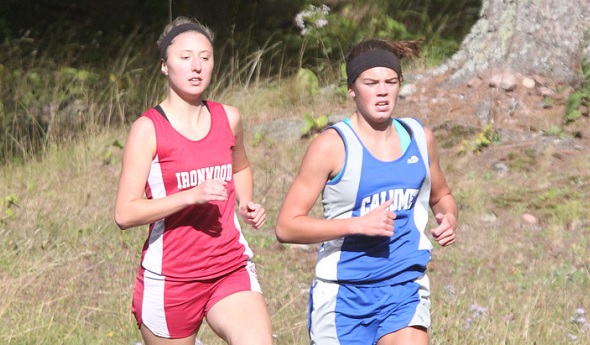
PHOTO: Calumet's Chelsea Jacques (right) won this season's Calumet Invitational with a time of 21:08.06, just ahead of Ironwood's Jessica Gering at 21:46.16. (Photo courtesy of Calumet athletic department.)
Brighton Names Baseball Field for Program Builder, Longtime Leader
By
Tim Robinson
Special for MHSAA.com
May 4, 2023
BRIGHTON — Mark Carrow didn’t know what to expect April 22 when he arrived at Brighton High School’s baseball field, where he was the guest of honor for a ceremony officially naming it Carrow Field.
 “I remember back in October, when they announced this would happen, I told my wife, Mary, that there will be probably 60-70 people here, because there are 18 players on each team and their parents,” he recalled. “We pulled up here and there were all these people, and these young men who look older now.”
Dozens of Brighton alumni, some of whom Carrow hadn’t seen since their high school days nearly a half-century ago, were in attendance for the ceremony held before a doubleheader with Ypsilanti Lincoln.
Carrow retired in 2006 after 34 seasons as Brighton’s baseball coach, recording 823 wins, now eighth on the state’s all-time list. He also was an assistant football coach and coached both boys and girls middle school basketball.
He came to Brighton a year after graduating from the University of Michigan, where he played baseball for the Wolverines, starring at third base.
“My dream was to coach baseball at Ann Arbor High,” Carrow said of his high school alma mater, now Ann Arbor Pioneer. “That was my dream.”
But he had applied to Brighton Area Schools as well, and after a year teaching in Grand Rapids, he and Mary both were offered teaching positions.
“Wouldn’t you know it? We were in school for two days and Ann Arbor calls me up,” Carrow said. “They had a phys ed job open. I’d have been the JV football coach, and I knew the baseball coach was on his way out. It was everything I wanted, and I went to (administrator) Bob Scranton and said, ‘Here’s what’s happening.’ He told me to think about it over the weekend and come back Monday.
“My wife and I talked it over, and we were so grateful to Brighton for giving us a chance to be near our hometown that we felt we owed them a year,” Carrow said. “In November, we bought a house that we lived in for 22 years.”
Brighton’s sports teams weren’t the dominant squads of today. The football team had had two winning seasons in 20 years, and the year Carrow arrived went 0-9.
“We played in six homecoming games, including our own,” he said. “Everyone wanted to play us.”
The baseball team wasn’t much better, having gone decades without a winning season.
But the Bulldogs were 12-12 that first spring under Carrow’s leadership, and never finished below .500 during the rest of his tenure.
 The Bulldogs joined the Southeastern Conference the next year and got off to a 7-0 start before losing at Lincoln.
“The kids were crying on the bus ride home,” Carrow said, “and I knew right then that Brighton had turned a corner, that it meant something to win and losing wasn’t acceptable anymore.”
Brighton took off, winning 20 games or more in all of his last 23 years as a coach, and a total of 13 league titles, 12 District titles, three Regional crowns and while making two trips to the Semifinals.
The talent was there, too, including 16 all-state players and two Mr. Baseball Award winners in Ron Hollis and Drew Henson.
Carrow earned national and Michigan Coach of the Year honors three times apiece and was inducted into the Michigan High School Baseball Coaches Hall of Fame in 1992.
The field was renamed in his honor after the Brighton school board changed its policy to allow the renaming of facilities to honor living persons less than two years ago.
But Carrow is quick to cite the reasons for his success.
“The players are the ones who made this possible,” he said. “I mean that from the bottom of my heart. I never threw a pitch or hit the baseball. I got 800 wins, but it was because of them.
Carrow has a photographic memory, which came in handy while chatting with former players.
“It was funny, because with each kid I remembered an incident about them,” he said. “Jeff Bogos, who I hadn’t seen since he graduated in 1979, came out and I said, ‘Do you remember when we were at Milan and your knee went out (of place) in the middle of the field?’ It happened twice. He said, ‘How do you remember that?’ And I said, ‘How could I not?’”
Carrow moved to Florida after his retirement, where he and his longtime assistant, George Reck, meet up a couple of times a week. He makes frequent trips north to watch U-M football and to visit his son, Chris, who lives in Chicago.
Baseball is firmly in his past.
“I think I’ve been to one high school game since I went down there,” Carrow said. “I hated the way the coach was coaching, and Mary did, too. She said, ‘We don’t have to watch any more high school baseball,’ and I said, ‘You’re right.’”
When he retired, Carrow said he would likely be forgotten in a few years.
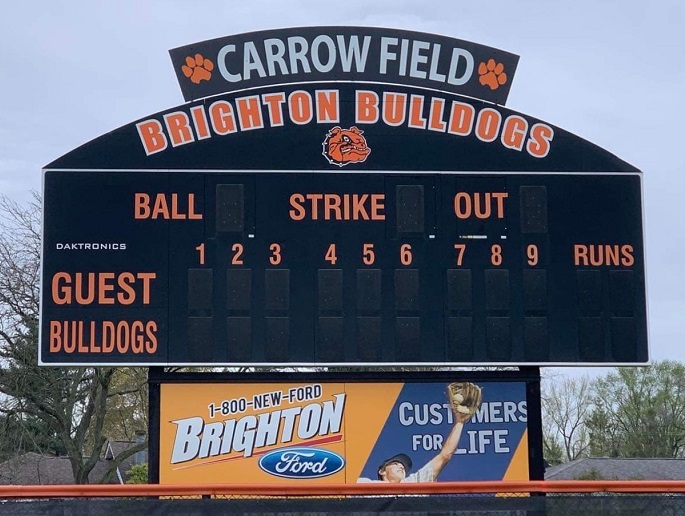
Seventeen years later, his legacy is assured and his memory will be invoked any time one looks at the scoreboard in left-center field that has a “Carrow Field” sign on top of it.
Not bad for a coach who was in the right place at the right time.
“My dream was fulfilled, and rightly so,” Carrow said. “And, believe me, I made the right decision. I couldn't have had better kids to teach or lived in a better community. It couldn't have worked out any better.”
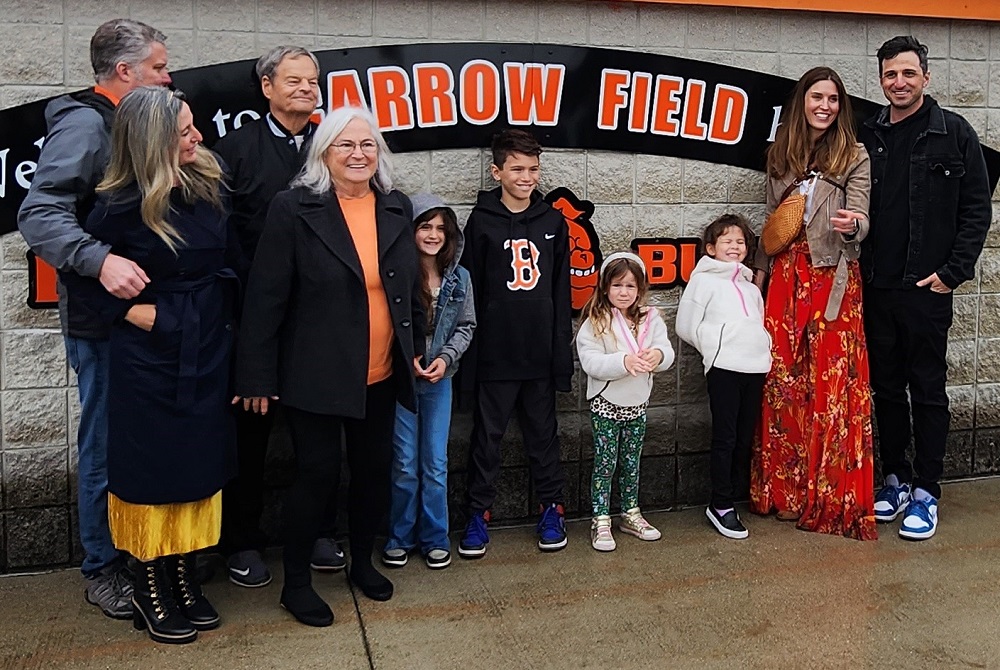
PHOTOS (Top) The Carrow family stands together in front of the welcome sign to Carrow Field – including daughter Tiffany (front left), Mark and Mary (second from left, front and back) and son Chris (far right). (Middle) The Carrow name stands tall atop the scoreboard at the field named for the longtime coach. (Family photo by Daniel Collins.)