

Calumet Invite Produces Northern Stars
September 18, 2013
By Geoff Kimmerly
Second Half editor
The Calumet Invitational dates back roughly 30 years as an annual staple of the cross country schedule for schools at the northernmost tip of Michigan's Upper Peninsula.
A creative move by the Copper Kings last year added some statewide prestige to the event.
 Last week, for the second season, Calumet ran the series of races at Keweenaw Mountain Lodge, a resort near Copper Harbor and the northern bank of the Keweenaw Peninsula.
Calumet is the northernmost high school in Michigan. And moving this race another 35 miles northeast more or less guaranteed it's the northernmost event run in the state.
"We figured it was pretty safe. We're the northernmost school in the state, and you can only go four more miles and you're in Lake Superior," Calumet athletic director Sean Jacques said. "Nobody else is going to do anything more north than that."
A total of 10 schools were represented this fall in the races for boys and girls varsity, junior varsity and middle schoolers.
Jacques said the event formerly was run at a golf course in Calumet. But a few years ago, Calumet graduate and former Copper Kings cross country runner Dan Harri moved home from Florida to become general manager at the Mountain Lodge (he's also a renowned chef and has owned restaurants in Miami with Hall of Fame Dolphins coach Don Shula).
Harri had asked a few times about bringing a cross country or golf event to the lodge. Jacques told him last year they'd give it a try, so Harri set up a course that includes golf course, a couple of bridges, trails and finishes with a climb on the No. 1 fairway. It also provides various points for fans to watch runners go by, not always available on other courses.
"We were looking for a little bit of a change, and it's a beautiful course," Jacques said. "We thought if people were willing to make the extra drive, it would be really nice."
Calumet won the boys race this season, just ahead of runner-up Houghton. Houghton's girls were victorious, followed by the host Copper Kings.
Click to read more about this year's event from the Houghton Mining Gazette.
Michigan's claim to an NFL evolution
As part of its NFL preview this month, Sports Illustrated reported on one of the most significant developments for offenses over the last few decades – the silent snap count, which is used regularly by visiting teams because offensive linemen can’t hear the quarterback calling for the ball over the clamor of the home crowd.
And the article explained that the silent snap count might’ve gotten its start at one of Michigan’s smallest high schools – Flint’s Michigan School for the Deaf.
Offensive linemen during the 1980s were feasted on by pass rushers like Lawrence Taylor and Bruce Smith, who built record sack totals by blasting past blockers who seemed a step slow. Turns out, that was true. Defensive players were getting an edge by attacking as soon as they saw the ball move. But blockers (especially offensive tackles), focused instead on the defensive ends and linebackers lined up across from them, and didn’t have the luxury of watching the ball – and since they also couldn’t hear the snap count, started each play a step behind.
Enter the silent count. The quarterback signals to the center that he is ready to receive the ball (with a pat on the back, by raising a foot, etc.). The center then raises his head, and after a predetermined count of at least one second snaps the ball without a sound. This means an offensive tackle doesn’t have to listen for a snap count – he just counts after seeing the center get set.
The SI report recognized longtime offensive line coach Howard Mudd as the guru of the silent snap count. But Mudd recalled a conversation he’d had while working for the Seattle Seahawks with another coach, the late Andy MacDonald, who also had coached early in his career at a school for the deaf in Michigan.
The article doesn’t mention Michigan School for the Deaf by name. But it seems to make sense that the Tartars were the first to use the now-revolutionary count. MacDonald – who played at Central Michigan University and went on to coach at Michigan State and four other colleges and also for the Buffalo Bills – grew up in Flint and attended Flint Northern before playing for the Chippewas from 1950-53. The historical web site Michigan-football.com has results for Flint’s Michigan School for the Deaf dating to 1950, making it a decent assumption that MacDonald might’ve gotten in a little early coaching experience at the school down the road from his home.
Click for the SI story and go to page 4 for the mention of Michigan’s school.
Michigan mourns trooper, running standout
The law enforcement community is mourning the death of Michigan State Police trooper Paul Butterfield, who was shot Sept. 9 during a traffic stop in Mason County. He also was a well-known distance runner during the 1980s and the MHSAA Class A cross country champion running for Bridgeport in 1987.
According to a Ludington Daily News report, Butterfield continued running after high school at the University of Tennessee, and also competed at the 1989 Pan American Junior Games in Argentina.
Butterfield was stationed in Hart after previously serving in Manistee, and lived in Mason County. He also had served in the U.S. Army. Click to read more from the Ludington Daily News.
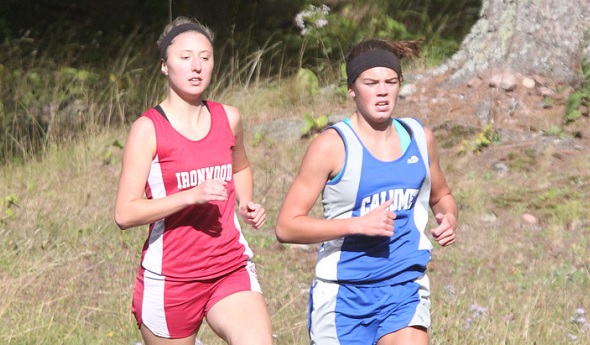
PHOTO: Calumet's Chelsea Jacques (right) won this season's Calumet Invitational with a time of 21:08.06, just ahead of Ironwood's Jessica Gering at 21:46.16. (Photo courtesy of Calumet athletic department.)
Little Provides Major Stride as 1st Woman to Officiate Boys Hoops Final since 1995
By
Keith Dunlap
Special for MHSAA.com
April 13, 2023
Delonda Little was already a trailblazer to many before this year’s MHSAA Boys Basketball Finals.
 But what happened last month at Breslin Center made her even more of one on a statewide level.
A referee and assigner for 20 years in the Detroit area, Little is a female boys and girls basketball official who mentors both male and female referees – no matter the gender or level, as she officiates high school and college games.
Officials often go to Little for guidance, direction and assignments, which has made her respected for years throughout Metro Detroit in the prep basketball community. Then, her status as a trailblazer grew even more.
Little was assigned as an official for the Division 3 Boys Basketball Final between Flint Beecher and Traverse City St. Francis, and she became the first female referee to officiate an MHSAA Boys Basketball Final since Traverse City’s Barb Beckett 1995.
“It was a very good feeling to know I was the one selected,” said Little, who officiated the Final with Matt Olson and Zach Porritt.
In fact, while attending a Semifinal game the Friday before the Final, Little received a phone call from an area code she didn’t recognize.
She answered, and it was Beckett.
“At first I didn’t know the name,” Little said. “I said, ‘No, I don’t know you, but that’s fine.’”
Beckett then explained she was the first female referee to be assigned a Boys Basketball Final, and just wanted to offer support to Little.
At that point, Little became excited and thankful she answered the call.
“It was very nice to hear from her because she wanted to reach out and if not pass the torch, to congratulate me,” Little said.
Little, 51, said she found out she was going to be refereeing the Division 3 boys championship game just before the start of the postseason when she received an email from the MHSAA.
“I’m looking at the email and I’m like, boys?” Little said. “I was shocked.”
But she was shocked in a good way, and obviously excited for the honor.
 Little didn’t find out until a couple of days before the St. Francis/Beecher contest that she would be officiating that specific championship game, but the Monday of boys championship week was when she really started to receive congratulations from friends and colleagues.
That’s when an article came out in the Detroit News detailing her selection, which led to countless calls, texts and congratulatory messages on social media.
“I couldn’t even (keep up with the comments),” she said. “That’s how overwhelming the actual tags were. It came from all across the state with officials, men and women, because I do women’s college (games). Some of the college ladies were reaching out. I was getting all the hoopla before the game.”
Little said she normally doesn’t get nervous for games, but not having some nerves became a bit harder once so many people knew of her achievement.
However, she settled into a normal routine quickly once the game started.
“I wanted to get it done, get it over with and do well,” she said.
Little did do well, which is no surprise to everyone who knew her before she officiated on the boys championship stage.
It was just another feather in the cap for Little, who in 2016 became the first woman to officiate a boys Detroit Public School League championship game.
“Delonda is one of the top officials in the Detroit area, and our staff doesn’t look at Delonda as a female working a boys game – we see one of the top officials in Detroit working a basketball game,” MHSAA Executive Director Mark Uyl said. “There are females officiating in the NBA and female officials in the NCAA Men’s Basketball Tournament. The aspect that made Delonda’s selection for this MHSAA championship game nearly unique will soon be the norm at all levels of athletics.”
Little graduated from Detroit Osborn in 1989 and starred on the basketball court at Wayne State, earning induction into WSU’s Athletic Hall of Fame in 2005.
Her day job is as an officer for the Michigan Department of Corrections, but her passion is officiating. She’s been an MHSAA-registered official for basketball for two decades and also was registered for volleyball for four years. This past fall she registered for football for the first time.
“I get something from it because it keeps me in shape, I love the people I work with and I like the kids,” Little said. “You are always teaching, and I like training the newer officials. I just enjoy it. I don’t know what I’d be doing if I wasn’t refereeing.”
Going forward, Little hopes her championship game assignment will now be an inspiration for other female referees.
“There aren’t very many women who would like to work boys basketball or feel comfortable,” Little said. “If that’s something they desire, I’m hoping more women are selected to work the games if they feel comfortable.”
 Keith Dunlap has served in Detroit-area sports media for more than two decades, including as a sportswriter at the Oakland Press from 2001-16 primarily covering high school sports but also college and professional teams. His bylines also have appeared in USA Today, the Washington Post, the Detroit Free Press, the Houston Chronicle and the Boston Globe. He served as the administrator for the Oakland Activities Association’s website from 2017-2020. Contact him at [email protected] with story ideas for Oakland, Macomb and Wayne counties
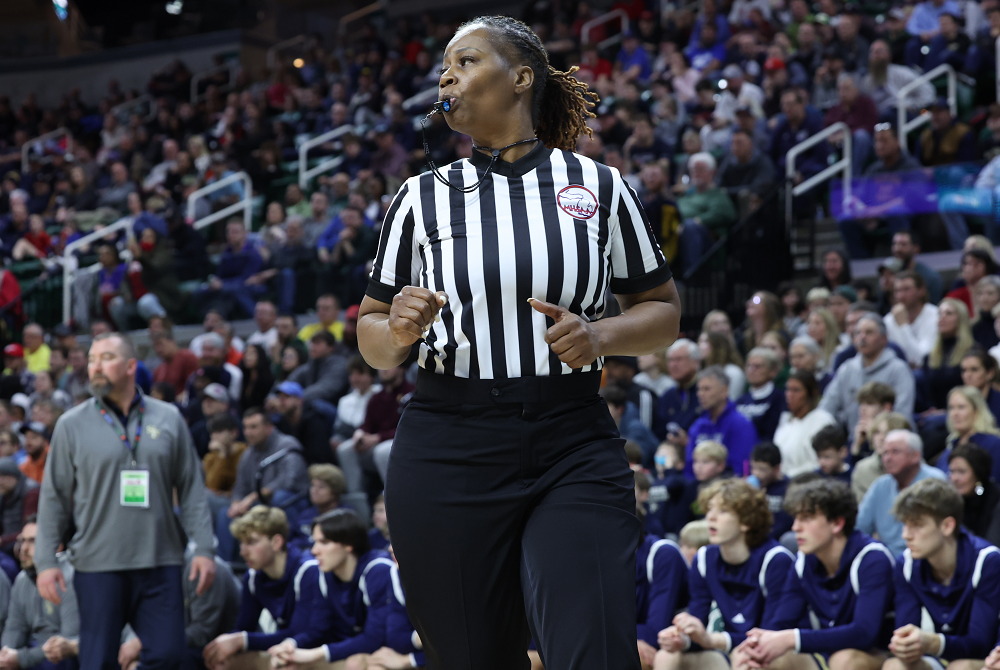
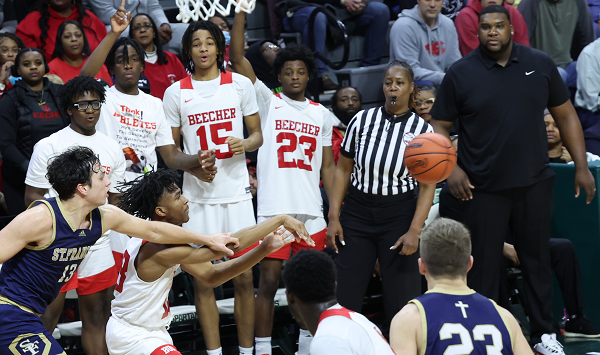
PHOTOS (Top) Delonda Little takes her position on the court during the Division 3 Boys Basketball Final on March 25 at Breslin Center. (Middle) Little monitors the action between Flint Beecher and Traverse City St. Francis.