

Calumet Invite Produces Northern Stars
September 18, 2013
By Geoff Kimmerly
Second Half editor
The Calumet Invitational dates back roughly 30 years as an annual staple of the cross country schedule for schools at the northernmost tip of Michigan's Upper Peninsula.
A creative move by the Copper Kings last year added some statewide prestige to the event.
 Last week, for the second season, Calumet ran the series of races at Keweenaw Mountain Lodge, a resort near Copper Harbor and the northern bank of the Keweenaw Peninsula.
Calumet is the northernmost high school in Michigan. And moving this race another 35 miles northeast more or less guaranteed it's the northernmost event run in the state.
"We figured it was pretty safe. We're the northernmost school in the state, and you can only go four more miles and you're in Lake Superior," Calumet athletic director Sean Jacques said. "Nobody else is going to do anything more north than that."
A total of 10 schools were represented this fall in the races for boys and girls varsity, junior varsity and middle schoolers.
Jacques said the event formerly was run at a golf course in Calumet. But a few years ago, Calumet graduate and former Copper Kings cross country runner Dan Harri moved home from Florida to become general manager at the Mountain Lodge (he's also a renowned chef and has owned restaurants in Miami with Hall of Fame Dolphins coach Don Shula).
Harri had asked a few times about bringing a cross country or golf event to the lodge. Jacques told him last year they'd give it a try, so Harri set up a course that includes golf course, a couple of bridges, trails and finishes with a climb on the No. 1 fairway. It also provides various points for fans to watch runners go by, not always available on other courses.
"We were looking for a little bit of a change, and it's a beautiful course," Jacques said. "We thought if people were willing to make the extra drive, it would be really nice."
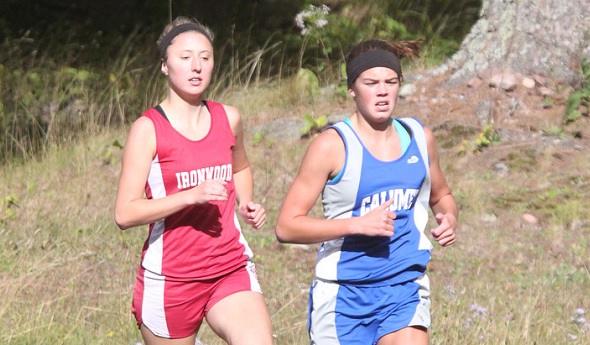
Calumet won the boys race this season, just ahead of runner-up Houghton. Houghton's girls were victorious, followed by the host Copper Kings.
Click to read more about this year's event from the Houghton Mining Gazette.
Michigan's claim to an NFL evolution
As part of its NFL preview this month, Sports Illustrated reported on one of the most significant developments for offenses over the last few decades – the silent snap count, which is used regularly by visiting teams because offensive linemen can’t hear the quarterback calling for the ball over the clamor of the home crowd.
And the article explained that the silent snap count might’ve gotten its start at one of Michigan’s smallest high schools – Flint’s Michigan School for the Deaf.
Offensive linemen during the 1980s were feasted on by pass rushers like Lawrence Taylor and Bruce Smith, who built record sack totals by blasting past blockers who seemed a step slow. Turns out, that was true. Defensive players were getting an edge by attacking as soon as they saw the ball move. But blockers (especially offensive tackles), focused instead on the defensive ends and linebackers lined up across from them, and didn’t have the luxury of watching the ball – and since they also couldn’t hear the snap count, started each play a step behind.
Enter the silent count. The quarterback signals to the center that he is ready to receive the ball (with a pat on the back, by raising a foot, etc.). The center then raises his head, and after a predetermined count of at least one second snaps the ball without a sound. This means an offensive tackle doesn’t have to listen for a snap count – he just counts after seeing the center get set.
The SI report recognized longtime offensive line coach Howard Mudd as the guru of the silent snap count. But Mudd recalled a conversation he’d had while working for the Seattle Seahawks with another coach, the late Andy MacDonald, who also had coached early in his career at a school for the deaf in Michigan.
The article doesn’t mention Michigan School for the Deaf by name. But it seems to make sense that the Tartars were the first to use the now-revolutionary count. MacDonald – who played at Central Michigan University and went on to coach at Michigan State and four other colleges and also for the Buffalo Bills – grew up in Flint and attended Flint Northern before playing for the Chippewas from 1950-53. The historical web site Michigan-football.com has results for Flint’s Michigan School for the Deaf dating to 1950, making it a decent assumption that MacDonald might’ve gotten in a little early coaching experience at the school down the road from his home.
Click for the SI story and go to page 4 for the mention of Michigan’s school.
Michigan mourns trooper, running standout
The law enforcement community is mourning the death of Michigan State Police trooper Paul Butterfield, who was shot Sept. 9 during a traffic stop in Mason County. He also was a well-known distance runner during the 1980s and the MHSAA Class A cross country champion running for Bridgeport in 1987.
According to a Ludington Daily News report, Butterfield continued running after high school at the University of Tennessee, and also competed at the 1989 Pan American Junior Games in Argentina.
Butterfield was stationed in Hart after previously serving in Manistee, and lived in Mason County. He also had served in the U.S. Army. Click to read more from the Ludington Daily News.
PHOTO: Calumet's Chelsea Jacques (right) won this season's Calumet Invitational with a time of 21:08.06, just ahead of Ironwood's Jessica Gering at 21:46.16. (Photo courtesy of Calumet athletic department.)

Moggach Honored Nationally for 25 Years of 'Sticking In, Doing Good'
By
Tim Robinson
Special for MHSAA.com
March 17, 2023
When Paul Moggach began his tenure as Brighton’s hockey coach, the program was at its nadir.
“When we got into high school hockey, it wasn't very good,” he said recently. “Our league wasn't very good. Our team wasn't very good. We started with character to try to build something different, you know, a different mousetrap.”
Over the next quarter of a century, Moggach and his assistants, primarily Rick Bourbonais (whom Moggach succeeded as coach) and current coach Kurt Kivisto helped lift the program into one of the most respected, and successful, in the state.
Moggach (pronounced MUG-uhth), along with former Detroit Catholic Central coach Gordon St. John, in February was named a co-recipient of the John Mariucci Award by the American Hockey Coaches Association.
They, along with Andy Weidenbach of Bloomfield Hills Cranbrook Kingswood, are the only Michigan coaches to have received the award, named after the longtime hockey coach at Michigan Tech.
“He brought in people that he knew could do things he may have had limitations at,” said Kivisto, who played for Moggach at Brighton two decades ago and was an assistant for 10 years before taking over as head coach in 2020. “He did a good job surrounding himself with people he trusted and knew would be good for the program while he steered the ship in the direction he wanted. And he was very good at that.”
Moggach calls the honor “very humbling.
“I got into hockey because there was a need,” he added, “then I ended up with Rick at the high school for those years. When you look back at it, I grew a lot. I grew a lot personally and from a coaching perspective I grew. I had to change things, and so I think it's not so much the reward as at least a recognition that I stuck it out. My grandmother used to always tell me, ‘Stick in and do good.’ She would say that when I was on the way out the door. That was her message to me, and I think (the award) just emphasizes that I did, I did stick in.”
“You can’t be happier for a guy than for a guy like Paul,” said Bourbonais, who coached with Moggach at Brighton for a total of 30 years, the last 20 as an assistant. “He took a hockey team and made it into a hockey program that is a top-five contender every year. Guys come out of the program with championships, but they also come out with life lessons and some idea of what it takes to be a great citizen and a great student as well as what it takes to be a great athlete.”
At first, though, there were trials. The Bulldogs struggled in his first two seasons, and the program itself was in jeopardy for a short while after a bench-clearing brawl.
Once that crisis passed, Moggach and his staff, which for many years consisted of Bourbonais, Mike Brown and Jason Valente, worked to rebuild the Bulldogs from a team known for its physicality to one with a more wide-open passing style of play.
When hockey trends went to a more defensive style, where the defense sparked the offense, Moggach adapted.
During the first decade of his tenure, as the Bulldogs had more success and built their reputation, teams that had shunned scheduling them in the past began adding Brighton to their schedules.
He kept looking for ways to improve his team, both on and off the ice.
Brighton was the first team to schedule a game with those in the Keweenaw Peninsula, both for the keen competition, but also as a team-bonding exercise.
The bus rides, about 11 hours each way, helped players who in many cases didn’t know each other outside the rink to bond. So did activities outside of hockey including team dinners and curling, and the experience of being together as a team for four days.
Other teams took notice, and team bonding trips, including those far shorter than the 550 miles from Brighton to Houghton, are commonplace.
 Soon after, he introduced a skating coach and stricter team nutrition to the program.
“It’s not something that we had done when I was in high school," said Kivisto, who graduated in 2003. “It was something that some of the families and players weren’t overly excited about, but he knew it was good for the team and he was always looking ahead and finding ways to give his team an advantage.”
Brighton grew to dominate its league, and winning gave Moggach the authority to introduce concepts new to players and families who grew up in travel hockey.
“I'm sure we weren't pleasing everybody,” he said, “But we thought we would do with character and live the kind of model that we would hope that the players would follow, that their families would follow. And as we did that it changed and we got in front of some things with our league, and had a good run in our league.”
Brighton won its first Division 1 championship in 2006. That was followed by back-to-back Division 1 titles in 2012 and 2013, and then 2017 and 2018, a stretch that saw the Bulldogs reach the Finals in six out of seven seasons.
“Some of that is when you learn how to win, you win, even sometimes when you shouldn't,” he said. “I'm not saying that you know when we got to the Finals that we didn't deserve to win. We had a good recipe there that got us those five wins, but once we got it rolling, that momentum kept us going sometimes then maybe it shouldn't have.”
As the program’s success and reputation grew, players who had been in travel hockey started opting to play for the Bulldogs.
“There are some kids on (this year’s Brighton) team who came from Triple A who are tired of that commitment, because of the travel, the time, the money,” he said. “And they found that high school hockey is different. I mean just look at the crowds. They don't get that kind of a reward for the work that they put in.
“I think it's developed to that point now for us and we get players like that and it's made a difference, I think, and not just for our team but for all of high school hockey, " Moggach continued. “The coaches association has done a great job in promoting now and so it is a great destination for so many good reasons for kids to spend that time and grow up with their friends who are in their neighborhoods and in their community.”
Moggach is still a fixture at Brighton games, still in close touch with Kivisto when not driving to see his grandsons play or his stepson, Damon Whitten, who coaches at Lake Superior State.
His impact will be felt in Brighton hockey for years to come.
“He left no stone unturned to try and be the best he thought we could be,” Brighton athletic director John Thompson said. “He’s one of those people who was genuinely invested in young people, and he always, always put the program first. He was a good manager of young men and developed some pretty good coaches, too.”
Moggach finished with a record of 467-172-43. St. John, who won six state titles at Catholic Central and another at Cranbrook, had a record of 229-29-18 in 10 seasons at Catholic Central.
“I was excited for (Moggach) when I heard the news,” Kivisto said, “seeing him put at a level of the guys who have won the award and the contributions they made to high school hockey. It’s neat to see him recognized at that level.”
Both men will receive their awards sometime this spring.
“I can be recognized,” Moggach said, “and I think kids are and their families are always looking for that. But I think before you do that you have to build the program, the program has to be something that's respectful and respected and competitive, and I think we accomplished that.”
***
Gordon St. John led Detroit Catholic Central and Bloomfield Hills Cranbrook Kingswood to a combined eight Finals championships over 16 seasons, the last seven with the Shamrocks including five straight in Class A or Division 1 from 1999-2003.
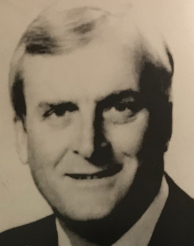 DCC’s Class A championship in 1994 was the first of now 17 Finals titles, which rank second-most in MHSAA history. He built a 222-29-18 record (.859 winning percentage) over 10 seasons leading the Shamrocks through 2003-04, the last two seasons as co-head coach before then staying with the program as an assistant and helping the team to another Division 1 championship in 2005.
St. John’s championship at Cranbrook came in 1988 in Class B-C-D.
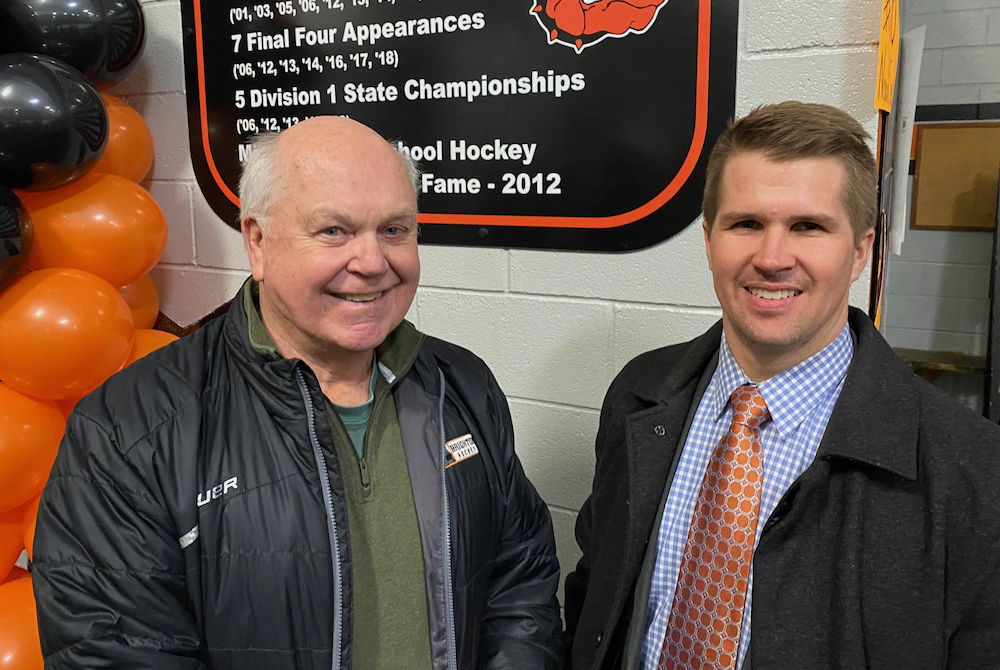
PHOTOS (Top) Retired Brighton hockey coach Paul Moggach, far right, stands alongside his players as they await to receive their medals after winning the 2018 Division 1 championship (Middle) Moggach stands with his former assistant and current Brighton head coach Kurt Kivisto. (Middle photo by Tim Robinson; St. John photo courtesy of the American Hockey Coaches Association.)