


Calumet Invite Produces Northern Stars
September 18, 2013
By Geoff Kimmerly
Second Half editor
The Calumet Invitational dates back roughly 30 years as an annual staple of the cross country schedule for schools at the northernmost tip of Michigan's Upper Peninsula.
A creative move by the Copper Kings last year added some statewide prestige to the event.
 Last week, for the second season, Calumet ran the series of races at Keweenaw Mountain Lodge, a resort near Copper Harbor and the northern bank of the Keweenaw Peninsula.
Calumet is the northernmost high school in Michigan. And moving this race another 35 miles northeast more or less guaranteed it's the northernmost event run in the state.
"We figured it was pretty safe. We're the northernmost school in the state, and you can only go four more miles and you're in Lake Superior," Calumet athletic director Sean Jacques said. "Nobody else is going to do anything more north than that."
A total of 10 schools were represented this fall in the races for boys and girls varsity, junior varsity and middle schoolers.
Jacques said the event formerly was run at a golf course in Calumet. But a few years ago, Calumet graduate and former Copper Kings cross country runner Dan Harri moved home from Florida to become general manager at the Mountain Lodge (he's also a renowned chef and has owned restaurants in Miami with Hall of Fame Dolphins coach Don Shula).
Harri had asked a few times about bringing a cross country or golf event to the lodge. Jacques told him last year they'd give it a try, so Harri set up a course that includes golf course, a couple of bridges, trails and finishes with a climb on the No. 1 fairway. It also provides various points for fans to watch runners go by, not always available on other courses.
"We were looking for a little bit of a change, and it's a beautiful course," Jacques said. "We thought if people were willing to make the extra drive, it would be really nice."
Calumet won the boys race this season, just ahead of runner-up Houghton. Houghton's girls were victorious, followed by the host Copper Kings.
Click to read more about this year's event from the Houghton Mining Gazette.
Michigan's claim to an NFL evolution
As part of its NFL preview this month, Sports Illustrated reported on one of the most significant developments for offenses over the last few decades – the silent snap count, which is used regularly by visiting teams because offensive linemen can’t hear the quarterback calling for the ball over the clamor of the home crowd.
And the article explained that the silent snap count might’ve gotten its start at one of Michigan’s smallest high schools – Flint’s Michigan School for the Deaf.
Offensive linemen during the 1980s were feasted on by pass rushers like Lawrence Taylor and Bruce Smith, who built record sack totals by blasting past blockers who seemed a step slow. Turns out, that was true. Defensive players were getting an edge by attacking as soon as they saw the ball move. But blockers (especially offensive tackles), focused instead on the defensive ends and linebackers lined up across from them, and didn’t have the luxury of watching the ball – and since they also couldn’t hear the snap count, started each play a step behind.
Enter the silent count. The quarterback signals to the center that he is ready to receive the ball (with a pat on the back, by raising a foot, etc.). The center then raises his head, and after a predetermined count of at least one second snaps the ball without a sound. This means an offensive tackle doesn’t have to listen for a snap count – he just counts after seeing the center get set.
The SI report recognized longtime offensive line coach Howard Mudd as the guru of the silent snap count. But Mudd recalled a conversation he’d had while working for the Seattle Seahawks with another coach, the late Andy MacDonald, who also had coached early in his career at a school for the deaf in Michigan.
The article doesn’t mention Michigan School for the Deaf by name. But it seems to make sense that the Tartars were the first to use the now-revolutionary count. MacDonald – who played at Central Michigan University and went on to coach at Michigan State and four other colleges and also for the Buffalo Bills – grew up in Flint and attended Flint Northern before playing for the Chippewas from 1950-53. The historical web site Michigan-football.com has results for Flint’s Michigan School for the Deaf dating to 1950, making it a decent assumption that MacDonald might’ve gotten in a little early coaching experience at the school down the road from his home.
Click for the SI story and go to page 4 for the mention of Michigan’s school.
Michigan mourns trooper, running standout
The law enforcement community is mourning the death of Michigan State Police trooper Paul Butterfield, who was shot Sept. 9 during a traffic stop in Mason County. He also was a well-known distance runner during the 1980s and the MHSAA Class A cross country champion running for Bridgeport in 1987.
According to a Ludington Daily News report, Butterfield continued running after high school at the University of Tennessee, and also competed at the 1989 Pan American Junior Games in Argentina.
Butterfield was stationed in Hart after previously serving in Manistee, and lived in Mason County. He also had served in the U.S. Army. Click to read more from the Ludington Daily News.
PHOTO: Calumet's Chelsea Jacques (right) won this season's Calumet Invitational with a time of 21:08.06, just ahead of Ironwood's Jessica Gering at 21:46.16. (Photo courtesy of Calumet athletic department.)
Hastings' Life-Saving Response Reinforces Vital Importance of Being Prepared
By
Geoff Kimmerly
MHSAA.com senior editor
August 23, 2022
HASTINGS – Preseason silence, mixed with anticipation, made Hastings High School’s gym feel especially pristine last week.
 The raucousness is returning soon as the school’s volleyball teams are into their first matches of a new season, with winter sports bringing everyone inside in a few months. This is a place where big-game memories are made – but one from a scrimmage June 14 certainly will stick with many who were at Hastings High that day.
That evening, Potterville junior Da’Marion Hicks was playing in a basketball scrimmage when he suffered a heart attack due to a valve that later required open-heart surgery.
During a period of just a few minutes that could have meant his life, Hastings staff, students and a doctor who fortunately happened to be watching his son’s team from the stands, responded to assist Hicks before it was too late. In fact, he’s expected to be cleared to return this upcoming basketball season.
It’s a situation everyone hopes will never happen, but very occasionally it does. And when it did this time, Hastings – with crucial assistance coming out of the bleachers – showed what can be done to assure a best-possible result.
“We debriefed after this whole thing, and we actually had six people from our school (there) trained in CPR and AED use. Enough people felt comfortable enough to take some action to cause it to have a good outcome,” Hastings athletic director Mike Goggins said. “I think more times than not in a situation like this, bad results don’t come from people trying to help. Bad results come from people being afraid to help. What was great about this situation was … lots of people took the initiative to jump in.”
As another school year begins, Hastings’ ready response should continue to reinforce the importance of being prepared for the scariest of situations. (The Grand Rapids Press spoke with Hicks as he was beginning his recovery; click here to read.)
Emergency planning for sports venues has emerged as an important topic especially over the last decade, and the National Federation of State High School Associations (NFHS) and National Athletic Trainers’ Association (NATA) detail how these should work, with the “Anyone Can Save A Life” plan provided to all member schools by the MHSAA at the start of the 2015-16 school year.
Goggins said that while Hastings doesn’t necessarily have a “formal” plan like those linked above, what his department does is “saturate” his teams’ coaches and athletes with knowledge of where to find AEDs – and Hastings also has created a setup whereby a person is never more than one minute from an AED while on school property.
That evening, four boys basketball teams were playing on adjacent courts – including Potterville against Wyoming Tri-unity Christian. Goggins himself wasn’t at the school at the time (although he quickly arrived after being notified of the situation), but the following is the collection of information he has gathered over the last two months.
- Hicks had felt especially fatigued that evening and actually had mentioned to a few Hastings players during their scrimmage earlier that night that he was having a hard time catching his breath – definitely rare for a three-sport athlete who had run the 400 meters at an MHSAA Track & Field Finals a few weeks earlier.
- Hicks went to his bench for a break during the Tri-unity scrimmage, and laid down. Goggins said Potterville teammates thought Hicks was just gassed, but then noticed his eyes rolling back into his head. They started yelling for help.
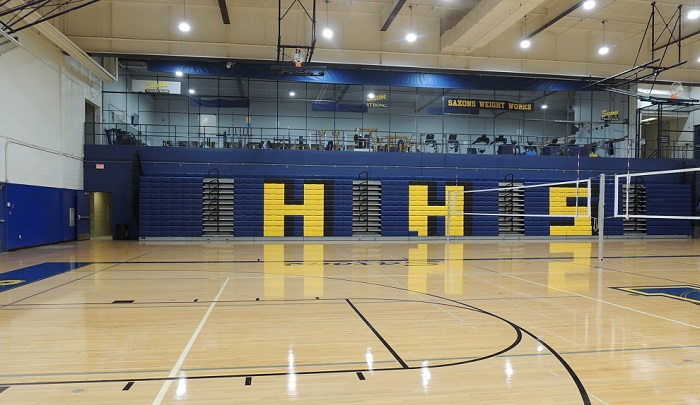
- Hastings boys basketball coach Rich Long sprang into action, running over to the Potterville bench and then calling into the crowd to see if anyone with medical expertise could help a student in distress. Meanwhile, Long was joined by Hastings’ strength coach (and U.S. Marine) James Avery – who was training athletes in the weight room in the balcony overlooking the gym – and Dr. Luke Van Klompenberg, an emergency medicine physician at Holland Hospital who was there watching his son play for Tri-unity.
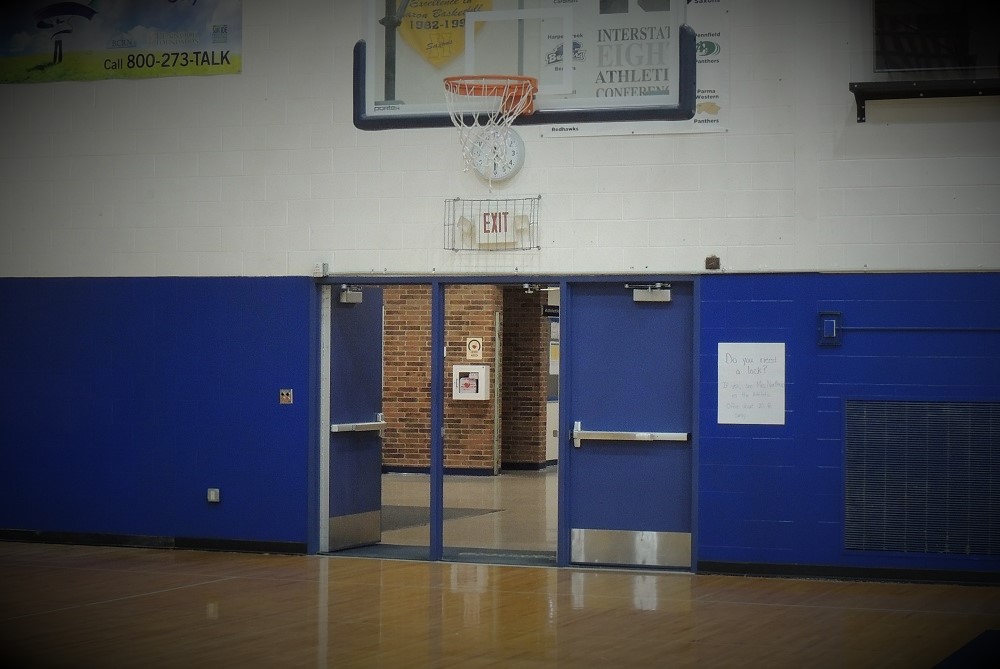
- Long sent an athlete to retrieve the closest AED, located on the wall just outside the gym doors. He also sent a parent to call 9-1-1, and Saxons boys track & field coach Lin Nickels sent multiple athletes to set up a relay near the school’s doors to direct paramedics when they arrived.
- Van Klompenberg, meanwhile, couldn’t find Hicks’ pulse, and the athlete’s breathing was shallow. Avery had begun chest compressions, the AED was used, and as the ambulance arrived Hicks was beginning to regain some consciousness. He was transported to the local Spectrum Health Pennock hospital, then to Helen DeVos Children's Hospital in Grand Rapids.
“It was one of those things where it just worked,” Goggins said. “My message, if nothing else, is we all practice it for a time that may never come – but the more you can saturate your people with the idea of A, being prepared, and B, don’t be afraid to take action … that’s really I think the key.”
 Beginning this year, the MHSAA is requiring all head coaches at the varsity, junior varsity and freshman levels to have CPR certification. That training almost always includes direction in the use of an AED.
Hastings has been on this track for a while. The MHSAA’s first CPR requirement for coaches was added for the 2015-16 school year, just for varsity head coaches – but Goggins made it a requirement for all of his coaches at all levels at that time.
Hastings also has taken AED prep to another level. There are 16 throughout the district – one each at the four elementary schools, two at the middle school and 10 at the high school – and they represent an even bigger investment in the life-saving technology as the district’s school board purchased those 16 a year ago to replace 12 that were nearing their expirations.
Goggins said doctors have told him that if Hicks had not received care for even 4-5 more minutes, he would not have survived because of the damage done to his heart and brain. Potterville athletic director and boys basketball coach Jake Briney said surgeons have broken things down to a 45-second window that made the difference between a good result and a sad one.
Coincidentally, Briney had scheduled a game this upcoming season against Wyoming Tri-unity Christian; Potterville should be tough, and Tri-unity is last season’s Division 4 runner-up. But the events of June 14 will make the events of this upcoming Jan. 14 much more meaningful.
Briney said Potterville also has formed a close relationship with Hastings. Multiple Saxons administrators have checked in, including Goggins almost daily during the first weeks after the incident.
Briney is filled with nothing but praise for Hastings’ preparation. And both athletic directors noted a similar effect at their schools as another school year begins.
“It really, really made the training, made you look at it through a different lens,” Briney said.
“Our fall coaches are now like, ‘You know, if Heather (Coipel, Hastings’ trainer) wanted to stop by and run through the AED procedure again, that would be great,’” Goggins said. “(Or) ‘Where is the AED? We have one at the fieldhouse, right? Where’s the closest one for me again?’ They’re just doublechecking.”
 Geoff Kimmerly joined the MHSAA in Sept. 2011 after 12 years as Prep Sports Editor of the Lansing State Journal. He is a senior editor of MHSAA.com's editorial content and has served as MHSAA Communications Director since January 2021. Contact him at [email protected] with story ideas for the Barry, Eaton, Ingham, Livingston, Ionia, Clinton, Shiawassee, Gratiot, Isabella, Clare and Montcalm counties.
PHOTOS (Top) An AED, located just outside the doors to Hastings’ gymnasium, was used to save Da’Marion Hicks’ life June 14. (Middle) Strength coach James Avery emerged from the balcony weight room to assist in Hicks’ care that evening. (Photos by Geoff Kimmerly.)