

Calumet Invite Produces Northern Stars
September 18, 2013
By Geoff Kimmerly
Second Half editor
The Calumet Invitational dates back roughly 30 years as an annual staple of the cross country schedule for schools at the northernmost tip of Michigan's Upper Peninsula.
A creative move by the Copper Kings last year added some statewide prestige to the event.
 Last week, for the second season, Calumet ran the series of races at Keweenaw Mountain Lodge, a resort near Copper Harbor and the northern bank of the Keweenaw Peninsula.
Calumet is the northernmost high school in Michigan. And moving this race another 35 miles northeast more or less guaranteed it's the northernmost event run in the state.
"We figured it was pretty safe. We're the northernmost school in the state, and you can only go four more miles and you're in Lake Superior," Calumet athletic director Sean Jacques said. "Nobody else is going to do anything more north than that."
A total of 10 schools were represented this fall in the races for boys and girls varsity, junior varsity and middle schoolers.
Jacques said the event formerly was run at a golf course in Calumet. But a few years ago, Calumet graduate and former Copper Kings cross country runner Dan Harri moved home from Florida to become general manager at the Mountain Lodge (he's also a renowned chef and has owned restaurants in Miami with Hall of Fame Dolphins coach Don Shula).
Harri had asked a few times about bringing a cross country or golf event to the lodge. Jacques told him last year they'd give it a try, so Harri set up a course that includes golf course, a couple of bridges, trails and finishes with a climb on the No. 1 fairway. It also provides various points for fans to watch runners go by, not always available on other courses.
"We were looking for a little bit of a change, and it's a beautiful course," Jacques said. "We thought if people were willing to make the extra drive, it would be really nice."
Calumet won the boys race this season, just ahead of runner-up Houghton. Houghton's girls were victorious, followed by the host Copper Kings.
Click to read more about this year's event from the Houghton Mining Gazette.
Michigan's claim to an NFL evolution
As part of its NFL preview this month, Sports Illustrated reported on one of the most significant developments for offenses over the last few decades – the silent snap count, which is used regularly by visiting teams because offensive linemen can’t hear the quarterback calling for the ball over the clamor of the home crowd.
And the article explained that the silent snap count might’ve gotten its start at one of Michigan’s smallest high schools – Flint’s Michigan School for the Deaf.
Offensive linemen during the 1980s were feasted on by pass rushers like Lawrence Taylor and Bruce Smith, who built record sack totals by blasting past blockers who seemed a step slow. Turns out, that was true. Defensive players were getting an edge by attacking as soon as they saw the ball move. But blockers (especially offensive tackles), focused instead on the defensive ends and linebackers lined up across from them, and didn’t have the luxury of watching the ball – and since they also couldn’t hear the snap count, started each play a step behind.
Enter the silent count. The quarterback signals to the center that he is ready to receive the ball (with a pat on the back, by raising a foot, etc.). The center then raises his head, and after a predetermined count of at least one second snaps the ball without a sound. This means an offensive tackle doesn’t have to listen for a snap count – he just counts after seeing the center get set.
The SI report recognized longtime offensive line coach Howard Mudd as the guru of the silent snap count. But Mudd recalled a conversation he’d had while working for the Seattle Seahawks with another coach, the late Andy MacDonald, who also had coached early in his career at a school for the deaf in Michigan.
The article doesn’t mention Michigan School for the Deaf by name. But it seems to make sense that the Tartars were the first to use the now-revolutionary count. MacDonald – who played at Central Michigan University and went on to coach at Michigan State and four other colleges and also for the Buffalo Bills – grew up in Flint and attended Flint Northern before playing for the Chippewas from 1950-53. The historical web site Michigan-football.com has results for Flint’s Michigan School for the Deaf dating to 1950, making it a decent assumption that MacDonald might’ve gotten in a little early coaching experience at the school down the road from his home.
Click for the SI story and go to page 4 for the mention of Michigan’s school.
Michigan mourns trooper, running standout
The law enforcement community is mourning the death of Michigan State Police trooper Paul Butterfield, who was shot Sept. 9 during a traffic stop in Mason County. He also was a well-known distance runner during the 1980s and the MHSAA Class A cross country champion running for Bridgeport in 1987.
According to a Ludington Daily News report, Butterfield continued running after high school at the University of Tennessee, and also competed at the 1989 Pan American Junior Games in Argentina.
Butterfield was stationed in Hart after previously serving in Manistee, and lived in Mason County. He also had served in the U.S. Army. Click to read more from the Ludington Daily News.
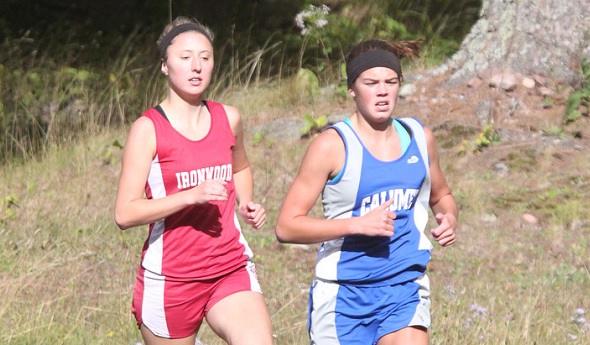
PHOTO: Calumet's Chelsea Jacques (right) won this season's Calumet Invitational with a time of 21:08.06, just ahead of Ironwood's Jessica Gering at 21:46.16. (Photo courtesy of Calumet athletic department.)
Lessons Learned on Track Have Jibowu's Business Surging to Quick Success
By
Paul Costanzo
Special for MHSAA.com
August 1, 2022
Athletics showed Soj Jibowu just how far he could push himself.
All the time spent on the track, working to become the state’s best high school 400-meter runner, and then more than that, taught him to stretch beyond what he thought were his limits.
So, when it came time to make a decision on whether to jump fully into his apparel company, Varlo, or keep it as a part-time side venture, the 2001 Saginaw Heritage graduate knew he could take himself to another level if needed.
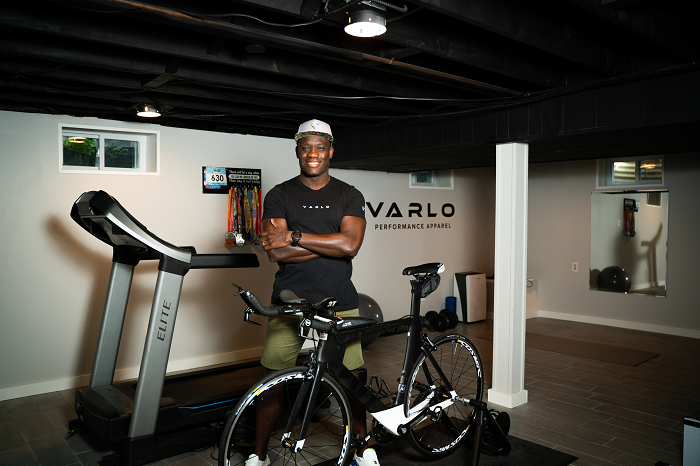
Jibowu is the founder and CEO of Varlo, a clothing company that specializes in outfitting triathletes, but also offers casual wear for men and women. The company is just over three years old, but its clientele includes hundreds of triathletes, eight professionals, three NCAA programs and even hospitals. Merchandise is sold in eight countries.
All of that is validation for Jibowu, who took the leap to pursuing the company full-time just one year into its existence.
“When I resigned (from a medical sales job) to do this full-time, my wife was pregnant with our second child, my daughter wasn’t even walking yet,” said Jibowu, who now lives in Cherry Hill, N.J., with his wife and two young children. “Where was my state of mind to leave my very comfortable, high-paying job to pursue this – to sell clothes?”
His mind was in the same place that helped him reach tremendous heights as a runner, both at Heritage and Central Michigan University.
Jibowu, who was born in Nigeria and spent much of his childhood in Huntsville, Ala., was part of some incredible Heritage teams. He graduated a year behind eventual NFL safety Stuart Schweigert, who he ran with on the Finals-winning 1,600 relay in 2000. Another member of that relay was Derold Sligh, who won the 400-meter Finals title that year, setting the Lower Peninsula Division 1 Finals record in the process. The Hawks were LP Division 1 runners-up as a team that season.
“I ran track when I was younger, and I was terrible,” Jibowu said. “In high school, if I look back at it, I probably would have called it impostor syndrome. I think that was me up until maybe like somewhere in my senior year when I started to think, ‘I’m pretty fast.’ … I had so many dominant people around me, in my mind, I was still the slow guy.”
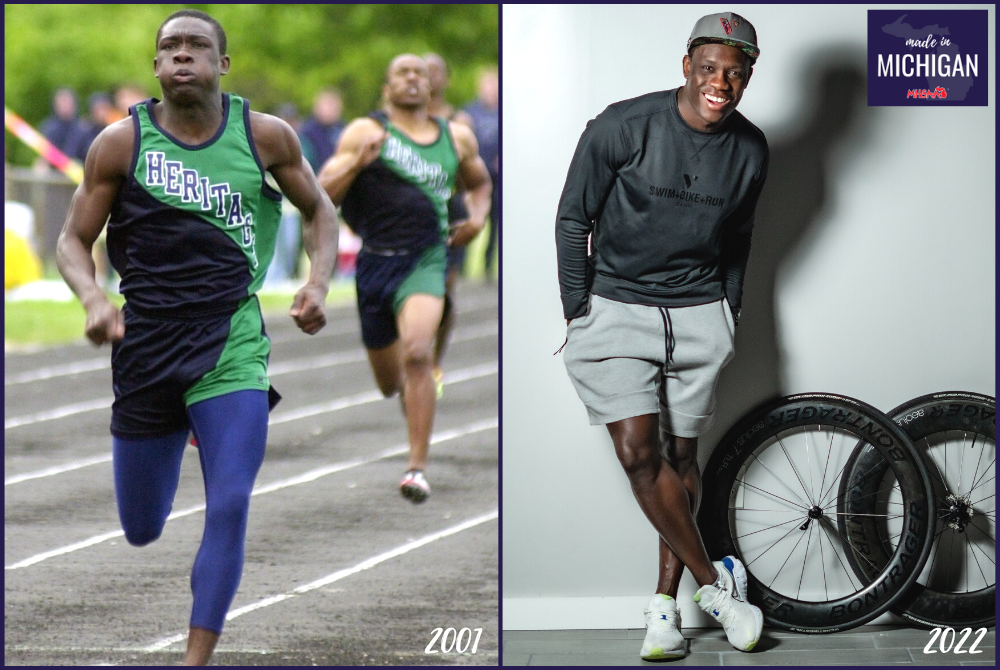
 As a senior, Jibowu erased that self-doubt. He led Heritage to its first, and still only, Division 1 Finals title, running the 400 in 48.28 and breaking the record Sligh had set the year prior.
It was working to get to that point that Jibowu still credits with his ability to push himself in all things.
“I preach this all the time: if you have the ability to be involved in sports at a young age, do it,” Jibowu said. “It’s a gift, first of all. You don’t know any better when you’re young, you think you’re just training your body, but what’s really, truly occurring is you’re training your mind and building discipline. You’re building your character as far as who you are as a person. What is your will? How far are you willing to push? Am I able to be coached? Am I able to learn? Am I able to lose over and over again and keep going? Am I able to navigate to feel what it’s like to win? What you’re truly developing is how to manage and handle life.”
Jibowu said he didn’t finalize his college decision until late in the process, as he had to work on his test scores into the summer. While at CMU, he majored in biomedical science and chemistry, and he excelled, admitting he was a much better student in college than in high school.
He was also reunited with Sligh on the Chippewas track team, and had a successful career. He was regularly within the top five in the 200 and 400 in the Mid-American Conference, and won a MAC title in the 400 at the 2004 indoor championships. His personal bests in the races were 21.19 and 46.81, respectively.
After graduating from CMU, Jibowu began working as a pharmaceutical rep, then moved into medical sales.
While he remained active, it wasn’t until he took a trip to Chicago that he discovered triathlons.
“I remember seeing these really cool bikes and these really fit people, and then they jumped into Lake Michigan,” he said. “And I didn’t know that was possible, because I didn’t grow up swimming. I didn’t know that volume of people knew how to swim like that. Then they get out of Lake Michigan, jump on their bikes and they’re flying. Then they’re sprinting a 6K and I remember thinking, ‘Oh my God, these guys are the real freaking deal.’ I was hooked and wanted to start competing.”
As he began competing, the wheels for his current venture began turning. At this point, Jibowu was living out east and had worked for a pair of successful start-ups in the medical industry. That helped give him knowledge, and confidence, to make his own moves.
“I had always been into clothes and fashion, and how you express yourself with what you wear,” Jibowu said. “There was an opportunity there. The sport of triathlon is as old as me; it started in (1983). That’s a baby. That’s like basketball without the 3-point line. There’s so much opportunity for innovation.”
With that, Varlo was born, and it has since thrived, with Jibowu and the lessons he learned on a track in Saginaw paving the way.
“If you are in high school and have the ability to be in a sport, it’s a gift,” he said. “At that young of an age, truly learning to manage the trials and tribulations of life. That is a gift.”
2021-22 Made in Michigan
July 28: Running Set Life's Stage for Grosse Pointe South's Record-Setting Meier Sisters - Read
July 25: 2005 Miss Basketball DeHaan Cherishing Newest Title: 1st-Time Mom - Read
July 21: Championship Memories Still Resonate with St. Thomas Star Lillard - Read
July 14: Portage Central Champ Rolls to Vanderbilt, Writing Next Chapter in Alabama - Read
July 12: Coaching Couple Passing On Knowledge, Providing Opportunities for Frankfort Wrestlers - Read
June 30: Hrynewich's Star Continuing to Rise with Olympic, Pro Sports Arrivals - Read
PHOTOS (Top) At left, Heritage’s Soj Jibowu wins the 400 meters during the 2001 Saginaw Valley League championship meet. At right, Jibowu is the founder and CEO of the Varlo clothing company. (Middle) Jibowu’s company specializes in outfitting triathletes, and he has taken up the sport after a successful college track & field career. (Heritage photo courtesy of Saginaw News/MLive; current photos courtesy of Soj Jibowu.)