

Calumet Invite Produces Northern Stars
September 18, 2013
By Geoff Kimmerly
Second Half editor
The Calumet Invitational dates back roughly 30 years as an annual staple of the cross country schedule for schools at the northernmost tip of Michigan's Upper Peninsula.
A creative move by the Copper Kings last year added some statewide prestige to the event.
 Last week, for the second season, Calumet ran the series of races at Keweenaw Mountain Lodge, a resort near Copper Harbor and the northern bank of the Keweenaw Peninsula.
Calumet is the northernmost high school in Michigan. And moving this race another 35 miles northeast more or less guaranteed it's the northernmost event run in the state.
"We figured it was pretty safe. We're the northernmost school in the state, and you can only go four more miles and you're in Lake Superior," Calumet athletic director Sean Jacques said. "Nobody else is going to do anything more north than that."
A total of 10 schools were represented this fall in the races for boys and girls varsity, junior varsity and middle schoolers.
Jacques said the event formerly was run at a golf course in Calumet. But a few years ago, Calumet graduate and former Copper Kings cross country runner Dan Harri moved home from Florida to become general manager at the Mountain Lodge (he's also a renowned chef and has owned restaurants in Miami with Hall of Fame Dolphins coach Don Shula).
Harri had asked a few times about bringing a cross country or golf event to the lodge. Jacques told him last year they'd give it a try, so Harri set up a course that includes golf course, a couple of bridges, trails and finishes with a climb on the No. 1 fairway. It also provides various points for fans to watch runners go by, not always available on other courses.
"We were looking for a little bit of a change, and it's a beautiful course," Jacques said. "We thought if people were willing to make the extra drive, it would be really nice."
Calumet won the boys race this season, just ahead of runner-up Houghton. Houghton's girls were victorious, followed by the host Copper Kings.
Click to read more about this year's event from the Houghton Mining Gazette.
Michigan's claim to an NFL evolution
As part of its NFL preview this month, Sports Illustrated reported on one of the most significant developments for offenses over the last few decades – the silent snap count, which is used regularly by visiting teams because offensive linemen can’t hear the quarterback calling for the ball over the clamor of the home crowd.
And the article explained that the silent snap count might’ve gotten its start at one of Michigan’s smallest high schools – Flint’s Michigan School for the Deaf.
Offensive linemen during the 1980s were feasted on by pass rushers like Lawrence Taylor and Bruce Smith, who built record sack totals by blasting past blockers who seemed a step slow. Turns out, that was true. Defensive players were getting an edge by attacking as soon as they saw the ball move. But blockers (especially offensive tackles), focused instead on the defensive ends and linebackers lined up across from them, and didn’t have the luxury of watching the ball – and since they also couldn’t hear the snap count, started each play a step behind.
Enter the silent count. The quarterback signals to the center that he is ready to receive the ball (with a pat on the back, by raising a foot, etc.). The center then raises his head, and after a predetermined count of at least one second snaps the ball without a sound. This means an offensive tackle doesn’t have to listen for a snap count – he just counts after seeing the center get set.
The SI report recognized longtime offensive line coach Howard Mudd as the guru of the silent snap count. But Mudd recalled a conversation he’d had while working for the Seattle Seahawks with another coach, the late Andy MacDonald, who also had coached early in his career at a school for the deaf in Michigan.
The article doesn’t mention Michigan School for the Deaf by name. But it seems to make sense that the Tartars were the first to use the now-revolutionary count. MacDonald – who played at Central Michigan University and went on to coach at Michigan State and four other colleges and also for the Buffalo Bills – grew up in Flint and attended Flint Northern before playing for the Chippewas from 1950-53. The historical web site Michigan-football.com has results for Flint’s Michigan School for the Deaf dating to 1950, making it a decent assumption that MacDonald might’ve gotten in a little early coaching experience at the school down the road from his home.
Click for the SI story and go to page 4 for the mention of Michigan’s school.
Michigan mourns trooper, running standout
The law enforcement community is mourning the death of Michigan State Police trooper Paul Butterfield, who was shot Sept. 9 during a traffic stop in Mason County. He also was a well-known distance runner during the 1980s and the MHSAA Class A cross country champion running for Bridgeport in 1987.
According to a Ludington Daily News report, Butterfield continued running after high school at the University of Tennessee, and also competed at the 1989 Pan American Junior Games in Argentina.
Butterfield was stationed in Hart after previously serving in Manistee, and lived in Mason County. He also had served in the U.S. Army. Click to read more from the Ludington Daily News.
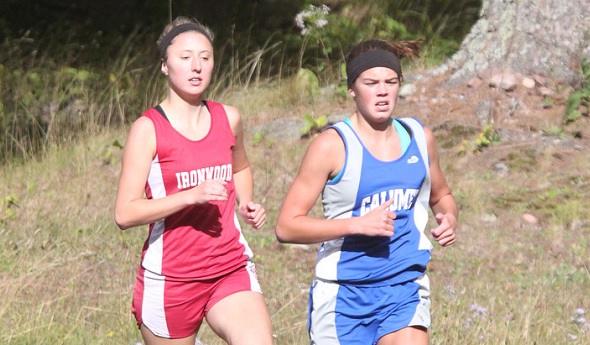
PHOTO: Calumet's Chelsea Jacques (right) won this season's Calumet Invitational with a time of 21:08.06, just ahead of Ironwood's Jessica Gering at 21:46.16. (Photo courtesy of Calumet athletic department.)
Rep Council Approves New Hockey Classification Procedure, Wrestling Weights at Spring Meeting
By
Geoff Kimmerly
MHSAA.com senior editor
May 6, 2022
The selection of a restructured classification procedure for ice hockey and the approval of new boys wrestling weight classes were among the most notable actions taken by the Representative Council of the Michigan High School Athletic Association during its annual Spring Meeting, May 1-2 in Gaylord.
The Spring Meeting of the 19-member legislative body of the Association’s more than 1,500 member schools is generally the busiest of its sessions each year. The Council considered 33 committee proposals and dealt with a variety of eligibility rule, postseason tournament and operational issues.
The Council approved an Ice Hockey Committee proposal to continue classifying teams by enrollment, but with consideration to whether those teams are standalone (one school) or cooperative (multi-school) programs. Approximately half of MHSAA member hockey programs are cooperatives. Beginning with the 2022-23 season, standalone and cooperative programs will be ranked by enrollment but on separate lists, with the top one-third from each list put into Division 1, the second thirds into Division 2 and the lowest thirds into Division 3. This change is expected to rebalance the divisions; in the recent past, Division 1 has been made up mostly of cooperative programs because the combined enrollments of schools involved in co-ops pushed them to the top of the overall classification list for the sport. However, cooperatives generally have not derived an advantage by having more schools involved; instead, cooperatives primarily have allowed schools to continue providing opportunities to athletes who wanted to play hockey when a school doesn’t have enough for a full team.
The Council also approved a switch from current boys wrestling weight classes to those determined by the National Federation of State High School Associations (NFHS): 106, 113, 120, 126, 132, 138, 144, 150, 157, 165, 175, 190, 215 and 285 pounds. The NFHS will begin use of those weights nationally in 2023-24, but MHSAA member schools will make the switch beginning with 2022-23. The Council also approved a change to one girls weight, from 255 pounds to 235, aligning all MHSAA girls weight classes with those determined by the NFHS.
A pair of new opportunities to utilize video replay beginning with the 2022-23 school year will provide further support for game officials as they make split-second calls during competition, while assuring the correct outcome of some of the most controversial plays. The Council approved an Officials Review Committee recommendation to provide MHSAA staff the ability to review video of an ejection and modify subsequent penalties in three instances – when there is a clear misidentification and the incorrect athlete is ejected, when that participant is ejected as the direct result of a rules misapplication, or when incontrovertible video evidence shows an ejection or suspension for flagrant contact with an opponent or official was in error. Officials have continued to support the use of replay at MHSAA events where possible, and game officials make up more than half of the Officials Review Committee.
Also concerning video review, replay will be expanded at the 11-Player Football Finals to allow head coaches one challenge during the game. The challenge will cost that team a timeout if the original outcome is confirmed. Coaches will be allowed to challenge the following: complete/incomplete passes, if a runner/receiver was in/out of bounds, a runner who is ruled not down, the forward progress spot as it relates to the yard to gain, which player first touched a kick, the recovery of a ball in/out of bounds, if a pass was forward or backward, and penalties for illegal forward pass, targeting or illegal helmet contact, and pass interference only as it relates to the pass being previously tipped. All potential scores and turnovers will remain automatically reviewed by replay booth officials. This was a proposal by the MHSAA Football Committee.
The Council took multiple actions concerning the “fifth quarter” regulation that allows athletes to play both at the subvarsity and varsity levels on the same day (or same competition week for football) to help programs that are otherwise lacking enough participants to field teams at both levels. The Council approved a Soccer Committee recommendation to allow athletes to play in no more than three halves on a day not followed by a school day. The Council also approved an enhanced penalty stating that violators of the fifth quarter rule must forfeit the contest during which the violation took place (either varsity of subvarsity), and that head coach in violation will be ineligible for the next day of competition. Additionally, the Council approved a Junior High/Middle School Committee recommendation allowing leagues and conferences to request from the MHSAA staff the opportunity to use the fifth quarter rule for basketball.
Here is a summary of other notable actions taken by the Representative Council at the Spring Meeting, which will take effect during the 2022-23 school year unless noted:
Regulations
• Minnesota has been added as a “border state” for all out-of-state competition purposes. MHSAA member schools will be allowed to play opponents from anywhere in Minnesota regardless of the 300-mile travel limit rule, as is also allowed for opponents in Illinois, Indiana, Ohio, Ontario and Wisconsin.
Sport Matters
• For baseball and softball, the Council approved the creation of separate site selection committees to determine where District and Regional rounds of those tournaments will be played.
• In bowling, the Council approved a Bowling Committee proposal to make the Team Regional qualifying block format the same as the Team Final format. Teams will play eight Baker games and two regular games at both levels of the MHSAA Tournament beginning with the 2022-23 season. Previously, teams bowled six Baker games and three regular games at Regionals.
• In competitive cheer, the Council approved a Girls Competitive Cheer Committee recommendation to, beginning with the 2023-24 season, adopt a new choreography chart that awards points based on tumbling, one-leg extensions, vertical twists/360s and release skills which cannot supersede a 10-point maximum of points earned.
• Also in cheer, the Council approved a Committee recommendation adjusting the penalty for going over the time limit in each round to one penalty point for every second over the time limit, not to exceed 15 points.
• In football, the Council approved a Football Committee recommendation to allow players to wear shoulder pads at college camps sponsored and conducted directly by NCAA or NAIA institutions.
• In golf, the Council approved a pair of Golf Committee recommendations concerning MHSAA Tournament play. Beginning with the 2022-23 school year, teams will be allowed two “school-approved” coaches to be present and actively coaching during postseason competition. Also, the Council approved a reduction in the maximum number of strokes allowed per hole during MHSAA Tournament play from 12 to 10.
• Two more Council actions on Hockey Committee recommendations will affect MHSAA Tournament play in that sport. Beginning with the 2022-23 season, Michigan Power Ratings (MPR) will be used to seed the entire Regional round (which is the first round of postseason play in hockey; there is no District round). Also, teams will be reseeded prior to the start of the Semifinals by a seeding committee, with the top seed in each division then facing the No. 4 seed, and the No. 2 seed facing No. 3 in the other Semifinal.
• In soccer, the Council approved a Soccer Committee recommendation allowing the two seeded teams at the District level to host their games if they are not to be played at a prearranged host site. For these Districts, the No. 1 seed gets hosting priority, followed by the No. 2 seed, followed by the team on the top line of the bracket.
• For diving, the Council approved a Swimming & Diving Committee proposal reorganizing how many Finals qualifiers will advance from each Diving Regional. In each of the three divisions, each Regional will be guaranteed 10 qualifiers for the Finals; the remaining six qualifying spots per division will be distributed to the Regionals that have one of the previous year’s top six returning Finals divers in their fields.
• In tennis, the Council approved a Tennis Committee recommendation allowing for seeding at No. 1 singles of up to seven players if there are between 21-23 in the field, and seeding of up to eight players if the field includes 24 or more. No. 1 singles is the only flight where participants may qualify for the Finals separately from their full team.
Junior High/Middle School
• In track & field, the Council approved a Junior High/Middle School Committee recommendation to begin conducting Regionals beginning with the 2022-23 school year.
• In wrestling, the Council approved a Junior High/Middle School Committee recommendation to add weights of 215 pounds, 245 pounds and heavyweight, with the heavyweight class not to exceed 285 pounds.
• In competitive cheer, the Council approved a Girls Competitive Cheer Committee recommendation allowing junior high/middle school teams to perform a one-leg extension as part of a pyramid with one bracer. A liberty flair is the only flair allowed, and this pyramid requires two points of contact from the bracer.
Calendar
• The Council approved the seven-year calendar of MHSAA Tournament events, with notable basketball changes for two years. For the 2023-24 and 2024-25 school years, the Boys Basketball Tournament will be completed first, followed by the Girls Basketball Tournament – a switch from the traditional order of the girls tournament Finals followed by the boys Finals. This will allow for flexibility in the event Michigan State University is selected to host NCAA Women’s Basketball Tournament first and second-round games at the Breslin Center.
The Council also reviewed reports on membership, with 750 senior high schools and 759 junior high/middle schools in 2021-22 plus 62 elementary schools with 6th-grader participation; cooperative programs, with 378 high school programs for 699 teams during 2021-22; eligibility advancement applications, which totaled zero for the second-straight school year; the use of Educational Transfer Forms, of which there were 142; school violations, attendance at athletic director in-service workshops and Coaches Advancement Program sessions; officials’ registrations, rules meetings attendance and officials reports submitted for the past three sports seasons. The Association’s $12.8 million budget for the 2022-23 school year also was approved.
The Representative Council is the 19-member legislative body of the MHSAA. All but five are elected by member schools. Four members are appointed by the Council to facilitate representation of females and minorities, and the 19th position is occupied by the Superintendent of Public Instruction or designee.
The MHSAA is a private, not-for-profit corporation of voluntary membership by more than 1,500 public and private senior high schools and junior high/middle schools which exists to develop common rules for athletic eligibility and competition. No government funds or tax dollars support the MHSAA, which was the first such association nationally to not accept membership dues or tournament entry fees from schools. Member schools which enforce these rules are permitted to participate in MHSAA tournaments, which attract more than 1.4 million spectators each year.