

Calumet Invite Produces Northern Stars
September 18, 2013
By Geoff Kimmerly
Second Half editor
The Calumet Invitational dates back roughly 30 years as an annual staple of the cross country schedule for schools at the northernmost tip of Michigan's Upper Peninsula.
A creative move by the Copper Kings last year added some statewide prestige to the event.
 Last week, for the second season, Calumet ran the series of races at Keweenaw Mountain Lodge, a resort near Copper Harbor and the northern bank of the Keweenaw Peninsula.
Calumet is the northernmost high school in Michigan. And moving this race another 35 miles northeast more or less guaranteed it's the northernmost event run in the state.
"We figured it was pretty safe. We're the northernmost school in the state, and you can only go four more miles and you're in Lake Superior," Calumet athletic director Sean Jacques said. "Nobody else is going to do anything more north than that."
A total of 10 schools were represented this fall in the races for boys and girls varsity, junior varsity and middle schoolers.
Jacques said the event formerly was run at a golf course in Calumet. But a few years ago, Calumet graduate and former Copper Kings cross country runner Dan Harri moved home from Florida to become general manager at the Mountain Lodge (he's also a renowned chef and has owned restaurants in Miami with Hall of Fame Dolphins coach Don Shula).
Harri had asked a few times about bringing a cross country or golf event to the lodge. Jacques told him last year they'd give it a try, so Harri set up a course that includes golf course, a couple of bridges, trails and finishes with a climb on the No. 1 fairway. It also provides various points for fans to watch runners go by, not always available on other courses.
"We were looking for a little bit of a change, and it's a beautiful course," Jacques said. "We thought if people were willing to make the extra drive, it would be really nice."
Calumet won the boys race this season, just ahead of runner-up Houghton. Houghton's girls were victorious, followed by the host Copper Kings.
Click to read more about this year's event from the Houghton Mining Gazette.
Michigan's claim to an NFL evolution
As part of its NFL preview this month, Sports Illustrated reported on one of the most significant developments for offenses over the last few decades – the silent snap count, which is used regularly by visiting teams because offensive linemen can’t hear the quarterback calling for the ball over the clamor of the home crowd.
And the article explained that the silent snap count might’ve gotten its start at one of Michigan’s smallest high schools – Flint’s Michigan School for the Deaf.
Offensive linemen during the 1980s were feasted on by pass rushers like Lawrence Taylor and Bruce Smith, who built record sack totals by blasting past blockers who seemed a step slow. Turns out, that was true. Defensive players were getting an edge by attacking as soon as they saw the ball move. But blockers (especially offensive tackles), focused instead on the defensive ends and linebackers lined up across from them, and didn’t have the luxury of watching the ball – and since they also couldn’t hear the snap count, started each play a step behind.
Enter the silent count. The quarterback signals to the center that he is ready to receive the ball (with a pat on the back, by raising a foot, etc.). The center then raises his head, and after a predetermined count of at least one second snaps the ball without a sound. This means an offensive tackle doesn’t have to listen for a snap count – he just counts after seeing the center get set.
The SI report recognized longtime offensive line coach Howard Mudd as the guru of the silent snap count. But Mudd recalled a conversation he’d had while working for the Seattle Seahawks with another coach, the late Andy MacDonald, who also had coached early in his career at a school for the deaf in Michigan.
The article doesn’t mention Michigan School for the Deaf by name. But it seems to make sense that the Tartars were the first to use the now-revolutionary count. MacDonald – who played at Central Michigan University and went on to coach at Michigan State and four other colleges and also for the Buffalo Bills – grew up in Flint and attended Flint Northern before playing for the Chippewas from 1950-53. The historical web site Michigan-football.com has results for Flint’s Michigan School for the Deaf dating to 1950, making it a decent assumption that MacDonald might’ve gotten in a little early coaching experience at the school down the road from his home.
Click for the SI story and go to page 4 for the mention of Michigan’s school.
Michigan mourns trooper, running standout
The law enforcement community is mourning the death of Michigan State Police trooper Paul Butterfield, who was shot Sept. 9 during a traffic stop in Mason County. He also was a well-known distance runner during the 1980s and the MHSAA Class A cross country champion running for Bridgeport in 1987.
According to a Ludington Daily News report, Butterfield continued running after high school at the University of Tennessee, and also competed at the 1989 Pan American Junior Games in Argentina.
Butterfield was stationed in Hart after previously serving in Manistee, and lived in Mason County. He also had served in the U.S. Army. Click to read more from the Ludington Daily News.
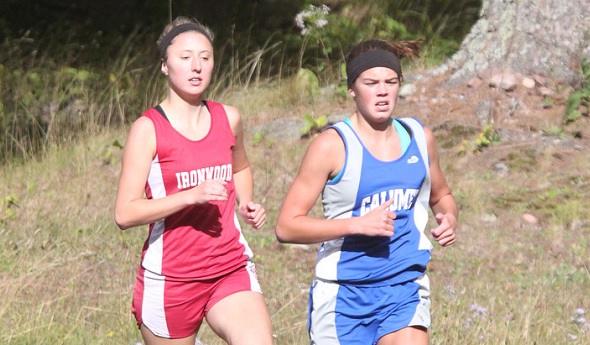
PHOTO: Calumet's Chelsea Jacques (right) won this season's Calumet Invitational with a time of 21:08.06, just ahead of Ironwood's Jessica Gering at 21:46.16. (Photo courtesy of Calumet athletic department.)
Rep Council Approves Expanded Basketball Schedules, Classification Changes at Winter Meeting
By
Geoff Kimmerly
MHSAA.com senior editor
March 29, 2022
An increase in the number of regular-season games high school basketball teams are allowed to play may be the most visible action taken by the Representative Council of the Michigan High School Athletic Association during its annual Winter Meeting on March 25 in East Lansing. However, a change in classification procedure expected to bring more equity to tournament groupings should have the most far-reaching effects across all sports.
The Winter Meeting frequently serves as an opportunity for the Council to discuss items expected to come up for action at its final meeting of the school year, scheduled for May 1-2. However, the Council took a number of actions at this meeting as they relate to scheduling currently underway for the 2022-23 school year, or Spring tournaments this May.
The Council approved a Basketball Committee proposal that will allow, beginning with the 2022-23 season, high school basketball teams to play up to 22 regular-season games at every level (varsity, junior varsity and freshman). Teams previously played a maximum of 20 games during the regular season; this adjustment brings MHSAA school schedules in line with what is allowed in most other Midwest states. Additionally as part of that proposal, mandatory preseason practice was reduced by one week, allowing teams to begin playing games after 14 days instead of 21.
The Council also approved a proposal by the Classification Committee that will result in postseason divisions more reflective of the number of schools actively sponsoring teams for that season. Divisions are assigned by taking the number of teams playing a sport and dividing equally by the number of team championships awarded in that sport (for example, four in baseball and softball). Previously, by the time seasons started the smallest-school divisions in many sports ended up with fewer teams than larger-school divisions because several small schools would declare they would be sponsoring a team during the classification process in March but then be unable to do so because of lack of participation or other reasons.
With this change, schools that have indicated they will sponsor a sport but haven’t participated in that sport as a team or with individual qualifiers over the previous two years will be removed from the classification process before divisions are determined. Those schools that have been removed must then notify the MHSAA they have an active team before being added back into the tournament.
A number of other actions will affect competition as quickly as this spring’s MHSAA Tournaments, and into the 2022-23 school year.
The Council approved a Cross Country/Track & Field proposal to allow for more MHSAA Tournament opportunities for wheelchair athletes. Starting with this Spring 2022 season, Regional and Final meets will include four events for wheelchair participants – 100, 200 and 400-meter races and shot put. These events will be open to wheelchair track & field athletes at MHSAA member schools. Additionally, the Council approved the expansion of postseason Paralympic opportunities in swimming, adding a 100-yard freestyle heat to the 50-yard freestyle heat that has been offered at Finals since 2020.
In baseball and softball, the Council approved committee proposals in those sports to allow District first-round games to be played during the week before Memorial Day. Baseball may play first-round games that previous Thursday, Friday or Saturday, and softball may play that previous Thursday and Friday, beginning this upcoming season. Previously, all first-round games were played the Tuesday after Memorial Day. This change is expected to alleviate pitch count concerns in baseball and provide scheduling flexibility for later District rounds that could allow athletes – especially at small schools where baseball and softball players frequently participate in track & field – opportunities to compete in both sports during the week following Memorial Day.
Another change proposed by the Classification Committee and approved by the Council will raise the enrollment cap for cooperative hockey programs, potentially allowing for more opportunities for schools to contribute athletes who wish to play the sport. Nearly 50 percent of hockey teams playing in the MHSAA Tournament are cooperatives made up of students from multiple schools, and for hockey those schools’ enrollments now may total up to 5,500 students, an increase of 2,000 students for hockey only. Schools participating in a cooperative hockey program must continue to receive Executive Committee approval and show a demonstrated lack of participation in hockey.
The Council also approved a Classification Committee proposal that will allow football teams to opt up in division after the annual release of classifications for the upcoming season in late March/early April. Football teams may opt up one division, with Executive Committee approval, and must show reason and rationale for their request. All football opt ups will be for a minimum of two years, and the Executive Committee will consider those opt-up requests at only its April and May meetings each year.
The Council approved a number of increased benefits for MHSAA-registered game officials, including raises in postseason game fees paid to officials across all sports. Also moving forward, MHSAA officials will be provided membership in the National Association of Sports Officials (NASO), which will provide expanded liability insurance plus additional resources and professional services for all MHSAA registered officials. The Council also approved a change to the registration process and fees that will automatically provide each official registration in two sports. All three changes were proposed by the Audit & Finance Committee.
The Council also approved a rule change allowing the use of school transportation during summer, but it must be funded from school-approved activities of booster clubs, school teams, student groups and community, civic or service groups. This includes the use of busses, vans and other vehicles owned or leased by the school district or operated by any entity with which the district contracts to provide transportation services.
The Representative Council is the legislative body of the MHSAA. All but five members are elected by member schools. Four members are appointed by the Council to facilitate representation of females and minorities, and the 19th position is occupied by the Superintendent of Public Instruction or designee.
The MHSAA is a private, not-for-profit corporation of voluntary membership by more than 1,500 public and private senior high schools and junior high/middle schools which exists to develop common rules for athletic eligibility and competition. No government funds or tax dollars support the MHSAA, which was the first such association nationally to not accept membership dues or tournament entry fees from schools. Member schools which enforce these rules are permitted to participate in MHSAA tournaments, which attract more than 1.4 million spectators each year.