

Calumet Invite Produces Northern Stars
September 18, 2013
By Geoff Kimmerly
Second Half editor
The Calumet Invitational dates back roughly 30 years as an annual staple of the cross country schedule for schools at the northernmost tip of Michigan's Upper Peninsula.
A creative move by the Copper Kings last year added some statewide prestige to the event.
 Last week, for the second season, Calumet ran the series of races at Keweenaw Mountain Lodge, a resort near Copper Harbor and the northern bank of the Keweenaw Peninsula.
Calumet is the northernmost high school in Michigan. And moving this race another 35 miles northeast more or less guaranteed it's the northernmost event run in the state.
"We figured it was pretty safe. We're the northernmost school in the state, and you can only go four more miles and you're in Lake Superior," Calumet athletic director Sean Jacques said. "Nobody else is going to do anything more north than that."
A total of 10 schools were represented this fall in the races for boys and girls varsity, junior varsity and middle schoolers.
Jacques said the event formerly was run at a golf course in Calumet. But a few years ago, Calumet graduate and former Copper Kings cross country runner Dan Harri moved home from Florida to become general manager at the Mountain Lodge (he's also a renowned chef and has owned restaurants in Miami with Hall of Fame Dolphins coach Don Shula).
Harri had asked a few times about bringing a cross country or golf event to the lodge. Jacques told him last year they'd give it a try, so Harri set up a course that includes golf course, a couple of bridges, trails and finishes with a climb on the No. 1 fairway. It also provides various points for fans to watch runners go by, not always available on other courses.
"We were looking for a little bit of a change, and it's a beautiful course," Jacques said. "We thought if people were willing to make the extra drive, it would be really nice."
Calumet won the boys race this season, just ahead of runner-up Houghton. Houghton's girls were victorious, followed by the host Copper Kings.
Click to read more about this year's event from the Houghton Mining Gazette.
Michigan's claim to an NFL evolution
As part of its NFL preview this month, Sports Illustrated reported on one of the most significant developments for offenses over the last few decades – the silent snap count, which is used regularly by visiting teams because offensive linemen can’t hear the quarterback calling for the ball over the clamor of the home crowd.
And the article explained that the silent snap count might’ve gotten its start at one of Michigan’s smallest high schools – Flint’s Michigan School for the Deaf.
Offensive linemen during the 1980s were feasted on by pass rushers like Lawrence Taylor and Bruce Smith, who built record sack totals by blasting past blockers who seemed a step slow. Turns out, that was true. Defensive players were getting an edge by attacking as soon as they saw the ball move. But blockers (especially offensive tackles), focused instead on the defensive ends and linebackers lined up across from them, and didn’t have the luxury of watching the ball – and since they also couldn’t hear the snap count, started each play a step behind.
Enter the silent count. The quarterback signals to the center that he is ready to receive the ball (with a pat on the back, by raising a foot, etc.). The center then raises his head, and after a predetermined count of at least one second snaps the ball without a sound. This means an offensive tackle doesn’t have to listen for a snap count – he just counts after seeing the center get set.
The SI report recognized longtime offensive line coach Howard Mudd as the guru of the silent snap count. But Mudd recalled a conversation he’d had while working for the Seattle Seahawks with another coach, the late Andy MacDonald, who also had coached early in his career at a school for the deaf in Michigan.
The article doesn’t mention Michigan School for the Deaf by name. But it seems to make sense that the Tartars were the first to use the now-revolutionary count. MacDonald – who played at Central Michigan University and went on to coach at Michigan State and four other colleges and also for the Buffalo Bills – grew up in Flint and attended Flint Northern before playing for the Chippewas from 1950-53. The historical web site Michigan-football.com has results for Flint’s Michigan School for the Deaf dating to 1950, making it a decent assumption that MacDonald might’ve gotten in a little early coaching experience at the school down the road from his home.
Click for the SI story and go to page 4 for the mention of Michigan’s school.
Michigan mourns trooper, running standout
The law enforcement community is mourning the death of Michigan State Police trooper Paul Butterfield, who was shot Sept. 9 during a traffic stop in Mason County. He also was a well-known distance runner during the 1980s and the MHSAA Class A cross country champion running for Bridgeport in 1987.
According to a Ludington Daily News report, Butterfield continued running after high school at the University of Tennessee, and also competed at the 1989 Pan American Junior Games in Argentina.
Butterfield was stationed in Hart after previously serving in Manistee, and lived in Mason County. He also had served in the U.S. Army. Click to read more from the Ludington Daily News.
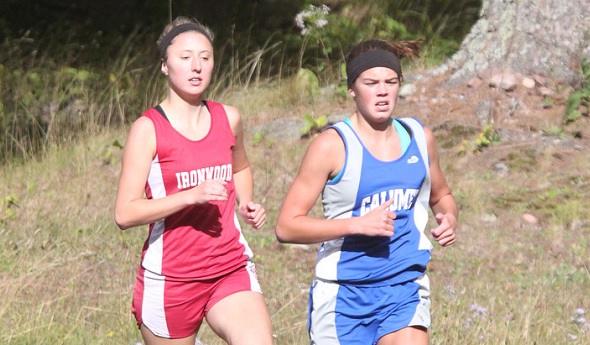
PHOTO: Calumet's Chelsea Jacques (right) won this season's Calumet Invitational with a time of 21:08.06, just ahead of Ironwood's Jessica Gering at 21:46.16. (Photo courtesy of Calumet athletic department.)

Piggee Leans on Big Reds After Dad's Death, Lifts Team with Dazzling Play
By
Tom Kendra
Special for MHSAA.com
November 3, 2021
Watching Destin Piggee do his thing on the football field – drawing collective gasps from the crowd with an array of moves, bursts of amazing speed and dramatic stops and starts – is nothing short of pure joy.
 What a contrast from the tragedy the quiet, humble, 15-year-old Muskegon High School sophomore suffered two months ago.
Muskegon coach Shane Fairfield said his young sensation has the heart of a lion, but that heart was ripped out of his chest on the afternoon of Sept. 3 – just hours before the Big Reds hosted Detroit Cass Tech in the biggest game in the state that weekend.
Piggee learned that his previously healthy father, 43-year-old Dereko Piggee, had died from complications after a short bout with COVID-19.
He then did what his dad would have wanted that night and played for the Big Reds, ripping off a 43-yard run (appropriately, one yard for every year of his dad’s life), giving a packed house at Hackley Stadium a preview of what was to come over the next eight games.
“I played that game, but I wasn’t in my right mind,” admitted Piggee, a 5-foot-6, 160-pound slot back and return man.
“My teammates and my coaches have helped me like you wouldn’t believe. If I didn’t have football, I probably would have gone out and done something stupid.”
The next game at Zeeland West was even more challenging, as earlier that day was his father’s funeral service – and then the young man who is too young to drive a car had to lay his father and best friend to rest at the cemetery.
He responded once again, scoring the winning touchdown on a 32-yard run in the fourth quarter.
Piggee hasn’t slowed down since, rolling up 705 rushing yards on a mere 30 carries, for a staggering 24 yards per attempt, with nine touchdowns. He also has caught nine passes for 201 yards and a touchdown, giving him 17 plays of 20-plus yards on only 39 offensive touches.
 “He is a gifted natural athlete, but you should see the way this young man works,” said Muskegon coach Shane Fairfield, who has led his team to nine straight wins after the humbling Week 2 loss to Cass Tech. “His love for the game and for his teammates is contagious.”
Muskegon (9-1) hopes to win its 10th-straight District championship at 1 p.m. Saturday when it hosts Cedar Springs (8-2).
The Big Reds, who have also won five straight Regional titles, are aspiring to make it to Ford Field for the eighth time in the past 10 years. Muskegon has won a state-best 878 games and 18 state titles, including six in the playoff era, with the latest coming in 2017.
It has been the emergence of super sophomore “smurfs” Piggee and his good friend, running back Jakob Price (5-7, 165), which has keyed this team’s resurgence.
Exhibit A was Muskegon’s 49-28 win over crosstown rival and two-time reigning Division 2 champion Muskegon Mona Shores on Oct. 8. With the Sailors keying on senior quarterback Myles Walton, the sophomores stole the show – Price with six carries for 217 yards and TD runs of 70 yards and 99 yards and Piggee with six carries for 123 yards and two TDs, along with two catches for 71 yards and another score.
Against Wyoming earlier this year, Piggee touched the ball twice all game and scored touchdowns both times, on an 82-yard run and an electrifying 50-yard punt return.
Although he makes it look easy on the field, it’s been a daily, hourly, minute-by-minute battle off of it for Piggee and his family, especially his mother, stepmother, grandparents and siblings.
“One day after school, I just started crying and I couldn’t stop,” said Piggee, who is the youngest of his father’s five children.
That was when his Big Red family stepped in.
 Senior Damari Foster hugged him and held him for a long time, before passing him off to freshman coach Corey Bibbs, who then handed him to Fairfield.
“Coach Fairfield finally got me to stop crying,” said Piggee, who wants to study electrical engineering in college. “He told me about some of the hard things he dealt with growing up, and I learned some things from him.”
Piggee said he draws motivation from his friend Dametrius “Meechie” Walker, a towering, 6-5 senior defensive lineman who was diagnosed last fall with osteosarcoma in his left leg, a rare bone cancer most often seen in teenage boys. The cancer has ended the playing career for Walker – who already had six Division I scholarship offers including from Michigan State, Minnesota and Kentucky – but he remains a positive, smiling force on the Muskegon sideline.
While Piggee is motivated to play hard for Walker, he is also determined to follow in the footsteps of his father, a 1996 grad who was a three-year varsity player and all-area defensive back for the Big Reds. He played running back, but was better known as a dangerous return man and lockdown cover man in the secondary.
“I remember Dereko was a nice, nice kid,” said Dave Taylor, Dereko’s head coach at Muskegon, who led the Big Reds to Class A championships in 1986 and 1989. “He did what I told him to do, and he was one of my favorites.”
This year’s Muskegon team is the youngest in Fairfield’s 12 years as head coach, with as many as eight freshmen and sophomores starting in some games.
The turning point in the season came after the 49-14 defeat at the hands of Cass Tech, when Fairfield challenged Piggee and his underclassmen teammates to rise above their youth and start playing “big boy football.”
“Big boy football means being confident and being in control of yourself at all times,” said Piggee. “We got on a group text and talked about that after our loss.
“We support our brothers here even when no one else does. These guys have helped me to get through every single day since my dad passed; you have no idea. I just want to go out and play as hard as I can for them.”
 Tom Kendra worked 23 years at The Muskegon Chronicle, including five as assistant sports editor and the final six as sports editor through 2011. E-mail him at [email protected] with story ideas for Muskegon, Oceana, Mason, Lake, Oceola, Mecosta and Newaygo counties.
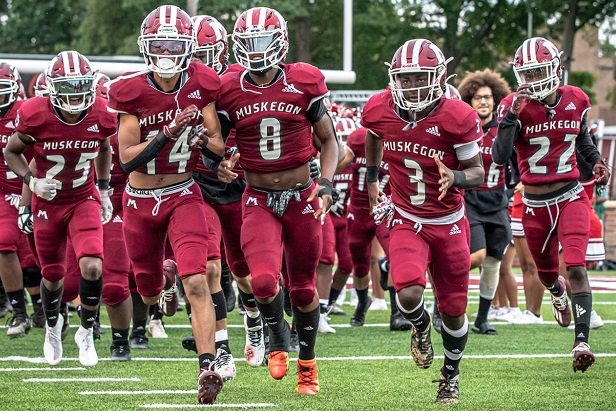
PHOTOS (Top) Muskegon’s Destin Piggee (3) eludes the grasp of a Lowell defender during the Big Reds’ District Semifinal win Saturday. (Middle) Piggee takes the field with his teammates before the Sept. 3 game against Detroit Cass Tech. (Below) Piggee makes his move upfield against East Kentwood. (Top and below photos courtesy of Local Sports Journal. Middle photo by Tim Reilly.)