

Calumet Invite Produces Northern Stars
September 18, 2013
By Geoff Kimmerly
Second Half editor
The Calumet Invitational dates back roughly 30 years as an annual staple of the cross country schedule for schools at the northernmost tip of Michigan's Upper Peninsula.
A creative move by the Copper Kings last year added some statewide prestige to the event.
 Last week, for the second season, Calumet ran the series of races at Keweenaw Mountain Lodge, a resort near Copper Harbor and the northern bank of the Keweenaw Peninsula.
Calumet is the northernmost high school in Michigan. And moving this race another 35 miles northeast more or less guaranteed it's the northernmost event run in the state.
"We figured it was pretty safe. We're the northernmost school in the state, and you can only go four more miles and you're in Lake Superior," Calumet athletic director Sean Jacques said. "Nobody else is going to do anything more north than that."
A total of 10 schools were represented this fall in the races for boys and girls varsity, junior varsity and middle schoolers.
Jacques said the event formerly was run at a golf course in Calumet. But a few years ago, Calumet graduate and former Copper Kings cross country runner Dan Harri moved home from Florida to become general manager at the Mountain Lodge (he's also a renowned chef and has owned restaurants in Miami with Hall of Fame Dolphins coach Don Shula).
Harri had asked a few times about bringing a cross country or golf event to the lodge. Jacques told him last year they'd give it a try, so Harri set up a course that includes golf course, a couple of bridges, trails and finishes with a climb on the No. 1 fairway. It also provides various points for fans to watch runners go by, not always available on other courses.
"We were looking for a little bit of a change, and it's a beautiful course," Jacques said. "We thought if people were willing to make the extra drive, it would be really nice."
Calumet won the boys race this season, just ahead of runner-up Houghton. Houghton's girls were victorious, followed by the host Copper Kings.
Click to read more about this year's event from the Houghton Mining Gazette.
Michigan's claim to an NFL evolution
As part of its NFL preview this month, Sports Illustrated reported on one of the most significant developments for offenses over the last few decades – the silent snap count, which is used regularly by visiting teams because offensive linemen can’t hear the quarterback calling for the ball over the clamor of the home crowd.
And the article explained that the silent snap count might’ve gotten its start at one of Michigan’s smallest high schools – Flint’s Michigan School for the Deaf.
Offensive linemen during the 1980s were feasted on by pass rushers like Lawrence Taylor and Bruce Smith, who built record sack totals by blasting past blockers who seemed a step slow. Turns out, that was true. Defensive players were getting an edge by attacking as soon as they saw the ball move. But blockers (especially offensive tackles), focused instead on the defensive ends and linebackers lined up across from them, and didn’t have the luxury of watching the ball – and since they also couldn’t hear the snap count, started each play a step behind.
Enter the silent count. The quarterback signals to the center that he is ready to receive the ball (with a pat on the back, by raising a foot, etc.). The center then raises his head, and after a predetermined count of at least one second snaps the ball without a sound. This means an offensive tackle doesn’t have to listen for a snap count – he just counts after seeing the center get set.
The SI report recognized longtime offensive line coach Howard Mudd as the guru of the silent snap count. But Mudd recalled a conversation he’d had while working for the Seattle Seahawks with another coach, the late Andy MacDonald, who also had coached early in his career at a school for the deaf in Michigan.
The article doesn’t mention Michigan School for the Deaf by name. But it seems to make sense that the Tartars were the first to use the now-revolutionary count. MacDonald – who played at Central Michigan University and went on to coach at Michigan State and four other colleges and also for the Buffalo Bills – grew up in Flint and attended Flint Northern before playing for the Chippewas from 1950-53. The historical web site Michigan-football.com has results for Flint’s Michigan School for the Deaf dating to 1950, making it a decent assumption that MacDonald might’ve gotten in a little early coaching experience at the school down the road from his home.
Click for the SI story and go to page 4 for the mention of Michigan’s school.
Michigan mourns trooper, running standout
The law enforcement community is mourning the death of Michigan State Police trooper Paul Butterfield, who was shot Sept. 9 during a traffic stop in Mason County. He also was a well-known distance runner during the 1980s and the MHSAA Class A cross country champion running for Bridgeport in 1987.
According to a Ludington Daily News report, Butterfield continued running after high school at the University of Tennessee, and also competed at the 1989 Pan American Junior Games in Argentina.
Butterfield was stationed in Hart after previously serving in Manistee, and lived in Mason County. He also had served in the U.S. Army. Click to read more from the Ludington Daily News.
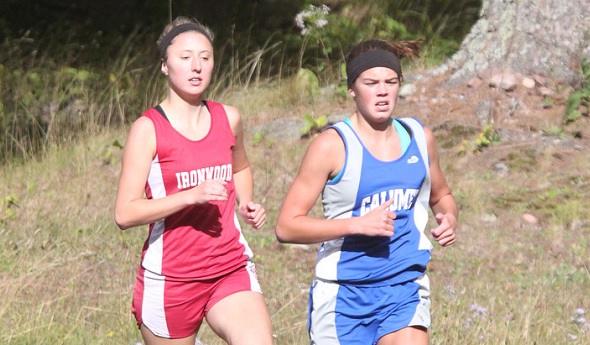
PHOTO: Calumet's Chelsea Jacques (right) won this season's Calumet Invitational with a time of 21:08.06, just ahead of Ironwood's Jessica Gering at 21:46.16. (Photo courtesy of Calumet athletic department.)
Accomplished College Coach Giving Back to HS Track at Salem
By
Doug Donnelly
Special for MHSAA.com
April 23, 2021
PINCKNEY – John Goodridge has coached athletes of just about every level imaginable.
"My passion for coaching is just as high as ever,” said Goodridge, 72, recently named the head boys track & field coach at Salem High School in Canton. “It’s been fun. You really do come full circle.”
It’s been a tremendous coaching journey over the past 50 years for Goodridge, a New York City native. It was not long after retiring from Eastern Michigan University in the fall that Goodridge got the coaching bug again. It started when he began attending cross country meets in the Ann Arbor area. Soon he realized he wanted to continue coaching and spoke to one of his former EMU athletes who was coaching at Salem and had found out the job as boys track coach was going to be open.
"At some point, late in my career, I had the notion that someday I’d come back and coach high school, where it all started,” Goodridge said. “In the fall, after I retired, an EMU alum who coached at Pinckney High School invited me to his home opening cross country meet.
"It was enough being out there and seeing the young kids that it brought me back to 40-50 years ago. I spent the fall, every week, going to various local cross country meets. Just observing, just to see if I thought it was something I wanted to do.”
Ultimately, Salem athletic director Tim Baechler hired Goodridge, who has an incredible resume as a track & field and cross country coach. From coaching Olympic athletes to the United States team at the World University Cross Country Championships in Austria, Goodridge has coached world class athletes and NCAA championship-level contenders for decades.
High school coaches have always had a special place in Goodridge’s heart. One reason is he interacted with coaches from across the country while recruiting athletes to compete for him at Michigan State University (1979-1982), Wake Forest University (1984-1999) and Eastern Michigan (2001-2020). Another reason is that he started out coaching at that level.
"It’s natural,” he said. “A lot of people think college is a higher level and that kind of stuff, but I’ve always told people that being a high school coach is such an important role and opportunity to work with young people.
"In many cases it’s the most special relationship. A high school coach sets the tone. You are introducing the sport to young kids. That’s quite a responsibility.”
Goodridge graduated from Long Island University in 1972. He and wife Francie (Kraker) met in the northeast while working for a shoe company. They returned to her native Ann Arbor while she was an elite world class athlete. Francie ran on U.S. Olympic teams in 1968 and 1972 and owned a world record in 1967.
While in grad school, Francie was offered the position of track coach at Ann Arbor Huron but couldn’t accept it because she was still an amateur athlete and couldn’t profit from that status and remain eligible for the Olympics.
Instead, she suggested to the Huron athletic director that the school hire her husband. His coaching career was launched.
"We were two young people, trying to get through school on part-time jobs,” Goodridge said. “We didn’t even have a car. (Coaching) was a source of income.”
While coaching high school track, they also coached younger athletes on club squads, before moving to the University of Wisconsin-Milwaukee where they both were hired as coaches – Francie as the women’s track coach and John the men’s. After a short stint there, they returned to Ann Arbor and both took on roles at Ann Arbor Greenhills.
Both coached for years. Goodridge had a long tenure at Wake Forest, coaching both cross country and track & field at a time when the Demon Deacons had unparalleled success in school history with 14 individual Atlantic Coast Conference champions and seven All-Americans. Francie coached at Wake Forest as well.
The couple returned to Michigan in the early 2000s, with Goodridge taking over the Eastern Michigan cross country program and serving as an assistant track coach. He later became the head track coach. During his time at Ypsilanti, he directed numerous Eagles squads in both sports to conference titles. During his distinguished career, he coached conference cross country championship teams in the Mid-American, Big Ten and Atlantic Coast Conferences. He was the MAC Coach of the Year 13 times in cross country and coached 22 NCAA track & field All-Americans.
This season he has more than 100 athletes on the Salem boys track & field team. He’s having a blast with it, especially with the freshmen athletes who are just starting out learning about track.
"Some of them may not be the most talented, natural athletes but they want to be part of the team,” he said. “They might not be able to make another team, but they want to be involved in athletics and be on a team. It’s been very intellectually challenging and inspiring to come up with new things for ninth graders, to make it fun and not let them get discouraged.
"They put a smile on my face just about every day. I hope it’s going to be keep me a young 72 and a young 73 and as long as I keep doing this.”
Goodridge also is building relationships with other area coaches. He’s not been afraid to seek out advice.
It’s been a long time since I designed workouts for the young ones,” he said. “It’s fun to sort it out, to my own approach to training, with that age group. All athletes respond differently to training and intensity and what you give them. The age of the athlete is a factor in that. It’s been a long time since I had experience working with freshmen. That’s been fun.”
 Doug Donnelly has served as a sports and news reporter and city editor over 25 years, writing for the Daily Chief-Union in Upper Sandusky, Ohio from 1992-1995, the Monroe Evening News from 1995-2012 and the Adrian Daily Telegram since 2013. He's also written a book on high school basketball in Monroe County and compiles record books for various schools in southeast Michigan. E-mail him at [email protected] with story ideas for Jackson, Washtenaw, Hillsdale, Lenawee and Monroe counties.
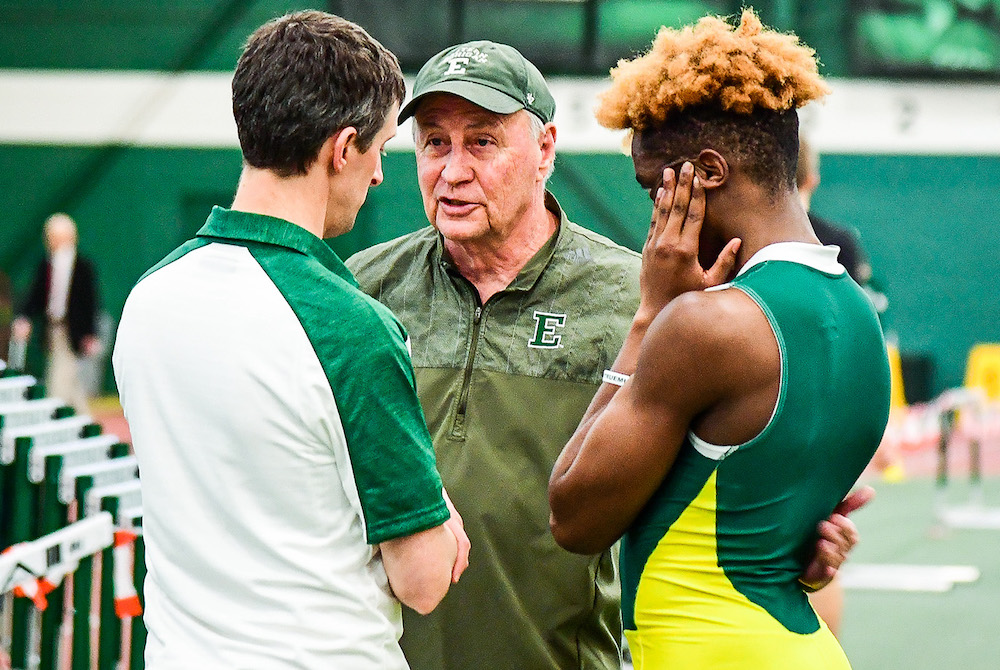
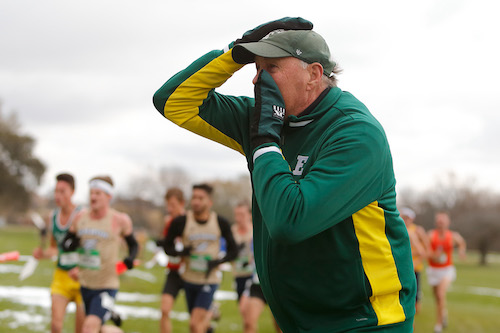
PHOTOS: (Top) John Goodridge, center, retired in the fall from coaching the men’s track & field team at Eastern Michigan University. (Middle) Goodridge also served as coach of the men’s cross country team. (Photos courtesy of the EMU athletic department.)