

Calumet Invite Produces Northern Stars
September 18, 2013
By Geoff Kimmerly
Second Half editor
The Calumet Invitational dates back roughly 30 years as an annual staple of the cross country schedule for schools at the northernmost tip of Michigan's Upper Peninsula.
A creative move by the Copper Kings last year added some statewide prestige to the event.
 Last week, for the second season, Calumet ran the series of races at Keweenaw Mountain Lodge, a resort near Copper Harbor and the northern bank of the Keweenaw Peninsula.
Calumet is the northernmost high school in Michigan. And moving this race another 35 miles northeast more or less guaranteed it's the northernmost event run in the state.
"We figured it was pretty safe. We're the northernmost school in the state, and you can only go four more miles and you're in Lake Superior," Calumet athletic director Sean Jacques said. "Nobody else is going to do anything more north than that."
A total of 10 schools were represented this fall in the races for boys and girls varsity, junior varsity and middle schoolers.
Jacques said the event formerly was run at a golf course in Calumet. But a few years ago, Calumet graduate and former Copper Kings cross country runner Dan Harri moved home from Florida to become general manager at the Mountain Lodge (he's also a renowned chef and has owned restaurants in Miami with Hall of Fame Dolphins coach Don Shula).
Harri had asked a few times about bringing a cross country or golf event to the lodge. Jacques told him last year they'd give it a try, so Harri set up a course that includes golf course, a couple of bridges, trails and finishes with a climb on the No. 1 fairway. It also provides various points for fans to watch runners go by, not always available on other courses.
"We were looking for a little bit of a change, and it's a beautiful course," Jacques said. "We thought if people were willing to make the extra drive, it would be really nice."
Calumet won the boys race this season, just ahead of runner-up Houghton. Houghton's girls were victorious, followed by the host Copper Kings.
Click to read more about this year's event from the Houghton Mining Gazette.
Michigan's claim to an NFL evolution
As part of its NFL preview this month, Sports Illustrated reported on one of the most significant developments for offenses over the last few decades – the silent snap count, which is used regularly by visiting teams because offensive linemen can’t hear the quarterback calling for the ball over the clamor of the home crowd.
And the article explained that the silent snap count might’ve gotten its start at one of Michigan’s smallest high schools – Flint’s Michigan School for the Deaf.
Offensive linemen during the 1980s were feasted on by pass rushers like Lawrence Taylor and Bruce Smith, who built record sack totals by blasting past blockers who seemed a step slow. Turns out, that was true. Defensive players were getting an edge by attacking as soon as they saw the ball move. But blockers (especially offensive tackles), focused instead on the defensive ends and linebackers lined up across from them, and didn’t have the luxury of watching the ball – and since they also couldn’t hear the snap count, started each play a step behind.
Enter the silent count. The quarterback signals to the center that he is ready to receive the ball (with a pat on the back, by raising a foot, etc.). The center then raises his head, and after a predetermined count of at least one second snaps the ball without a sound. This means an offensive tackle doesn’t have to listen for a snap count – he just counts after seeing the center get set.
The SI report recognized longtime offensive line coach Howard Mudd as the guru of the silent snap count. But Mudd recalled a conversation he’d had while working for the Seattle Seahawks with another coach, the late Andy MacDonald, who also had coached early in his career at a school for the deaf in Michigan.
The article doesn’t mention Michigan School for the Deaf by name. But it seems to make sense that the Tartars were the first to use the now-revolutionary count. MacDonald – who played at Central Michigan University and went on to coach at Michigan State and four other colleges and also for the Buffalo Bills – grew up in Flint and attended Flint Northern before playing for the Chippewas from 1950-53. The historical web site Michigan-football.com has results for Flint’s Michigan School for the Deaf dating to 1950, making it a decent assumption that MacDonald might’ve gotten in a little early coaching experience at the school down the road from his home.
Click for the SI story and go to page 4 for the mention of Michigan’s school.
Michigan mourns trooper, running standout
The law enforcement community is mourning the death of Michigan State Police trooper Paul Butterfield, who was shot Sept. 9 during a traffic stop in Mason County. He also was a well-known distance runner during the 1980s and the MHSAA Class A cross country champion running for Bridgeport in 1987.
According to a Ludington Daily News report, Butterfield continued running after high school at the University of Tennessee, and also competed at the 1989 Pan American Junior Games in Argentina.
Butterfield was stationed in Hart after previously serving in Manistee, and lived in Mason County. He also had served in the U.S. Army. Click to read more from the Ludington Daily News.
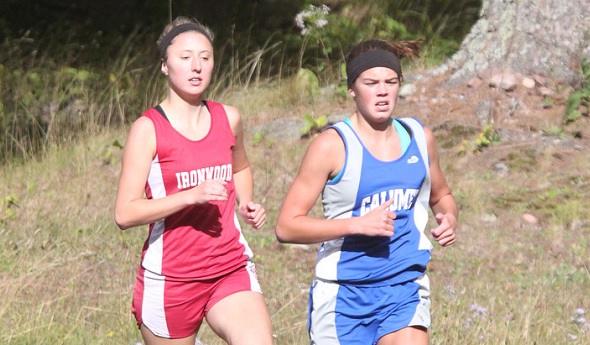
PHOTO: Calumet's Chelsea Jacques (right) won this season's Calumet Invitational with a time of 21:08.06, just ahead of Ironwood's Jessica Gering at 21:46.16. (Photo courtesy of Calumet athletic department.)
Many Champs Have Played Waiting Game
January 12, 2021
By Ron Pesch
Special for Second Half
A state football championship is a dream for many. Fans wait for the day that they can beam with pride as their favorite squad or school hoists the title trophy toward the sky. For coaches and kids, it’s a road to memories never to be forgotten.
Many schools still wait for that day. Others pray for a return to such glory.
Today, we look at return trips to the winner’s circle. It’s filled with fascinating facts.
Ten schools have won three or more consecutive gridiron championship since the arrival of the tournament in 1975 (when titles began being awarded annually in four classifications based on enrollment – A, B, C & D). Grand Rapids West Catholic, Farmington Hills Harrison and East Grand Rapids lead the pack with five successive titles. Muskegon Catholic Central, Detroit St. Martin dePorres and Ithaca each had streaks of four in a row, while Jackson Lumen Christi, Orchard Lake St. Mary’s, Detroit Catholic Central and Bloomfield Hills Brother Rice each had three-peats. Michigan has seen 31 instances of back-to-back crowns in 11-player football, accomplished at least once by 28 schools. To date, Powers North Central is the only squad to repeat since the 8-player playoffs began in 2011.
But what about the span between titles?
Patience is a Virtue
Eighteen schools have seen gaps of 10 or more years between MHSAA football championships. It’s happened twice for both Orchard Lake St. Mary’s and Crystal Falls Forest Park.
St. Mary’s earned its first football title in 1977 under coach Art Paddy. Its second came 17 years later under current head coach George Porritt. The Eaglets have earned eight titles total and have appeared in 14 championship games. Seven of those titles have come under Porritt’s guidance. They went back-to-back in 1999-2000, but then had to wait 11 seasons before winning their fifth title in 2011. In between, they finished as runner-up on five occasions.
Forest Park has appeared in 13 MHSAA Football Finals over the years, including six of the first 10 Class D title games between 1975 and 1984. Led by Upper Peninsula coaching legend Richard Mettlach, the Trojans were winners of the first two Class D titles, when only 16 teams qualified for the postseason. A total of 31 seasons would pass before Forest Park would win its third football championship. In between, multiple alterations were made to the postseason.
In 1977, the playoffs expanded to a three-week format that included 32 participating teams. The tournament grew to 64 qualifiers in 1985, then moved from awarding titles in four classes to eight (AA, A, BB, B, CC, C, DD & D) involving 128 teams, played out over four weeks. In 1999, the postseason was again altered, to a five-week layout including 256 contenders within eight groupings of 32 teams (Division 1 through Division 8), established after the 256 qualifiers were determined.
 Bill Santilli, captain and star running back of the Trojans’ 1975 championship squad, took over the program in 1996 and led the Red and Black on seven trips to the Division 8 championship game – the first in 2000, then to six straight appearances in the title game between 2004-2009. Leading 22-14, Santilli’s 2007 team ground the final 6:07 off the game clock to seal their victory over Fulton, ensuring celebration during the Trojans’ eight-hour, 500+ mile trip back to the Upper Peninsula.
Much changed over the following decade at Forest Park. Santilli retired following the 2013 season. He finished with and impressive 171-45 win-loss mark that included 17 straight years in the MHSAA Playoffs. He went out on a high note, posting a 12-1 mark in 2013.
In 2015, following a trend of continued declining enrollments at U.P. schools, the Crystal Falls Forest Park Board of Education chose to move to 8-player football beginning with the 2016 season.
In 2017, seeing a 20-percent increase in the number of schools that chose this option for their student-athletes, the MHSAA expanded the 8-player tournament to two divisions. That fall, under head coach David Graff, the Trojans returned home with the 8-player Division 2 crown, becoming the second team in Michigan to win titles in both forms of the game
So far, Lawrence, is the only other high school to win championships in both 11-player and 8-player ball. The Tigers won their first football title in 1997 in Class DD. In 2014, 17 years later, they trounced Cedarville, 56-12, to pick up their first championship in 8-player.
The Longest Interval of All
Ishpeming fans have enjoyed seven trips to the MHSAA Finals over the years. The Hematites, nicknamed after the reddish-black iron ore that was long mined in the area, waited 33 years between their 1979 title and their 2012 championship. That’s currently the longest span between football championships in Michigan history.
Boasting a strong ground attack, Ishpeming picked up its first state crown in 1975 in an impressive manner, defeating heavily-favored Hudson in a Class C showdown hosted at Central Michigan University. Coach Mike Mileski’s squad rambled to a 24-8 lead by the end of one quarter, then cruised to a 38-22 victory. Hudson hadn’t lost a contest since the 1968 season, and the Hematites’ triumph halted the Tigers’ national win streak at 72-games.
Mileski guided the Hematites to the 1978 Semifinal before departing for Marquette High School to continue his coaching and teaching career. John Croze, an assistant under Mileski, took the reins in 1979 and drove Ishpeming to its second MHSAA title – finishing with a 13-0 victory over Watervliet.
It took 31 years before Ishpeming earned another shot at a crown. The 2010 Division 7 title game was, once again, a showdown between the Hematites and Hudson. This time, Hudson – coached by Chris Luma, the Tigers’ quarterback back in 1975 – won a thriller, 28-26.
A mere two seasons later, Ishpeming was back, this time winning the first of back-to-back titles, both with victories over Detroit Loyola. Those also were the first of four straight visits to the Finals by coach Jeff Olson’s teams. In 2014, the two teams met again, this time with Loyola emerging as victor. Ishpeming won its third title in four seasons in 2015, downing Pewamo-Westphalia, 22-16.
On the coaching side, Rich Hulkow at Marshall waited 13 seasons (1996 & 2009) between championships. Schoolcraft’s Larry Ledlow (1989 & 2001) had a pause of 12 years between celebrations. The aforementioned Porritt at St. Mary’s saw a break of 11 years between title triumphs. Mike Giannone went 10 season between titles at Macomb Dakota (2007) and later Warren De La Salle Collegiate (2017). Even legends Al Fracassa at Brother Rice (1990 & 2000) and George Barcheski (1983 & 1993) at East Grand Rapids had 10-years spans of wonder during their long coaching careers. Pete Kutches won titles in 1980 and 1982 at Muskegon Catholic, then a decade passed before “The Catch” gave his Muskegon Reeths-Puffer squad the 1992 Class A championship.
Don’t Stop Believing
One school with a long streak of waiting remain in the chase during this extended 2020-21 postseason.
Traverse City High School last won a football title in 1988. Coach Jim Ooley’s Trojans finished Class A runner-up in 1975, then rattled off titles in 1978, 1985 and 1988. Named head coach in 1967, he retired following the 1991 season.
In the fall of 1997, the school split into two with the opening of Traverse City West.
Traverse City Central, as the original school is now known, is still chasing its next football championship 32 years later. The Trojans take on reigning Division 2 champion Muskegon Mona Shores in a Semifinal this Saturday.
 Ron Pesch has taken an active role in researching the history of MHSAA events since 1985 and began writing for MHSAA Finals programs in 1986, adding additional features and "flashbacks" in 1992. He inherited the title of MHSAA historian from the late Dick Kishpaugh following the 1993-94 school year, and resides in Muskegon. Contact him at [email protected]:void(0);t with ideas for historical articles.
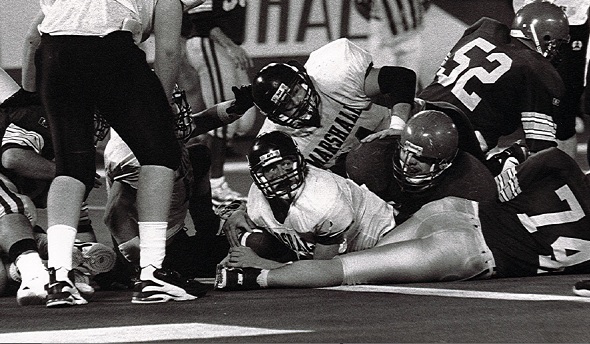
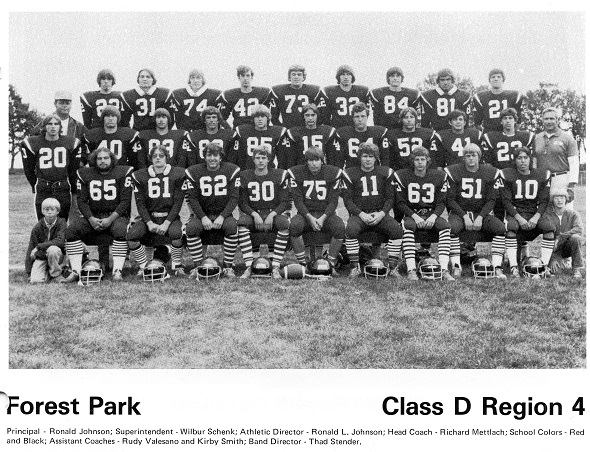
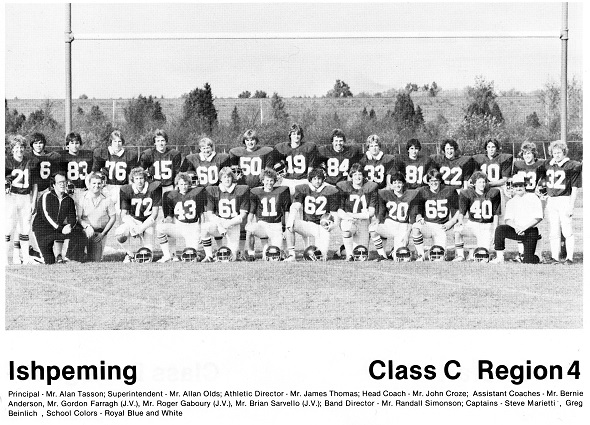
PHOTOS: (Top) Ryan Van Dyke scores one of his two touchdowns in Marshall’s 14-13 win over Kingsford in the 1996 Class BB Final. (Middle) The 1976 Crystal Falls Forest Park team. (Below) The 1979 Ishpeming team. (Photos from MHSAA files; Marshall photo by Gary Shook.)