

Calumet Invite Produces Northern Stars
September 18, 2013
By Geoff Kimmerly
Second Half editor
The Calumet Invitational dates back roughly 30 years as an annual staple of the cross country schedule for schools at the northernmost tip of Michigan's Upper Peninsula.
A creative move by the Copper Kings last year added some statewide prestige to the event.
 Last week, for the second season, Calumet ran the series of races at Keweenaw Mountain Lodge, a resort near Copper Harbor and the northern bank of the Keweenaw Peninsula.
Calumet is the northernmost high school in Michigan. And moving this race another 35 miles northeast more or less guaranteed it's the northernmost event run in the state.
"We figured it was pretty safe. We're the northernmost school in the state, and you can only go four more miles and you're in Lake Superior," Calumet athletic director Sean Jacques said. "Nobody else is going to do anything more north than that."
A total of 10 schools were represented this fall in the races for boys and girls varsity, junior varsity and middle schoolers.
Jacques said the event formerly was run at a golf course in Calumet. But a few years ago, Calumet graduate and former Copper Kings cross country runner Dan Harri moved home from Florida to become general manager at the Mountain Lodge (he's also a renowned chef and has owned restaurants in Miami with Hall of Fame Dolphins coach Don Shula).
Harri had asked a few times about bringing a cross country or golf event to the lodge. Jacques told him last year they'd give it a try, so Harri set up a course that includes golf course, a couple of bridges, trails and finishes with a climb on the No. 1 fairway. It also provides various points for fans to watch runners go by, not always available on other courses.
"We were looking for a little bit of a change, and it's a beautiful course," Jacques said. "We thought if people were willing to make the extra drive, it would be really nice."
Calumet won the boys race this season, just ahead of runner-up Houghton. Houghton's girls were victorious, followed by the host Copper Kings.
Click to read more about this year's event from the Houghton Mining Gazette.
Michigan's claim to an NFL evolution
As part of its NFL preview this month, Sports Illustrated reported on one of the most significant developments for offenses over the last few decades – the silent snap count, which is used regularly by visiting teams because offensive linemen can’t hear the quarterback calling for the ball over the clamor of the home crowd.
And the article explained that the silent snap count might’ve gotten its start at one of Michigan’s smallest high schools – Flint’s Michigan School for the Deaf.
Offensive linemen during the 1980s were feasted on by pass rushers like Lawrence Taylor and Bruce Smith, who built record sack totals by blasting past blockers who seemed a step slow. Turns out, that was true. Defensive players were getting an edge by attacking as soon as they saw the ball move. But blockers (especially offensive tackles), focused instead on the defensive ends and linebackers lined up across from them, and didn’t have the luxury of watching the ball – and since they also couldn’t hear the snap count, started each play a step behind.
Enter the silent count. The quarterback signals to the center that he is ready to receive the ball (with a pat on the back, by raising a foot, etc.). The center then raises his head, and after a predetermined count of at least one second snaps the ball without a sound. This means an offensive tackle doesn’t have to listen for a snap count – he just counts after seeing the center get set.
The SI report recognized longtime offensive line coach Howard Mudd as the guru of the silent snap count. But Mudd recalled a conversation he’d had while working for the Seattle Seahawks with another coach, the late Andy MacDonald, who also had coached early in his career at a school for the deaf in Michigan.
The article doesn’t mention Michigan School for the Deaf by name. But it seems to make sense that the Tartars were the first to use the now-revolutionary count. MacDonald – who played at Central Michigan University and went on to coach at Michigan State and four other colleges and also for the Buffalo Bills – grew up in Flint and attended Flint Northern before playing for the Chippewas from 1950-53. The historical web site Michigan-football.com has results for Flint’s Michigan School for the Deaf dating to 1950, making it a decent assumption that MacDonald might’ve gotten in a little early coaching experience at the school down the road from his home.
Click for the SI story and go to page 4 for the mention of Michigan’s school.
Michigan mourns trooper, running standout
The law enforcement community is mourning the death of Michigan State Police trooper Paul Butterfield, who was shot Sept. 9 during a traffic stop in Mason County. He also was a well-known distance runner during the 1980s and the MHSAA Class A cross country champion running for Bridgeport in 1987.
According to a Ludington Daily News report, Butterfield continued running after high school at the University of Tennessee, and also competed at the 1989 Pan American Junior Games in Argentina.
Butterfield was stationed in Hart after previously serving in Manistee, and lived in Mason County. He also had served in the U.S. Army. Click to read more from the Ludington Daily News.
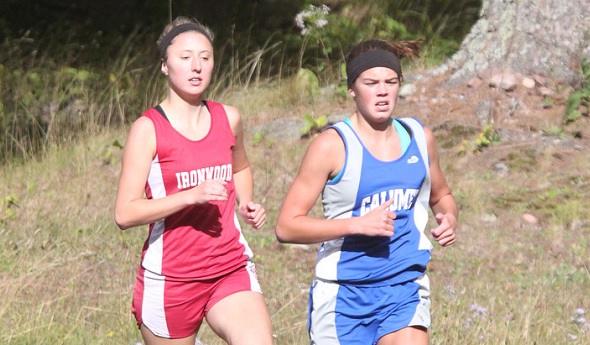
PHOTO: Calumet's Chelsea Jacques (right) won this season's Calumet Invitational with a time of 21:08.06, just ahead of Ironwood's Jessica Gering at 21:46.16. (Photo courtesy of Calumet athletic department.)
Search for Longest FG Starts in '50s
October 30, 2020
By Ron Pesch
Special for Second Half
Rob LaMielle’s first attempted field goal was a memorable one, and frankly, a bit amazing.
For starters, his track record on extra points, at least to that point in the season, was less than stellar. Flint Holy Redeemer entered their third game of the 1963 slate with a 1-1 record. The Flyers were defeated by Bad Axe in Week 1, then trounced Imlay City the next week. The senior had been successful on only 3 of 9 extra-point placements on the year.
“You had to bring that up,” said LaMielle over 55 years later, laughing at the statistic. “That’s probably so. Bad Axe was rated No. 1 in the state in Class ‘B.’ We were a ‘C’ school. They beat us 13-12 that night, because I missed two extra points. They scored in the very last couple minutes.”
The fact that his field goal was on the mark is all the more impressive considering it traveled 50 yards, clearing the crossbar by three feet, according to observers. Even more remarkable, it was a mere three yards shy of Lou ‘The Toe’ Groza’s best effort for the National Football League’s Cleveland Browns, and just six yards short of the NFL record, set by Bert Rechichar of the Baltimore Colts in 1953. Rechichar held the mark until it was famously topped by New Orleans Saints kicker Tom Dempsey in 1970 against the Detroit Lions.
“We practiced behind our football field,” said LaMielle, recalling how he got the job. “Behind our football field was two baseball fields with a backstop at each end. Well the coach lined everybody up on second base and said, ‘OK, we’re going to find out who can kick a field goal.’ So we started kicking the ball over the backstop. One of the times I kicked it, and it went a long ways.”
St. Redeemer’s coach Dick Clark stopped the drill and named LaMielle the team’s kicker.
“Before my senior year, I’d never kicked off, never attempted an extra point.”
At the time, the 220-pound LaMielle, who, like Groza, played tackle, was asked if he was surprised by the success of his kick.
“I was more surprised Coach Clark asked me to try it,” he said.
The field goal helped Flint Holy Redeemer top Bay City St. James, 29-6.
It also prompted another question from sports reporters. Was LaMielle’s kick a Michigan high school record?
The Search
The publicity surrounding the kick sent sportswriters around the state scurrying for the archives.
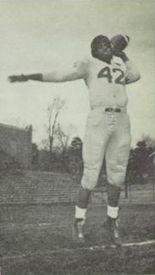 Initial inquiries indicated that Jim Yore of Battle Creek Central held the state mark, with a 56-yard field goal about 10 years prior, but a recheck of records by Dick Kishpaugh, “sports publicity director at Kalamazoo College and a close observer of Michigan prep football records,” indicated that Yore’s longest had been a 38-yard field goal, kicked on the last play of the game to beat Ypsilanti 3-0 on Oct. 3, 1952. It was thought to be the longest in state history.
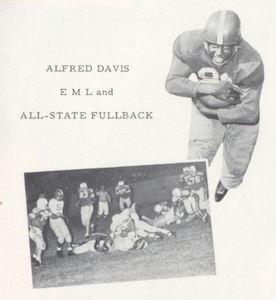
Additional digging found that Port Huron High School’s Alfred Davis, a 212-pound fullback, had drilled a flawless 46-yard field goal in a 19-14 win over Hazel Park in 1953.
“The word ‘tremendous’ is probably one of the most overused words in sports lexicon,” wrote Port Huron Times reporter Fred J. Vincent, “but it should be used in describing this kick.”
Vincent called it “perfect, splitting the uprights and clearing the bar by about six feet.”
Impressively, Davis also had kicked a 36-yarder earlier in the contest. “Bob Boyd held on both kicks,” added the sportswriter. “Not since Oct. 8, 1930 had a Big Red player kicked a three pointer. Hank Ceasor did it then to best Ferndale, 3-0.”
Word came that Cheboygan Catholic’s Joe Poirier had kicked one “reported to have traveled at least 53 yards from the point of the kick to the goal posts” in a 10-0 victory over Alcona in 1957. Since the MHSAA didn’t keep records at the time, Kishpaugh added it to his listing of unofficial state records.
The Ironwood Daily Globe unearthed a nugget. While it wasn’t considered by Kishpaugh for his record book, it did bring back memories of changes seen in the game.
Ironwood’s John ‘Cutz’ Cavosie made a “tremendous boot on Oct. 10, 1925 in the final seconds of a game at Oliver Field here in which Ironwood swamped Menominee 41-0. Cavosie apparently was back to punt, but instead he dropkicked the ball squarely through the goal posts 55 yards away. He was in his senior year that fall and was captain of the team. He played a big role in the rout on Menominee by scoring on runs of 42, 51 and 67 yards.”
Record Toppled
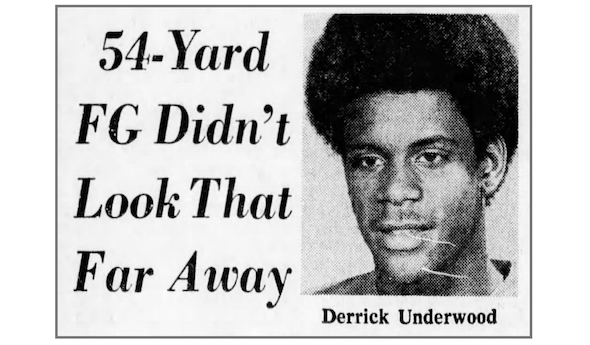
So it was quite the event when, nearly 19 years later, junior Derrick Underwood broke Poirier’s mark on a cold October Friday at Inkster.
A week earlier, Underwood had made his first field goal of the season, a 23-yard boot in overtime to give Ecorse its first victory of the year in five starts, 9-6, over River Rouge. This time, his kick gave Ecorse a 3-0 victory over the Vikings, although in decidedly less dramatic fashion as the kick came in the second quarter.
 “The strange thing is I didn’t even know that I was kicking it from the 44-yard line. To be honest, I wasn’t paying that much attention and it didn’t look that long,” Underwood told the Detroit Free Press in 1976. “But I got a real good snap on it and an excellent hold.
Red Raiders coach Patrick Kearney believed the kick would have been good from another five or 10 yards out.
“It felt good when I hit it,” added Underwood, “but because I was in front of the goal posts, I couldn’t tell whether it went over or under the crossbar. But I saw my teammates jumping up and down on the sidelines and I knew it made it.
“I was pretty loose because I figured that if I missed, we still had another half to come back and win it.”
Underwood’s accomplishment garnered national attention in the June/July ’77 issue of Joe Namath’s National Prep Sports magazine. At the time, Jerry Spicer of Hobart (Ind.) High School held the national record with a kick of 61 yards in 1975.
Exasperation to Jubilation
Underwood, who also served as the Red Raiders’ quarterback and defensive end, guided the team to Inkster’s one-foot line in that same game as the clock wound down. But with the lead, instead of pushing for the end zone, they let time expire.
A year earlier, in 1975, the Ecorse players watched their season disappear after a single game.
“The school millage was defeated just prior to the start of that season,” said Underwood, recalling his high school days some 45 years later. “I was the starting QB for the Red Raiders through my senior year ('78). We were heartbroken that our season was over after the first game against Muskegon Heights. No energy for that game.
“We were foaming at the mouth to be playing organized football. Some of us played flag football to stay active.”
“I was just practicing holding for a teammate,” Underwood had told the Free Press back in October 1976. “Eventually I thought I’d try and I got to be pretty good at it.”
“I didn’t take kicking seriously at all,” he states now. “I wasn’t a dedicated kicker. My stars were aligned in my head as being the next Thomas Lott.”
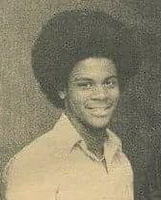 Lott, a Parade All-American out of San Antonio, Texas, played quarterback at Oklahoma, where his coach, the legendary Barry Switzer, once called him the greatest wishbone quarterback in Oklahoma history.
“Went down to Tennessee State University and found out how much football I didn’t know,” Underwood said.
Reminiscing he added, “Looking back, wouldn’t change a thing growing up in Ecorse.”
Equaled, then Topped – in the Same Game
Underwood’s mark would hold in Michigan until 1979, when junior Harold Moore of Dearborn equaled, then topped the mark in a season-ending game against Plymouth Canton.
Moore, a left-footed, straight-on kicking specialist, matched Underwood’s record with a 54-yard boot in the game’s first half, and then topped the record with a 55-yard field goal during the second half.
“I’ve never seen anyone with the leg power he has,” said his coach, Dick Ryan. “His 55-yard field goal cleared the bar with 20 feet to spare.”
Over the next two seasons, three players – Mike Prindle of Grand Rapids Union (1980), Bob Hirschman from Sterling Heights Ford (1980), and Dave Blackmer of Farmington Hills Harrison (1981) – would match Moore’s longest kick.
Since then, only five players have matched or exceeded 55 yards. John Langeloh of Utica shattered the mark in 1985 with a 58 yarder. Doug Kochanski of Warren Woods-Tower is the state’s current record holder, with a kick in 1994 that traveled 59 yards before splitting the uprights. The successful kick came in his final high school contest.
In these days of more and more specialization, one wonders, will Michigan ever see one of 60 yards or more?
 Ron Pesch has taken an active role in researching the history of MHSAA events since 1985 and began writing for MHSAA Finals programs in 1986, adding additional features and "flashbacks" in 1992. He inherited the title of MHSAA historian from the late Dick Kishpaugh following the 1993-94 school year, and resides in Muskegon. Contact him at [email protected] with ideas for historical articles.
PHOTOS: (Top) The Detroit Free Press told the story behind Derrick Underwood’s record field goal for Ecorse in its Oct. 30, 1976 edition. (2) Battle Creek Central’s Jim Yore was one of the earliest record holders for longest field goal in Michigan high school history. (3) Alfred Davis also was a standout fullback for Port Huron. (4) Underwood also played quarterback and defensive end for the Red Raiders. (Photos gathered by Ron Pesch.)