

Calumet Invite Produces Northern Stars
September 18, 2013
By Geoff Kimmerly
Second Half editor
The Calumet Invitational dates back roughly 30 years as an annual staple of the cross country schedule for schools at the northernmost tip of Michigan's Upper Peninsula.
A creative move by the Copper Kings last year added some statewide prestige to the event.
 Last week, for the second season, Calumet ran the series of races at Keweenaw Mountain Lodge, a resort near Copper Harbor and the northern bank of the Keweenaw Peninsula.
Calumet is the northernmost high school in Michigan. And moving this race another 35 miles northeast more or less guaranteed it's the northernmost event run in the state.
"We figured it was pretty safe. We're the northernmost school in the state, and you can only go four more miles and you're in Lake Superior," Calumet athletic director Sean Jacques said. "Nobody else is going to do anything more north than that."
A total of 10 schools were represented this fall in the races for boys and girls varsity, junior varsity and middle schoolers.
Jacques said the event formerly was run at a golf course in Calumet. But a few years ago, Calumet graduate and former Copper Kings cross country runner Dan Harri moved home from Florida to become general manager at the Mountain Lodge (he's also a renowned chef and has owned restaurants in Miami with Hall of Fame Dolphins coach Don Shula).
Harri had asked a few times about bringing a cross country or golf event to the lodge. Jacques told him last year they'd give it a try, so Harri set up a course that includes golf course, a couple of bridges, trails and finishes with a climb on the No. 1 fairway. It also provides various points for fans to watch runners go by, not always available on other courses.
"We were looking for a little bit of a change, and it's a beautiful course," Jacques said. "We thought if people were willing to make the extra drive, it would be really nice."
Calumet won the boys race this season, just ahead of runner-up Houghton. Houghton's girls were victorious, followed by the host Copper Kings.
Click to read more about this year's event from the Houghton Mining Gazette.
Michigan's claim to an NFL evolution
As part of its NFL preview this month, Sports Illustrated reported on one of the most significant developments for offenses over the last few decades – the silent snap count, which is used regularly by visiting teams because offensive linemen can’t hear the quarterback calling for the ball over the clamor of the home crowd.
And the article explained that the silent snap count might’ve gotten its start at one of Michigan’s smallest high schools – Flint’s Michigan School for the Deaf.
Offensive linemen during the 1980s were feasted on by pass rushers like Lawrence Taylor and Bruce Smith, who built record sack totals by blasting past blockers who seemed a step slow. Turns out, that was true. Defensive players were getting an edge by attacking as soon as they saw the ball move. But blockers (especially offensive tackles), focused instead on the defensive ends and linebackers lined up across from them, and didn’t have the luxury of watching the ball – and since they also couldn’t hear the snap count, started each play a step behind.
Enter the silent count. The quarterback signals to the center that he is ready to receive the ball (with a pat on the back, by raising a foot, etc.). The center then raises his head, and after a predetermined count of at least one second snaps the ball without a sound. This means an offensive tackle doesn’t have to listen for a snap count – he just counts after seeing the center get set.
The SI report recognized longtime offensive line coach Howard Mudd as the guru of the silent snap count. But Mudd recalled a conversation he’d had while working for the Seattle Seahawks with another coach, the late Andy MacDonald, who also had coached early in his career at a school for the deaf in Michigan.
The article doesn’t mention Michigan School for the Deaf by name. But it seems to make sense that the Tartars were the first to use the now-revolutionary count. MacDonald – who played at Central Michigan University and went on to coach at Michigan State and four other colleges and also for the Buffalo Bills – grew up in Flint and attended Flint Northern before playing for the Chippewas from 1950-53. The historical web site Michigan-football.com has results for Flint’s Michigan School for the Deaf dating to 1950, making it a decent assumption that MacDonald might’ve gotten in a little early coaching experience at the school down the road from his home.
Click for the SI story and go to page 4 for the mention of Michigan’s school.
Michigan mourns trooper, running standout
The law enforcement community is mourning the death of Michigan State Police trooper Paul Butterfield, who was shot Sept. 9 during a traffic stop in Mason County. He also was a well-known distance runner during the 1980s and the MHSAA Class A cross country champion running for Bridgeport in 1987.
According to a Ludington Daily News report, Butterfield continued running after high school at the University of Tennessee, and also competed at the 1989 Pan American Junior Games in Argentina.
Butterfield was stationed in Hart after previously serving in Manistee, and lived in Mason County. He also had served in the U.S. Army. Click to read more from the Ludington Daily News.
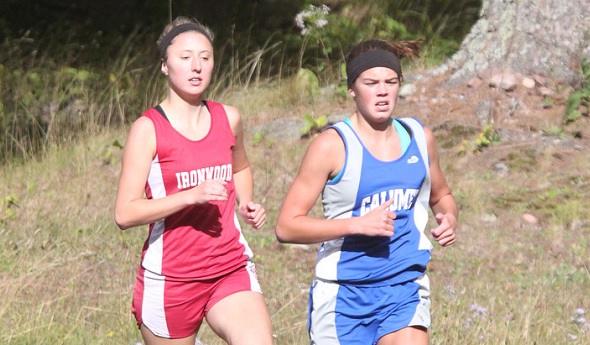
PHOTO: Calumet's Chelsea Jacques (right) won this season's Calumet Invitational with a time of 21:08.06, just ahead of Ironwood's Jessica Gering at 21:46.16. (Photo courtesy of Calumet athletic department.)

Cranes' Team Effort Pays Off in Title Tie-Breaker
October 16, 2020
By Jarred Chrapek
Special for Second Half
HOLLAND – To regain the Lower Peninsula Division 3 boys tennis title, Bloomfield Hills Cranbrook Kingswood knew every point would matter.
That laser-focused approach proved to be spot on as the Cranes outlasted reigning champion Ann Arbor Greenhills to capture this season’s championship at Holland Christian.
The two teams split the eight matches in the final 4-4, with the tie-breaker total sets won. Cranbrook Kingswood had one more set to its advantage.
And not just every set, but every game could've carried additional significance. Had the teams tied for number of sets won, the Cranes also would've won the next tie-breaker – most games won within those sets.
“We knew it was going to be close,” said Cranbrook Kingswood coach Steve Herdoiza. “We knew that every point mattered, especially with this format.”
Unlike previous years, where the team champion was determined by how many matches individual players won during bracketed flight play, this year’s format was a pure team, head-to-head dual as the COVID-19 virus changed the way not only the tennis season was run but the way the MHSAA Tournament was set up.
This year’s title came down to a rematch between the two powers in Division 3 the past several years. Cranbrook Kingswood had won four straight Finals titles before Ann Arbor Greenhills snapped the streak last year. The two teams met three times this fall, tying 4-4 each time with Cranbrook winning twice on tie-breakers and Greenhills winning by tie-breaker the other time.
“Both teams knew it was likely to come down to total games won, or maybe sets. Cranbrook was deeper and won the lower flights by decisive margins, while Greenhills was stronger at the top, winning those matches,” Greenhills coach Eric Gajar said. “In the new format, it still came down to a total team effort, and Cranbrook was better (Friday) – they deserved to win. We will learn from it, and be stronger for having come through it. I know it will motivate the players to work hard this offseason, and they will come back ready for another shot."
This time, Cranbrook Kingswood junior Patrick Tiwari helped provide the tie-breaking set as he pushed his No. 2 singles match to three despite falling 7-5, 3-6, 6-3.
Tiwari, however, did his part for the team as he won the middle set in what was the final match of the day that ended just as darkness was falling on the courts.
“(The same opponent) defeated me pretty good in two sets earlier this season,” Tiwari said. “It felt good to win that second set and help to clinch the title. Winning that set to clinch the title for us was one of the best feelings I’ve ever had. The whole season was definitely weird, and to regain the state title was a great feeling.”
Just minutes before Tiwari’s match concluded, Cranbrook Kingswood senior Geoffrey Qin won his at No. 4 singles to give the Cranes their fourth victory of the dual. For the undefeated Qin, the victory was part of a total-team effort that started even before the season began.
“Winning this state title required so much effort by everyone,” Qin said. “It started back in August when we had COVID cases at our school. Not only did we have to work hard on our tennis and our conditioning, but we had to be diligent with the virus and practice good social distancing.”
The team also had to remain focused on preparing for every match, as lessons learned while coming up short at last year’s Final proved valuable this time around.
 “We had some guys cramp up at last year’s state finals including myself,” Qin said. “We had to make sure that we kept hydrated and did proper stretching before matches this year to prevent cramping up. You learn lessons from defeat that you don’t learn by winning. That was an important lesson we learned last year, and I don’t think we would’ve won this year’s state title without learning those lessons.”
Qin and fellow team captains Dhilan Nagaraju and Enzo Martella provided Cranbrook Kingswood with strong leadership the entire season.
“We had four seniors this year and some very good leadership from our captains,” Herdoiza said. “We also had some freshmen step up along with some sophomores and juniors.
“We knew it was going to be a battle with Greenhills. We are two evenly-matched teams, and it came down to one set. Today we just took advantage of the opportunities given to us.”
Cranbrook Kingswood received some strong efforts from its doubles teams. The Cranes won three of the four doubles matches, led by the No. 2 pair Martella and Theo Taubman, who claimed a 7-5, 6-1 win.
“Our team goal was to peak for states,” Martella said. “This was a really difficult season with the COVID and everything, but we just kept getting better every week.”
The total team effort proved to be the key for Cranbrook Kingswood in the end.
“Everyone on the team played very well the entire tournament, especially at the end,” Nagaraju said. “Patrick at two singles exceeded expectations. We just kept on battling this year and overcoming numerous setbacks. We developed into a real team, and that was the difference. We just trusted the process.”
Cranbrook Kingswood claimed wins at No. 3 and No. 4 doubles. Sebs Taubman and Jacob Coburn picked up a 6-3, 6-2 win at No. 3 doubles, while Caden Che and Andrew Fink won at No. 4 by a score of 6-0, 6-0.
Greenhills claimed the No. 1 doubles match with Joey Formicola and Thomas Zeng winning 6-1, 6-3.
Greenhills also won three singles matches. Mert Oral claimed a 6-1, 6-0 win at No. 1 singles. Sophomore Rishi Verma won at No. 3 by a score of 7-6(6), 6-1.
“I was particularly pleased with my top three singles players – all of whom won their matches in the final. Between them, they had only one loss all season long despite a brutal schedule against top competition,” Gajar said. “My one doubles team had a great tournament, including avenging a regular-season loss in the semifinal round, then played lights out in the finals, defeating a solid team.
“There are lots of teams that would have loved to be in our position and playing for a title in their last match. We did well to get there and came up just short. I am proud of how my guys competed and handled themselves. Of course, we were thrilled to have had a season at all; that wasn't always a sure thing. Hard to believe it's over.”
PHOTOS: (Top) Patrick Tiwari of Bloomfield Hills Cranbrook Kingswood returns a shot during his No. 2 singles match against Ann Arbor Greenhills. (Middle) Greenhills’ Mert Oral returns a volley at No. 1 singles. (Click to see more from HighSchoolSportsScene.com.)