

Calumet Invite Produces Northern Stars
September 18, 2013
By Geoff Kimmerly
Second Half editor
The Calumet Invitational dates back roughly 30 years as an annual staple of the cross country schedule for schools at the northernmost tip of Michigan's Upper Peninsula.
A creative move by the Copper Kings last year added some statewide prestige to the event.
 Last week, for the second season, Calumet ran the series of races at Keweenaw Mountain Lodge, a resort near Copper Harbor and the northern bank of the Keweenaw Peninsula.
Calumet is the northernmost high school in Michigan. And moving this race another 35 miles northeast more or less guaranteed it's the northernmost event run in the state.
"We figured it was pretty safe. We're the northernmost school in the state, and you can only go four more miles and you're in Lake Superior," Calumet athletic director Sean Jacques said. "Nobody else is going to do anything more north than that."
A total of 10 schools were represented this fall in the races for boys and girls varsity, junior varsity and middle schoolers.
Jacques said the event formerly was run at a golf course in Calumet. But a few years ago, Calumet graduate and former Copper Kings cross country runner Dan Harri moved home from Florida to become general manager at the Mountain Lodge (he's also a renowned chef and has owned restaurants in Miami with Hall of Fame Dolphins coach Don Shula).
Harri had asked a few times about bringing a cross country or golf event to the lodge. Jacques told him last year they'd give it a try, so Harri set up a course that includes golf course, a couple of bridges, trails and finishes with a climb on the No. 1 fairway. It also provides various points for fans to watch runners go by, not always available on other courses.
"We were looking for a little bit of a change, and it's a beautiful course," Jacques said. "We thought if people were willing to make the extra drive, it would be really nice."
Calumet won the boys race this season, just ahead of runner-up Houghton. Houghton's girls were victorious, followed by the host Copper Kings.
Click to read more about this year's event from the Houghton Mining Gazette.
Michigan's claim to an NFL evolution
As part of its NFL preview this month, Sports Illustrated reported on one of the most significant developments for offenses over the last few decades – the silent snap count, which is used regularly by visiting teams because offensive linemen can’t hear the quarterback calling for the ball over the clamor of the home crowd.
And the article explained that the silent snap count might’ve gotten its start at one of Michigan’s smallest high schools – Flint’s Michigan School for the Deaf.
Offensive linemen during the 1980s were feasted on by pass rushers like Lawrence Taylor and Bruce Smith, who built record sack totals by blasting past blockers who seemed a step slow. Turns out, that was true. Defensive players were getting an edge by attacking as soon as they saw the ball move. But blockers (especially offensive tackles), focused instead on the defensive ends and linebackers lined up across from them, and didn’t have the luxury of watching the ball – and since they also couldn’t hear the snap count, started each play a step behind.
Enter the silent count. The quarterback signals to the center that he is ready to receive the ball (with a pat on the back, by raising a foot, etc.). The center then raises his head, and after a predetermined count of at least one second snaps the ball without a sound. This means an offensive tackle doesn’t have to listen for a snap count – he just counts after seeing the center get set.
The SI report recognized longtime offensive line coach Howard Mudd as the guru of the silent snap count. But Mudd recalled a conversation he’d had while working for the Seattle Seahawks with another coach, the late Andy MacDonald, who also had coached early in his career at a school for the deaf in Michigan.
The article doesn’t mention Michigan School for the Deaf by name. But it seems to make sense that the Tartars were the first to use the now-revolutionary count. MacDonald – who played at Central Michigan University and went on to coach at Michigan State and four other colleges and also for the Buffalo Bills – grew up in Flint and attended Flint Northern before playing for the Chippewas from 1950-53. The historical web site Michigan-football.com has results for Flint’s Michigan School for the Deaf dating to 1950, making it a decent assumption that MacDonald might’ve gotten in a little early coaching experience at the school down the road from his home.
Click for the SI story and go to page 4 for the mention of Michigan’s school.
Michigan mourns trooper, running standout
The law enforcement community is mourning the death of Michigan State Police trooper Paul Butterfield, who was shot Sept. 9 during a traffic stop in Mason County. He also was a well-known distance runner during the 1980s and the MHSAA Class A cross country champion running for Bridgeport in 1987.
According to a Ludington Daily News report, Butterfield continued running after high school at the University of Tennessee, and also competed at the 1989 Pan American Junior Games in Argentina.
Butterfield was stationed in Hart after previously serving in Manistee, and lived in Mason County. He also had served in the U.S. Army. Click to read more from the Ludington Daily News.
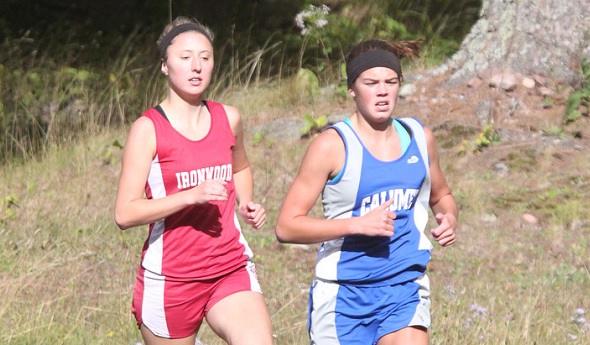
PHOTO: Calumet's Chelsea Jacques (right) won this season's Calumet Invitational with a time of 21:08.06, just ahead of Ironwood's Jessica Gering at 21:46.16. (Photo courtesy of Calumet athletic department.)

NFHS Voice: Participants Show Resilience
September 28, 2020
By Karissa Niehoff
NFHS Executive Director
The resiliency of players, coaches and leaders in high school activity programs the past seven months has been amazing. As attempts continue to offer all sports and performing arts this year, these individuals are making the most of tough times and demonstrating great resolve to change.
No doubt, high school juniors and seniors involved in high school sports and performing arts would have preferred a less turbulent end to their high school days, but many have been willing to go to great lengths to have an opportunity to participate.
In Michigan, when football was initially moved to the spring, student-athletes had two choices: be upset that their sport was postponed or seize the moment and look for new opportunities. Royce Daugherty of Watervliet High School chose the latter.
A 6-foot-3, 300-pound two-way starter last year as a freshman on the Watervliet football team, Daugherty opted to join the cross country team! He said he decided to run cross country because it would help him get tougher mentally and physically.
Daugherty’s decision was perhaps predictable given that he played four sports – football, wrestling, basketball and baseball – as a freshman. Although the switch was short-lived with Michigan reinstating football a couple of weeks ago, Daugherty’s resilience is remarkable and a good predictor of future success.
In Colorado, with football on hold this fall, members of the Limon High School two-time defending Class 1A state football championship team petitioned the school administration to resurrect the golf program.
“Sports are our lifeline,” said Andy Love, the school’s baseball coach who agreed to coach the golf team, in an article posted on CHSAANow. “Our community follows our sports so strongly. It gives our kids this great atmosphere and environment whether it’s the football field, the basketball court or whatever. Our community rallies around our kids.”
Turning a problem into an opportunity, the Limon High School football players and staff demonstrated the never-give-up spirit of high school activities.
In Kansas, with the heading of “the show must go on,” the Goodland High School athletic director and superintendent stepped in to coach the football team a few weeks ago because the head coach and assistant coach were quarantined during the week. The result? Goodland, a Class 3A school, defeated Liberal High School, a Class 5A school!
Coaches have demonstrated resiliency as well by finding new ways to conduct competition and keep students engaged. In Minnesota, at a swimming meet between Chaska High School and Bloomington Kennedy High School, Chaska swimmers occupied lanes 1 to 4, while Kennedy swimmers were in lanes 5 to 8 for social distancing purposes.
In the same state, the South Suburban Conference decided to conduct virtual swim meets this fall. Each team competes in 11 races in their own pool, and the coaches compare times to determine scoring. Two methods in the same state, both done to keep students engaged but to minimize risks of the virus.
On the performing arts side, teachers and leaders have benefited from an aerosol study conducted by the NFHS and more than 125 other organizations to determine best practices. In some cases, band and other music programs were moved to the spring, but leaders continued to engage with students in many innovative ways.
Larry Friend, assistant principal of Caesar Rodney High School in Camden, Delaware, in a Dover Post article, told his students, “This is not the time to put the instruments aside. This is not the time to stop singing. This is not the time to run away from your passion. This is an opportunity to run toward your passion and to find what it is that motivates you to reconnect.”
Band directors in Michigan – like those in many other states – are finding new ways to keep music going during the pandemic – from outdoor band camps to all-virtual rehearsals.
“We have some really incredible band directors doing some really neat things locally,” said Josh Bartz, director of bands at Portage Northern High School in an interview with WWMT-TV in Kalamazoo.
In the same interview, Chris Ludwa, assistant professor of music at Kalamazoo College, said, “I think you will always find ways to make art. Oftentimes, when in society there is deep need, deep pain, struggle, oppression – that’s the time when art flourishes.”
These are but a few of the great stories that have occurred across the country as players, coaches, administrators, officials, parents and fans are making the most of tough times. While these student participants may not become stellar athletes at the next level or excel at higher levels in the arts, their resiliency through these tough times will play a major role in their future success.
High school activity programs – building resilient people for the future of our nation.
Dr. Karissa L. Niehoff is starting her third year as executive director of the National Federation of State High School Associations (NFHS) in Indianapolis, Indiana. She is the first female to head the national leadership organization for high school athletics and performing arts activities and the sixth full-time executive director of the NFHS, which celebrated its 100th year of service during the 2018-19 school year. She previously was executive director of the Connecticut Association of Schools-Connecticut Interscholastic Athletic Conference for seven years.