


Calumet Invite Produces Northern Stars
September 18, 2013
By Geoff Kimmerly
Second Half editor
The Calumet Invitational dates back roughly 30 years as an annual staple of the cross country schedule for schools at the northernmost tip of Michigan's Upper Peninsula.
A creative move by the Copper Kings last year added some statewide prestige to the event.
 Last week, for the second season, Calumet ran the series of races at Keweenaw Mountain Lodge, a resort near Copper Harbor and the northern bank of the Keweenaw Peninsula.
Calumet is the northernmost high school in Michigan. And moving this race another 35 miles northeast more or less guaranteed it's the northernmost event run in the state.
"We figured it was pretty safe. We're the northernmost school in the state, and you can only go four more miles and you're in Lake Superior," Calumet athletic director Sean Jacques said. "Nobody else is going to do anything more north than that."
A total of 10 schools were represented this fall in the races for boys and girls varsity, junior varsity and middle schoolers.
Jacques said the event formerly was run at a golf course in Calumet. But a few years ago, Calumet graduate and former Copper Kings cross country runner Dan Harri moved home from Florida to become general manager at the Mountain Lodge (he's also a renowned chef and has owned restaurants in Miami with Hall of Fame Dolphins coach Don Shula).
Harri had asked a few times about bringing a cross country or golf event to the lodge. Jacques told him last year they'd give it a try, so Harri set up a course that includes golf course, a couple of bridges, trails and finishes with a climb on the No. 1 fairway. It also provides various points for fans to watch runners go by, not always available on other courses.
"We were looking for a little bit of a change, and it's a beautiful course," Jacques said. "We thought if people were willing to make the extra drive, it would be really nice."
Calumet won the boys race this season, just ahead of runner-up Houghton. Houghton's girls were victorious, followed by the host Copper Kings.
Click to read more about this year's event from the Houghton Mining Gazette.
Michigan's claim to an NFL evolution
As part of its NFL preview this month, Sports Illustrated reported on one of the most significant developments for offenses over the last few decades – the silent snap count, which is used regularly by visiting teams because offensive linemen can’t hear the quarterback calling for the ball over the clamor of the home crowd.
And the article explained that the silent snap count might’ve gotten its start at one of Michigan’s smallest high schools – Flint’s Michigan School for the Deaf.
Offensive linemen during the 1980s were feasted on by pass rushers like Lawrence Taylor and Bruce Smith, who built record sack totals by blasting past blockers who seemed a step slow. Turns out, that was true. Defensive players were getting an edge by attacking as soon as they saw the ball move. But blockers (especially offensive tackles), focused instead on the defensive ends and linebackers lined up across from them, and didn’t have the luxury of watching the ball – and since they also couldn’t hear the snap count, started each play a step behind.
Enter the silent count. The quarterback signals to the center that he is ready to receive the ball (with a pat on the back, by raising a foot, etc.). The center then raises his head, and after a predetermined count of at least one second snaps the ball without a sound. This means an offensive tackle doesn’t have to listen for a snap count – he just counts after seeing the center get set.
The SI report recognized longtime offensive line coach Howard Mudd as the guru of the silent snap count. But Mudd recalled a conversation he’d had while working for the Seattle Seahawks with another coach, the late Andy MacDonald, who also had coached early in his career at a school for the deaf in Michigan.
The article doesn’t mention Michigan School for the Deaf by name. But it seems to make sense that the Tartars were the first to use the now-revolutionary count. MacDonald – who played at Central Michigan University and went on to coach at Michigan State and four other colleges and also for the Buffalo Bills – grew up in Flint and attended Flint Northern before playing for the Chippewas from 1950-53. The historical web site Michigan-football.com has results for Flint’s Michigan School for the Deaf dating to 1950, making it a decent assumption that MacDonald might’ve gotten in a little early coaching experience at the school down the road from his home.
Click for the SI story and go to page 4 for the mention of Michigan’s school.
Michigan mourns trooper, running standout
The law enforcement community is mourning the death of Michigan State Police trooper Paul Butterfield, who was shot Sept. 9 during a traffic stop in Mason County. He also was a well-known distance runner during the 1980s and the MHSAA Class A cross country champion running for Bridgeport in 1987.
According to a Ludington Daily News report, Butterfield continued running after high school at the University of Tennessee, and also competed at the 1989 Pan American Junior Games in Argentina.
Butterfield was stationed in Hart after previously serving in Manistee, and lived in Mason County. He also had served in the U.S. Army. Click to read more from the Ludington Daily News.
PHOTO: Calumet's Chelsea Jacques (right) won this season's Calumet Invitational with a time of 21:08.06, just ahead of Ironwood's Jessica Gering at 21:46.16. (Photo courtesy of Calumet athletic department.)
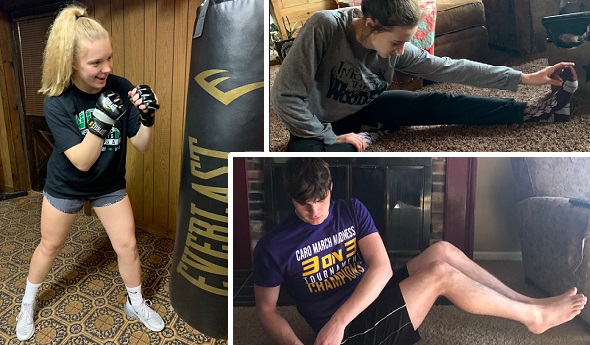
Adjust Your Workout When Gym Isn't Option
April 6, 2020

Henry Ford Health System
Feeling at a loss about not being able to stick to your normal workout routine? You’re not alone.
Social distancing during the COVID-19 outbreak has resulted in people all over the world having to adjust their schedules to accommodate working from home, schooling and caring for kids, and finding ways to maintain as much of a “normal” schedule as possible.
As a result, many people are struggling to figure out how to get a good workout in without the help of gym equipment or a personal trainer.
“Anxiety over the current situation can add to a lack of motivation to work out,” says Brianna Gauna, an athletic trainer for Henry Ford Health System. “But just remember how beneficial it is to move your body, even if it is just around the house.”
How a Routine Change Affects Your Body
If you are used to working out every day or going hard at the gym on a regular basis, a short rest period from your routine might have its advantages.
“Taking time to rest can actually be a really good thing because it allows your body to recover,” says Gauna. “You might even start to see more muscle tone set in as you give your body a break.”
On the other hand, if you usually work out a few times throughout the week and suddenly stop, the results may cause negative effects. You may experience:
- Increased resting heart rate
- Less energy
- Change in mood or emotions
- Loss of sleep
How to Work Out at Home
Being stuck at home is not an excuse to skip a daily workout. Everyone works out a little differently, and there are plenty of options for you to stay active and try out new forms of exercise.
“Whether you are used to strength training or cardio, think about what your fitness goals are and choose activities based on what you’d like to achieve,” says Gauna.
Here are some ideas to keep you and your family active:
1. Yoga. Practicing yoga requires a great deal of muscle strength and balance. It is best for a full body workout. Look to YouTube or free apps on your phone for beginner workout videos that you can follow along.
2. HIIT workouts. These workouts are best for getting your heart pumping and increasing your stamina. Try choosing four exercises from the following list. (Search YouTube or Google for examples if you are not sure what each of these entails.) Do one exercise at a time for 30 seconds and then give yourself 20 seconds of rest before moving on to the next exercise. After you get through one rotation of those exercises, repeat three more times.
- Squats
- Push-ups
- Lunges
- Burpees
- Mountain climbers
- Glute bridges
3. Running or walking. Many apps allow you to track your run on a map, so you can plan out your route in your own neighborhood. This allows you to adjust how far you run or how much time you have for a run. A brisk walk through the neighborhood also works.
4. Biking. Biking is a great low-impact workout that works to engage and tone leg muscles. (Remember to wear a helmet!)
5. Team sports. If you are looking for something to engage you and your family, team sports are the way to go. Kick a soccer ball around, try to race through an obstacle course while dribbling a basketball or take turns throwing a football. If you don’t have the equipment, try playing keep-away with a stuffed animal or set up a relay race.
Exercise by Age and Fitness Level
The younger you are, chances are you have a faster metabolism. If you can’t get to a gym, think about how active you usually are and gauge the length of your workout from there.
If you are using this time to get started on your fitness journey, use these recommendations as a starting point:
Ages 7-17: 1-2 hours. Athletes that are used to going to weekly practices may find that two-hour workouts are more suitable.
Ages 18-30: About an hour. Look for times throughout the day that you can squeeze in workouts. Maybe you do yoga in the morning, a HIIT workout in the afternoon and a walk after dinner.
Ages 31-49: About a half hour. If you have children or a pet, you may find that you are already spending more time being active than this!
Ages 50 and up: At least 10-15 minutes. Gauge this based on your own abilities. You may live a more active lifestyle that allows you to be very active throughout the day. If you find yourself struggling to meet this mark, consider a walk during the day or stretches in the morning.
Once you get a regular fitness routine in place, work your way up to longer or more intense workouts to keep yourself challenged.
Making Your Own Equipment
If you have a treadmill, stationary bike or elliptical machine at home, now is the time to clear off the laundry it may have been collecting. If you don’t have access to weights or other gym equipment, though, that doesn’t mean you have to miss out on a quality workout. Look for things around your house that you can use in their place – get creative!
- Bags of beans, rice or pet food as added weight for squats or lunges
- Old books/textbooks as dumbbells
- A chair for triceps dips, calf raises or for stability during yoga
- Stairs to run sprints or to help you stretch out leg muscles
When your day-to-day routine is shaken up, do what you can to create normalcy in your life. If you find you have more free time throughout the day, take that time to get moving – even if it’s running up and down the stairs or going for a walk around the block.
“Don’t worry about feeling silly for switching up your routine,” adds Gauna. “Whether that’s using a random object for added weight during a workout or trying to remember how to ride a bike again on your street, think about yourself and your fitness goals first. Don’t let thoughts of what other people think of you get in the way of you reaching your goals!”
Want to learn more? Henry Ford Health System sports medicine experts are treating the whole athlete, in a whole new way. From nutrition to neurology, and from injury prevention to treatment of sports-related conditions, they can give your athlete a unique game plan.
Visit henryford.com/sports or call (313) 972-4216 for an appointment within 24 business hours.
PHOTOS: (Clockwise from left) MHSAA Student Advisory Council members Abigail Pheiffer of Novi, Lydia Davenport of Ithaca and Trevin Phillips of Caro will be working to stay in shape while staying home these next many weeks.