

Calumet Invite Produces Northern Stars
September 18, 2013
By Geoff Kimmerly
Second Half editor
The Calumet Invitational dates back roughly 30 years as an annual staple of the cross country schedule for schools at the northernmost tip of Michigan's Upper Peninsula.
A creative move by the Copper Kings last year added some statewide prestige to the event.
 Last week, for the second season, Calumet ran the series of races at Keweenaw Mountain Lodge, a resort near Copper Harbor and the northern bank of the Keweenaw Peninsula.
Calumet is the northernmost high school in Michigan. And moving this race another 35 miles northeast more or less guaranteed it's the northernmost event run in the state.
"We figured it was pretty safe. We're the northernmost school in the state, and you can only go four more miles and you're in Lake Superior," Calumet athletic director Sean Jacques said. "Nobody else is going to do anything more north than that."
A total of 10 schools were represented this fall in the races for boys and girls varsity, junior varsity and middle schoolers.
Jacques said the event formerly was run at a golf course in Calumet. But a few years ago, Calumet graduate and former Copper Kings cross country runner Dan Harri moved home from Florida to become general manager at the Mountain Lodge (he's also a renowned chef and has owned restaurants in Miami with Hall of Fame Dolphins coach Don Shula).
Harri had asked a few times about bringing a cross country or golf event to the lodge. Jacques told him last year they'd give it a try, so Harri set up a course that includes golf course, a couple of bridges, trails and finishes with a climb on the No. 1 fairway. It also provides various points for fans to watch runners go by, not always available on other courses.
"We were looking for a little bit of a change, and it's a beautiful course," Jacques said. "We thought if people were willing to make the extra drive, it would be really nice."
Calumet won the boys race this season, just ahead of runner-up Houghton. Houghton's girls were victorious, followed by the host Copper Kings.
Click to read more about this year's event from the Houghton Mining Gazette.
Michigan's claim to an NFL evolution
As part of its NFL preview this month, Sports Illustrated reported on one of the most significant developments for offenses over the last few decades – the silent snap count, which is used regularly by visiting teams because offensive linemen can’t hear the quarterback calling for the ball over the clamor of the home crowd.
And the article explained that the silent snap count might’ve gotten its start at one of Michigan’s smallest high schools – Flint’s Michigan School for the Deaf.
Offensive linemen during the 1980s were feasted on by pass rushers like Lawrence Taylor and Bruce Smith, who built record sack totals by blasting past blockers who seemed a step slow. Turns out, that was true. Defensive players were getting an edge by attacking as soon as they saw the ball move. But blockers (especially offensive tackles), focused instead on the defensive ends and linebackers lined up across from them, and didn’t have the luxury of watching the ball – and since they also couldn’t hear the snap count, started each play a step behind.
Enter the silent count. The quarterback signals to the center that he is ready to receive the ball (with a pat on the back, by raising a foot, etc.). The center then raises his head, and after a predetermined count of at least one second snaps the ball without a sound. This means an offensive tackle doesn’t have to listen for a snap count – he just counts after seeing the center get set.
The SI report recognized longtime offensive line coach Howard Mudd as the guru of the silent snap count. But Mudd recalled a conversation he’d had while working for the Seattle Seahawks with another coach, the late Andy MacDonald, who also had coached early in his career at a school for the deaf in Michigan.
The article doesn’t mention Michigan School for the Deaf by name. But it seems to make sense that the Tartars were the first to use the now-revolutionary count. MacDonald – who played at Central Michigan University and went on to coach at Michigan State and four other colleges and also for the Buffalo Bills – grew up in Flint and attended Flint Northern before playing for the Chippewas from 1950-53. The historical web site Michigan-football.com has results for Flint’s Michigan School for the Deaf dating to 1950, making it a decent assumption that MacDonald might’ve gotten in a little early coaching experience at the school down the road from his home.
Click for the SI story and go to page 4 for the mention of Michigan’s school.
Michigan mourns trooper, running standout
The law enforcement community is mourning the death of Michigan State Police trooper Paul Butterfield, who was shot Sept. 9 during a traffic stop in Mason County. He also was a well-known distance runner during the 1980s and the MHSAA Class A cross country champion running for Bridgeport in 1987.
According to a Ludington Daily News report, Butterfield continued running after high school at the University of Tennessee, and also competed at the 1989 Pan American Junior Games in Argentina.
Butterfield was stationed in Hart after previously serving in Manistee, and lived in Mason County. He also had served in the U.S. Army. Click to read more from the Ludington Daily News.
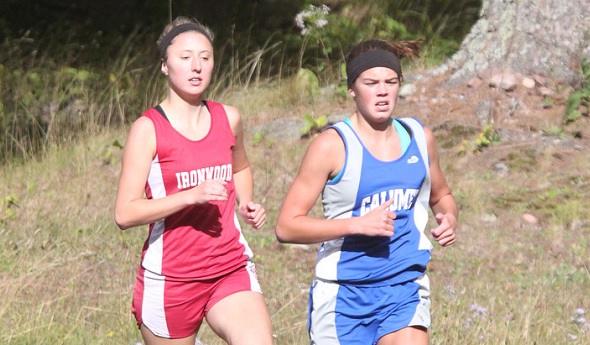
PHOTO: Calumet's Chelsea Jacques (right) won this season's Calumet Invitational with a time of 21:08.06, just ahead of Ironwood's Jessica Gering at 21:46.16. (Photo courtesy of Calumet athletic department.)

Comebacks Succeed for D1 Title Winners
By
Perry A. Farrell
Special for MHSAA.com
March 6, 2020
ALLEN PARK – Utica Eisenhower’s boys and Zeeland’s girls both went into the regular game portion of their Team Finals matches behind after the Baker round.
Both rallied and ended up claiming Division 1 championships Friday at Thunderbowl Lanes.
Eisenhower rallied from 34 pins down, taking advantage of splits by Salem in the 10th frame to win the crown by five pins, 1,454-1,449. Zeeland fell behind Jenison, the 2019 champion, but rallied in the regular games of the match to win 1,185-1,155 and claim its first Finals title.
“Just amazing,’’ said Zeeland coach Jeremey Baum. “We had shot an 1,119 early in the day, and the girls never gave up.”
“We fell behind, but we stayed positive,’’ senior Skylar Beverwyk added. “We knew we were going to get their best because they were the defending state champs.’’
Eagles senior Dylan Kelly struck out to finish with a 235 and secure his team’s title.
“Dylan has been there for us all year,’’ said Eisenhower coach John Snider. “He’s clutch for us. We got lucky. We had some things go our way in the 10th frame.
Said Kelly: “We kept our spirits up. It wasn’t over until it was over. It’s a special group. We bonded well. We pick each other up when we’re down.’’
Eisenhower fell behind after the first Baker game, losing 216-177, forcing the Eagles to play catchup.
They won the second Baker game, 198-193, but had 34 pins (409-375) to make up in the regular games.
Salem advanced to the championship match by eliminating Davison 1,419-1,243, while the Eagles dispatched of Farmington 1,314-1,160.
Salem had won titles in 2017 and 2013. Eisenhower had won a state championship in 2004 prior to the addition of the sport to the MHSAA lineup in 2006.
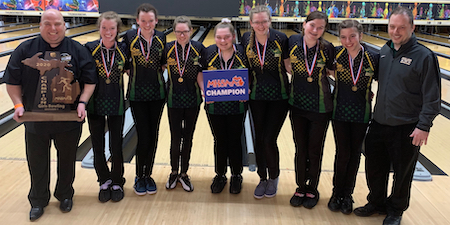 In the girls championship match, Jenison built a 63-pin lead after the first Baker game. Zeeland rallied in the second Baker game and headed into regular games trailing 355-325.
“It’s a grind, but the team kept its composure,’’ said Baum.
Perennial power Macomb Dakota was the boys’ top qualifier at 3,684, followed by Oxford (3,624) and fellow Macomb Area Conference Red opponent Eisenhower at 3,623.
Dakota’s run was short-lived as it fell to the eighth-seeded and always tough Davison 1,427-1,359. It was the first time in 16 years Davison had beaten Dakota, head-to-head or in tournament play. Second-seeded Oxford also fell in the quarterfinals, losing to Farmington 1,337-1,313.
Davison advanced to face Salem, which beat Livonia Franklin, 1,475-1,392, while Farmington faced Eisenhower in the other semifinal after Eisenhower had disposed of Swartz Creek, 1,553-1,149.
Zeeland advanced to the championship match by defeating Lake Orion, 1,280-1,194, while the reigning champion was dispatching New Baltimore Anchor Bay, 1,201-1,061.
In the girls’ qualifying round Monroe and Lapeer tied for eighth (3,013), resulting in a roll-off to determine which would face top qualifier Lake Orion (3,344). Lapeer won the tie-breaker, then fell to the Dragons 1,151-1,098.
Anchor Bay was the second seed at 3,184, and Jenison was third at 3,123. Jenison advanced over Westland John Glenn with a 1,415-1,381 victory to face Anchor Bay, which had beaten MAC rival St. Clair Shores Lakeshore 1,224-1,176.
In its quarterfinal, Zeeland opened some eyes with two bowlers shooting 253 and another 255 to set a school record with an 1,119 pin fall in the regular games portion of its match against Rockford. Zeeland advanced to the semifinals with a 1,484-1,232 romp.
Jenison defeated Anchor Bay by 140 pins, while Zeeland reached the final with an 86-pin victory.
Click for full girls results and boys results.