

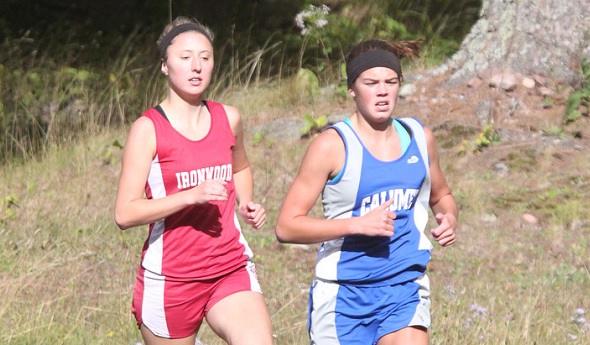
Calumet Invite Produces Northern Stars
September 18, 2013
By Geoff Kimmerly
Second Half editor
The Calumet Invitational dates back roughly 30 years as an annual staple of the cross country schedule for schools at the northernmost tip of Michigan's Upper Peninsula.
A creative move by the Copper Kings last year added some statewide prestige to the event.
 Last week, for the second season, Calumet ran the series of races at Keweenaw Mountain Lodge, a resort near Copper Harbor and the northern bank of the Keweenaw Peninsula.
Calumet is the northernmost high school in Michigan. And moving this race another 35 miles northeast more or less guaranteed it's the northernmost event run in the state.
"We figured it was pretty safe. We're the northernmost school in the state, and you can only go four more miles and you're in Lake Superior," Calumet athletic director Sean Jacques said. "Nobody else is going to do anything more north than that."
A total of 10 schools were represented this fall in the races for boys and girls varsity, junior varsity and middle schoolers.
Jacques said the event formerly was run at a golf course in Calumet. But a few years ago, Calumet graduate and former Copper Kings cross country runner Dan Harri moved home from Florida to become general manager at the Mountain Lodge (he's also a renowned chef and has owned restaurants in Miami with Hall of Fame Dolphins coach Don Shula).
Harri had asked a few times about bringing a cross country or golf event to the lodge. Jacques told him last year they'd give it a try, so Harri set up a course that includes golf course, a couple of bridges, trails and finishes with a climb on the No. 1 fairway. It also provides various points for fans to watch runners go by, not always available on other courses.
"We were looking for a little bit of a change, and it's a beautiful course," Jacques said. "We thought if people were willing to make the extra drive, it would be really nice."
Calumet won the boys race this season, just ahead of runner-up Houghton. Houghton's girls were victorious, followed by the host Copper Kings.
Click to read more about this year's event from the Houghton Mining Gazette.
Michigan's claim to an NFL evolution
As part of its NFL preview this month, Sports Illustrated reported on one of the most significant developments for offenses over the last few decades – the silent snap count, which is used regularly by visiting teams because offensive linemen can’t hear the quarterback calling for the ball over the clamor of the home crowd.
And the article explained that the silent snap count might’ve gotten its start at one of Michigan’s smallest high schools – Flint’s Michigan School for the Deaf.
Offensive linemen during the 1980s were feasted on by pass rushers like Lawrence Taylor and Bruce Smith, who built record sack totals by blasting past blockers who seemed a step slow. Turns out, that was true. Defensive players were getting an edge by attacking as soon as they saw the ball move. But blockers (especially offensive tackles), focused instead on the defensive ends and linebackers lined up across from them, and didn’t have the luxury of watching the ball – and since they also couldn’t hear the snap count, started each play a step behind.
Enter the silent count. The quarterback signals to the center that he is ready to receive the ball (with a pat on the back, by raising a foot, etc.). The center then raises his head, and after a predetermined count of at least one second snaps the ball without a sound. This means an offensive tackle doesn’t have to listen for a snap count – he just counts after seeing the center get set.
The SI report recognized longtime offensive line coach Howard Mudd as the guru of the silent snap count. But Mudd recalled a conversation he’d had while working for the Seattle Seahawks with another coach, the late Andy MacDonald, who also had coached early in his career at a school for the deaf in Michigan.
The article doesn’t mention Michigan School for the Deaf by name. But it seems to make sense that the Tartars were the first to use the now-revolutionary count. MacDonald – who played at Central Michigan University and went on to coach at Michigan State and four other colleges and also for the Buffalo Bills – grew up in Flint and attended Flint Northern before playing for the Chippewas from 1950-53. The historical web site Michigan-football.com has results for Flint’s Michigan School for the Deaf dating to 1950, making it a decent assumption that MacDonald might’ve gotten in a little early coaching experience at the school down the road from his home.
Click for the SI story and go to page 4 for the mention of Michigan’s school.
Michigan mourns trooper, running standout
The law enforcement community is mourning the death of Michigan State Police trooper Paul Butterfield, who was shot Sept. 9 during a traffic stop in Mason County. He also was a well-known distance runner during the 1980s and the MHSAA Class A cross country champion running for Bridgeport in 1987.
According to a Ludington Daily News report, Butterfield continued running after high school at the University of Tennessee, and also competed at the 1989 Pan American Junior Games in Argentina.
Butterfield was stationed in Hart after previously serving in Manistee, and lived in Mason County. He also had served in the U.S. Army. Click to read more from the Ludington Daily News.
PHOTO: Calumet's Chelsea Jacques (right) won this season's Calumet Invitational with a time of 21:08.06, just ahead of Ironwood's Jessica Gering at 21:46.16. (Photo courtesy of Calumet athletic department.)

NFHS Voice: March Madness Begins Again
March 4, 2020
By Karissa Niehoff
NFHS Executive Director
The calendar has turned to March, which in the world of high school sports can only mean one thing – Basketball. It is time for state tournaments, March Madness and, yes, the annual rhetoric about the merits of the shot clock.
For the almost one million boys and girls who participate in high school basketball, there is nothing quite like the state tournament. Although there are great memories from the one-class days, led by Carr Creek’s almost upset of powerhouse Ashland in Kentucky in 1928 and Milan’s Cinderella victory in Indiana in 1954, today, basketball provides more opportunities for girls and boys teams to be crowned state champion than any other sport.
This month, about 450 girls and boys teams will earn state basketball titles in championships conducted by NFHS member state associations. Multiple team champions are crowned for both boys and girls in all states but two, with the majority of states sponsoring tournaments in 4-6 classifications for each, and four states conducting state championships in seven classes.
That is truly March Madness, which is appropriate since the term was first used in connection with high school basketball. Although the tag line became familiar to millions on a national scale in relation to the NCAA Division I Men’s Basketball Championship, the NCAA shares a dual-use trademark with the Illinois High School Association (IHSA), thanks to H. V. Porter, the first full-time executive director of the NFHS.
In his final year as IHSA executive director in 1939, Porter published his “March Madness” essay in reference to the mania surrounding the IHSA’s annual state basketball tournament. Eight years later, in a 1947 Associated Press article, Porter said, “Naturally, we think basketball has done a lot for high school kids, but it’s done something for the older people, too. It has made community life in general a lot more fun each winter.”
While many things have changed in the past 73 years, the value of high school sports – and especially state basketball tournaments – remains as strong as ever today. In some states, seemingly the entire community will travel to the site of the state tournament in support of the high school team.
As a footnote to the use of March Madness, Scott Johnson – recently retired assistant executive director of the IHSA in his book “Association Work” – discovered through research that the first recorded mention of March Madness in relation to basketball occurred in 1931 by Bob Stranahan, sports editor of the New Castle Courier-Times in Indiana.
While the sport remains strong and March Madness is set to begin in earnest across the nation, there is a belief by some that the addition of a shot clock would make the game even better.
Although there are some arguments for implementing the shot clock, the
NFHS Basketball Rules Committee, similar to the other 14 NFHS rules committees, must make decisions based on what is best for the masses – the small schools with less than 100 students as well as large urban schools with 3,000-plus students. Rules changes will always be made with considerations for minimizing risks, containing costs and developing rules that are best for high school athletes.
Nine of our member state associations have elected to use a shot clock in their states, which certainly adds to the clamor for its implementation nationally. And, we at the NFHS have read the headlines, seen the social media posts and received the phone calls advocating for the shot clock’s adoption. However, the Basketball Rules Committee will continue to assess the shot clock based on the aforementioned considerations, as well its members representing all areas of the country.
We encourage everyone to support their local high school teams by attending this year’s exciting state basketball tournaments.
Dr. Karissa L. Niehoff is in her second year as executive director of the National Federation of State High School Associations (NFHS) in Indianapolis, Indiana. She is the first female to head the national leadership organization for high school athletics and performing arts activities and the sixth full-time executive director of the NFHS, which celebrated its 100th year of service during the 2018-19 school year. She previously was executive director of the Connecticut Association of Schools-Connecticut Interscholastic Athletic Conference for seven years.