

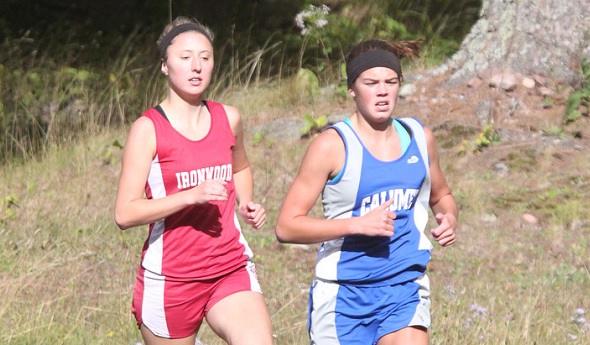
Calumet Invite Produces Northern Stars
September 18, 2013
By Geoff Kimmerly
Second Half editor
The Calumet Invitational dates back roughly 30 years as an annual staple of the cross country schedule for schools at the northernmost tip of Michigan's Upper Peninsula.
A creative move by the Copper Kings last year added some statewide prestige to the event.
 Last week, for the second season, Calumet ran the series of races at Keweenaw Mountain Lodge, a resort near Copper Harbor and the northern bank of the Keweenaw Peninsula.
Calumet is the northernmost high school in Michigan. And moving this race another 35 miles northeast more or less guaranteed it's the northernmost event run in the state.
"We figured it was pretty safe. We're the northernmost school in the state, and you can only go four more miles and you're in Lake Superior," Calumet athletic director Sean Jacques said. "Nobody else is going to do anything more north than that."
A total of 10 schools were represented this fall in the races for boys and girls varsity, junior varsity and middle schoolers.
Jacques said the event formerly was run at a golf course in Calumet. But a few years ago, Calumet graduate and former Copper Kings cross country runner Dan Harri moved home from Florida to become general manager at the Mountain Lodge (he's also a renowned chef and has owned restaurants in Miami with Hall of Fame Dolphins coach Don Shula).
Harri had asked a few times about bringing a cross country or golf event to the lodge. Jacques told him last year they'd give it a try, so Harri set up a course that includes golf course, a couple of bridges, trails and finishes with a climb on the No. 1 fairway. It also provides various points for fans to watch runners go by, not always available on other courses.
"We were looking for a little bit of a change, and it's a beautiful course," Jacques said. "We thought if people were willing to make the extra drive, it would be really nice."
Calumet won the boys race this season, just ahead of runner-up Houghton. Houghton's girls were victorious, followed by the host Copper Kings.
Click to read more about this year's event from the Houghton Mining Gazette.
Michigan's claim to an NFL evolution
As part of its NFL preview this month, Sports Illustrated reported on one of the most significant developments for offenses over the last few decades – the silent snap count, which is used regularly by visiting teams because offensive linemen can’t hear the quarterback calling for the ball over the clamor of the home crowd.
And the article explained that the silent snap count might’ve gotten its start at one of Michigan’s smallest high schools – Flint’s Michigan School for the Deaf.
Offensive linemen during the 1980s were feasted on by pass rushers like Lawrence Taylor and Bruce Smith, who built record sack totals by blasting past blockers who seemed a step slow. Turns out, that was true. Defensive players were getting an edge by attacking as soon as they saw the ball move. But blockers (especially offensive tackles), focused instead on the defensive ends and linebackers lined up across from them, and didn’t have the luxury of watching the ball – and since they also couldn’t hear the snap count, started each play a step behind.
Enter the silent count. The quarterback signals to the center that he is ready to receive the ball (with a pat on the back, by raising a foot, etc.). The center then raises his head, and after a predetermined count of at least one second snaps the ball without a sound. This means an offensive tackle doesn’t have to listen for a snap count – he just counts after seeing the center get set.
The SI report recognized longtime offensive line coach Howard Mudd as the guru of the silent snap count. But Mudd recalled a conversation he’d had while working for the Seattle Seahawks with another coach, the late Andy MacDonald, who also had coached early in his career at a school for the deaf in Michigan.
The article doesn’t mention Michigan School for the Deaf by name. But it seems to make sense that the Tartars were the first to use the now-revolutionary count. MacDonald – who played at Central Michigan University and went on to coach at Michigan State and four other colleges and also for the Buffalo Bills – grew up in Flint and attended Flint Northern before playing for the Chippewas from 1950-53. The historical web site Michigan-football.com has results for Flint’s Michigan School for the Deaf dating to 1950, making it a decent assumption that MacDonald might’ve gotten in a little early coaching experience at the school down the road from his home.
Click for the SI story and go to page 4 for the mention of Michigan’s school.
Michigan mourns trooper, running standout
The law enforcement community is mourning the death of Michigan State Police trooper Paul Butterfield, who was shot Sept. 9 during a traffic stop in Mason County. He also was a well-known distance runner during the 1980s and the MHSAA Class A cross country champion running for Bridgeport in 1987.
According to a Ludington Daily News report, Butterfield continued running after high school at the University of Tennessee, and also competed at the 1989 Pan American Junior Games in Argentina.
Butterfield was stationed in Hart after previously serving in Manistee, and lived in Mason County. He also had served in the U.S. Army. Click to read more from the Ludington Daily News.
PHOTO: Calumet's Chelsea Jacques (right) won this season's Calumet Invitational with a time of 21:08.06, just ahead of Ironwood's Jessica Gering at 21:46.16. (Photo courtesy of Calumet athletic department.)

NFHS Voice: Give Thanks for Officials
February 19, 2020
By Karissa Niehoff
NFHS Executive Director
While the behavior of parents and other fans at high school games is still a work in progress, there is some good news on the officiating front.
Last fall, we reported on a growing shortage of officials nationwide – even reaching a crisis stage in some areas as games were being cancelled. Through a nationwide recruitment effort, progress is being made in attracting more people to the high school officiating avocation.
Thanks to the NFHS’ #BecomeAnOfficial campaign that was launched in the spring of 2017, more than 4,000 men and women across the country have registered and become certified officials. Many of these individuals are former high school athletes who want to remain involved in sports, earn some extra income and stay in shape, including first responders such as police officers, firefighters and EMTs.
On the flip side, however, is the fear that any gains in new officials coming in the front door are being offset by other officials heading out the back door because of the continued boorish behavior on the part of parents and other fans.
Rickey Neaves, associate director of the Mississippi High School Activities Association, is struggling to cover all basketball games in his state in his role as officials’ coordinator.
“Fans and coaches alike feel freer to downgrade officials, and holler and scream at them, as opposed to the way it was 10 years ago,” Neaves said. “You can see where it is getting worse and worse with parents and coaches blaming officials or staying on an official to the point where they’re just not going to take it, so they just get out.”
Unfortunately, we continue to hear reports like this from across the country. A recent survey conducted by Officially Human: Behind the Stripes that was completed by about 19,000 respondents in 14 states indicated that the problem persists, with fans who do not know the rules being the main culprit.
If efforts by the NFHS at the national level – and others at state and local levels – to attract more people to officiating are to be successful, unsportsmanlike behavior on the part of parents and other fans must cease or we will lose some of these new officials within two years.
While we recognize the task of improving the culture at high school events is challenging and is one more item on the busy plates of school administrators, it is essential if we are to retain officials.
Brenda Hilton, founder of Officially Human: Beyond the Stripes, said, “The time is now for all of us to realize that officials are human and their existence and hard work at sporting events allows all of us to enjoy the games that we love. We must start to humanize officials now before the whistles fall silent.”
Recognition and thanks should also be a part of the game plan. We must regularly share our appreciation for the men and women who officiate high school sports.
Dana Pappas, commissioner of officials for the New Mexico Officials Association, shared the following with officials in her state during a special appreciation week:
“Never think that what you do as an official doesn’t matter because it does. Never let one contest where the fans are exceedingly brutal and the scrutiny is overly intense derail your love for what you do. Never think that you are not making a difference because you most definitely are. You are educators, role models and guardians of the integrity of the sport you officiate. You officiate because you care about kids, you care about your chosen sport and you care about your community.”
Instead of viewing these officiating issues as a crisis, let’s see them as an opportunity to impact lives through education-based athletics.
Dr. Karissa L. Niehoff is in her second year as executive director of the National Federation of State High School Associations (NFHS) in Indianapolis, Indiana. She is the first female to head the national leadership organization for high school athletics and performing arts activities and the sixth full-time executive director of the NFHS, which celebrated its 100th year of service during the 2018-19 school year. She previously was executive director of the Connecticut Association of Schools-Connecticut Interscholastic Athletic Conference for seven years.