

Calumet Invite Produces Northern Stars
September 18, 2013
By Geoff Kimmerly
Second Half editor
The Calumet Invitational dates back roughly 30 years as an annual staple of the cross country schedule for schools at the northernmost tip of Michigan's Upper Peninsula.
A creative move by the Copper Kings last year added some statewide prestige to the event.
 Last week, for the second season, Calumet ran the series of races at Keweenaw Mountain Lodge, a resort near Copper Harbor and the northern bank of the Keweenaw Peninsula.
Calumet is the northernmost high school in Michigan. And moving this race another 35 miles northeast more or less guaranteed it's the northernmost event run in the state.
"We figured it was pretty safe. We're the northernmost school in the state, and you can only go four more miles and you're in Lake Superior," Calumet athletic director Sean Jacques said. "Nobody else is going to do anything more north than that."
A total of 10 schools were represented this fall in the races for boys and girls varsity, junior varsity and middle schoolers.
Jacques said the event formerly was run at a golf course in Calumet. But a few years ago, Calumet graduate and former Copper Kings cross country runner Dan Harri moved home from Florida to become general manager at the Mountain Lodge (he's also a renowned chef and has owned restaurants in Miami with Hall of Fame Dolphins coach Don Shula).
Harri had asked a few times about bringing a cross country or golf event to the lodge. Jacques told him last year they'd give it a try, so Harri set up a course that includes golf course, a couple of bridges, trails and finishes with a climb on the No. 1 fairway. It also provides various points for fans to watch runners go by, not always available on other courses.
"We were looking for a little bit of a change, and it's a beautiful course," Jacques said. "We thought if people were willing to make the extra drive, it would be really nice."
Calumet won the boys race this season, just ahead of runner-up Houghton. Houghton's girls were victorious, followed by the host Copper Kings.
Click to read more about this year's event from the Houghton Mining Gazette.
Michigan's claim to an NFL evolution
As part of its NFL preview this month, Sports Illustrated reported on one of the most significant developments for offenses over the last few decades – the silent snap count, which is used regularly by visiting teams because offensive linemen can’t hear the quarterback calling for the ball over the clamor of the home crowd.
And the article explained that the silent snap count might’ve gotten its start at one of Michigan’s smallest high schools – Flint’s Michigan School for the Deaf.
Offensive linemen during the 1980s were feasted on by pass rushers like Lawrence Taylor and Bruce Smith, who built record sack totals by blasting past blockers who seemed a step slow. Turns out, that was true. Defensive players were getting an edge by attacking as soon as they saw the ball move. But blockers (especially offensive tackles), focused instead on the defensive ends and linebackers lined up across from them, and didn’t have the luxury of watching the ball – and since they also couldn’t hear the snap count, started each play a step behind.
Enter the silent count. The quarterback signals to the center that he is ready to receive the ball (with a pat on the back, by raising a foot, etc.). The center then raises his head, and after a predetermined count of at least one second snaps the ball without a sound. This means an offensive tackle doesn’t have to listen for a snap count – he just counts after seeing the center get set.
The SI report recognized longtime offensive line coach Howard Mudd as the guru of the silent snap count. But Mudd recalled a conversation he’d had while working for the Seattle Seahawks with another coach, the late Andy MacDonald, who also had coached early in his career at a school for the deaf in Michigan.
The article doesn’t mention Michigan School for the Deaf by name. But it seems to make sense that the Tartars were the first to use the now-revolutionary count. MacDonald – who played at Central Michigan University and went on to coach at Michigan State and four other colleges and also for the Buffalo Bills – grew up in Flint and attended Flint Northern before playing for the Chippewas from 1950-53. The historical web site Michigan-football.com has results for Flint’s Michigan School for the Deaf dating to 1950, making it a decent assumption that MacDonald might’ve gotten in a little early coaching experience at the school down the road from his home.
Click for the SI story and go to page 4 for the mention of Michigan’s school.
Michigan mourns trooper, running standout
The law enforcement community is mourning the death of Michigan State Police trooper Paul Butterfield, who was shot Sept. 9 during a traffic stop in Mason County. He also was a well-known distance runner during the 1980s and the MHSAA Class A cross country champion running for Bridgeport in 1987.
According to a Ludington Daily News report, Butterfield continued running after high school at the University of Tennessee, and also competed at the 1989 Pan American Junior Games in Argentina.
Butterfield was stationed in Hart after previously serving in Manistee, and lived in Mason County. He also had served in the U.S. Army. Click to read more from the Ludington Daily News.
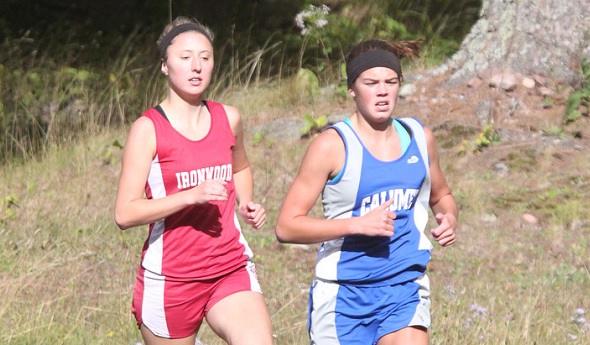
PHOTO: Calumet's Chelsea Jacques (right) won this season's Calumet Invitational with a time of 21:08.06, just ahead of Ironwood's Jessica Gering at 21:46.16. (Photo courtesy of Calumet athletic department.)
WISL Honoree Leads by Making Connections
By
Geoff Kimmerly
MHSAA.com senior editor
January 29, 2020
Nikki Norris received her life’s education from professional educators. Her father Howes Smith served as an assistant principal and then principal at Ithaca High School, and her mother Maple was a teacher. Howes’ mom also taught.
Their influence and example certainly rubbed off on Nikki and her siblings. Norris has worked in education for more than 30 years, while her sister is a school guidance counselor and their brother a college professor.
In fact, Norris has impacted educational athletics in nearly every role possible as a teacher and athletic director at multiple schools, coach at various levels and game official. She is in her second year as athletic director at East Lansing High School after eight in that position for Corunna Public Schools. She previously taught for six years at Carson City-Crystal and then 11 at Corunna before taking over the Cavaliers’ athletic department during the summer of 2010.
She also coached volleyball at multiple levels over more than 15 years including Corunna’s varsity from 1999-2002 and 2006-09, and coached high school basketball for a combined eight years during her time at the two schools where she taught. Before and between her volleyball coaching stints, Norris also has served as an MHSAA registered volleyball official for a total of 12 years.
Norris’ many and continuing contributions will be celebrated Sunday, Feb. 2, when she receives the Michigan High School Athletic Association’s 33rd Women In Sports Leadership Award during the WISL Banquet at the Crowne Plaza Lansing West.
“I try to connect with all students, athletes or not, because there are so many kids who just need a connection," Norris said. "And if we can find it through sports, or through clubs, or teaching – I do look at them all as my own children, to a certain extent. We used to say in Corunna, 'They're all our kids.' And I want them to be successful in whatever it is they want. And if I can help them, that's what I'm there for.
“So many people did it for me. Coming from a family of educators, and my dad an administrator, I knew what that entailed as far as how they get into your heart. I want to do that for kids.”
Each year, the MHSAA Representative Council considers the achievements of women coaches, officials and athletic administrators affiliated with the MHSAA who show exemplary leadership capabilities and positive contributions to athletics.
Those who wrote letters recommending Norris for this year’s WISL Award especially noted that personal impact she has on students, staff and colleagues.
Fowlerville athletic director Brian Osborn – one of her former coaches – wrote of how Norris goes above and beyond to care for and connect with her student-athletes. Owosso athletic director Dallas Lintner wrote of Norris’ dedication to children’s safety and educational values. Fenton athletic director Mike Bakker noted how fortunate her students are that Norris made the decision to leave coaching for administration, where she can have an even larger impact.
“Someone asked me once, why do you want to be an athletic director? Well, I can go from impacting 100 kids a day, at that time (as a coach and teacher), to maybe 600 kids a day, to now 1,200 kids a day (at East Lansing),” Norris said, then quipping, “Well, maybe (not all) 1,200 every day.”
But she does continue to lead on wide-ranging levels, both at her much larger school and beyond.
 While at Corunna, Norris served as master scheduler and part of the constitution committee for the Genesee Area Conference. Her schools have hosted various MHSAA Tournament events in multiple sports, in addition to local invitationals and conference meets. She’s served on every type of MHSAA Committee, providing input on a variety of sports, site selection, officials selection and the Scholar-Athlete Award. She also annually volunteers as a tournament administrator at the MHSAA’s Volleyball Finals in November and Baseball/Softball/Girls Soccer Finals in June.
A certified Red Cross instructor, Norris has provided CPR/AED training to coaches, bus drivers and staff members. Corunna in multiple years received the state’s HEARTSafe School designation recognizing preparedness to respond to cardiac emergencies.
As a member of the Michigan Interscholastic Athletic Administrators Association (MIAAA), she has facilitated sessions and presented at its conferences and served on the newsletter committee.
She was named the MIAAA’s Region 7 “Athletic Director of the Year” in 2016. She also has received “Certified Athletic Administrator” designation from the National Interscholastic Athletic Administrators Association (NIAAA).
“Nikki is one of the most genuine, caring and hard-working people I’ve ever met in athletics,” MHSAA Executive Director Mark Uyl said. “She has worked extremely hard in both Corunna and East Lansing to develop a first-class program that produced high-character people. Nikki is truly a role model to everyone in the world of athletic administration.”
A 1987 graduate of Ithaca High School, Norris received her bachelor’s degree in biology with a minor in exercise health science from Alma College – where she also competed as a runner and thrower in track & field – and then earned master’s degrees in biological sciences from Michigan State University and educational leadership from American College of Education.
Norris lives in Bancroft and is the mother to two daughters, Meredith and Elizabeth Norris. Neither is planning to go into education – but sports is a big part of both their current lives and likely futures, and no doubt the impact of growing up in a sports family has played a significant part. (Their dad, Dr. Robert Norris, played basketball at Alma College and serves as physician for the MSU hockey, volleyball and baseball programs and Lansing Lugnuts.)
Meredith was named the state’s Miss Volleyball Award winner in 2017 as a senior at Corunna and plays currently at Michigan State. Elizabeth is a senior at Corunna and was a finalist for the same award this past fall, and will continue her academic and volleyball careers at University of North Dakota. Meredith is majoring in kinesiology, and Elizabeth is planning on orthopedic surgery.
“I look at the names that are on the (WISL Award) list, and there are so many deserving women who over my career I've looked up to and aspired to be like when I 'grow up,'" Norris said. "So to even be considered in that group is amazing, humbling. It's an honor."
Past recipients of the Women In Sports Leadership Award
1990 – Carol Seavoy, L’Anse
1991 – Diane Laffey, Harper Woods
1992 – Patricia Ashby, Scotts
1993 – Jo Lake, Grosse Pointe
1994 – Brenda Gatlin, Detroit
1995 – Jane Bennett, Ann Arbor
1996 – Cheryl Amos-Helmicki, Huntington Woods
1997 – Delores L. Elswick, Detroit
1998 – Karen S. Leinaar, Delton
1999 – Kathy McGee, Flint
2000 – Pat Richardson, Grass Lake
2001 – Suzanne Martin, East Lansing
2002 – Susan Barthold, Kentwood
2003 – Nancy Clark, Flint
2004 – Kathy Vruggink Westdorp, Grand Rapids
2005 – Barbara Redding, Capac
2006 – Melanie Miller, Lansing
2007 – Jan Sander, Warren Woods
2008 – Jane Bos, Grand Rapids
2009 – Gail Ganakas, Flint; Deb VanKuiken, Holly
2010 – Gina Mazzolini, Lansing
2011 – Ellen Pugh, West Branch; Patti Tibaldi, Traverse City
2012 – Janet Gillette, Comstock Park
2013 – Barbara Beckett, Traverse City
2014 – Teri Reyburn, DeWitt
2015 – Jean LaClair, Bronson
2016 – Betty Wroubel, Pontiac
2017 – Dottie Davis, Ann Arbor
2018 – Meg Seng, Ann Arbor
2019 – Kris Isom, Adrian
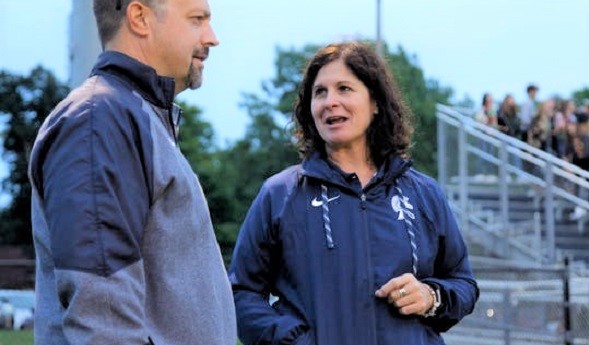
PHOTOS: (Top) East Lansing athletic director Nikki Norris confers with Grand Ledge athletic director Steve Baker during a 2018 football game. (Middle) Norris with daughters Elizabeth, left, and Meredith, after Nikki presented the Cavaliers with a District championship trophy won in 2016. (Top photo courtesy of the Lansing State Journal; middle photo courtesy of Nikki Norris.)