

Calumet Invite Produces Northern Stars
September 18, 2013
By Geoff Kimmerly
Second Half editor
The Calumet Invitational dates back roughly 30 years as an annual staple of the cross country schedule for schools at the northernmost tip of Michigan's Upper Peninsula.
A creative move by the Copper Kings last year added some statewide prestige to the event.
 Last week, for the second season, Calumet ran the series of races at Keweenaw Mountain Lodge, a resort near Copper Harbor and the northern bank of the Keweenaw Peninsula.
Calumet is the northernmost high school in Michigan. And moving this race another 35 miles northeast more or less guaranteed it's the northernmost event run in the state.
"We figured it was pretty safe. We're the northernmost school in the state, and you can only go four more miles and you're in Lake Superior," Calumet athletic director Sean Jacques said. "Nobody else is going to do anything more north than that."
A total of 10 schools were represented this fall in the races for boys and girls varsity, junior varsity and middle schoolers.
Jacques said the event formerly was run at a golf course in Calumet. But a few years ago, Calumet graduate and former Copper Kings cross country runner Dan Harri moved home from Florida to become general manager at the Mountain Lodge (he's also a renowned chef and has owned restaurants in Miami with Hall of Fame Dolphins coach Don Shula).
Harri had asked a few times about bringing a cross country or golf event to the lodge. Jacques told him last year they'd give it a try, so Harri set up a course that includes golf course, a couple of bridges, trails and finishes with a climb on the No. 1 fairway. It also provides various points for fans to watch runners go by, not always available on other courses.
"We were looking for a little bit of a change, and it's a beautiful course," Jacques said. "We thought if people were willing to make the extra drive, it would be really nice."
Calumet won the boys race this season, just ahead of runner-up Houghton. Houghton's girls were victorious, followed by the host Copper Kings.
Click to read more about this year's event from the Houghton Mining Gazette.
Michigan's claim to an NFL evolution
As part of its NFL preview this month, Sports Illustrated reported on one of the most significant developments for offenses over the last few decades – the silent snap count, which is used regularly by visiting teams because offensive linemen can’t hear the quarterback calling for the ball over the clamor of the home crowd.
And the article explained that the silent snap count might’ve gotten its start at one of Michigan’s smallest high schools – Flint’s Michigan School for the Deaf.
Offensive linemen during the 1980s were feasted on by pass rushers like Lawrence Taylor and Bruce Smith, who built record sack totals by blasting past blockers who seemed a step slow. Turns out, that was true. Defensive players were getting an edge by attacking as soon as they saw the ball move. But blockers (especially offensive tackles), focused instead on the defensive ends and linebackers lined up across from them, and didn’t have the luxury of watching the ball – and since they also couldn’t hear the snap count, started each play a step behind.
Enter the silent count. The quarterback signals to the center that he is ready to receive the ball (with a pat on the back, by raising a foot, etc.). The center then raises his head, and after a predetermined count of at least one second snaps the ball without a sound. This means an offensive tackle doesn’t have to listen for a snap count – he just counts after seeing the center get set.
The SI report recognized longtime offensive line coach Howard Mudd as the guru of the silent snap count. But Mudd recalled a conversation he’d had while working for the Seattle Seahawks with another coach, the late Andy MacDonald, who also had coached early in his career at a school for the deaf in Michigan.
The article doesn’t mention Michigan School for the Deaf by name. But it seems to make sense that the Tartars were the first to use the now-revolutionary count. MacDonald – who played at Central Michigan University and went on to coach at Michigan State and four other colleges and also for the Buffalo Bills – grew up in Flint and attended Flint Northern before playing for the Chippewas from 1950-53. The historical web site Michigan-football.com has results for Flint’s Michigan School for the Deaf dating to 1950, making it a decent assumption that MacDonald might’ve gotten in a little early coaching experience at the school down the road from his home.
Click for the SI story and go to page 4 for the mention of Michigan’s school.
Michigan mourns trooper, running standout
The law enforcement community is mourning the death of Michigan State Police trooper Paul Butterfield, who was shot Sept. 9 during a traffic stop in Mason County. He also was a well-known distance runner during the 1980s and the MHSAA Class A cross country champion running for Bridgeport in 1987.
According to a Ludington Daily News report, Butterfield continued running after high school at the University of Tennessee, and also competed at the 1989 Pan American Junior Games in Argentina.
Butterfield was stationed in Hart after previously serving in Manistee, and lived in Mason County. He also had served in the U.S. Army. Click to read more from the Ludington Daily News.
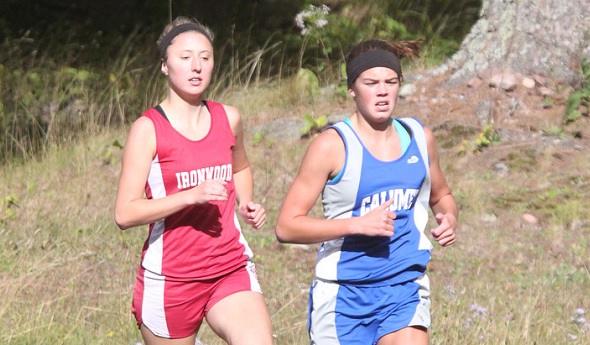
PHOTO: Calumet's Chelsea Jacques (right) won this season's Calumet Invitational with a time of 21:08.06, just ahead of Ironwood's Jessica Gering at 21:46.16. (Photo courtesy of Calumet athletic department.)

Armada's Fredette Receives NFHS Honor
January 16, 2020
By Geoff Kimmerly
Second Half editor
Longtime Armada tennis coach David Fredette has been named one of 23 National Coaches of the Year for 2018-19 by the National Federation of State High School Associations (NHFS) Coaches Association.
Fredette was selected first at the state level and then from among the eight sections that make up the NFHS – Michigan is part of Section 4 with Illinois, Indiana, Iowa and Wisconsin.
The following brief bio includes an excerpt from Fredette’s coaching philosophy, which nominees were asked to submit after being identified as candidates for the awards.
 David Fredette began Armada’s tennis program in 1966 and coached the boys team through the 2018 season. He led more than half his teams over the years to the MHSAA Finals, and 17 to top-10 finishes at the championship meet – including four straight from 2009-12. He also was a major contributor during the early days of the Michigan High School Tennis Coaches Association, and began serving on its board in 1982. Four times he was selected MHSTeCA state Coach of the Year: in Class C-D in 1982, Class B in 1992, and as one of two selections in Division 4 in both 1998 and 2018. Fredette was inducted into the MHSTeCA Hall of Fame in 1988. Armada’s tennis courts are named for him.
Fredette played tennis at Dowagiac High School and then Benton Harbor Community College. He also coached basketball and football during his time at Armada.
“Athletics give students a chance to become student-athletes, which means athletics teach athletes discipline, a strong work ethic, and cooperation with others. Athletics teach athletes how to not only compete, but how to handle both winning and losing. … I know that students who play sports upon graduation are more prepared to face the challenges that life presents them. While I always expected my players to work hard, I wanted my athletes to enjoy the experiences on and off the courts. My former players tell me how much they enjoyed competing, but also how much fun they had on the trips we went on together, whether it was to play top competition across the state of Michigan or on the Florida trips I took my boys teams on over Easter vacation from 1989 through 2001 to practice and bond as a team. Athletes learn how to compete, but they also gain friendships that last a lifetime, if only in their memories.”
Four more Michigan coaches earned honors in Section 4. Brighton girls swimming & diving coach Jason Black led the Bulldogs to a Lower Peninsula Division 1 Finals runner-up finish in Fall 2018, its best placing in program history. Dexter boys swimming & diving coach Michael McHugh was selected for the second-straight year as a Section 4 winner after leading his team to its fourth-straight Lower Peninsula Division 2 championship last winter. Battle Creek St. Philip volleyball coach Vicky Groat at one point guided the Tigers to nine Class D championships in 10 seasons from 2005-14 and is the sixth-winningest coach in MHSAA volleyball history with a record of 1,154-262-93. Bloomfield Hills Academy of the Sacred Heart co-coach Judy Hehs helped lead that program to its second-straight Lower Peninsula Division 4 championship this past fall, its sixth title in eight seasons, in her final tournament before retirement. She previously was named NFHS Coaches Association National Coach of the Year for girls tennis in 2016.
The NFHS has been recognizing coaches through an awards program since 1982. Winners of NFHS awards must be active coaches during the year for which they receive their award.