

Calumet Invite Produces Northern Stars
September 18, 2013
By Geoff Kimmerly
Second Half editor
The Calumet Invitational dates back roughly 30 years as an annual staple of the cross country schedule for schools at the northernmost tip of Michigan's Upper Peninsula.
A creative move by the Copper Kings last year added some statewide prestige to the event.
 Last week, for the second season, Calumet ran the series of races at Keweenaw Mountain Lodge, a resort near Copper Harbor and the northern bank of the Keweenaw Peninsula.
Calumet is the northernmost high school in Michigan. And moving this race another 35 miles northeast more or less guaranteed it's the northernmost event run in the state.
"We figured it was pretty safe. We're the northernmost school in the state, and you can only go four more miles and you're in Lake Superior," Calumet athletic director Sean Jacques said. "Nobody else is going to do anything more north than that."
A total of 10 schools were represented this fall in the races for boys and girls varsity, junior varsity and middle schoolers.
Jacques said the event formerly was run at a golf course in Calumet. But a few years ago, Calumet graduate and former Copper Kings cross country runner Dan Harri moved home from Florida to become general manager at the Mountain Lodge (he's also a renowned chef and has owned restaurants in Miami with Hall of Fame Dolphins coach Don Shula).
Harri had asked a few times about bringing a cross country or golf event to the lodge. Jacques told him last year they'd give it a try, so Harri set up a course that includes golf course, a couple of bridges, trails and finishes with a climb on the No. 1 fairway. It also provides various points for fans to watch runners go by, not always available on other courses.
"We were looking for a little bit of a change, and it's a beautiful course," Jacques said. "We thought if people were willing to make the extra drive, it would be really nice."
Calumet won the boys race this season, just ahead of runner-up Houghton. Houghton's girls were victorious, followed by the host Copper Kings.
Click to read more about this year's event from the Houghton Mining Gazette.
Michigan's claim to an NFL evolution
As part of its NFL preview this month, Sports Illustrated reported on one of the most significant developments for offenses over the last few decades – the silent snap count, which is used regularly by visiting teams because offensive linemen can’t hear the quarterback calling for the ball over the clamor of the home crowd.
And the article explained that the silent snap count might’ve gotten its start at one of Michigan’s smallest high schools – Flint’s Michigan School for the Deaf.
Offensive linemen during the 1980s were feasted on by pass rushers like Lawrence Taylor and Bruce Smith, who built record sack totals by blasting past blockers who seemed a step slow. Turns out, that was true. Defensive players were getting an edge by attacking as soon as they saw the ball move. But blockers (especially offensive tackles), focused instead on the defensive ends and linebackers lined up across from them, and didn’t have the luxury of watching the ball – and since they also couldn’t hear the snap count, started each play a step behind.
Enter the silent count. The quarterback signals to the center that he is ready to receive the ball (with a pat on the back, by raising a foot, etc.). The center then raises his head, and after a predetermined count of at least one second snaps the ball without a sound. This means an offensive tackle doesn’t have to listen for a snap count – he just counts after seeing the center get set.
The SI report recognized longtime offensive line coach Howard Mudd as the guru of the silent snap count. But Mudd recalled a conversation he’d had while working for the Seattle Seahawks with another coach, the late Andy MacDonald, who also had coached early in his career at a school for the deaf in Michigan.
The article doesn’t mention Michigan School for the Deaf by name. But it seems to make sense that the Tartars were the first to use the now-revolutionary count. MacDonald – who played at Central Michigan University and went on to coach at Michigan State and four other colleges and also for the Buffalo Bills – grew up in Flint and attended Flint Northern before playing for the Chippewas from 1950-53. The historical web site Michigan-football.com has results for Flint’s Michigan School for the Deaf dating to 1950, making it a decent assumption that MacDonald might’ve gotten in a little early coaching experience at the school down the road from his home.
Click for the SI story and go to page 4 for the mention of Michigan’s school.
Michigan mourns trooper, running standout
The law enforcement community is mourning the death of Michigan State Police trooper Paul Butterfield, who was shot Sept. 9 during a traffic stop in Mason County. He also was a well-known distance runner during the 1980s and the MHSAA Class A cross country champion running for Bridgeport in 1987.
According to a Ludington Daily News report, Butterfield continued running after high school at the University of Tennessee, and also competed at the 1989 Pan American Junior Games in Argentina.
Butterfield was stationed in Hart after previously serving in Manistee, and lived in Mason County. He also had served in the U.S. Army. Click to read more from the Ludington Daily News.
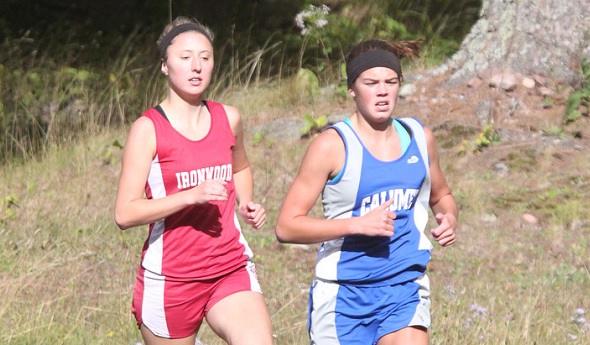
PHOTO: Calumet's Chelsea Jacques (right) won this season's Calumet Invitational with a time of 21:08.06, just ahead of Ironwood's Jessica Gering at 21:46.16. (Photo courtesy of Calumet athletic department.)

Minding Our Business: Focus on Mental Health
December 30, 2019
By Mark Uyl
MHSAA Executive Director
For as long as I can remember, rules have played an important role in my life.
My father officiated high school and youth sports. So my brother and I did the same, and were fortunate enough to earn the right to work contests at the collegiate level. Today, my sons are officiating high school and youth sports.
I was hired by the MHSAA as an assistant director in large part due to my officiating background. Rules and regulations remain the backbone of athletics specifically, and society in general, as I learned more acutely when I entered the working world as a teacher and coach, then school administrator.
What also became abundantly clear to me within that framework was that it is our responsibility to provide our students not only the opportunity for competition, but also for our games and practices to take place under the safest conditions possible. From preseason physicals to equipment inventory and facility maintenance, a premium was placed on the well-being of participants and spectators.
Throughout my time at the MHSAA, various initiatives continued to target the growing list of health and safety concerns. My predecessor, Jack Roberts, often pointed to the “4 Hs” of the MHSAA’s health and safety campaign: Health Histories (Physicals), Heat and Hydration, Heads, and Hearts. Those pillars still hold the bulk of the content and resources on the Health & Safety resource pages of MHSAA.com. A few years ago, an extensive section promoting multi-sport participation was developed as an increasing amount of overuse injuries among single-sport athletes was being reported.
This fall, another section has been added as a sub-category to “Heads.” While attending an NCAA meeting in the summer of 2017, the topic of concussions came up, which I assumed to be the No. 1 issue concerning health and safety of student-athletes. It was quickly pointed out that student mental health – not concussions – had become the top health concern among our young people. That knocked me back.
Medical personnel have determined that depression, anxiety and other issues related to mental health are the No. 1 concern among adolescent-age children. There’s a real opportunity to provide some leadership and guidance in this area.
We need to offer resources on the subject, and also be prepared to provide guidance for our membership. The MHSAA has developed a Mental Health Speakers Bureau (please visit our Health & Safety page online). The first statewide Student Mental Health Summit scheduled for Lansing in October provided an opportunity for school principals, counselors, student leadership advisers and student leaders to convene on the topic.
The gathering was quickly sold out, indicating not only the growing nature of concern for this issue, but once again displaying the willingness of our educational leaders to recognize and react to another challenge.
This week, Second Half will publish the latest benchmarks report on the MHSAA’s mental health initiatives and those being undertaken by other states as well.