

Casting Lines for Future Tournaments
August 12, 2016
By Jack Roberts
MHSAA Executive Director
The MHSAA is best known to the public for the tournaments it conducts to conclude the fall, winter and spring seasons each school year.
These tournaments, the first and largest program of the MHSAA, have survived the Vietnam War, the Korean conflict and two World Wars. They have survived the technology bubble, the housing collapse, the energy crisis and the Great Depression.
MHSAA tournaments existed at the dawn of aviation and at the time of our nation’s lunar landing. Popes, presidents and governors have changed and changed again and again, and MHSAA tournaments roll on year after year.
But the sense of tradition and permanence and inevitability of MHSAA tournaments doesn’t dissuade us from asking questions about our tournaments, even some of the most basic questions. Here are two.
Question #1
I have long been and will always be an advocate for a Ryder Cup format for the MHSAA Golf Finals, and a team tennis approach to the MHSAA Tennis Finals; but 90 years of tradition is hard to overcome. Might this be a more exciting format? Could it be co-ed? Could it reverse the decline in boys tennis participation, and increase girls golf participation? Wouldn’t it be fun to try?
Periodically, the International Olympic Committee requires each of the designated Olympic sports to defend its status, to state its case why the sport should remain a part of the Olympic program. Then, after a series or votes that retain one sport at a time, the IOC drops the sport that makes the weakest case. It does so to make room for one of the previously unlisted sports that makes the best case for inclusion.
This would appear to keep the existing Olympic sports on their toes, and to keep the Olympic movement fresh and reflective of modern trends in sports.
While I would not enjoy the controversy, I can see the potential for some positive results if the MHSAA were to invoke the same policy for determining the 14 tournaments it will provide for girls and the 14 for boys.
This might cause us to consider more deeply what a high school sport should look like, or at least what an MHSAA tournament sport should stand for.
On the one hand, we might be inclined to drop tournaments for those sports that involve mostly non-faculty coaches and non-school venues, or require cooperative programs to generate enough participants to support a team, or resort almost entirely to non-school funding, or cater to individuals more than teams.
Or perhaps this process would cause policymakers to forget traditional thinking and ask: “In this day and age, should we shake off traditional notions of sport and consider more where modern kids are coming from?” That might mean fewer team sports and more individual sports, more “extreme” sports like snowboarding and skateboarding, and more lifetime sports, meaning not just golf and tennis and running sports, but also fishing and even shooting sports.
Currently, MHSAA policy states that the MHSAA will consider sponsorship of a tournament series for any sport which 64 member schools conduct on an interscholastic basis as a result of action by the governing boards of those schools.
Should the only question be how many schools sponsor a sport, or must an activity also have certain qualities and/or avoid certain “defects?” What should an MHSAA tournament sport look like and stand for?
Question #2
Bristling from criticism that his association is a money-grabbing exploiter of children, my counterpart in another state said, “If we were running our programs just to make money, we would do very many things very differently.” I knew exactly what he meant.
Because we care about the health and welfare of students, because we mean what we say that the athletic program needs to maximize the ways it enhances the school experience while minimizing academic conflicts, and because we try to model our claim that no sport is a minor sport when it comes to its potential to teach young people life lessons, we operate our programs in ways that make promoters, marketers and business entrepreneurs laugh, cry or cringe.
If money were the only object, we would seed and select sites to assure the teams that attracted the most spectators had the best chance to advance in our tournaments, regardless of the travel for any team or its fan base. If money were the only object, we would never schedule two tournaments to overlap and compete for public attention, much less tolerate three or four overlapping events. If money were the only object, we would allow signage like NASCAR events and promotions like minor league baseball games.
Those approaches to event sponsorship may not be all wrong; they’re just not all right for us. And we will live with the consequences of our belief system.
During a typical school year, more than 20 percent of the MHSAA’s 2,097 District, Regional and Final tournaments lose money. Not a single site in golf, skiing or tennis makes a single penny. In no sport did every District, Regional and Final site have revenue in excess of direct expenses.
In fact, in only three sports – boys and girls basketball and football – is revenue so much greater than direct expenses overall that it helps to pay for all the other tournaments in which the MHSAA invests.
That’s right: invests. When we present our budget to our board, we talk about the MHSAA’s investment in providing tournament opportunities in all those sports and all those places that cannot sustain the cost of those events on their own. How much is this investment worth to students, schools and society?
These two are core questions that require our focus far in advance of talk about scheduling, site selection, seeding and the myriad matters that too often hijack our time and attention.
Care for Students Drove Forsythe Honoree Isom's Work for Nearly 40 Years
By
Geoff Kimmerly
MHSAA.com senior editor
March 10, 2025
For 39 years, Kris Isom poured herself into education and educational athletics as a teacher, coach, class advisor, athletic director, league president and advocate statewide as a remember of the Representative Council of the Michigan High School Athletic Association.
To celebrate nearly a lifetime of contributions – including several that continue to impact this state’s student-athletes – Isom has been selected as the 2025 honoree for the MHSAA’s Charles E. Forsythe Lifetime Achievement Award.
The annual award is in its 48th year and named after past MHSAA Executive Director Charles E. Forsythe, the Association's first full-time and longest-serving chief executive. Forsythe Award recipients are selected each year by the MHSAA Representative Council, based on an individual's outstanding contributions to the interscholastic athletics community at the local, regional and statewide levels. Isom will be honored during the MHSAA Boys Basketball Division 4 Final on March 15 at Michigan State University’s Breslin Student Events Center.
 Isom retired at the close of the 2023-24 school year after 38 at Adrian Madison and one at Clinton, where she attended high school and then began her teaching career before moving to Madison and becoming a pillar locally and statewide for nearly four decades.
In addition to serving as part of the MHSAA’s Council from 2008-23, Isom served as the president of the Tri-County Conference for more than two decades, on top of all the daily responsibilities that come with serving as a school athletic director. She also was one of the few athletic directors who also coached every year at some level, leading teams in basketball, volleyball, sideline cheer, softball and track & field.
“What I miss the most is the interaction with the kids. The coaching of course, but then everyday them coming into the office or giving me a hug or asking me what’s up,” Isom said. “It’s not always the athletes you intermingle with; it’s the kids in need, and even today when I see them or run into them, I get a hug or thank you, and that makes it all worth it.”
Isom has been recognized several times in the past for her contributions. She received the MHSAA’s Women In Sports Leadership Award in 2019, after previously being honored with an MHSAA Allen W. Bush Award in 2016 to recognize her behind-the-scenes contributions to school sports. She also was named Region 6 Athletic Director of the Year in 2000 by the Michigan Interscholastic Athletic Administrators Association (MIAAA).
During her time at Madison, she saw several of her school’s athletic programs enjoy success. Among recent highlights, Madison’s competitive cheer team finished Division 4 runner-up in 2022, the girls track & field team won a Lower Peninsula Division 3 Finals championship in 2017 and finished runner-up in 2016, and the 2016 volleyball team reached the Class C Semifinals with her daughter Rachel a contributor.
Kristen Isom indeed was a significant contributor to MHSAA work from a behind-the-scenes point of view, as she was a frequent host of District, Regional and Quarterfinal competitions and also MHSAA Coaches Advancement Program (CAP) sessions at her school. She also has been a longtime member of the MIAAA and National Interscholastic Athletic Administrators Association.
“For nearly four decades, Kristen Isom served as an excellent example of how to navigate the daily challenges of athletic administration while making a difference in the lives of her students and an impact on educational athletics on a larger scale as well,” said MHSAA executive director Mark Uyl. “She often showed a way forward as the MHSAA worked through complex topics, and always with the best interests of students first and foremost.”
A graduate of Clinton High School, Isom received her bachelor’s degree in science and teaching certification in physical education and health in 1984 from Michigan State University. She earned her master’s in elementary education in 1986 from Eastern Michigan University and also has completed graduate courses from Fresno Pacific University.
In addition to the MIAAA and NIAAA, Isom also has been a member of the Michigan Association for Health, Physical Education, Recreation and Dance (MAHPERD) and the Michigan State University Alumni Association. She’s been active with the Clinton United Church of Christ and Land & Lakes Ladies Club in various service efforts, and participated in local Meals on Wheels and roadside cleanup projects.
Isom is married to her husband Jerry, and she’s also maintained her real estate license for 30 years and is continuing in that work.
“Obviously (the Forsythe Award) being a high achievement, and being nominated by your peers, it doesn’t get any better than that. They know everything that goes into this job,” Isom said. “I think, like my daughter said, most people said you got paid to go watch games – that’s a perception many people have and that’s OK, because everybody’s job has ups and downs.
“But to have done something 38 years, at the same place, there must have been something you’re doing right, and you must have enjoyed it. And it’s hard to find that. It kinda makes you feel like everything you’ve done was worthwhile, that you made a difference in someone’s life.”
Past recipients
1978 - Brick Fowler, Port Huron; Paul Smarks, Warren
1979 - Earl Messner, Reed City; Howard Beatty, Saginaw
1980 - Max Carey, Freesoil
1981 - Steven Sluka, Grand Haven; Samuel Madden, Detroit
1982 - Ernest Buckholz, Mt. Clemens; T. Arthur Treloar, Petoskey
1983 - Leroy Dues, Detroit; Richard Maher, Sturgis
1984 - William Hart, Marquette; Donald Stamats, Caro
1985 - John Cotton, Farmington; Robert James, Warren
1986 - William Robinson, Detroit; Irving Soderland, Norway
1987 - Jack Streidl, Plainwell; Wayne Hellenga, Decatur
1988 - Jack Johnson, Dearborn; Alan Williams, North Adams
1989 - Walter Bazylewicz, Berkley; Dennis Kiley, Jackson
1990 - Webster Morrison, Pickford; Herbert Quade, Benton Harbor
1991 - Clifford Buckmaster, Petoskey; Donald Domke, Northville
1992 - William Maskill, Kalamazoo; Thomas G. McShannock, Muskegon
1993 - Roy A. Allen Jr., Detroit; John Duncan, Cedarville
1994 - Kermit Ambrose, Royal Oak
1995 - Bob Perry, Lowell
1996 - Charles H. Jones, Royal Oak
1997 - Michael A. Foster, Richland; Robert G. Grimes, Battle Creek
1998 - Lofton C. Greene, River Rouge; Joseph J. Todey, Essexville
1999 - Bernie Larson, Battle Creek
2000 - Blake Hagman, Kalamazoo; Jerry Cvengros, Escanaba
2001 - Norm Johnson, Bangor; George Lovich, Canton
2002 - John Fundukian, Novi
2003 - Ken Semelsberger, Port Huron
2004 - Marco Marcet, Frankenmuth
2005 - Jim Feldkamp, Troy
2006 - Dan McShannock, Midland; Dail Prucka, Monroe
2007 - Keith Eldred, Williamston; Tom Hickman, Spring Lake
2008 - Jamie Gent, Haslett; William Newkirk, Sanford Meridian
2009 - Paul Ellinger, Cheboygan
2010 - Rudy Godefroidt, Hemlock; Mike Boyd, Waterford
2011 - Eric C. Federico, Trenton
2012 - Bill Mick, Midland
2013 - Jim Gilmore, Tecumseh; Dave Hutton, Grandville
2014 - Dan Flynn, Escanaba
2015 - Hugh Matson, Saginaw
2016 - Gary Hice, Petoskey; Gina Mazzolini, Lansing
2017 - Chuck Nurek, Rochester Hills
2018 - Gary Ellis, Allegan
2019 - Jim Derocher, Negaunee; Fredrick J. Smith, Stevensville
2020 - Michael Garvey, Lawton
2021 – Leroy Hackley Jr., Byron Center; Patti Tibaldi, Traverse City
2022 – Bruce Horsch, Houghton
2023 – Karen Leinaar, Frankfort
2024 – Sean Jacques, Calumet
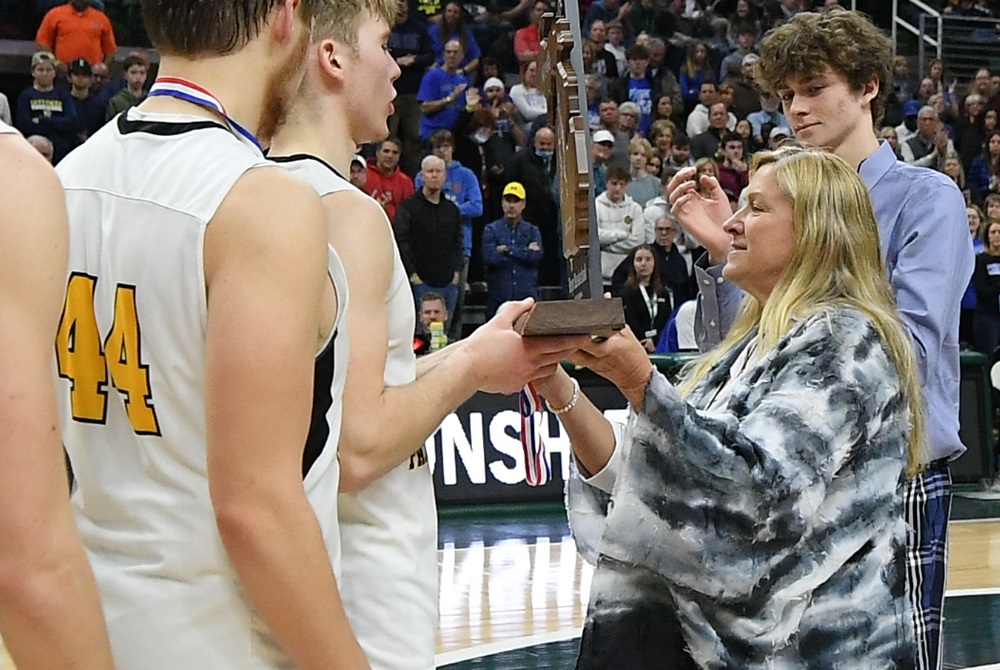
PHOTO Retired Adrian Madison athletic director Kristen Isom presents the Division 4 finalist trophy to Ewen-Trout Creek in 2022. (Photo by Andrew Frushour.)