

Casting Lines for Future Tournaments
August 12, 2016
By Jack Roberts
MHSAA Executive Director
The MHSAA is best known to the public for the tournaments it conducts to conclude the fall, winter and spring seasons each school year.
These tournaments, the first and largest program of the MHSAA, have survived the Vietnam War, the Korean conflict and two World Wars. They have survived the technology bubble, the housing collapse, the energy crisis and the Great Depression.
MHSAA tournaments existed at the dawn of aviation and at the time of our nation’s lunar landing. Popes, presidents and governors have changed and changed again and again, and MHSAA tournaments roll on year after year.
But the sense of tradition and permanence and inevitability of MHSAA tournaments doesn’t dissuade us from asking questions about our tournaments, even some of the most basic questions. Here are two.
Question #1
I have long been and will always be an advocate for a Ryder Cup format for the MHSAA Golf Finals, and a team tennis approach to the MHSAA Tennis Finals; but 90 years of tradition is hard to overcome. Might this be a more exciting format? Could it be co-ed? Could it reverse the decline in boys tennis participation, and increase girls golf participation? Wouldn’t it be fun to try?
Periodically, the International Olympic Committee requires each of the designated Olympic sports to defend its status, to state its case why the sport should remain a part of the Olympic program. Then, after a series or votes that retain one sport at a time, the IOC drops the sport that makes the weakest case. It does so to make room for one of the previously unlisted sports that makes the best case for inclusion.
This would appear to keep the existing Olympic sports on their toes, and to keep the Olympic movement fresh and reflective of modern trends in sports.
While I would not enjoy the controversy, I can see the potential for some positive results if the MHSAA were to invoke the same policy for determining the 14 tournaments it will provide for girls and the 14 for boys.
This might cause us to consider more deeply what a high school sport should look like, or at least what an MHSAA tournament sport should stand for.
On the one hand, we might be inclined to drop tournaments for those sports that involve mostly non-faculty coaches and non-school venues, or require cooperative programs to generate enough participants to support a team, or resort almost entirely to non-school funding, or cater to individuals more than teams.
Or perhaps this process would cause policymakers to forget traditional thinking and ask: “In this day and age, should we shake off traditional notions of sport and consider more where modern kids are coming from?” That might mean fewer team sports and more individual sports, more “extreme” sports like snowboarding and skateboarding, and more lifetime sports, meaning not just golf and tennis and running sports, but also fishing and even shooting sports.
Currently, MHSAA policy states that the MHSAA will consider sponsorship of a tournament series for any sport which 64 member schools conduct on an interscholastic basis as a result of action by the governing boards of those schools.
Should the only question be how many schools sponsor a sport, or must an activity also have certain qualities and/or avoid certain “defects?” What should an MHSAA tournament sport look like and stand for?
Question #2
Bristling from criticism that his association is a money-grabbing exploiter of children, my counterpart in another state said, “If we were running our programs just to make money, we would do very many things very differently.” I knew exactly what he meant.
Because we care about the health and welfare of students, because we mean what we say that the athletic program needs to maximize the ways it enhances the school experience while minimizing academic conflicts, and because we try to model our claim that no sport is a minor sport when it comes to its potential to teach young people life lessons, we operate our programs in ways that make promoters, marketers and business entrepreneurs laugh, cry or cringe.
If money were the only object, we would seed and select sites to assure the teams that attracted the most spectators had the best chance to advance in our tournaments, regardless of the travel for any team or its fan base. If money were the only object, we would never schedule two tournaments to overlap and compete for public attention, much less tolerate three or four overlapping events. If money were the only object, we would allow signage like NASCAR events and promotions like minor league baseball games.
Those approaches to event sponsorship may not be all wrong; they’re just not all right for us. And we will live with the consequences of our belief system.
During a typical school year, more than 20 percent of the MHSAA’s 2,097 District, Regional and Final tournaments lose money. Not a single site in golf, skiing or tennis makes a single penny. In no sport did every District, Regional and Final site have revenue in excess of direct expenses.
In fact, in only three sports – boys and girls basketball and football – is revenue so much greater than direct expenses overall that it helps to pay for all the other tournaments in which the MHSAA invests.
That’s right: invests. When we present our budget to our board, we talk about the MHSAA’s investment in providing tournament opportunities in all those sports and all those places that cannot sustain the cost of those events on their own. How much is this investment worth to students, schools and society?
These two are core questions that require our focus far in advance of talk about scheduling, site selection, seeding and the myriad matters that too often hijack our time and attention.
Allen Park Extends Era of Dominance with 5th Title Over 6 Seasons
By
Tom Kendra
Special for MHSAA.com
March 1, 2025
MOUNT PLEASANT – Allen Park sure makes it look easy during pressure-packed competitive cheer competitions, and veteran coach Julie Goodwin has an explanation for that.
“All of the hard work goes on during the week, in the gym,” explained Goodwin, who just finished her 21st year as the Jaguars’ coach.
“Today, or any competition we have, we get to dress up and pick up a trophy. But we actually won it in the gym.”
Allen Park picked up yet another trophy Saturday at Central Michigan University’s McGuirk Arena, winning its second-consecutive Division 2 Finals championship – and the fifth over the past six years.
The Jaguars posted the best score in the eight-team field in all three rounds, taking the lead early and continuing to build on it, finishing with 791.90 points.
Gibraltar Carlson, AP’s longtime conference rival, kept the pressure on the Jaguars all day, taking second at 788.42. Carleton Airport (784.16) took third, and Walled Lake Western (779.68) placed fourth.
Allen Park got the upper hand again over Carlson in one of the state’s best high school rivalries, in any sport.
Consider: It has been 18 years, all the way back to 2007 (Holland Christian), since a school other than Allen Park or Gibraltar Carlson has won the Division 2 cheer title. Carlson has won 11 championships, and AP now has seven over that span.
“We love it,” explained Allen Park senior Abby Obrycki, a returning first-team all-stater. “We are so lucky to have such good competition in the Downriver League to push as all the time. We love being a part of it.”
 The Jaguars defeated Carlson at the Regional by more than seven points, but Saturday, the Marauders cut that margin significantly.
Carlson, which won the Division 2 title in 2023 and took fourth last year, trailed by just over two points Saturday entering the decisive third round. The Marauders were in the unenviable position of going first in Round 3, but led by seniors Sofia Lanzini, Maranda Steinmetz and Haley Sanchez, they came up with a stellar final performance.
That meant it came down to Allen Park having to answer under the pressure of thousands of fans on the state’s biggest stage, which it did in impressive fashion once again.
“We call that third round the money round because that’s where you have to win it, even though we had a little bit of a lead going into it today,” said Goodwin, who also has five runner-up finishes in her career. “We had a great week, and it showed in that final round. There was no fear and no nervousness.”
Allen Park scored 321.90 in Round 3, slightly better than Carlson’s 320.80, to provide the final margin of victory.
Other leaders for the Jaguars this season were junior Sophia Ramey, a returning first-team all-stater, and senior Peyton Will, an honorable mention choice.
Allen Park is a young team, losing just five seniors off its 23-girl roster, making a ‘three-peat’ a definite possibility. Other seniors were Leslie Hernandez, Kate O’Riley and Ella Peschke.
Peschke said going out as a back-to-back champion makes the grind and all of the long, six days of practice every week more than worth it.
“It felt great to leave it all out on the mat one more time,” said Peschke. “It’s a great feeling to be a state champion, but it’s an even better feeling to do it with your best friends.”
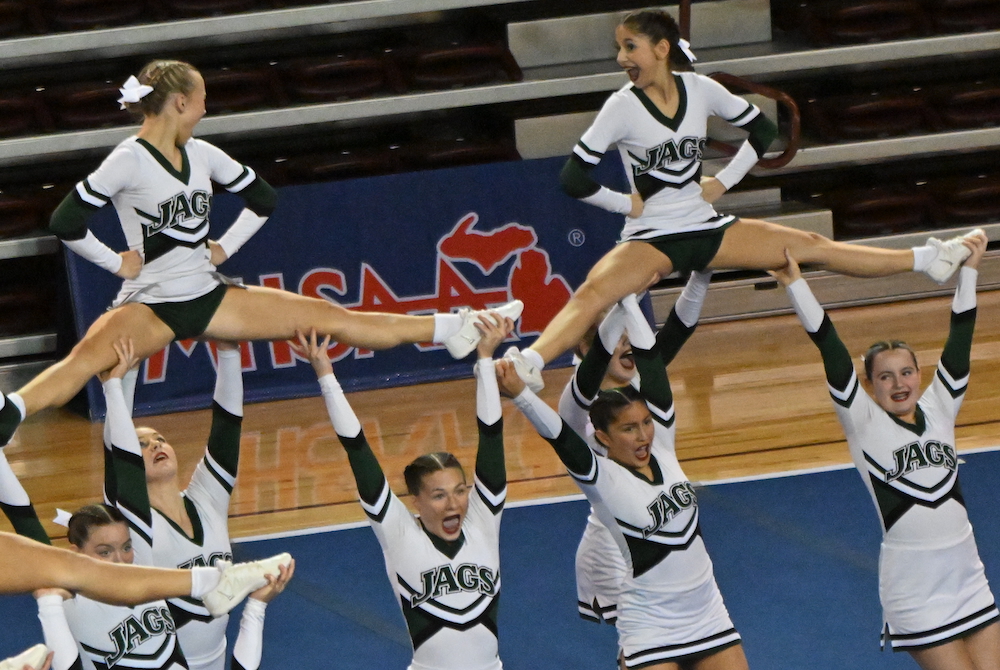
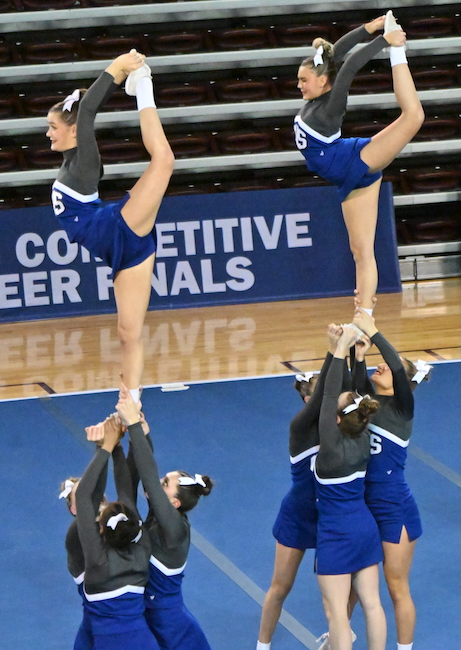
PHOTOS Allen Park (top) and Gibraltar Carlson compete Saturday during the Division 2 Competitive Cheer Final at McGuirk Arena.