

Casting Lines for Future Tournaments
August 12, 2016
By Jack Roberts
MHSAA Executive Director
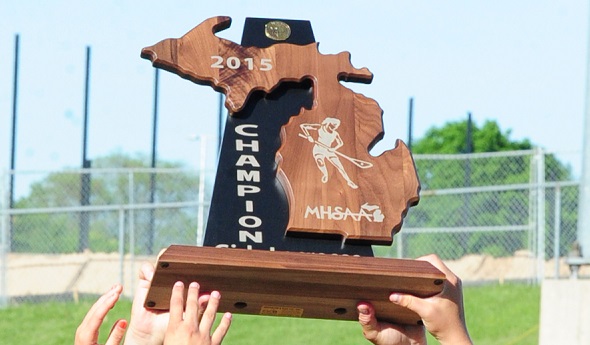
The MHSAA is best known to the public for the tournaments it conducts to conclude the fall, winter and spring seasons each school year.
These tournaments, the first and largest program of the MHSAA, have survived the Vietnam War, the Korean conflict and two World Wars. They have survived the technology bubble, the housing collapse, the energy crisis and the Great Depression.
MHSAA tournaments existed at the dawn of aviation and at the time of our nation’s lunar landing. Popes, presidents and governors have changed and changed again and again, and MHSAA tournaments roll on year after year.
But the sense of tradition and permanence and inevitability of MHSAA tournaments doesn’t dissuade us from asking questions about our tournaments, even some of the most basic questions. Here are two.
Question #1
I have long been and will always be an advocate for a Ryder Cup format for the MHSAA Golf Finals, and a team tennis approach to the MHSAA Tennis Finals; but 90 years of tradition is hard to overcome. Might this be a more exciting format? Could it be co-ed? Could it reverse the decline in boys tennis participation, and increase girls golf participation? Wouldn’t it be fun to try?
Periodically, the International Olympic Committee requires each of the designated Olympic sports to defend its status, to state its case why the sport should remain a part of the Olympic program. Then, after a series or votes that retain one sport at a time, the IOC drops the sport that makes the weakest case. It does so to make room for one of the previously unlisted sports that makes the best case for inclusion.
This would appear to keep the existing Olympic sports on their toes, and to keep the Olympic movement fresh and reflective of modern trends in sports.
While I would not enjoy the controversy, I can see the potential for some positive results if the MHSAA were to invoke the same policy for determining the 14 tournaments it will provide for girls and the 14 for boys.
This might cause us to consider more deeply what a high school sport should look like, or at least what an MHSAA tournament sport should stand for.
On the one hand, we might be inclined to drop tournaments for those sports that involve mostly non-faculty coaches and non-school venues, or require cooperative programs to generate enough participants to support a team, or resort almost entirely to non-school funding, or cater to individuals more than teams.
Or perhaps this process would cause policymakers to forget traditional thinking and ask: “In this day and age, should we shake off traditional notions of sport and consider more where modern kids are coming from?” That might mean fewer team sports and more individual sports, more “extreme” sports like snowboarding and skateboarding, and more lifetime sports, meaning not just golf and tennis and running sports, but also fishing and even shooting sports.
Currently, MHSAA policy states that the MHSAA will consider sponsorship of a tournament series for any sport which 64 member schools conduct on an interscholastic basis as a result of action by the governing boards of those schools.
Should the only question be how many schools sponsor a sport, or must an activity also have certain qualities and/or avoid certain “defects?” What should an MHSAA tournament sport look like and stand for?
Question #2
Bristling from criticism that his association is a money-grabbing exploiter of children, my counterpart in another state said, “If we were running our programs just to make money, we would do very many things very differently.” I knew exactly what he meant.
Because we care about the health and welfare of students, because we mean what we say that the athletic program needs to maximize the ways it enhances the school experience while minimizing academic conflicts, and because we try to model our claim that no sport is a minor sport when it comes to its potential to teach young people life lessons, we operate our programs in ways that make promoters, marketers and business entrepreneurs laugh, cry or cringe.
If money were the only object, we would seed and select sites to assure the teams that attracted the most spectators had the best chance to advance in our tournaments, regardless of the travel for any team or its fan base. If money were the only object, we would never schedule two tournaments to overlap and compete for public attention, much less tolerate three or four overlapping events. If money were the only object, we would allow signage like NASCAR events and promotions like minor league baseball games.
Those approaches to event sponsorship may not be all wrong; they’re just not all right for us. And we will live with the consequences of our belief system.
During a typical school year, more than 20 percent of the MHSAA’s 2,097 District, Regional and Final tournaments lose money. Not a single site in golf, skiing or tennis makes a single penny. In no sport did every District, Regional and Final site have revenue in excess of direct expenses.
In fact, in only three sports – boys and girls basketball and football – is revenue so much greater than direct expenses overall that it helps to pay for all the other tournaments in which the MHSAA invests.
That’s right: invests. When we present our budget to our board, we talk about the MHSAA’s investment in providing tournament opportunities in all those sports and all those places that cannot sustain the cost of those events on their own. How much is this investment worth to students, schools and society?
These two are core questions that require our focus far in advance of talk about scheduling, site selection, seeding and the myriad matters that too often hijack our time and attention.

Today in the MHSAA: 1/13/25
By
Geoff Kimmerly
MHSAA.com senior editor
January 13, 2025
1. BOYS SWIMMING & DIVING Holland Christian – No. 1 in Lower Peninsula Division 3 – was first and No. 2 East Grand Rapids second at the annual D3 Invitational – Holland Sentinel
2. WRESTLING Division 1 No. 6 Temperance Bedford defeated Middleville Thornapple Kellogg, Stevensville Lakeshore, No. 7 Rockford, Holt and Division 2 No. 6 Greenville to win the Rockford Duals – Monroe News
3. BOWLING The Eisenhower/Utica girls and New Baltimore Anchor Bay boys won Macomb County championships – Macomb Daily Girls | Boys
4. BOYS BASKETBALL East Lansing edged Orchard Lake St. Mary’s 69-68 in a matchup of top teams in Division 1 at the GottaGetIt Hoops Classic at East Kentwood – WLNS
5. BOYS BASKETBALL Bloomfield Hills Brother Rice impressively downed Muskegon 66-50 in East Kentwood – Muskegon Chronicle
6. BOYS BASKETBALL Peyton Ruel became the all-time leading scorer for Muskegon Oakridge during a 66-45 win over Muskegon Western Michigan Christian – Local Sports Journal
7. WRESTLING Kingsford won its Ray Mariucci Tournament for the first time since 1993 – Escanaba Daily Press
8. GIRLS BASKETBALL Alison Rockburn went over 1,000 career points in Belding’s win over Comstock Park – Greenville Daily News
9. BOWLING Frankenmuth’s Liam Liddle rolled a 300 in his team’s win over Essexville Garber – Saginaw News
10. GIRLS BASKETBALL Anna Wypych set a Rockford record with 38 points in a win over East Kentwood – Grand Rapids Press
Also of note …
VOLLEYBALL Farmington Hills Mercy’s Campbell Flynn was named Gatorade National Player of the Year – Oakland Press
FOOTBALL Dearborn is mourning the death of Divine Child legend Bill McCartney, who actually led the boys basketball team to the Class B title in 1973, and later the Colorado football program to a national title – Southgate News-Herald