

Casting Lines for Future Tournaments
August 12, 2016
By Jack Roberts
MHSAA Executive Director
The MHSAA is best known to the public for the tournaments it conducts to conclude the fall, winter and spring seasons each school year.
These tournaments, the first and largest program of the MHSAA, have survived the Vietnam War, the Korean conflict and two World Wars. They have survived the technology bubble, the housing collapse, the energy crisis and the Great Depression.
MHSAA tournaments existed at the dawn of aviation and at the time of our nation’s lunar landing. Popes, presidents and governors have changed and changed again and again, and MHSAA tournaments roll on year after year.
But the sense of tradition and permanence and inevitability of MHSAA tournaments doesn’t dissuade us from asking questions about our tournaments, even some of the most basic questions. Here are two.
Question #1
I have long been and will always be an advocate for a Ryder Cup format for the MHSAA Golf Finals, and a team tennis approach to the MHSAA Tennis Finals; but 90 years of tradition is hard to overcome. Might this be a more exciting format? Could it be co-ed? Could it reverse the decline in boys tennis participation, and increase girls golf participation? Wouldn’t it be fun to try?
Periodically, the International Olympic Committee requires each of the designated Olympic sports to defend its status, to state its case why the sport should remain a part of the Olympic program. Then, after a series or votes that retain one sport at a time, the IOC drops the sport that makes the weakest case. It does so to make room for one of the previously unlisted sports that makes the best case for inclusion.
This would appear to keep the existing Olympic sports on their toes, and to keep the Olympic movement fresh and reflective of modern trends in sports.
While I would not enjoy the controversy, I can see the potential for some positive results if the MHSAA were to invoke the same policy for determining the 14 tournaments it will provide for girls and the 14 for boys.
This might cause us to consider more deeply what a high school sport should look like, or at least what an MHSAA tournament sport should stand for.
On the one hand, we might be inclined to drop tournaments for those sports that involve mostly non-faculty coaches and non-school venues, or require cooperative programs to generate enough participants to support a team, or resort almost entirely to non-school funding, or cater to individuals more than teams.
Or perhaps this process would cause policymakers to forget traditional thinking and ask: “In this day and age, should we shake off traditional notions of sport and consider more where modern kids are coming from?” That might mean fewer team sports and more individual sports, more “extreme” sports like snowboarding and skateboarding, and more lifetime sports, meaning not just golf and tennis and running sports, but also fishing and even shooting sports.
Currently, MHSAA policy states that the MHSAA will consider sponsorship of a tournament series for any sport which 64 member schools conduct on an interscholastic basis as a result of action by the governing boards of those schools.
Should the only question be how many schools sponsor a sport, or must an activity also have certain qualities and/or avoid certain “defects?” What should an MHSAA tournament sport look like and stand for?
Question #2
Bristling from criticism that his association is a money-grabbing exploiter of children, my counterpart in another state said, “If we were running our programs just to make money, we would do very many things very differently.” I knew exactly what he meant.
Because we care about the health and welfare of students, because we mean what we say that the athletic program needs to maximize the ways it enhances the school experience while minimizing academic conflicts, and because we try to model our claim that no sport is a minor sport when it comes to its potential to teach young people life lessons, we operate our programs in ways that make promoters, marketers and business entrepreneurs laugh, cry or cringe.
If money were the only object, we would seed and select sites to assure the teams that attracted the most spectators had the best chance to advance in our tournaments, regardless of the travel for any team or its fan base. If money were the only object, we would never schedule two tournaments to overlap and compete for public attention, much less tolerate three or four overlapping events. If money were the only object, we would allow signage like NASCAR events and promotions like minor league baseball games.
Those approaches to event sponsorship may not be all wrong; they’re just not all right for us. And we will live with the consequences of our belief system.
During a typical school year, more than 20 percent of the MHSAA’s 2,097 District, Regional and Final tournaments lose money. Not a single site in golf, skiing or tennis makes a single penny. In no sport did every District, Regional and Final site have revenue in excess of direct expenses.
In fact, in only three sports – boys and girls basketball and football – is revenue so much greater than direct expenses overall that it helps to pay for all the other tournaments in which the MHSAA invests.
That’s right: invests. When we present our budget to our board, we talk about the MHSAA’s investment in providing tournament opportunities in all those sports and all those places that cannot sustain the cost of those events on their own. How much is this investment worth to students, schools and society?
These two are core questions that require our focus far in advance of talk about scheduling, site selection, seeding and the myriad matters that too often hijack our time and attention.
TC Christian's Broderick Approaching Records, But Team Goals Top His List
By
Tom Spencer
Special for MHSAA.com
January 10, 2025
If Reese Broderick falls short of the main goal this season, he may never forgive himself.
 Rest assured he‘ll likely go easier on his Traverse City Christian basketball teammates.
Broderick is the Sabres’ senior sharpshooter with defensive prowess. The most career 3-pointers in MHSAA history and the school’s scoring record could be his when the dust settles on this season.
But neither feat is at the top of his season goal list.
Broderick has his eyes set on helping his team win the school’s first boys basketball District championship. That outcome might also include a postseason win over the school’s biggest rival, Lake Leelanau St. Mary.
The Eagles ended Broderick’s freshman and sophomore seasons. They also ended his older brother Brock’s career in 2022 as the Brodericks were playing varsity together as a freshman and senior, respectively.
The older Broderick finished that season as the school’s all-time scoring leader, setting the bar at 1,528 career points.
The younger Broderick entered the 2025 calendar year with 284 career 3-point shots made is about to top the 1,300 career scoring mark. He connected on four 3-pointers in the first game of 2025 in a loss to Onekama. He had six the next time out in a win over Leland and finished this week with three more in a win at Bear Lake.
He is now at 297 career 3-pointers made, ranking him fifth in MHSAA history. Matt Kitchen, who starred for Mayville and Unionville-Sebewaing, owns the career mark of 340.
But hosting a District trophy is of far greater importance to Broderick. The Sabres are 9-2 on the season and collecting wins is their focus.
 “I am already on the list, so that’s not too high of a priority and it’s an honor to be on the list,” said Broderick, who joined the 1,000-point club a year ago. “As a school, we haven’t won a District yet, so that’s definitely the big goal and after that just keep going."
Points from Broderick, a second-team all-state selection the past two seasons, are not counted on as much this winter.
“His points are probably 12 points per game — it could be 25, but we’re not worried about (that),” said Sabres coach Rene LaFreniere. “We’re got four guys that any one of them could be all-state selections if we made the push — with Reece being one of them — but at the end of the day, they want to win the District trophy. That’s their focus.’
LaFreniere, now in his fourth year at the school with an enrollment barely topping 100, has seen the Sabres rotate scoring leaders all season. Senior guard Austin Miller – who gets points in transition and is considered the team’s top defender – junior power forward Garret Schultz, and sophomore Asher Coates, a newcomer who can score but focuses on distributing the ball, have all had a few double-digit nights already this season.
Schultz led the Sabres in scoring in their win over Bear Lake with 18 points. Coates kicked in 17.
The team’s stingy defense though has been a bigger contributor to the Sabres’ success, noted LaFreniere. They held Bear Lake to just 32 points this week.
“We’re holding teams to 38-42 points per game,” LaFreniere said. “Right now defensively is what they’re more focused on.”
And while the Sabres play tough defense, Broderick draws the opponent’s best defender every time. It’s not really anything new though.
And while the Sabres are not focused on Broderick getting the career mark, they’ll take every 3-pointer he can muster. The offense relies on screen actions and inbound passes to get the 3-point opportunities.
“I get the ball, but it’s tough,” said Broderick, who missed two games due to illness this season. “I’ll take whatever I can get at the end of season.”
Broderick is rarely hesitant to take the shot whenever it presents itself on the court. He always takes a look at how the team is set for rebounding before making the shot decision.
“The thought is I want to shoot it every time,” he said with a little laugh. “Honestly, it’s just flow — whatever I am feeling.”
 Mistakes and shortfalls are tolerated a lot more for teammates than by Broderick himself. “I am pretty easy going — hard on myself though,” he said. “But easy on others, I think.”
LaFreniere loves the intensity his quiet leader plays with at both ends of the court.
“He doesn’t say much,” LaFreniere said. “He’s definitely hard on himself, but most people don’t realize that Reece is one our better defenders on the floor. He likes to play defense. He understands the little nuances of the game.”
The Sabres have 11 games left during regular season. They’d love to ride some hot shooting and strong defense deep into the postseason. Suttons Bay will host the District, which also features Leland, Buckley and Frankfort in addition to St. Mary.
Traverse City Christian will try to take one game at a time, but is looking ahead to a rematch with the rival Eagles. Christian will host them Feb. 7, a part of their unwritten agreement to play each other twice during the regular season. In addition to each school gaining a quality local opponent, the need is greater as neither school currently competes in a league.
St. Mary won 36-27 in front of a large audience in December, as the Sabres shot as they often do in their rival’s gym.
“They got us up there at their place because historically we never shoot well in their gym, and I don’t know why,” LaFreniere said. “But the good side is they don’t shoot well in our gym either. We can’t wait to see.”
A full gymnasium is expected when the Eagles venture south to Traverse City.
“I think it’s a good rivalry – it’s healthy and it’s respectful, and we kind of feed off of it — it’s fun,” LaFreniere said. “When we go to their place it’s a packed house, and when they come to our place it’s a packed house.”
 Tom Spencer is a longtime MHSAA-registered basketball and soccer official, and former softball and baseball official, and he also has coached in the northern Lower Peninsula area. He previously has written for the Saginaw News, Bay County Sports Page and Midland Daily News. He can be reached at [email protected] with story ideas for Manistee, Wexford, Missaukee, Roscommon, Ogemaw, Iosco, Alcona, Oscoda, Crawford, Kalkaska, Grand Traverse, Benzie, Leelanau, Antrim, Otsego, Montmorency, Alpena, Presque Isle, Cheboygan, Charlevoix and Emmet counties.
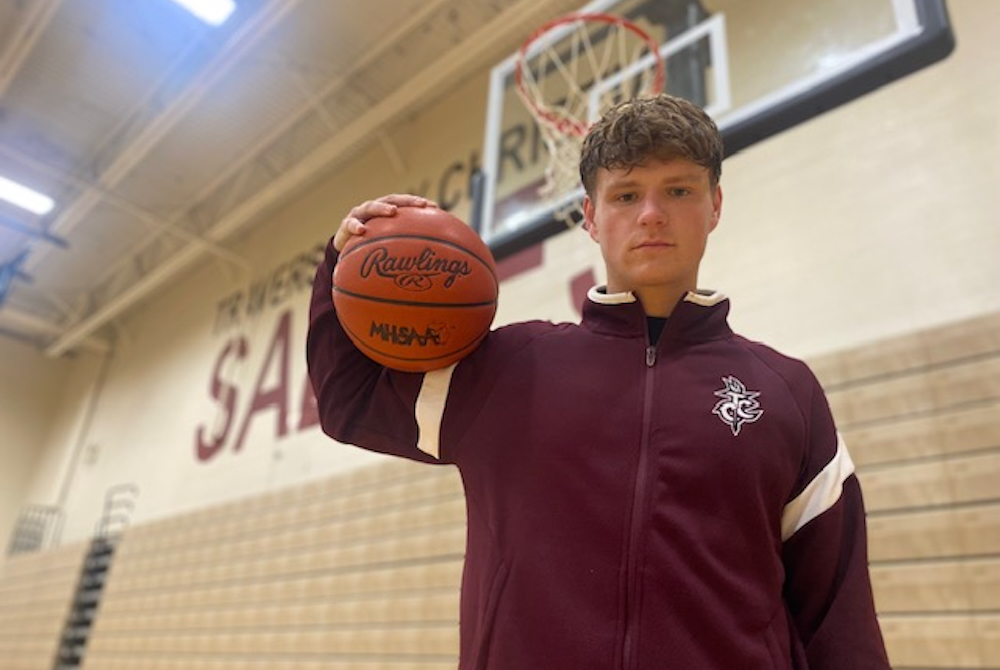
PHOTOS (Top) Traverse City Christian’s Reese Broderick is approaching the MHSAA record for career 3-pointers. (Middle) Broderick looks for an open dribbling lane this winter against Manton. (Below) Broderick gets up a shot last season against Bear Lake. (Top photo courtesy of Traverse City Christian High School. Action photos by TC Rick Sports Photography.)