

Casting Lines for Future Tournaments
August 12, 2016
By Jack Roberts
MHSAA Executive Director
The MHSAA is best known to the public for the tournaments it conducts to conclude the fall, winter and spring seasons each school year.
These tournaments, the first and largest program of the MHSAA, have survived the Vietnam War, the Korean conflict and two World Wars. They have survived the technology bubble, the housing collapse, the energy crisis and the Great Depression.
MHSAA tournaments existed at the dawn of aviation and at the time of our nation’s lunar landing. Popes, presidents and governors have changed and changed again and again, and MHSAA tournaments roll on year after year.
But the sense of tradition and permanence and inevitability of MHSAA tournaments doesn’t dissuade us from asking questions about our tournaments, even some of the most basic questions. Here are two.
Question #1
I have long been and will always be an advocate for a Ryder Cup format for the MHSAA Golf Finals, and a team tennis approach to the MHSAA Tennis Finals; but 90 years of tradition is hard to overcome. Might this be a more exciting format? Could it be co-ed? Could it reverse the decline in boys tennis participation, and increase girls golf participation? Wouldn’t it be fun to try?
Periodically, the International Olympic Committee requires each of the designated Olympic sports to defend its status, to state its case why the sport should remain a part of the Olympic program. Then, after a series or votes that retain one sport at a time, the IOC drops the sport that makes the weakest case. It does so to make room for one of the previously unlisted sports that makes the best case for inclusion.
This would appear to keep the existing Olympic sports on their toes, and to keep the Olympic movement fresh and reflective of modern trends in sports.
While I would not enjoy the controversy, I can see the potential for some positive results if the MHSAA were to invoke the same policy for determining the 14 tournaments it will provide for girls and the 14 for boys.
This might cause us to consider more deeply what a high school sport should look like, or at least what an MHSAA tournament sport should stand for.
On the one hand, we might be inclined to drop tournaments for those sports that involve mostly non-faculty coaches and non-school venues, or require cooperative programs to generate enough participants to support a team, or resort almost entirely to non-school funding, or cater to individuals more than teams.
Or perhaps this process would cause policymakers to forget traditional thinking and ask: “In this day and age, should we shake off traditional notions of sport and consider more where modern kids are coming from?” That might mean fewer team sports and more individual sports, more “extreme” sports like snowboarding and skateboarding, and more lifetime sports, meaning not just golf and tennis and running sports, but also fishing and even shooting sports.
Currently, MHSAA policy states that the MHSAA will consider sponsorship of a tournament series for any sport which 64 member schools conduct on an interscholastic basis as a result of action by the governing boards of those schools.
Should the only question be how many schools sponsor a sport, or must an activity also have certain qualities and/or avoid certain “defects?” What should an MHSAA tournament sport look like and stand for?
Question #2
Bristling from criticism that his association is a money-grabbing exploiter of children, my counterpart in another state said, “If we were running our programs just to make money, we would do very many things very differently.” I knew exactly what he meant.
Because we care about the health and welfare of students, because we mean what we say that the athletic program needs to maximize the ways it enhances the school experience while minimizing academic conflicts, and because we try to model our claim that no sport is a minor sport when it comes to its potential to teach young people life lessons, we operate our programs in ways that make promoters, marketers and business entrepreneurs laugh, cry or cringe.
If money were the only object, we would seed and select sites to assure the teams that attracted the most spectators had the best chance to advance in our tournaments, regardless of the travel for any team or its fan base. If money were the only object, we would never schedule two tournaments to overlap and compete for public attention, much less tolerate three or four overlapping events. If money were the only object, we would allow signage like NASCAR events and promotions like minor league baseball games.
Those approaches to event sponsorship may not be all wrong; they’re just not all right for us. And we will live with the consequences of our belief system.
During a typical school year, more than 20 percent of the MHSAA’s 2,097 District, Regional and Final tournaments lose money. Not a single site in golf, skiing or tennis makes a single penny. In no sport did every District, Regional and Final site have revenue in excess of direct expenses.
In fact, in only three sports – boys and girls basketball and football – is revenue so much greater than direct expenses overall that it helps to pay for all the other tournaments in which the MHSAA invests.
That’s right: invests. When we present our budget to our board, we talk about the MHSAA’s investment in providing tournament opportunities in all those sports and all those places that cannot sustain the cost of those events on their own. How much is this investment worth to students, schools and society?
These two are core questions that require our focus far in advance of talk about scheduling, site selection, seeding and the myriad matters that too often hijack our time and attention.
Keeler Approaching Milestone Win Amid Final Season of Legendary Tri-unity Career
By
Dean Holzwarth
Special for MHSAA.com
December 18, 2024
WYOMING – Mark Keeler has spent four decades coaching boys basketball at Tri-unity Christian High School.
 And while he has many stories that he shares often, one of his favorites comes from the beginnings of the program.
“We didn't have bleachers in our gym when I first started,” Keeler said. “I would make my boys set several rows of chairs up so people could watch our games. And then they eventually added bleachers that were donated by the church.”
Keeler’s teams have been filling up the bleachers since he took the reins for the 1983-84 season, and he has built the program into one of the most successful in the state.
Now, as he leads his team through the opening month of his 38th and final campaign, Keeler is nearing a rare milestone only achieved by a few. He is expected to soon become the fourth coach in MHSAA history to reach 700 wins.
Tri-unity is 3-1 this winter, making Keeler a combined 697-217 coaching the Defenders. Roy Johnston is the winningest coach in state boys basketball history with 833 victories earned during stints at Yale, Howell and Beaverton before retiring in March. He is followed by longtime River Rouge coach Lofton Greene (728) and Clarkston’s Dan Fife (703).
“It's a statement of longevity with these men,” Keeler said. “All three of them were very successful at the schools they were at and most of them spent a long time at one school, just like I’m doing now. I’ve never coached anywhere but Tri-unity, and that is quite a privilege to have been a part of this school.”
Keeler reached 697 wins with last week’s nonconference victory over Wyoming Kelloggsville and can move closer to the milestone with another Friday night against Grandville Calvin Christian. The Defenders then play East Grand Rapids and Grand Rapids West Catholic, respectively, at the Cornerstone University Holiday Classic at the end of the month.
Keeler, who retired from a 40-year teaching career two years ago, started coaching in 1983-84 when Tri-unity had only an eighth and ninth-grade team. After two seasons of playing subvarsity, the school formed its varsity team for the start of the 1985-86 season, with Keeler at the helm. After three seasons with the varsity, he took a break from coaching (but continued teaching and serving as athletic director).
 “I had to get my priorities right with the Lord,” Keeler said. “I was trying to do too much and lost focus, and it was something that needed to be done. I look back, and it was something that set me up for the rest of my coaching career.”
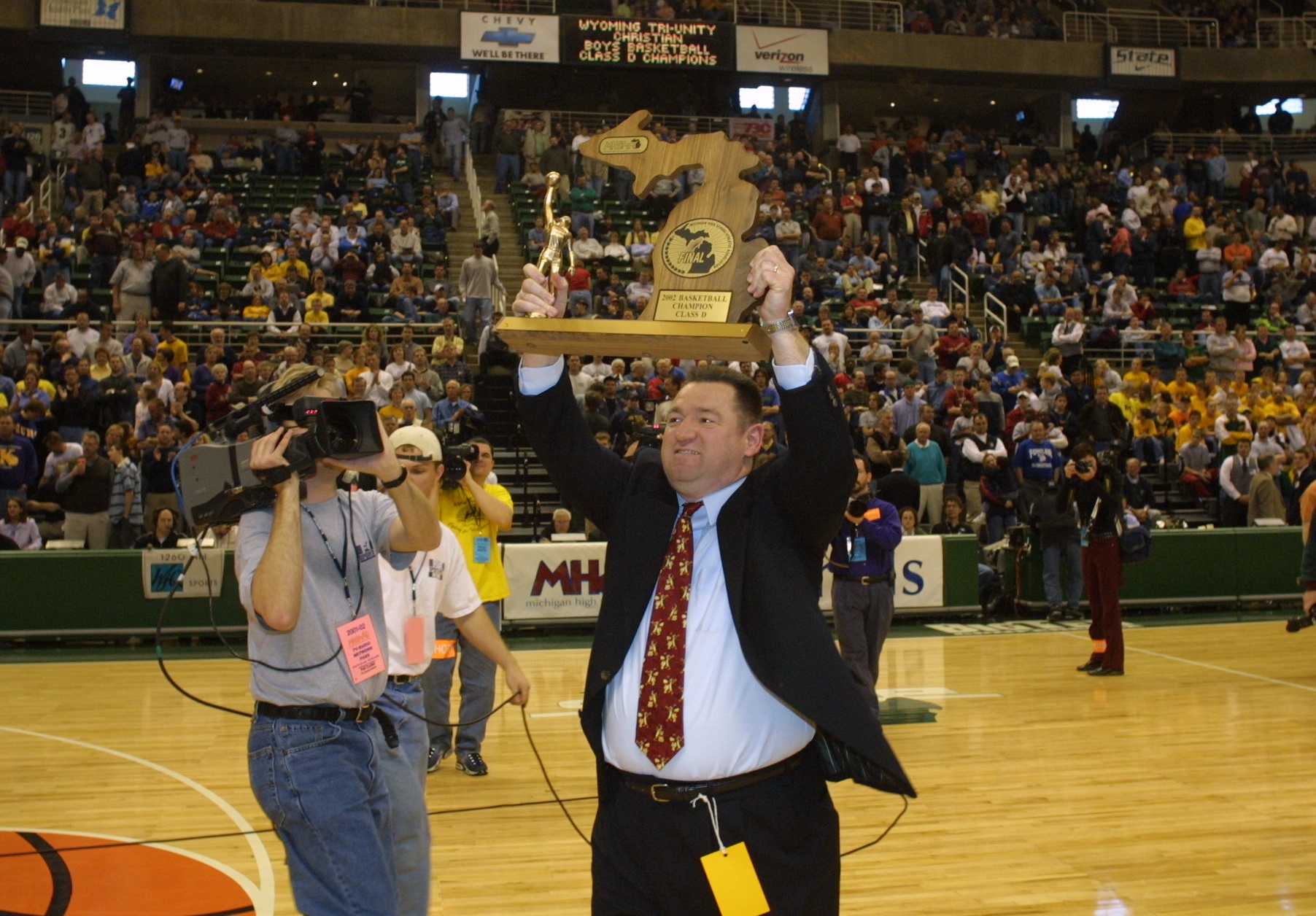
Keeler returned for the 1990-91 season and has been at the forefront ever since. He has guided the Defenders to six state championships, including last year’s with a victory over Mount Pleasant Sacred Heart in the Division 4 Final. Tri-unity also has won titles in 1996, 2002, 2006, 2011 and 2022, while finishing as Finals runner-up six times.
Keeler’s teams also have reached the Semifinals 15 times, won 19 Regional championships, 26 District titles and 22 conference championships. His players have filled Class D and Division 4 all-state teams for years, with surely the best-known 2000 grad Chris Kaman – who went on to play at Central Michigan and 13 seasons in the NBA – and Brandon Voorhees, who led Tri-unity to the 2002 title as a senior, went on to CMU and then Park University in Missouri, and played professionally overseas.
“I’m so glad that I’ve been able to just be here this long,” said Keeler, who was inducted into the Basketball Coaches Association of Michigan Hall of Fame in 2016. “I love Tri-unity. My wife taught there, we met there, and my daughters went all the way through and graduated from there, so it's always been a part of my life. There's been so many quality people that have been there along the way.
“I've been very blessed to have had so many quality players and parents and coaches. It’s amazing when I look back at all those that have been a part of the program.”
Keeler, a man with a strong Christian faith, could’ve gone elsewhere during his career, but believed he had a calling at Tri-unity.
“I've had some opportunities to move on and go to different places, but whenever I prayed about it I always thought that this is where the Lord wanted me and that's always my priority,” Keeler said. “I want to please him first, because as a Christian that's my priority. I just thought this is where he placed me, so I’m going to set roots and do the best I can.”
Tri-unity senior guard Keaton Blanker, one of two returning starters on this year’s team, is excited to see his coach reach such a prestigious milestone.
“It’s the perfect scenario for him with this being his last year and getting to 700 wins,” Blanker said. “He’s going to leave his mark, and it’s well deserved. Being a small Division 4 school, he’s helped to put the program on the map and I remember growing up and watching his teams win state titles. I was waiting for the opportunity to play for him so I could help do the same thing.”
While Keeler is grateful for the unbridled success of the program on the court, creating lasting relationships with his players off the court and helping them grow in their faith has been equally gratifying.
 “I know without a doubt that the Lord has blessed our program.” Keeler said. “There are a lot of great coaches out there that are probably better at Xs and Os than I am, but I think I’m a strong motivator and build good relationships with the players and get to know them.
“I let each player know that I want them to grow in their walk with the Lord, and that's where my priority is. To be an influence toward Christ, not away from Christ.”
Past Tri-unity standout Brent Voorhees, who has been Keeler’s assistant coach the last several years and will succeed him next season, said Keeler has never changed his approach to the game.
“Coming back to coach with him, the one thing that stands out is he doesn't waver on his principles,” Voorhees said. “A lot has changed in the sport in terms of analytics and how coaches attack things, but he has definitely stayed firm in his approach that it’s defense first and he preaches the team aspect. It’s never about an individual.
“He doesn’t let anything off the court distract him from goals. He's really good at keeping the goal in front of the guys. He keeps them focused on the goal of winning state championships and also becoming great, young Christian men in the community, which is what he stands for and always comes first.”
The Defenders graduated eight players from last year’s team, but Blanker and senior Joey Mellon are back with several newcomers as they bid to send Keeler out with one more title at Breslin Center.
“I enjoy putting them together and getting them to mesh as a team,” Keeler said. “For me, I have learned that defense wins championships. The old adage that offense wins games, but defense wins championships ... I so believe that with all my heart.”
Reporter Dean Holzwarth, a longtime member of the West Michigan media, is also the junior varsity head coach and a varsity assistant for the Tri-unity Christian boys basketball program.
 Dean Holzwarth has covered primarily high school sports for Grand Rapids-based WOOD-TV for five years after serving at the Grand Rapids Press and MLive for 16 years along with shorter stints at the Ionia Sentinel and WZZM. Contact him at [email protected] with story ideas for Allegan, Kent and Ottawa counties.
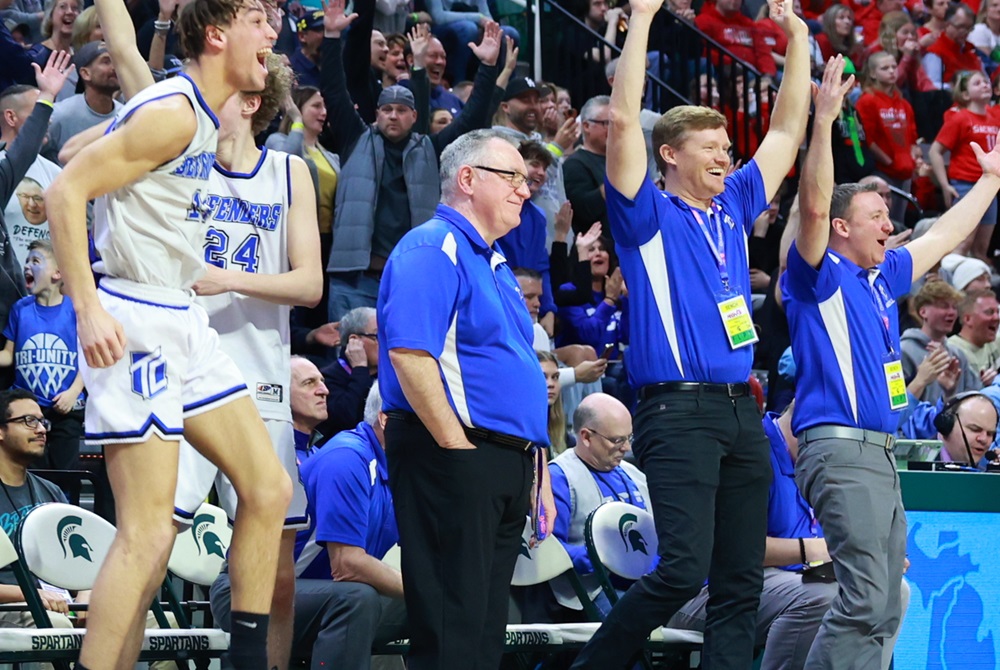
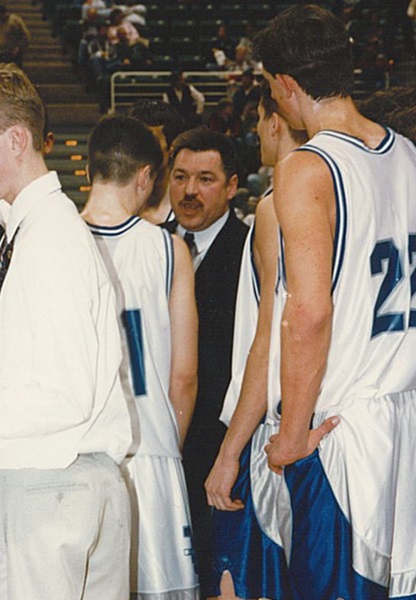
PHOTOS (Top) Surrounded by celebrating players and assistant coaches (including the author, far right), Tri-unity boys basketball coach Mark Keeler (hand in pocket) enjoys a moment near the end of last season’s Division 4 championship game. (Middle) Keeler, middle, huddles with his team during the 1997 run to Breslin, when the Defenders finished Class D runners-up. (Below) Keeler raises the 2002 Class D championship trophy to the cheers of Tri-unity’s supporters. (MHSAA file photos.)