

Casting Lines for Future Tournaments
August 12, 2016
By Jack Roberts
MHSAA Executive Director
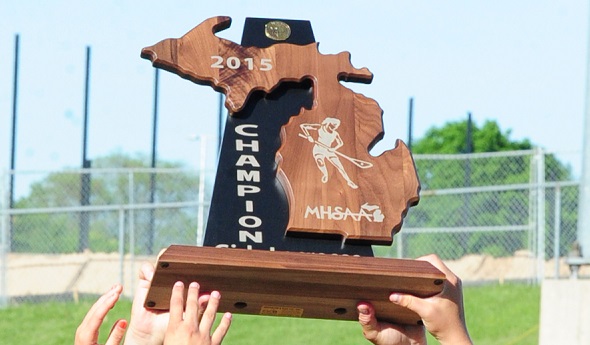
The MHSAA is best known to the public for the tournaments it conducts to conclude the fall, winter and spring seasons each school year.
These tournaments, the first and largest program of the MHSAA, have survived the Vietnam War, the Korean conflict and two World Wars. They have survived the technology bubble, the housing collapse, the energy crisis and the Great Depression.
MHSAA tournaments existed at the dawn of aviation and at the time of our nation’s lunar landing. Popes, presidents and governors have changed and changed again and again, and MHSAA tournaments roll on year after year.
But the sense of tradition and permanence and inevitability of MHSAA tournaments doesn’t dissuade us from asking questions about our tournaments, even some of the most basic questions. Here are two.
Question #1
I have long been and will always be an advocate for a Ryder Cup format for the MHSAA Golf Finals, and a team tennis approach to the MHSAA Tennis Finals; but 90 years of tradition is hard to overcome. Might this be a more exciting format? Could it be co-ed? Could it reverse the decline in boys tennis participation, and increase girls golf participation? Wouldn’t it be fun to try?
Periodically, the International Olympic Committee requires each of the designated Olympic sports to defend its status, to state its case why the sport should remain a part of the Olympic program. Then, after a series or votes that retain one sport at a time, the IOC drops the sport that makes the weakest case. It does so to make room for one of the previously unlisted sports that makes the best case for inclusion.
This would appear to keep the existing Olympic sports on their toes, and to keep the Olympic movement fresh and reflective of modern trends in sports.
While I would not enjoy the controversy, I can see the potential for some positive results if the MHSAA were to invoke the same policy for determining the 14 tournaments it will provide for girls and the 14 for boys.
This might cause us to consider more deeply what a high school sport should look like, or at least what an MHSAA tournament sport should stand for.
On the one hand, we might be inclined to drop tournaments for those sports that involve mostly non-faculty coaches and non-school venues, or require cooperative programs to generate enough participants to support a team, or resort almost entirely to non-school funding, or cater to individuals more than teams.
Or perhaps this process would cause policymakers to forget traditional thinking and ask: “In this day and age, should we shake off traditional notions of sport and consider more where modern kids are coming from?” That might mean fewer team sports and more individual sports, more “extreme” sports like snowboarding and skateboarding, and more lifetime sports, meaning not just golf and tennis and running sports, but also fishing and even shooting sports.
Currently, MHSAA policy states that the MHSAA will consider sponsorship of a tournament series for any sport which 64 member schools conduct on an interscholastic basis as a result of action by the governing boards of those schools.
Should the only question be how many schools sponsor a sport, or must an activity also have certain qualities and/or avoid certain “defects?” What should an MHSAA tournament sport look like and stand for?
Question #2
Bristling from criticism that his association is a money-grabbing exploiter of children, my counterpart in another state said, “If we were running our programs just to make money, we would do very many things very differently.” I knew exactly what he meant.
Because we care about the health and welfare of students, because we mean what we say that the athletic program needs to maximize the ways it enhances the school experience while minimizing academic conflicts, and because we try to model our claim that no sport is a minor sport when it comes to its potential to teach young people life lessons, we operate our programs in ways that make promoters, marketers and business entrepreneurs laugh, cry or cringe.
If money were the only object, we would seed and select sites to assure the teams that attracted the most spectators had the best chance to advance in our tournaments, regardless of the travel for any team or its fan base. If money were the only object, we would never schedule two tournaments to overlap and compete for public attention, much less tolerate three or four overlapping events. If money were the only object, we would allow signage like NASCAR events and promotions like minor league baseball games.
Those approaches to event sponsorship may not be all wrong; they’re just not all right for us. And we will live with the consequences of our belief system.
During a typical school year, more than 20 percent of the MHSAA’s 2,097 District, Regional and Final tournaments lose money. Not a single site in golf, skiing or tennis makes a single penny. In no sport did every District, Regional and Final site have revenue in excess of direct expenses.
In fact, in only three sports – boys and girls basketball and football – is revenue so much greater than direct expenses overall that it helps to pay for all the other tournaments in which the MHSAA invests.
That’s right: invests. When we present our budget to our board, we talk about the MHSAA’s investment in providing tournament opportunities in all those sports and all those places that cannot sustain the cost of those events on their own. How much is this investment worth to students, schools and society?
These two are core questions that require our focus far in advance of talk about scheduling, site selection, seeding and the myriad matters that too often hijack our time and attention.
Major Goal Accomplished as Three Rivers Racers Continue to Accelerate
By
Scott Hassinger
Special for MHSAA.com
October 8, 2024
THREE RIVERS – Sulley Zietlow and his teammates on the Three Rivers boys cross country team discussed their goals for the 2024 season prior to starting an early-evening workout back in June.
 With several experienced returners, coach Jason Muckel and his Wildcats set the bar high for success this Fall.
One of Three Rivers' preseason goals was to end Otsego's lengthy Wolverine Conference dual-meet winning streak.
The Wildcats quickly circled Tuesday, Sept. 17, as an important date on this fall’s schedule.
"Before the season began, we knew we were going to be running Otsego on our home course. We built our training plan around that race and made sure that our kids were ready to go," Muckel said.
Competing on its hilly home course at Meyer-Broadway Park, Three Rivers edged Otsego 24-31 thus ending the Bulldogs' 68-meet winning streak dating back to 2014.
Otsego, the 2021 Lower Peninsula Division 2 champion, has long been a state power under longtime head coach Steve Long. The Bulldogs have produced several talented runners, including 2018 individual Finals champion Alex Comerford, who went on to run at Syracuse University.
"I give Otsego a lot of credit for what they've done. Steve has built an incredible program. I have a lot of respect for him and his runners,” Muckel said. “He's helped me a lot here and there over the last few years, and I've learned a great deal from him."
Three Rivers, Plainwell and Otsego are currently tied for first in the league at 4-1 with two league duals plus next week's Wolverine Conference Meet in Otsego remaining. The Wildcats will need to win the league meet to earn an outright league title.
Zietlow, a three-time Finals qualifier, holds down Three Rivers' No. 1 spot and is also the top runner in the conference. The Wildcats qualified for the Finals as a team at the end of his freshman and junior seasons. He also qualified his sophomore year as an individual. As a junior he placed 52nd in LPD2 with a time of 16:18.9.
"Sulley is the top runner in our league and is beating the field by 30 or 40 seconds. He's gritty, hardworking, does whatever I ask of him and is the most committed runner I've ever had. He crushes everything he does," Muckel said.
Zietlow, who plans to continue his education and running career at Cornerstone University, ran a lifetime personal-best time of 15:52.4 in late August at the Under the Lights Invitational at Grand Rapids South Christian. He bested the field in the home victories over Otsego and Edwardsburg with a time of 16:12, his fastest on Three Rivers' home course.
"That (Otsego) win was very exciting and memorable,” Zietlow said. “This is the best team we've had here in a while. Our depth is good, and we want our pack time to be within a minute by season's end. I think we could take Top 10 in the state if reach our potential. The commitment, drive and positivity of our team is improved over last year."
 Winning a conference title and qualifying again for the Finals are both reachable goals for he and his teammates.
"I've ran for the last 493 days, and I've worked extremely hard to get where I am at this point. Our team is in good shape," Zietlow said.
Junior Charlie Brauer is Three Rivers' No. 2 runner.
"Charlie has made huge strides after fighting injuries the past couple years,” Muckel noted. “His CrossFit training and commitment to running a lot of miles over the summer have helped him make big gains. He's solidified himself as our number two runner and has a shot to finish among the top five or six in our conference."
Brauer clocked a personal-best of 16:35.03 at the Otsego Invitational, where Three Rivers took fourth.
"I'm kind of surprised to be our No. 2 runner,” Brauer said. “I do CrossFit training and that's helped me improve my kick along with my overall fitness. The last mile is the best part of my race."
Juniors Reece Howes (17:12) and Jonah Zietlow (17:18), Sulley's younger brother, have alternated as the Wildcats' Nos. 3 and 4 runners. Classmates Trey Hall (18:26) and Dontrel Taylor (18:26), along with freshman David Kore (17:48) round out Three Rivers' top seven.
"David is starting to race well against the older guys and can hold his own,” Muckel said. “If we're able to do some special things down the stretch here, a lot of that will depend on the performances of David, Reece and Jonah. Our sixth, seventh and eighth guys are working hard so they can step up if we incur an injury at some point."
Jonah Zietlow outlined his goals for the Wildcats the remainder of the season.
"It just depends what day it is and who steps up for us. We push one another to go faster,” he said. “If one of us isn't having the best race, we all work harder to make up for it.
“I'd like to solidify that No. 3 spot and get my time down under 17 minutes by the end of this season. I have a pretty strong kick, so that's a big key for me."
In the dual against Otsego, Zietlow played a key role by earning fourth overall while outpacing the Bulldogs' No. 2 and No. 3 runners after catching them with about 600 meters remaining.
He noted the team’s level of dedication is the highest he's seen since joining the program as a freshman. The top five runners for Three Rivers all logged more than 500 miles during the summer.
Muckel is pleased with the times his runners are posting, especially now since the Wildcats have started competing on some different kinds of courses and terrain.
"Up until the last week or two our times weren't quite as good on paper as we wanted them,” Muckel said. “That's because we were running some more difficult courses. Now as we get into running some flatter courses, our guys are excited to be able to show off their speed a little.
"In practice we do a workout called core sections, which is designed to split our course into sections and attack one of them at a time. We've done some very intentional workouts to prepare for races like our home course. I always talk to our kids about getting a good mileage base in the summer. Then we enter racing mode as the season starts. Now we're in championship gear, where we try to perfect our craft."
Three Rivers won its own Hill Climb Invitational followed by runner-up finishes at the Under The Lights and Battle Creek Lakeview invitationals, a third place at the Southwest Michigan Robuster Invite and a fourth-place finish at the Otsego Invite.
"My philosophy as a coach is to take our team to those difficult meets. We might take our licks early in the season, but it prepares us for the races that matter the most later on and builds character," Muckel said.
 Three Rivers frequently splits its boys practices up into two sessions.
"Each of our kids are committed,” said Muckel, who is in his third season coaching both the boys and girls Three Rivers teams. “As a coach I don't like to do an eight or nine-mile workout. Instead, we have our boys come in for a morning run and return in the afternoon for a five or six-mile practice. By breaking up those workouts, it’s easier on the body and keeps us healthier throughout the season.
"When I took over the program, there were some bad habits we had to break out of that first year. I basically have the boys run seven days a week now, which is something they weren't willing to do in the beginning.”
An individual goal-setting strategy has become a fun motivator.
“I ordered little mini records, and each kid is required to set goal-times and write them down. When they break that time during the season they get to break that record in half,” Muckel said. “These kinds of things have really helped the kids buy into our program and take ownership of it.”
***
After graduating nine seniors last year, Muckel is rebuilding his girls squad. His top two runners Brynn Copenhaver and Lillie Kerr are only sophomores.
"We have a young core of runners in our top of the pack who are learning to race. It's a talented group, and I believe we'll see a lot of cool things out of them in the next few seasons," Muckel said.
He noted several activities his boys and girls teams enjoy together as part of building a memorable all-around experience in the sport. Among those is the program’s summer camp involving both teams, which included four days this past offseason at Warner Camp in South Haven.
“Bringing our boys and girls teams together has also been really beneficial,” Muckel said. “While we are (at camp) we participate in a high ropes course, water ball and other activities and we get our workouts in as well. We use that time to solidify the team culture and do team-building tasks.”
 Scott Hassinger is a contributing sportswriter for Leader Publications and previously served as the sports editor for the Three Rivers Commercial-News from 1994-2022. He can be reached at [email protected] with story ideas for Berrien, Cass, St. Joseph and Branch counties.
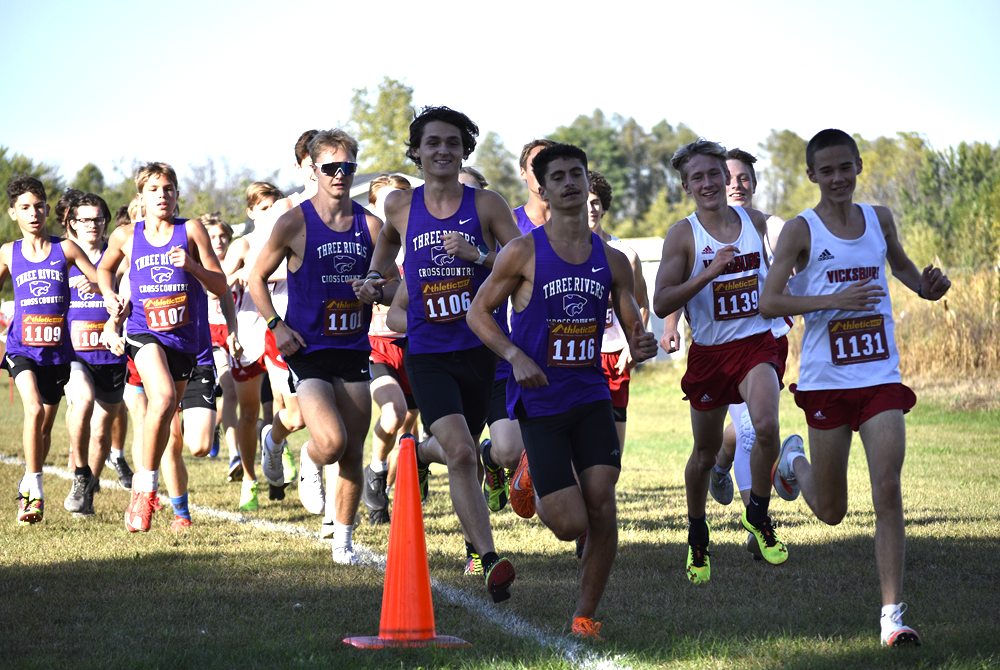
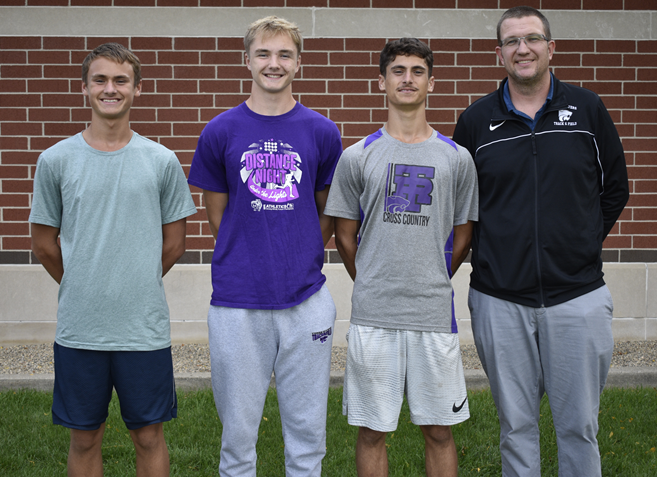
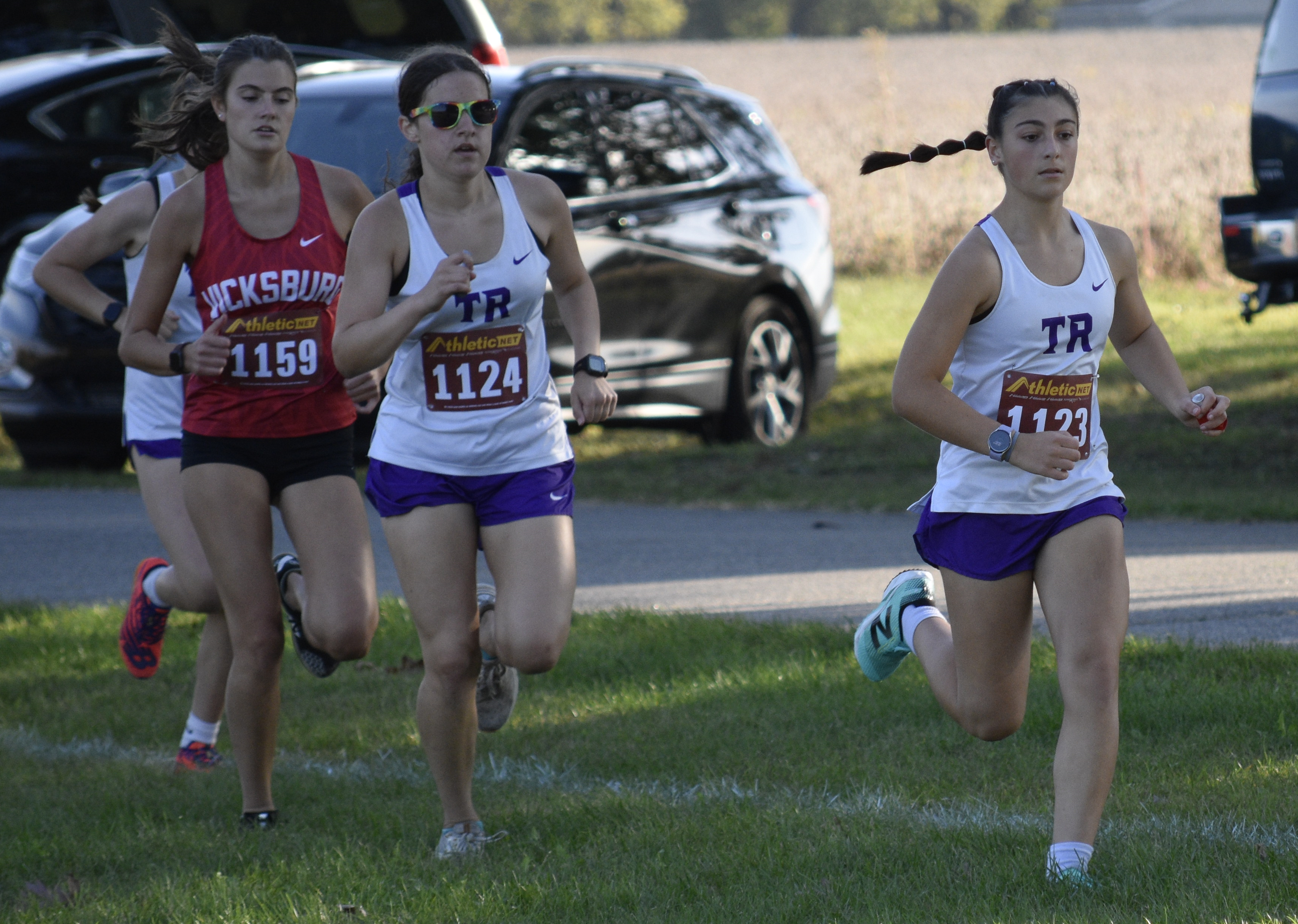
PHOTOS (Top) Three Rivers and Vicksburg runners take off at the start of the boys race last week at Indian Lake Nazarene Camp. (Middle) Pictured from left are Three Rivers juniors Jonah Zietlow and Charlie Brauer, senior Sulley Zietlow and Three Rivers head cross country coach Jason Muckel. (Below) Lillie Kerr, right, and teammate Gabby Kilbourn lead Three Rivers in the girls race against Vicksburg last week. (Photos by Scott Hassinger.)