

Casting Lines for Future Tournaments
August 12, 2016
By Jack Roberts
MHSAA Executive Director
The MHSAA is best known to the public for the tournaments it conducts to conclude the fall, winter and spring seasons each school year.
These tournaments, the first and largest program of the MHSAA, have survived the Vietnam War, the Korean conflict and two World Wars. They have survived the technology bubble, the housing collapse, the energy crisis and the Great Depression.
MHSAA tournaments existed at the dawn of aviation and at the time of our nation’s lunar landing. Popes, presidents and governors have changed and changed again and again, and MHSAA tournaments roll on year after year.
But the sense of tradition and permanence and inevitability of MHSAA tournaments doesn’t dissuade us from asking questions about our tournaments, even some of the most basic questions. Here are two.
Question #1
I have long been and will always be an advocate for a Ryder Cup format for the MHSAA Golf Finals, and a team tennis approach to the MHSAA Tennis Finals; but 90 years of tradition is hard to overcome. Might this be a more exciting format? Could it be co-ed? Could it reverse the decline in boys tennis participation, and increase girls golf participation? Wouldn’t it be fun to try?
Periodically, the International Olympic Committee requires each of the designated Olympic sports to defend its status, to state its case why the sport should remain a part of the Olympic program. Then, after a series or votes that retain one sport at a time, the IOC drops the sport that makes the weakest case. It does so to make room for one of the previously unlisted sports that makes the best case for inclusion.
This would appear to keep the existing Olympic sports on their toes, and to keep the Olympic movement fresh and reflective of modern trends in sports.
While I would not enjoy the controversy, I can see the potential for some positive results if the MHSAA were to invoke the same policy for determining the 14 tournaments it will provide for girls and the 14 for boys.
This might cause us to consider more deeply what a high school sport should look like, or at least what an MHSAA tournament sport should stand for.
On the one hand, we might be inclined to drop tournaments for those sports that involve mostly non-faculty coaches and non-school venues, or require cooperative programs to generate enough participants to support a team, or resort almost entirely to non-school funding, or cater to individuals more than teams.
Or perhaps this process would cause policymakers to forget traditional thinking and ask: “In this day and age, should we shake off traditional notions of sport and consider more where modern kids are coming from?” That might mean fewer team sports and more individual sports, more “extreme” sports like snowboarding and skateboarding, and more lifetime sports, meaning not just golf and tennis and running sports, but also fishing and even shooting sports.
Currently, MHSAA policy states that the MHSAA will consider sponsorship of a tournament series for any sport which 64 member schools conduct on an interscholastic basis as a result of action by the governing boards of those schools.
Should the only question be how many schools sponsor a sport, or must an activity also have certain qualities and/or avoid certain “defects?” What should an MHSAA tournament sport look like and stand for?
Question #2
Bristling from criticism that his association is a money-grabbing exploiter of children, my counterpart in another state said, “If we were running our programs just to make money, we would do very many things very differently.” I knew exactly what he meant.
Because we care about the health and welfare of students, because we mean what we say that the athletic program needs to maximize the ways it enhances the school experience while minimizing academic conflicts, and because we try to model our claim that no sport is a minor sport when it comes to its potential to teach young people life lessons, we operate our programs in ways that make promoters, marketers and business entrepreneurs laugh, cry or cringe.
If money were the only object, we would seed and select sites to assure the teams that attracted the most spectators had the best chance to advance in our tournaments, regardless of the travel for any team or its fan base. If money were the only object, we would never schedule two tournaments to overlap and compete for public attention, much less tolerate three or four overlapping events. If money were the only object, we would allow signage like NASCAR events and promotions like minor league baseball games.
Those approaches to event sponsorship may not be all wrong; they’re just not all right for us. And we will live with the consequences of our belief system.
During a typical school year, more than 20 percent of the MHSAA’s 2,097 District, Regional and Final tournaments lose money. Not a single site in golf, skiing or tennis makes a single penny. In no sport did every District, Regional and Final site have revenue in excess of direct expenses.
In fact, in only three sports – boys and girls basketball and football – is revenue so much greater than direct expenses overall that it helps to pay for all the other tournaments in which the MHSAA invests.
That’s right: invests. When we present our budget to our board, we talk about the MHSAA’s investment in providing tournament opportunities in all those sports and all those places that cannot sustain the cost of those events on their own. How much is this investment worth to students, schools and society?
These two are core questions that require our focus far in advance of talk about scheduling, site selection, seeding and the myriad matters that too often hijack our time and attention.

Longtime Coach Lukens Remembered for Building Champions, Changing Lives
By
Tom Spencer
Special for MHSAA.com
September 27, 2024
The results speak for themselves as there were conference, Regional and MHSAA Finals championship and runner-up finishes.
 But those accomplishments are not necessarily why Don Lukens will be remembered by most. It will be for the lives he touched and successes his student-athletes found after graduation.
Lukens impacted two communities separated by 200 miles during multi-decade coaching tenures for multiple high school programs.
Lukens died Sept. 15 at age 90. He was well-known across the state for his coaching as he spent 27 years teaching at Kalamazoo Loy Norrix, where he coached with Ted Duckett, and 33 years coaching at Traverse City Central with John Lober. Duckett, now 78, and Lober, 82, are still coaching today.
Tico Duckett, one of the most accomplished running backs in Michigan State University football history, is one of thousands of kids Lukens recruited into the running world. Duckett, who went on to play in the National Football League, credits Lukens for recruiting first-time track athletes from challenging life situations and turning them into college scholarship recipients.
Lukens knew how to get the best individual performances out his athletes, recalled Duckett, whose high school running career ended with a hamstring injury sustained during Regional preliminary sprints.
“I can tell story after story of kids that he plucked out of class, and they are successful today,” said the first MSU back to rush three times for more than 1,000 yards. “Between him and my dad, they would take kids that had no direction, no future, no hope and bring them in and teach them track and teach kids what you put into it is what you’re going to get out.”
Lukens had graduated from Western Michigan University where he’d participated in football and track. During his 38 years coaching track, Lukens’ teams posted a dual meet record of 220-24, won 20 conference championships, nine MHSAA Regional championships, a Lower Peninsula Class A title and finished runners-up twice.
Lukens’ cross country teams also were impressive with a record of 198-60 during his 34 years of coaching. They won 14 conference championships and 12 MHSAA Regional titles.
Tico Duckett has memories of being recruited to the sport as a child while his father served as an assistant coach at Loy Norrix.
“Coach Lukens would say, ‘I can’t wait ’til you get here,’” the former MSU star fondly recollected. “Coach Lukens loved track – he breathed and ate track.”
Loy Norrix hosts the highly-competitive Don Lukens Relays every May. Duckett attended this year’s meet as he often does. It was Lukens’ ability to recruit and coach track that made the Knights stand out across the state.
 “Loy Norrix track was special,” said Duckett, proudly noting the Knights’ dual-meet dominance. “When we would go places and get off the bus, people would literally say, ‘There’s Loy Norrix,’ and they would literally talk about us, and we would show ’em on the track and we backed it up.”
Inside the halls and walls of Loy Norrix, the Duckett name is engraved on trophies and next to track & field records earned by Tico Duckett and his brother TJ, who also went on to play professional football. Ted Duckett took over the head coaching duties when Lukens retired and moved to Platte Lake in Benzie County.
Word traveled fast that Lukens had arrived in Northern Michigan, and he immediately was asked to help Benzie Central by another legendary coach, Pete Moss, who died in 2019.
Lober ran across Lukens at a meet at Benzie and recruited him to coach distance running at Traverse City Central – which at the time had just five athletes committed to participate in those races.
Central had a prior history of success in sprints and field events, but the Trojans won the 1992 Class A title as their distance runners had become competitive enough to start contributing points at the Finals.
“We started coaching together in 1989, and we had 30-plus glorious years together,” Lober said. “We ended up qualifying right off the bat for the state finals, and we went 16 years in a row.”
Lober too was known for his recruiting to the sport.
“When we talked with kids, I’d be talking in one side of the kid’s ear and Don would be talking in the other,” Lober said with a laugh. “By the time we were done, the kid didn’t have a prayer of not joining the team.”
Lukens continued at Central until 2021, stepping aside as he ended 62 years of coaching.
Cody Inglis, now a senior assistant director for the MHSAA, served as Central’s athletic director while Lukens coached. He was well aware of Lukens’s coaching at Loy Norrix as he grew up a distance runner for nearby Portage Northern.
Inglis noted most of Northern Michigan knew very little of Lukens’ resume prior to his coming north. Inglis was coaching and serving as athletic director at the time for Suttons Bay when Lukens first joined the Trojans.
“People in Traverse City didn’t understand the success he had at Loy Norrix,” Inglis said. “I remember thinking, ‘Oh my gosh, Traverse City Central was good, and they’ll be even better’ and it’s no secret that the reason their cross country program took off was because of Don Lukens.”
Lukens won the inaugural Coaching Legacy Award at the 2019 Traverse City Record-Eagle/John Lober Honor Roll Meet. Going forward, the award will be named after Lukens.
Lukens is survived by his wife Rosinda, daughters Paige Gray of Gladwin, Wendy Pohl of Kalamazoo and Donyelle Hayhoe of Lansing, and five grandchildren: Brynn Rusch, Ian Gray, Westyn Hayhoe, Travis Hayhoe and Lucas Hayhoe.
The Trojans will host a memorial tribute to Lukens the day after next year’s Bayshore Marathon in Traverse City. A graveside service was held for Lukens on Monday at the Benzonia Township Cemetery.
 Tom Spencer is a longtime MHSAA-registered basketball and soccer official, and former softball and baseball official, and he also has coached in the northern Lower Peninsula area. He previously has written for the Saginaw News, Bay County Sports Page and Midland Daily News. He can be reached at [email protected] with story ideas for Manistee, Wexford, Missaukee, Roscommon, Ogemaw, Iosco, Alcona, Oscoda, Crawford, Kalkaska, Grand Traverse, Benzie, Leelanau, Antrim, Otsego, Montmorency, Alpena, Presque Isle, Cheboygan, Charlevoix and Emmet counties.
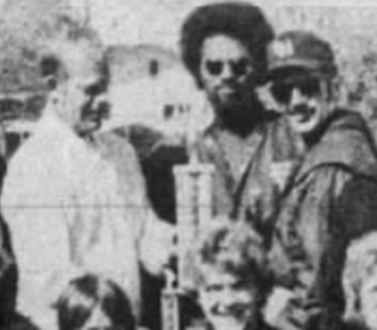
PHOTOS (Top) Longtime coach Don Lukens, far left, is pictured during the 2015 LP Cross Country Finals with past Traverse City Central runner John Steen (center) and Trojans coach John Lober, with Jane and Jack Steen standings in front. Jane and Jack Steen are current Traverse City Central runners. (Middle) The Niles Daily Star published this 1976 photo of Lukens (back row, second from right) and coach Ted Duckett (back row, center) receiving the championship trophy at the Daily Star Relays from publisher Bill Applebee. (Top photo courtesy of John Lober.)