

Casting Lines for Future Tournaments
August 12, 2016
By Jack Roberts
MHSAA Executive Director
The MHSAA is best known to the public for the tournaments it conducts to conclude the fall, winter and spring seasons each school year.
These tournaments, the first and largest program of the MHSAA, have survived the Vietnam War, the Korean conflict and two World Wars. They have survived the technology bubble, the housing collapse, the energy crisis and the Great Depression.
MHSAA tournaments existed at the dawn of aviation and at the time of our nation’s lunar landing. Popes, presidents and governors have changed and changed again and again, and MHSAA tournaments roll on year after year.
But the sense of tradition and permanence and inevitability of MHSAA tournaments doesn’t dissuade us from asking questions about our tournaments, even some of the most basic questions. Here are two.
Question #1
I have long been and will always be an advocate for a Ryder Cup format for the MHSAA Golf Finals, and a team tennis approach to the MHSAA Tennis Finals; but 90 years of tradition is hard to overcome. Might this be a more exciting format? Could it be co-ed? Could it reverse the decline in boys tennis participation, and increase girls golf participation? Wouldn’t it be fun to try?
Periodically, the International Olympic Committee requires each of the designated Olympic sports to defend its status, to state its case why the sport should remain a part of the Olympic program. Then, after a series or votes that retain one sport at a time, the IOC drops the sport that makes the weakest case. It does so to make room for one of the previously unlisted sports that makes the best case for inclusion.
This would appear to keep the existing Olympic sports on their toes, and to keep the Olympic movement fresh and reflective of modern trends in sports.
While I would not enjoy the controversy, I can see the potential for some positive results if the MHSAA were to invoke the same policy for determining the 14 tournaments it will provide for girls and the 14 for boys.
This might cause us to consider more deeply what a high school sport should look like, or at least what an MHSAA tournament sport should stand for.
On the one hand, we might be inclined to drop tournaments for those sports that involve mostly non-faculty coaches and non-school venues, or require cooperative programs to generate enough participants to support a team, or resort almost entirely to non-school funding, or cater to individuals more than teams.
Or perhaps this process would cause policymakers to forget traditional thinking and ask: “In this day and age, should we shake off traditional notions of sport and consider more where modern kids are coming from?” That might mean fewer team sports and more individual sports, more “extreme” sports like snowboarding and skateboarding, and more lifetime sports, meaning not just golf and tennis and running sports, but also fishing and even shooting sports.
Currently, MHSAA policy states that the MHSAA will consider sponsorship of a tournament series for any sport which 64 member schools conduct on an interscholastic basis as a result of action by the governing boards of those schools.
Should the only question be how many schools sponsor a sport, or must an activity also have certain qualities and/or avoid certain “defects?” What should an MHSAA tournament sport look like and stand for?
Question #2
Bristling from criticism that his association is a money-grabbing exploiter of children, my counterpart in another state said, “If we were running our programs just to make money, we would do very many things very differently.” I knew exactly what he meant.
Because we care about the health and welfare of students, because we mean what we say that the athletic program needs to maximize the ways it enhances the school experience while minimizing academic conflicts, and because we try to model our claim that no sport is a minor sport when it comes to its potential to teach young people life lessons, we operate our programs in ways that make promoters, marketers and business entrepreneurs laugh, cry or cringe.
If money were the only object, we would seed and select sites to assure the teams that attracted the most spectators had the best chance to advance in our tournaments, regardless of the travel for any team or its fan base. If money were the only object, we would never schedule two tournaments to overlap and compete for public attention, much less tolerate three or four overlapping events. If money were the only object, we would allow signage like NASCAR events and promotions like minor league baseball games.
Those approaches to event sponsorship may not be all wrong; they’re just not all right for us. And we will live with the consequences of our belief system.
During a typical school year, more than 20 percent of the MHSAA’s 2,097 District, Regional and Final tournaments lose money. Not a single site in golf, skiing or tennis makes a single penny. In no sport did every District, Regional and Final site have revenue in excess of direct expenses.
In fact, in only three sports – boys and girls basketball and football – is revenue so much greater than direct expenses overall that it helps to pay for all the other tournaments in which the MHSAA invests.
That’s right: invests. When we present our budget to our board, we talk about the MHSAA’s investment in providing tournament opportunities in all those sports and all those places that cannot sustain the cost of those events on their own. How much is this investment worth to students, schools and society?
These two are core questions that require our focus far in advance of talk about scheduling, site selection, seeding and the myriad matters that too often hijack our time and attention.
Bentz Adds Next Chapter to Inspirational Story as Novi Christian Athletic Director
By
Keith Dunlap
Special for MHSAA.com
September 24, 2024
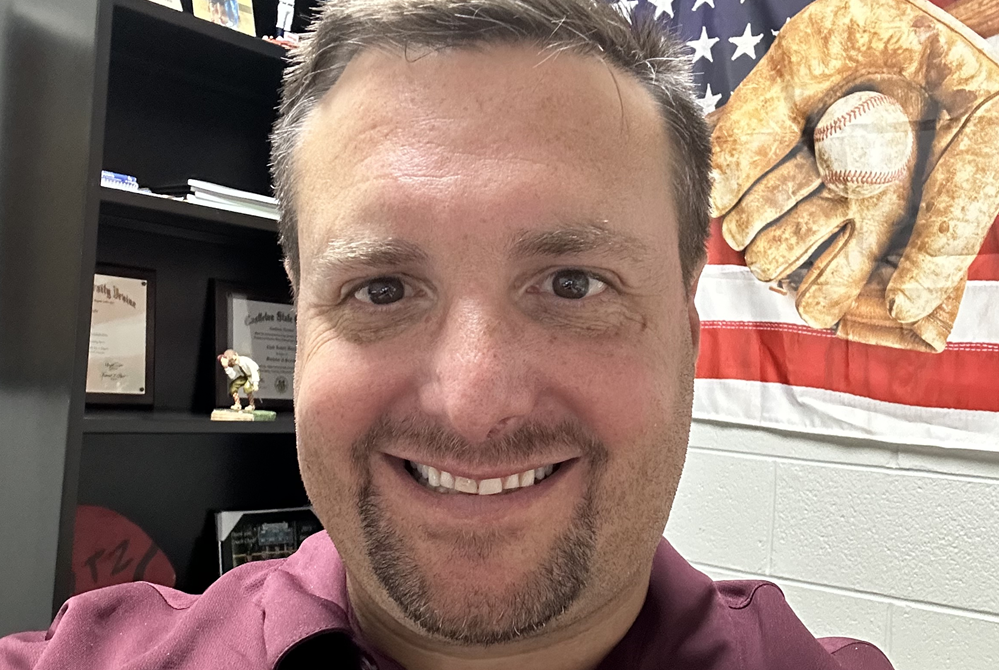
NOVI – For anyone seeking an inspirational speaker, new Novi Christian athletic director Chad Bentz has a story he’d like to tell.
 His includes the value of resilience, proof that improbable dreams can come true, and affirmation that mentors can change lives.
Bentz spent time in Major League Baseball, playing 36 games for the Montreal Expos in 2004 and four games in 2005 for the Miami Marlins as a left-handed relief pitcher.
The chances of making it to the big leagues are slim to begin with, but were even longer considering that Bentz grew up in Alaska.
On top of that, Bentz has a deformed right hand. When he debuted with the Expos, he followed in the footsteps of Jim Abbott, who also has a deformed right hand and starred at Flint Central and University of Michigan on the way to pitching for four MLB teams across 10 seasons.
Bentz was certainly a case of beating improbable odds, and watching Abbott while growing up was a big reason why.
“Everybody has their favorite players, but Jim was more than that to me,” Bentz said. “He gave me confidence to try things. I was always the kid with the weird hand. I always kept my hand in my pocket and was always self-conscious about it. Then I saw Jim pitching. He gave me confidence to try things, and thank goodness he did. When I tried things, I discovered I was good at it and got more confidence.”
It got even better for Bentz as a college freshman playing for Long Beach State, when he got to meet Abbott in during an unexpected visit.
“Meeting him was by far the most star-struck I’ve ever been,” he said. “We both stuck out our left hands to shake and it was the first time ever where it wasn’t that awkward. It was everything I thought it was going to be. He was incredibly nice, funny and just a good dude. That was one of my favorite moments. Kids being born, wedding and Jim.”
A big part of Bentz’ baseball development occurred in Michigan. Although he grew up in Alaska — he said he could’ve been a “Hall of Famer pitching inside of a gym” — Bentz would spend his summers in Michigan with family members in the Grand Rapids area.
He ended up hooking up with a travel ball team in the area, the Grand Rapids A’s, which was a step up from competition he saw in Alaska.
“I went down to Michigan, and I said, ‘OK, there are a lot of players in this country, and I am not as good as I thought I was,’” he said. “After my freshman year here (playing summer ball), I went back (to Alaska), and I started lifting and I didn’t stop. I kept working.”
Bentz eventually was drafted out of high school in the 34th round by the New York Yankees, played at Long Beach State and then was drafted in the seventh round by the Expos in 2001. In choosing baseball, he turned down opportunities to play football at Division I schools in what was then the PAC-10.
Bentz had been a standout linebacker and fullback, and when his baseball career was done, he began a college football career at age 30 playing for Castleton State College in Vermont.
“Playing college football at age 30 kind of gave me a taste of it, and that taste was that you should have done this 10 years ago,” Bentz quipped. “Not at 30. I was in slings every single Sunday. I couldn’t move. My arms were in slings. Both of them. But it was worth it. I loved and was thankful I had that opportunity. It filled that ‘what if’ type of thing.”
A husband and father of three, including 2-year-old twin boys, Bentz jumped on the chance to become the athletic director at Novi Christian and move to Michigan to not only be closer to family but give his kids a chance to be more active.
“Alaska is great, but it’s limiting,” Bentz said. “I told people that the grass isn’t going to be greener, but it’s just going to be a bigger yard and more swings for them to play on. We just wanted a little bit more opportunity.”
Bentz also said he would love the opportunity to speak in front of groups of people and share his journey in hopes of inspiring others, something he did regularly when he was in Major League Baseball at various ballparks.
"I was able to meet a lot of people of all ages who had any types of disabilities or anything,” he said. “I just know the kind of impact it can have. If I can do that and do a tiny bit of what Jim gave me, I’d like to pay it forward as much as possible.”
 Keith Dunlap has served in Detroit-area sports media for more than two decades, including as a sportswriter at the Oakland Press from 2001-16 primarily covering high school sports but also college and professional teams. His bylines also have appeared in USA Today, the Washington Post, the Detroit Free Press, the Houston Chronicle and the Boston Globe. He served as the administrator for the Oakland Activities Association’s website from 2017-2020. Contact him at [email protected] with story ideas for Oakland, Macomb and Wayne counties.
PHOTO courtesy of Chad Bentz.