

Casting Lines for Future Tournaments
August 12, 2016
By Jack Roberts
MHSAA Executive Director
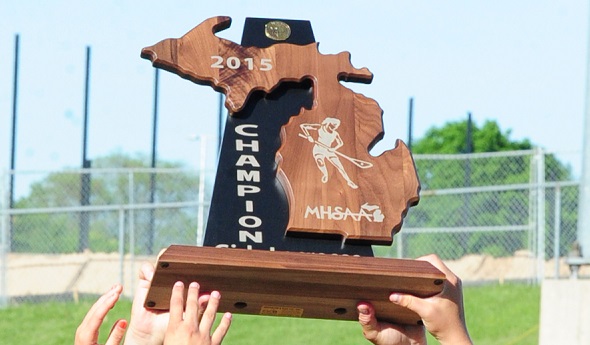
The MHSAA is best known to the public for the tournaments it conducts to conclude the fall, winter and spring seasons each school year.
These tournaments, the first and largest program of the MHSAA, have survived the Vietnam War, the Korean conflict and two World Wars. They have survived the technology bubble, the housing collapse, the energy crisis and the Great Depression.
MHSAA tournaments existed at the dawn of aviation and at the time of our nation’s lunar landing. Popes, presidents and governors have changed and changed again and again, and MHSAA tournaments roll on year after year.
But the sense of tradition and permanence and inevitability of MHSAA tournaments doesn’t dissuade us from asking questions about our tournaments, even some of the most basic questions. Here are two.
Question #1
I have long been and will always be an advocate for a Ryder Cup format for the MHSAA Golf Finals, and a team tennis approach to the MHSAA Tennis Finals; but 90 years of tradition is hard to overcome. Might this be a more exciting format? Could it be co-ed? Could it reverse the decline in boys tennis participation, and increase girls golf participation? Wouldn’t it be fun to try?
Periodically, the International Olympic Committee requires each of the designated Olympic sports to defend its status, to state its case why the sport should remain a part of the Olympic program. Then, after a series or votes that retain one sport at a time, the IOC drops the sport that makes the weakest case. It does so to make room for one of the previously unlisted sports that makes the best case for inclusion.
This would appear to keep the existing Olympic sports on their toes, and to keep the Olympic movement fresh and reflective of modern trends in sports.
While I would not enjoy the controversy, I can see the potential for some positive results if the MHSAA were to invoke the same policy for determining the 14 tournaments it will provide for girls and the 14 for boys.
This might cause us to consider more deeply what a high school sport should look like, or at least what an MHSAA tournament sport should stand for.
On the one hand, we might be inclined to drop tournaments for those sports that involve mostly non-faculty coaches and non-school venues, or require cooperative programs to generate enough participants to support a team, or resort almost entirely to non-school funding, or cater to individuals more than teams.
Or perhaps this process would cause policymakers to forget traditional thinking and ask: “In this day and age, should we shake off traditional notions of sport and consider more where modern kids are coming from?” That might mean fewer team sports and more individual sports, more “extreme” sports like snowboarding and skateboarding, and more lifetime sports, meaning not just golf and tennis and running sports, but also fishing and even shooting sports.
Currently, MHSAA policy states that the MHSAA will consider sponsorship of a tournament series for any sport which 64 member schools conduct on an interscholastic basis as a result of action by the governing boards of those schools.
Should the only question be how many schools sponsor a sport, or must an activity also have certain qualities and/or avoid certain “defects?” What should an MHSAA tournament sport look like and stand for?
Question #2
Bristling from criticism that his association is a money-grabbing exploiter of children, my counterpart in another state said, “If we were running our programs just to make money, we would do very many things very differently.” I knew exactly what he meant.
Because we care about the health and welfare of students, because we mean what we say that the athletic program needs to maximize the ways it enhances the school experience while minimizing academic conflicts, and because we try to model our claim that no sport is a minor sport when it comes to its potential to teach young people life lessons, we operate our programs in ways that make promoters, marketers and business entrepreneurs laugh, cry or cringe.
If money were the only object, we would seed and select sites to assure the teams that attracted the most spectators had the best chance to advance in our tournaments, regardless of the travel for any team or its fan base. If money were the only object, we would never schedule two tournaments to overlap and compete for public attention, much less tolerate three or four overlapping events. If money were the only object, we would allow signage like NASCAR events and promotions like minor league baseball games.
Those approaches to event sponsorship may not be all wrong; they’re just not all right for us. And we will live with the consequences of our belief system.
During a typical school year, more than 20 percent of the MHSAA’s 2,097 District, Regional and Final tournaments lose money. Not a single site in golf, skiing or tennis makes a single penny. In no sport did every District, Regional and Final site have revenue in excess of direct expenses.
In fact, in only three sports – boys and girls basketball and football – is revenue so much greater than direct expenses overall that it helps to pay for all the other tournaments in which the MHSAA invests.
That’s right: invests. When we present our budget to our board, we talk about the MHSAA’s investment in providing tournament opportunities in all those sports and all those places that cannot sustain the cost of those events on their own. How much is this investment worth to students, schools and society?
These two are core questions that require our focus far in advance of talk about scheduling, site selection, seeding and the myriad matters that too often hijack our time and attention.
Dedication Continues to Make Difference as Pittman Elevates Game, Shores' Offense
By
Tom Kendra
Special for MHSAA.com
September 11, 2024
Jonathan Pittman lives by the acronym “PGF.”
 “My mom gave me that life motto; it stands for 'Put God First,'” explained Pittman, the senior quarterback for Muskegon Mona Shores, which is off to a 2-0 start.
“That is the core of who I am.”
Those aren’t just words for Pittman, who starts every day – Monday through Friday, from 6 a.m. to 7, when much of the world and most 17-year-olds are still sleeping – by going to church to study his Mormon faith at the Spring Lake Ward of the Church of Jesus Christ of Latter-day Saints.
He heads directly from there to school, where he either practices throwing the football or shooting the basketball (Pittman is also a standout on the Sailors’ hoops team). Then it’s off to the classroom – where, by the way, he is a straight-A student in honors classes.
Only when all of that is completed does he switch his focus solely to football. The 6-foot-2, 205-pound senior is a three-year starter with a rocket arm and the power to run over linebackers like a fullback.
“Pitt is the hardest-working kid I have ever coached,” said 14th-year Mona Shores coach Matt Koziak, who has led the Sailors to four Division 2 championship games and won two, in 2019 and 2020.
“He is very critical of his own game. He identifies where he needs to get better, and he just keeps working at it.”
Koziak can track how much film his players are watching. One day, he checked and noticed that senior linebacker and film study devotee Solomon Robertson had logged two hours on that day. The only player with more was Pittman – with six hours.
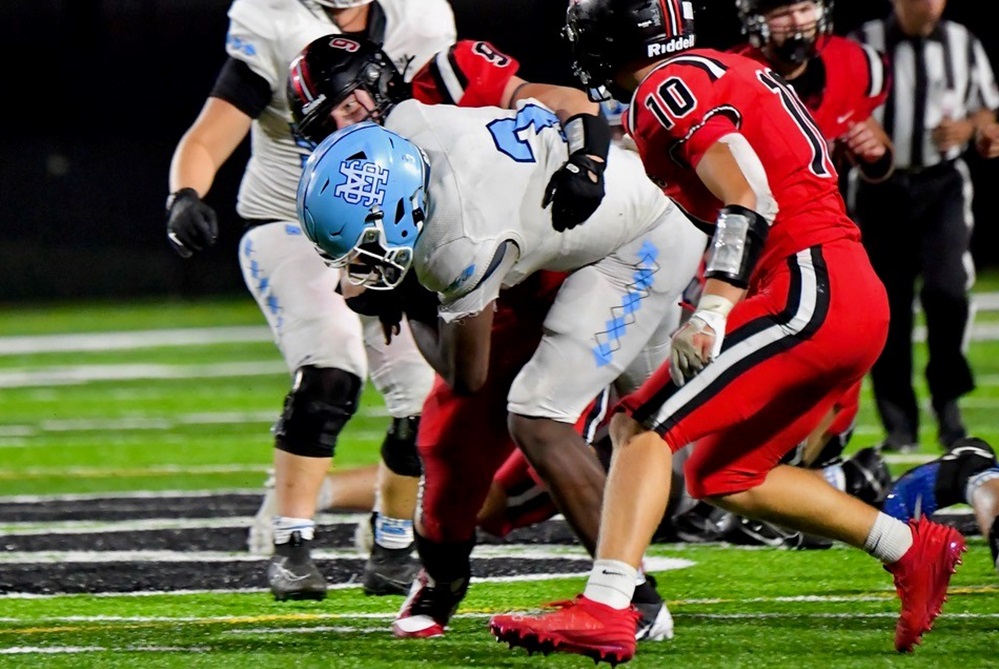
Pittman’s work ethic appears to be paying dividends, as he’s led the Sailors to impressive road wins over Grand Blanc (28-26) and River Rouge (21-6) to open the season and heading into yet another road game this week at undefeated Flint Hamady.
He did it with his feet against Grand Blanc, running 25 times for 192 yards and throwing for only 43. Against River Rouge, it was just the opposite – he completed 9-of-13 passes for 127 yards, while rushing for just 30.
Pittman comes from good pedigree. His father, also Jonathan Pittman, is a California native and former standout receiver at Brigham Young University who went on to play three years in the NFL for Buffalo, Tampa Bay and the New York Jets. His mother, Quintina, was a three-sport high school star whose college sports dreams were cut short by a knee injury.
 The Pittmans moved to Muskegon in 2014 when his father was hired as the general manager at The Lakes Mall, a position he held for five years. (The younger Pittman, who is the second oldest of four children, said his family is not related to any of the many Pittmans in the Muskegon area.)
Pittman has always had a big arm, which allowed him to earn the varsity starting role as a sophomore. Last fall, he completed 87-of-134 passes for 1,391 yards and 15 TDs. His main targets this fall are wideouts Jaeger Johnson and Micah Carafelle and tight end George Duggins.
Pittman is equally well-known for his power running, forming a tough-to-tackle 1-2 duo with junior running back Tomarion “Ike” Steward (5-11, 205).
The biggest improvement for Pittman so far this season has been his increased speed and agility, as he has slimmed down from 218 pounds to 205.
“I wasn’t as fast as I needed to be and couldn’t execute some of the things we like to run,” said Pittman. “I needed to work on that. Our offense is much more diverse this year. We have a ton of weapons, and we can hit teams from all angles.”
Koziak hopes his quicker quarterback will give his team the extra edge it needs in huge Ottawa-Kent Conference Green games at home against Byron Center (Sept. 20) and at Muskegon (Sept. 27) – both against likely Division 2 playoff opponents.
Shores made it to the Division 2 Final four times in eight years, losing to Warren De La Salle Collegiate in 2014 and 2018, then defeating Detroit Martin Luther King in 2019 and De La Salle in 2020. The Sailors have not advanced out of their District the past three years.
Right now, Shores is just waiting to play a game in West Michigan, and will have traveled 1,030 miles round-trip for their first three this season.
The most puzzling aspect of Pittman’s football career thus far is his surprisingly small number of college scholarship offers. Wayne State, Lawrence Tech and Siena Heights have made offers, while Eastern Michigan and Northern Illinois have made the trip to Muskegon to watch him throw.
Pittman, who plans to major in accounting, is not doing any lobbying – preferring to let his play on Friday nights speak for itself.
One thing is for certain: He has made a believer out of Koziak, who has been coaching football for more than 20 years, with prior stops as offensive coordinator at Muskegon Heights and head coach at Muskegon High in 2009.
“I will say this: Wherever he goes, by his junior year, he will be a team captain,” said Koziak. “You combine his athletic ability and his work ethic, and it’s magic. He’s a special kid; a generational kid.”
 Tom Kendra worked 23 years at The Muskegon Chronicle, including five as assistant sports editor and the final six as sports editor through 2011. E-mail him at [email protected] with story ideas for Muskegon, Oceana, Mason, Lake, Oceola, Mecosta and Newaygo counties.
PHOTOS (Top) Muskegon Mona Shores' Jonathan Pittman powers into the Grand Blanc defense during his team's season-opening win. (Middle) Pittman watches as a teammate carries the ball upfield. (Photos by Terry Lyons.)