

Casting Lines for Future Tournaments
August 12, 2016
By Jack Roberts
MHSAA Executive Director
The MHSAA is best known to the public for the tournaments it conducts to conclude the fall, winter and spring seasons each school year.
These tournaments, the first and largest program of the MHSAA, have survived the Vietnam War, the Korean conflict and two World Wars. They have survived the technology bubble, the housing collapse, the energy crisis and the Great Depression.
MHSAA tournaments existed at the dawn of aviation and at the time of our nation’s lunar landing. Popes, presidents and governors have changed and changed again and again, and MHSAA tournaments roll on year after year.
But the sense of tradition and permanence and inevitability of MHSAA tournaments doesn’t dissuade us from asking questions about our tournaments, even some of the most basic questions. Here are two.
Question #1
I have long been and will always be an advocate for a Ryder Cup format for the MHSAA Golf Finals, and a team tennis approach to the MHSAA Tennis Finals; but 90 years of tradition is hard to overcome. Might this be a more exciting format? Could it be co-ed? Could it reverse the decline in boys tennis participation, and increase girls golf participation? Wouldn’t it be fun to try?
Periodically, the International Olympic Committee requires each of the designated Olympic sports to defend its status, to state its case why the sport should remain a part of the Olympic program. Then, after a series or votes that retain one sport at a time, the IOC drops the sport that makes the weakest case. It does so to make room for one of the previously unlisted sports that makes the best case for inclusion.
This would appear to keep the existing Olympic sports on their toes, and to keep the Olympic movement fresh and reflective of modern trends in sports.
While I would not enjoy the controversy, I can see the potential for some positive results if the MHSAA were to invoke the same policy for determining the 14 tournaments it will provide for girls and the 14 for boys.
This might cause us to consider more deeply what a high school sport should look like, or at least what an MHSAA tournament sport should stand for.
On the one hand, we might be inclined to drop tournaments for those sports that involve mostly non-faculty coaches and non-school venues, or require cooperative programs to generate enough participants to support a team, or resort almost entirely to non-school funding, or cater to individuals more than teams.
Or perhaps this process would cause policymakers to forget traditional thinking and ask: “In this day and age, should we shake off traditional notions of sport and consider more where modern kids are coming from?” That might mean fewer team sports and more individual sports, more “extreme” sports like snowboarding and skateboarding, and more lifetime sports, meaning not just golf and tennis and running sports, but also fishing and even shooting sports.
Currently, MHSAA policy states that the MHSAA will consider sponsorship of a tournament series for any sport which 64 member schools conduct on an interscholastic basis as a result of action by the governing boards of those schools.
Should the only question be how many schools sponsor a sport, or must an activity also have certain qualities and/or avoid certain “defects?” What should an MHSAA tournament sport look like and stand for?
Question #2
Bristling from criticism that his association is a money-grabbing exploiter of children, my counterpart in another state said, “If we were running our programs just to make money, we would do very many things very differently.” I knew exactly what he meant.
Because we care about the health and welfare of students, because we mean what we say that the athletic program needs to maximize the ways it enhances the school experience while minimizing academic conflicts, and because we try to model our claim that no sport is a minor sport when it comes to its potential to teach young people life lessons, we operate our programs in ways that make promoters, marketers and business entrepreneurs laugh, cry or cringe.
If money were the only object, we would seed and select sites to assure the teams that attracted the most spectators had the best chance to advance in our tournaments, regardless of the travel for any team or its fan base. If money were the only object, we would never schedule two tournaments to overlap and compete for public attention, much less tolerate three or four overlapping events. If money were the only object, we would allow signage like NASCAR events and promotions like minor league baseball games.
Those approaches to event sponsorship may not be all wrong; they’re just not all right for us. And we will live with the consequences of our belief system.
During a typical school year, more than 20 percent of the MHSAA’s 2,097 District, Regional and Final tournaments lose money. Not a single site in golf, skiing or tennis makes a single penny. In no sport did every District, Regional and Final site have revenue in excess of direct expenses.
In fact, in only three sports – boys and girls basketball and football – is revenue so much greater than direct expenses overall that it helps to pay for all the other tournaments in which the MHSAA invests.
That’s right: invests. When we present our budget to our board, we talk about the MHSAA’s investment in providing tournament opportunities in all those sports and all those places that cannot sustain the cost of those events on their own. How much is this investment worth to students, schools and society?
These two are core questions that require our focus far in advance of talk about scheduling, site selection, seeding and the myriad matters that too often hijack our time and attention.
Awe Working to Reignite Three Rivers, Bring Best of Past to New-Look Home
By
Scott Hassinger
Special for MHSAA.com
September 11, 2024
THREE RIVERS – Jeff Awe had always been content as an assistant during his 30 years coaching high school football.
 All that changed in early April when Awe accepted the head varsity position at Three Rivers. Awe had spent 27 of those years as a Wildcats assistant before taking over the program.
"Becoming a varsity football coach was never on my radar," said Awe, who spent the last three years as head coach of the Wildcats junior varsity, guiding them to an 8-1 record last fall.
Awe felt he could help rejuvenate a program that stumbled to a 1-8 record in 2023 and suffered its first losing season since 2020.
“With the kind of season we had I could see, at least in my mind, exactly what needed to be done to turn this program around,” Awe said. “I wanted to bring some positivity back to Three Rivers football. The timing and circumstances made it the right time to pursue it.”
Awe, who played for and coached under former Three Rivers coaches Scot Shaw, Jeff Zonyk and Tom Foghino – all members of the Michigan High School Football Coaches Association Hall of Fame – has brought back some of that positivity already with increased participation. More than 80 players came out for the sport between the varsity and JV teams.
Three Rivers defeated Charlotte 36-0 in the season opener two weeks ago at newly-renovated Armstrong Field, avenging a 52-22 loss from 2023. The Wildcats are 1-1 overall after losing a hard-fought 10-7 decision Friday at Adrian. Three Rivers hosts 2023 league champ and Regional finalist Niles in Friday's Wolverine Conference opener.
Shaw, coincidently, is currently the head coach at Niles.
Awe played for Shaw, Three Rivers' head coach from 1986-2004, and was a standout receiver and cornerback earning first-team all-conference his senior year.
Three Rivers finished with back-to-back 9-0 records in Awe's freshman and sophomore years. Awe was a starter as a senior on the first Wildcats team to make the playoffs in 1986.
"In my junior year we went 8-1 but lost our last game to Coldwater and didn't make the playoffs under the old system," Jeff Awe recalled. Three Rivers finished the 1986 regular season 8-1 as well on the way to that first playoff berth.
Awe is graduate of Western Michigan University and a long-time science teacher at Three Rivers Middle School. His long-range vision for the football program is to combine the old-school mentality from when Three Rivers was the most physical and disciplined football team every week with new-school principles.
"I want to build a bridge from our youth flag football program all the way up to the varsity level. I want to be able to put a coaching staff in place that can take over the program someday when I am done and keep it going strong," Jeff Awe said.
Three Rivers, mainly a spread offense team for several years, has returned to its old-school I-formation principles. But the passing game will remain a big part of the Wildcats' attack.
"We're going to have multiple looks on both sides of the football. With the way high school football is played now, we have to ready to adjust and adapt every week," he said.
"Right now I want our seniors to have a great year. We're excited and ready to go, and I like the way the summer went. Now we have to win some games and compete against some very good football teams on our schedule."
Awe feels fortunate to have been influenced by a number of great football minds over the course of his career like Zonyk, Foghino, Shaw and J.J. Wagner at Three Rivers, along with Mendon's John Schwartz and the late Bob Critz.
"We all did a lot of good things together. All of those guys taught me a great deal about the game," Awe said.
However, the lessons he learned as a player from Shaw have really stuck with him.
"Scot is a master at motivating his players, getting teams ready mentally, and he knows how to make you feel like a million bucks with just a comment or two. He can get his athletes to run through a wall and do things you thought were impossible,” Awe said. “I loved playing and coaching for him, and now I'll be coaching against him.”
 Awe worked tirelessly over the summer promoting the Three Rivers football tradition.
"I've worked hard by having former players and coaches who have been successful in life come in and speak to our kids. There is a huge legacy here about what it means to put that Wildcat jersey on. I'm bringing the old nameplates back. The front of the uniform sports the name of the community you play for, and the name on the back is your family," Awe said.
"When you learn how to go out on the field and work hard and be disciplined, those are life lessons these kids will take with them into adulthood and beyond. I want them to understand that whatever number they wear there are people all over the country who once wore that number who are paying attention. They want to see if the individuals on this team are doing the correct things to make themselves successful."
Three Rivers features much more experience on the field than in the past. Brayden Carpenter and Aiden Williams are the lone sophomores on a 38-player varsity roster that features 17 seniors. Senior cornerback Jace Gray and two-way lineman Sam Reynolds, along with junior quarterback Mason Awe (Jeff’s son), have emerged as three of the team’s leaders on and off the field.
Gray, a 5-foot-9, 190-pound linebacker, has 18 tackles over two games after a team-high 12 against Adrian.
"Jace is the heart and soul of our defense. He is incredibly instinctive and has a knack for forcing turnovers,” Jeff Awe said. “He is a big reason we hope to be greatly improved on defense this season.”
Reynolds, a three-year varsity letterman, helps anchor much-improved offensive and defensive lines with his 5-10, 240-pound frame. "Sam is one of our best players and leaders. He is our strongest kid and anchors both sides of our line. We are looking forward to a big year from him," Awe said.
Mason Awe (5-11, 190) completed 4-of-5 passes for 57 yards against Charlotte. "Mason is smart, athletic and one of our leaders on offense. He can make plays with his arm, legs and brain and is a complete player at the quarterback position," Jeff Awe said.
Senior tailback Lamonta Stone leads Three Rivers in rushing with 34 carries for 267 yards and three TDs over those first two games. Other impact players on defense include senior linebackers Tre Rohrer (5-10, 185) with 16 tackles and a fumble recovery, and Landon Moreland with 16 stops.
Senior Max Burg (6-6, 260) is another key returning starter on the Wildcats' offensive line.
Reynolds sees a much different attitude from teammates this season.
"Everyone wants to be at practice this year. Coach Awe has created a camaraderie in our program that hasn't existed for a while,” said Reynolds, who aspires to become a coach and math teacher.
“My varsity experience has helped me with the physicality and the speed of the game. We got a bad taste in our mouth last year and aren't going to settle for a losing season.”
Gray feels he and his teammates are more connected with one another.
"The experience I bring back is valuable, and it gives me an advantage on the field. My strength and senior leadership are factors I hope contribute to us winning more games and making the playoffs," Gray said.
Mason Awe enjoys the special relationship he has as a son of the head coach.
"It's special because off the field I can go home and talk with him about how the practice or game went, the plays and what is working or not working. We have a good relationship, and we think alike on the field," Mason Awe said. "Our team wants to be the toughest and most gritty one out there. That's a trademark of old Three Rivers teams and we want to go back to that. I like being a big part of the offense, making plays and helping the team win. Confidence is a big key coming off last year. It will be the defining factor. This is a strong group, and we've been playing together for a while."
Awe's coaching staff consists of Mitch Walters, Nate Foley, Drew Bosma and Zac Robare at the varsity and JV levels, along with Scott Muffley, Toby Gose and Al Schmucker at the middle school level.
Armstrong Field introduces improvements
Three Rivers has played its home football games at Armstrong Field since 1951. Voters approved a bond in 2019 for upgrades to the stadium and the 40-year-old fieldhouse that was built during the early 1980s.
The renovations also included construction of a new weight room at the high school (completed in 2022), along with the installation of a new track, video scoreboard, artificial turf and new gating.
"We compete in the Wolverine Conference where over half of our schools play their football games on artificial turf,” said Three Rivers athletic director Matt Stofer. “It's been a long five years, but it’s cool to see it finished. Our community and alumni, along with our student-athletes have been great about everything, and the stadium looks great."
Finding a safe playing surface and one that could withstand multiple uses were major factors.
"We wanted to find a surface that other schools had a lot of success with. We traveled to and took a look at fields in St. Joseph, Chelsea, Olivet College and some other schools," Stofer added.
The high school soccer teams, band, physical education classes and youth football program also will have access to the facility.
Two of the biggest changes inside the facility are new gating and a new sound system.
"Before the renovations you could just pull into Armstrong Field, and you were right there. You can still drive in, but now you have to physically get out of your car to pay and enter the stadium through one of the two new gates located at the end near the concession stand," Stofer explained. "These changes allow us to lock up the facility now when we need to."
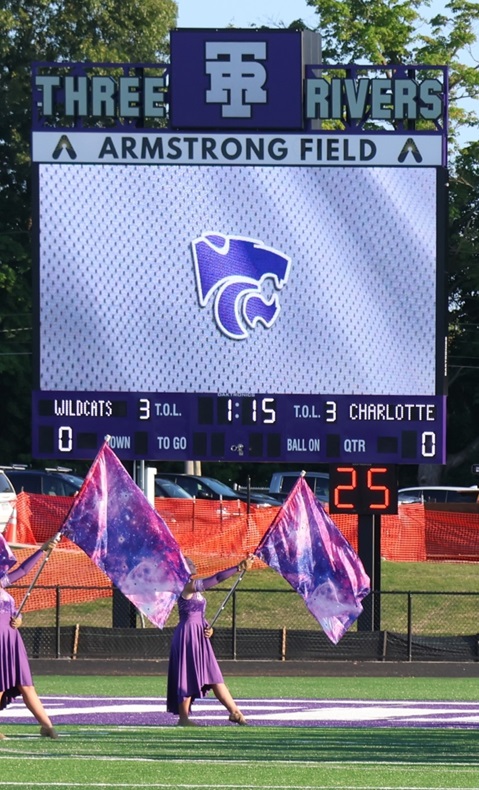
The new video scoreboard, purchased by an anonymous donor, will include a new sound system.
"It's been quite a busy summer,” Stofer said. “We've traveled to Stevensville Lakeshore and up to Holland West Ottawa to work with their video crew in a few training sessions. We're very excited about what we can use it for once we learn everything. Our goal for now is just to get it up and running.”
 Scott Hassinger is a contributing sportswriter for Leader Publications and previously served as the sports editor for the Three Rivers Commercial-News from 1994-2022. He can be reached at [email protected] with story ideas for Berrien, Cass, St. Joseph and Branch counties.
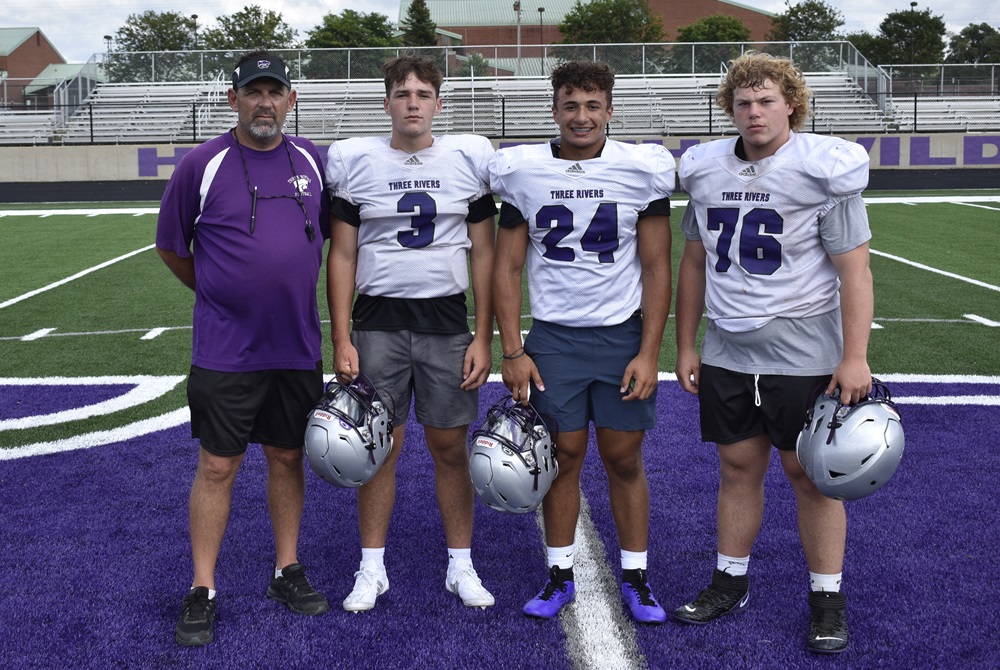
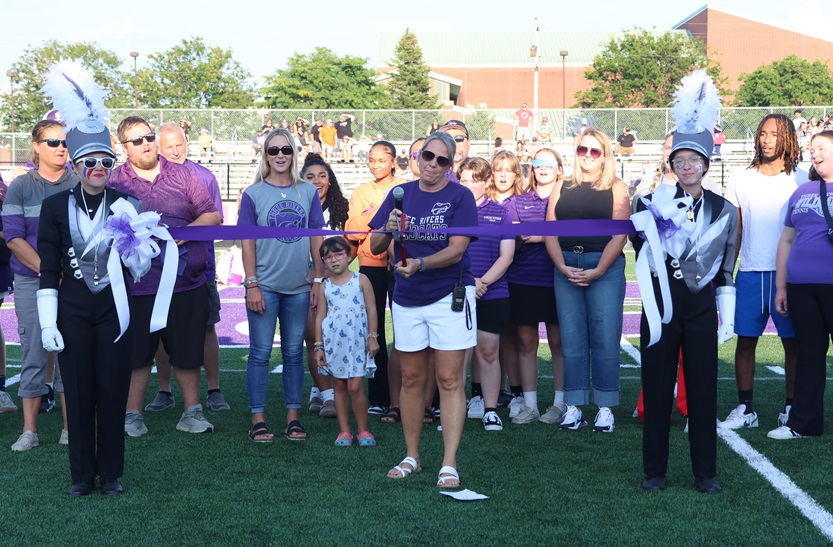
PHOTOS: (Top) From left: Three Rivers varsity football coach Jeff Awe and players Mason Awe, Jace Gray and Sam Reynolds. (Middle) A new video scoreboard complete with a sound system is among new features fans will see this season at Armstrong Field in Three Rivers. (Below) Three Rivers Community Schools superintendent Niki Nash gathers with students, school officials and community members near midfield Aug. 29 to cut the ribbon prior to the first home football game played on newly-renovated Armstrong Field. (Top photo by Scott Hassinger; scoreboard and ribbon-cutting photos by Matt Stofer.)