

Casting Lines for Future Tournaments
August 12, 2016
By Jack Roberts
MHSAA Executive Director
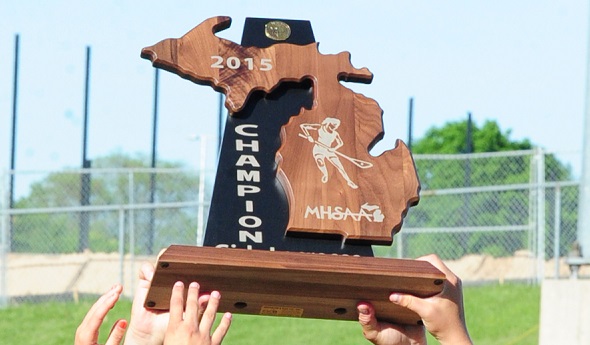
The MHSAA is best known to the public for the tournaments it conducts to conclude the fall, winter and spring seasons each school year.
These tournaments, the first and largest program of the MHSAA, have survived the Vietnam War, the Korean conflict and two World Wars. They have survived the technology bubble, the housing collapse, the energy crisis and the Great Depression.
MHSAA tournaments existed at the dawn of aviation and at the time of our nation’s lunar landing. Popes, presidents and governors have changed and changed again and again, and MHSAA tournaments roll on year after year.
But the sense of tradition and permanence and inevitability of MHSAA tournaments doesn’t dissuade us from asking questions about our tournaments, even some of the most basic questions. Here are two.
Question #1
I have long been and will always be an advocate for a Ryder Cup format for the MHSAA Golf Finals, and a team tennis approach to the MHSAA Tennis Finals; but 90 years of tradition is hard to overcome. Might this be a more exciting format? Could it be co-ed? Could it reverse the decline in boys tennis participation, and increase girls golf participation? Wouldn’t it be fun to try?
Periodically, the International Olympic Committee requires each of the designated Olympic sports to defend its status, to state its case why the sport should remain a part of the Olympic program. Then, after a series or votes that retain one sport at a time, the IOC drops the sport that makes the weakest case. It does so to make room for one of the previously unlisted sports that makes the best case for inclusion.
This would appear to keep the existing Olympic sports on their toes, and to keep the Olympic movement fresh and reflective of modern trends in sports.
While I would not enjoy the controversy, I can see the potential for some positive results if the MHSAA were to invoke the same policy for determining the 14 tournaments it will provide for girls and the 14 for boys.
This might cause us to consider more deeply what a high school sport should look like, or at least what an MHSAA tournament sport should stand for.
On the one hand, we might be inclined to drop tournaments for those sports that involve mostly non-faculty coaches and non-school venues, or require cooperative programs to generate enough participants to support a team, or resort almost entirely to non-school funding, or cater to individuals more than teams.
Or perhaps this process would cause policymakers to forget traditional thinking and ask: “In this day and age, should we shake off traditional notions of sport and consider more where modern kids are coming from?” That might mean fewer team sports and more individual sports, more “extreme” sports like snowboarding and skateboarding, and more lifetime sports, meaning not just golf and tennis and running sports, but also fishing and even shooting sports.
Currently, MHSAA policy states that the MHSAA will consider sponsorship of a tournament series for any sport which 64 member schools conduct on an interscholastic basis as a result of action by the governing boards of those schools.
Should the only question be how many schools sponsor a sport, or must an activity also have certain qualities and/or avoid certain “defects?” What should an MHSAA tournament sport look like and stand for?
Question #2
Bristling from criticism that his association is a money-grabbing exploiter of children, my counterpart in another state said, “If we were running our programs just to make money, we would do very many things very differently.” I knew exactly what he meant.
Because we care about the health and welfare of students, because we mean what we say that the athletic program needs to maximize the ways it enhances the school experience while minimizing academic conflicts, and because we try to model our claim that no sport is a minor sport when it comes to its potential to teach young people life lessons, we operate our programs in ways that make promoters, marketers and business entrepreneurs laugh, cry or cringe.
If money were the only object, we would seed and select sites to assure the teams that attracted the most spectators had the best chance to advance in our tournaments, regardless of the travel for any team or its fan base. If money were the only object, we would never schedule two tournaments to overlap and compete for public attention, much less tolerate three or four overlapping events. If money were the only object, we would allow signage like NASCAR events and promotions like minor league baseball games.
Those approaches to event sponsorship may not be all wrong; they’re just not all right for us. And we will live with the consequences of our belief system.
During a typical school year, more than 20 percent of the MHSAA’s 2,097 District, Regional and Final tournaments lose money. Not a single site in golf, skiing or tennis makes a single penny. In no sport did every District, Regional and Final site have revenue in excess of direct expenses.
In fact, in only three sports – boys and girls basketball and football – is revenue so much greater than direct expenses overall that it helps to pay for all the other tournaments in which the MHSAA invests.
That’s right: invests. When we present our budget to our board, we talk about the MHSAA’s investment in providing tournament opportunities in all those sports and all those places that cannot sustain the cost of those events on their own. How much is this investment worth to students, schools and society?
These two are core questions that require our focus far in advance of talk about scheduling, site selection, seeding and the myriad matters that too often hijack our time and attention.
MCC's Glover Fills Key Role as Athletic Trainer for Super Bowl Champions
By
Tom Kendra
Special for MHSAA.com
August 6, 2024
David Glover never had the glamour role – and didn’t even play the glamour sport – during his high school days at Muskegon Catholic Central.
 MCC is known statewide as a football powerhouse that ranks third in state history with 12 MHSAA Finals championships during the playoff era. But basketball was Glover’s sport of choice, and his specialty didn’t show up in the box score.
“I was the defensive stopper,” explained Glover, who graduated from MCC in 1996. “I was always the guy that Coach (Greg) Earnest would put on the other team’s best scorer. I took a lot of pride in that.”
Glover continues to be the ultimate team player, only now his role is the first assistant athletic trainer for the Kansas City Chiefs, who are aiming to three-peat this season as Super Bowl champions.
“As the team and the goals have grown, so have I,” said Glover, who has been on the Chiefs’ training staff for the past 18 years. “The job is the same, which is getting the players onto the field and back onto the field after injuries so that they can perform at their highest level. I have become more comfortable and experienced in that role.”
Glover broke into the NFL as an athletic training intern with the New York Jets in 2004. He came to Kansas City in 2006 when Jets head coach Herman Edwards took the KC job, bringing Glover and several other members of the training staff with him.
Glover quickly fell in love with the Chiefs’ famous family-first culture, along with the area’s world-famous barbecues. He also met his future wife, Jera.
He is known as a tireless worker and student of his craft, which has allowed him to steadily move up to his current position as first assistant athletic trainer on the Chiefs’ five-member training staff, second only to Rick Burkholder, the vice president of sports medicine and performance.
Glover’s skills also have caught the attention of his colleagues across the NFL, who awarded him the 2022 Tim Davey AFC Assistant Athletic Trainer of the Year Award – given annually to someone who represents an unyielding commitment, dedication and integrity in the profession of athletic training.
Glover said a big reason for his success in his profession can be traced back to high school.
 “Playing sports at MCC, especially for a smaller school, gave me such a sense of camaraderie, teamwork and a family outside of my normal family,” said Glover, the son of David and Lyndah Glover. “Those teammates energized me to be my best.
“There’s no doubt that some of the lessons that I learned playing sports in high school help me out in my job.”
Glover also ran track for the Crusaders – competing in the long jump, 200 meters, 400 meters and various relays – and said he enjoyed himself, even though he ran track initially as a way to stay in shape for basketball.
The highlight of his MCC basketball career came his senior year, when the underdog Crusaders captured a Class C District championship.
Growing up in Muskegon and close to Lake Michigan, Glover thought he would become a marine biologist someday – that is, until he suffered an injury during his senior basketball season.
Glover went up for a block and actually pinned the opponent’s shot against the backboard. However, the shooter inadvertently took his legs out on the play, causing him to crash violently to the court and lose feeling in his right leg for about 10 seconds.
The injury to his hip flexor put him on crutches for two weeks and off the court total for about a month, which he said “felt like the end of the world” at the time.
But the injury led him into rehab with Brian Hanks, a 1988 MCC graduate who was back working at his alma mater as an athletic trainer through Mercy Hospital.
Glover and Hanks turned out to be a perfect match. Glover was naturally curious about the entire process and wanted to know the “why” of his rebab program. Hanks recognized Glover’s interest in how the human body works and encouraged him to consider studying athletic training in college.
“God works in mysterious ways,” said Glover. “I was devastated when I got injured, but that experience opened my eyes to a whole new career. I wanted to learn everything I could about the human body and how it works.
“Looking back, the injury was a blessing in disguise. I wouldn’t change anything at all.”
Glover followed in Hanks’ footsteps and attended Central Michigan University, spending countless hours in the training room working with athletes in every sport – from football to track to gymnastics – graduating with a degree in health fitness and exercise science.
He said a huge inspiration in his career was CMU professor Dr. Rene Shingles, who in 2018 became the first African-American woman to be inducted into the National Athletic Trainers Association Hall of Fame. Shingles encouraged Glover to continue his studies at Seton Hall University in New Jersey, where he earned his master’s of science in athletic training.
He got his break into the NFL with his internship with the Jets, and his work ethic has kept him there for the past 20 years.
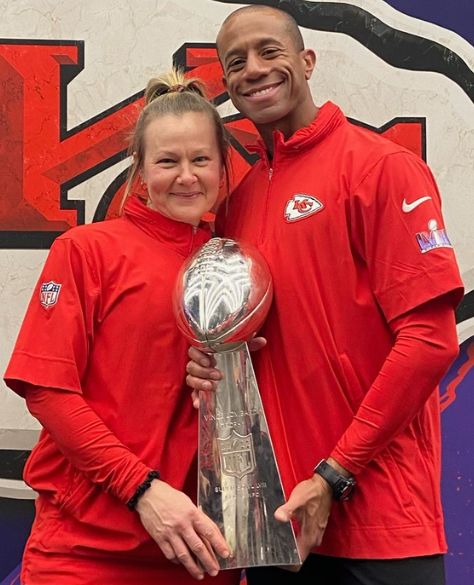 “If there are high school kids out there reading this, I guess I would tell them that there are a lot of different avenues to get to the NFL or the NBA,” Glover said. “I’m a perfect example. I didn’t even play high school football, but through athletic training I have been part of three Super Bowls.”
The Chiefs, who won their first Super Bowl way back in 1970, would have to wait 50 years (until 2020) to win their next one. But Kansas City now has won three Super Bowls in five years, adding titles in 2023 and 2024.
“To have these kind of experiences, and to be able to share so much of it with my family, is really a dream come true,” said Glover, 45, who said his ultimate goal is to become the head athletic trainer for an NFL team.
“I am always open to see what opportunities God has for me and what doors he opens.”
More immediately, with the start of training camp last month, Glover is back to his seven-day-a-week schedule, sharing the organization’s goal of making it to the Super Bowl for the third consecutive season.
Glover has worked with all of the Chiefs star players at some point, including star quarterback Patrick Mahomes, who he calls “a great, humble man.”
But perhaps the player he has worked with most is standout tight end Travis Kelce.
Kelce, who has become a huge name outside of football as the boyfriend of pop sensation Taylor Swift, injured his knee during his rookie preseason in 2013, sidelining him for the entire year. Glover was assigned to Kelce for his rehab.
With Glover’s daily help, Kelce was able to get back on the field the following year and emerged as a star, earning him the 2014 NFL Ed Block Courage Award as a model of inspiration, sportsmanship and courage.
After winning the award, Kelce invited Glover (he calls him “DG”) and his wife to attend the award ceremony with him in Baltimore.
“That was a huge honor for me, and I was blown away,” said Glover. “I look at it that I was just doing my job. He entrusted and believed in me throughout the process, and it worked out great.”
2024 Made In Michigan
August 1: Lessons from Multi-Sport Experience Guide Person in Leading New Team - Read
July 30: After Successful 'Sequel,' Suttons Bay's Hursey Embarking on Next Chapter - Read
July 24: East Kentwood Run Part of Memorable Start on Knuble's Way to NHL, Olympics - Read
July 22: Monroe High Memories Remain Rich for Michigan's 1987 Mr. Baseball - Read
July 17: Record-Setting Viney Gained Lifelong Confidence at Marine City - Read
July 11: High School 'Hoop Squad' Close to Heart as Hughes Continues Coaching Climb - Read
July 10: Nightingale Embarking on 1st Season as College Football Head Coach - Read
June 28: E-TC's Witt Bulldozing Path from Small Town to Football's Biggest Stage - Read
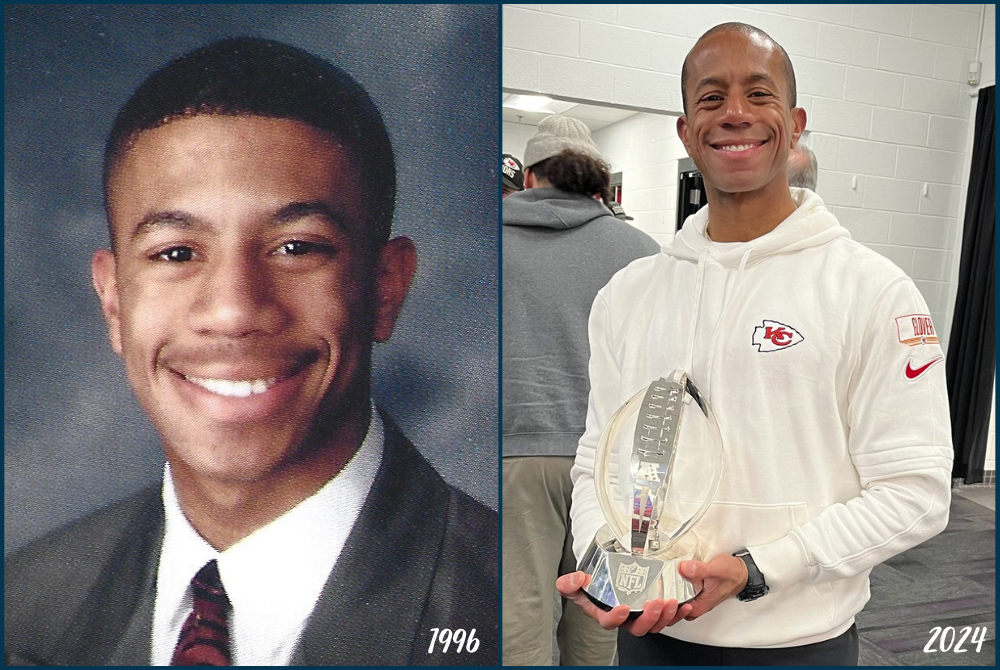
PHOTOS (Top) At left, David Glover as a senor during the 1995-96 school year at Muskegon Catholic Central, and at right Glover shows the AFC Championship trophy after Kansas City's 17-10 win at Baltimore on Jan. 28. (Middle) Glover, left, hugs teammate Doug Dozier after a victory over rival Muskegon Mona Shores in 1995-1996 basketball season opener. MCC finished 17-7 and a District champion. (Below) Glover poses with this year's Super Bowl Championship trophy alongside fellow Chiefs athletic trainer Julie Frymyer. (Trophy photos courtesy of David Glover; 1996 photos courtesy of the MCC yearbook.)