

Casting Lines for Future Tournaments
August 12, 2016
By Jack Roberts
MHSAA Executive Director
The MHSAA is best known to the public for the tournaments it conducts to conclude the fall, winter and spring seasons each school year.
These tournaments, the first and largest program of the MHSAA, have survived the Vietnam War, the Korean conflict and two World Wars. They have survived the technology bubble, the housing collapse, the energy crisis and the Great Depression.
MHSAA tournaments existed at the dawn of aviation and at the time of our nation’s lunar landing. Popes, presidents and governors have changed and changed again and again, and MHSAA tournaments roll on year after year.
But the sense of tradition and permanence and inevitability of MHSAA tournaments doesn’t dissuade us from asking questions about our tournaments, even some of the most basic questions. Here are two.
Question #1
I have long been and will always be an advocate for a Ryder Cup format for the MHSAA Golf Finals, and a team tennis approach to the MHSAA Tennis Finals; but 90 years of tradition is hard to overcome. Might this be a more exciting format? Could it be co-ed? Could it reverse the decline in boys tennis participation, and increase girls golf participation? Wouldn’t it be fun to try?
Periodically, the International Olympic Committee requires each of the designated Olympic sports to defend its status, to state its case why the sport should remain a part of the Olympic program. Then, after a series or votes that retain one sport at a time, the IOC drops the sport that makes the weakest case. It does so to make room for one of the previously unlisted sports that makes the best case for inclusion.
This would appear to keep the existing Olympic sports on their toes, and to keep the Olympic movement fresh and reflective of modern trends in sports.
While I would not enjoy the controversy, I can see the potential for some positive results if the MHSAA were to invoke the same policy for determining the 14 tournaments it will provide for girls and the 14 for boys.
This might cause us to consider more deeply what a high school sport should look like, or at least what an MHSAA tournament sport should stand for.
On the one hand, we might be inclined to drop tournaments for those sports that involve mostly non-faculty coaches and non-school venues, or require cooperative programs to generate enough participants to support a team, or resort almost entirely to non-school funding, or cater to individuals more than teams.
Or perhaps this process would cause policymakers to forget traditional thinking and ask: “In this day and age, should we shake off traditional notions of sport and consider more where modern kids are coming from?” That might mean fewer team sports and more individual sports, more “extreme” sports like snowboarding and skateboarding, and more lifetime sports, meaning not just golf and tennis and running sports, but also fishing and even shooting sports.
Currently, MHSAA policy states that the MHSAA will consider sponsorship of a tournament series for any sport which 64 member schools conduct on an interscholastic basis as a result of action by the governing boards of those schools.
Should the only question be how many schools sponsor a sport, or must an activity also have certain qualities and/or avoid certain “defects?” What should an MHSAA tournament sport look like and stand for?
Question #2
Bristling from criticism that his association is a money-grabbing exploiter of children, my counterpart in another state said, “If we were running our programs just to make money, we would do very many things very differently.” I knew exactly what he meant.
Because we care about the health and welfare of students, because we mean what we say that the athletic program needs to maximize the ways it enhances the school experience while minimizing academic conflicts, and because we try to model our claim that no sport is a minor sport when it comes to its potential to teach young people life lessons, we operate our programs in ways that make promoters, marketers and business entrepreneurs laugh, cry or cringe.
If money were the only object, we would seed and select sites to assure the teams that attracted the most spectators had the best chance to advance in our tournaments, regardless of the travel for any team or its fan base. If money were the only object, we would never schedule two tournaments to overlap and compete for public attention, much less tolerate three or four overlapping events. If money were the only object, we would allow signage like NASCAR events and promotions like minor league baseball games.
Those approaches to event sponsorship may not be all wrong; they’re just not all right for us. And we will live with the consequences of our belief system.
During a typical school year, more than 20 percent of the MHSAA’s 2,097 District, Regional and Final tournaments lose money. Not a single site in golf, skiing or tennis makes a single penny. In no sport did every District, Regional and Final site have revenue in excess of direct expenses.
In fact, in only three sports – boys and girls basketball and football – is revenue so much greater than direct expenses overall that it helps to pay for all the other tournaments in which the MHSAA invests.
That’s right: invests. When we present our budget to our board, we talk about the MHSAA’s investment in providing tournament opportunities in all those sports and all those places that cannot sustain the cost of those events on their own. How much is this investment worth to students, schools and society?
These two are core questions that require our focus far in advance of talk about scheduling, site selection, seeding and the myriad matters that too often hijack our time and attention.
Saugatuck's Dunn Makes MLB Debut, OLSM's Mooney Continues Impressive Climb
By
Steve Vedder
Special for MHSAA.com
August 5, 2024
Blake Dunn has realized his dream while Alex Mooney's chance may be right around the corner.
The careers of the two former Michigan high school baseball stars have taken major steps forward this summer, with Dunn, a Saugatuck graduate native, earning two stints with the Cincinnati Reds, and Mooney, from Orchard Lake St. Mary’s, tearing up the High-Class A Midwest League with Lake County, just northeast of Cleveland.
Both credit modest upbringings for their continuing baseball success. Dunn said his senior class included around 85 students.
"It was definitely hard because a lot of guys have played against a high level of competition from bigger schools," said Dunn, who earned 16 varsity letters across four high school sports at Saugatuck. "But a lot of good athletes come from smaller schools, and we have kind of a chip on our shoulders. That's no knock on smaller schools or their communities; we just work that much harder to make things happen.
"You can't just sit back and go with the flow. You work hard, set your mind on what you need to do and just go for it. I definitely take pride in where I come from and represent Saugatuck to the best of my ability or when I'm out in public."
Mooney, who was part of Orchard Lake St. Mary’s winning three MHSAA Finals titles over six years, said he traces much of his success to being part of an outstanding prep baseball program, regardless of the school's size. St. Mary's was an all-boys school during his time there, with just under 600 students.
 "Playing in the Catholic League was huge for me," he said. "It's the best league in the state, and playing there just made me better. I learned early how to win, and that's carried over (to the pros)."
Dunn was one of the great all-around athletes of his generation at Saugatuck. He had more than 1,500 career points in basketball, was a four-time hurdles Finals champion in track and a member of the Michigan High School Baseball Coaches Association Dream Team, and still finds himself all over the MHSAA football record book. His 113 career touchdowns are fourth all-time while his 2,748 rushing yards in 2015 are 12th best. Dunn's 827 points in 41 career games is second all-time to 924 points by East Grand Rapids' Kevin Grady in 51 games from 2001-04. Dunn's 6,954 rushing yards remains eighth all-time.
Dunn, who also had 26 consecutive 100-yard rushing games, said it seemed natural to him to play multiple sports in high school.
"I think it's the right thing for guys to test their ability to do a lot of things," he said. "It comes down to task management. You don't get a lot of free time because it's always go-go. So you need a good work ethic to stay on top of things."
Dunn and Mooney are in the midst of notable summers. Slowed by the injury bug dating all the way back to high school and then Western Michigan, Dunn developed into a bona fide prospect in the Reds system a year ago when he hit .312 with 23 homers and 79 RBIs at Double-A Chattanooga and Low-A Dayton.
Statistically, Dunn is batting .226 with six homers and 28 RBIs in Triple-A this season, but earned a 10-day stint with the Reds from June 4-13 and then again from July 3-10. He collected his first major league hit against the Cubs on June 7.
A shortstop, Mooney has hit wherever he's been. He batted .444 as a sophomore and .460 with nine homers and 57 RBIs as a senior at Orchard Lake St. Mary’s, then hit .305 with 113 runs, 30 doubles, 11 homers and 33 stolen bases (in 39 attempts) in 117 career games at Duke. With the Lake County Captains this season, Mooney is tops in the Midwest League in runs (65), third in stolen bases (34), tied for 14th in home runs (10) and tied for 16th in RBIs (46).
Mooney said hitting has always been his calling card.
"I feel like I've been able to hit since I was around 8 years old," he said. "My dad coached me when I was young, and I still talk to him about it when I go home. Hitting gets significantly harder, but your mindset is that you learn to flush a bad day. I learned at Orchard Lake St. Mary that you're still a good hitter if you go 0-for-4. You just get on with it."
Mooney, the state's Mr. Baseball Award winner in 2021 and two-time MHSBCA Dream Team member, was ranked among the top five shortstops nationally out of high school by Perfect Game and Under Armour. He went on to become all-Atlantic Coast Conference at Duke before being drafted in the seventh round by Cleveland in 2021.
 Among the lessons he's learned in the professional ranks is that baseball is a business.
"It's a job. A darn good one, but a job," he said. "But I also know that the worst day you could have in baseball is better than the best day in another field. Baseball is a grind, though."
Dunn has battled his share of the grind since becoming a 15th-round draft choice by the Reds in 2021. He hit .333 with 11 homers, 50 stolen bases and 78 RBIs in135 games at Western Michigan. Injuries plagued him as a Bronco, then limited him to just 48 games in his first two years in the Reds system. This year he missed time with facial lacerations after getting hit with a pitch.
No matter the difficulties, Dunn said he always believed he could become a major leaguer. The size of high schools and subsequent level of competition was never a consideration.
"I've never considered myself an underachiever, and in my mind it doesn't matter where I've been,” he said. "I know I have talent, and I've worked hard. I feel like I have a lot of years left in baseball."
Dunn and Mooney are just two of several former Michigan high school ballplayers making a mark in the minor leagues, including two members of arguably the best-ever MHSBCA Dream Team pitching staff in 2016. Tommy Henry (Portage Northern) and Karl Kauffman (Brother Rice) have combined to pitch in 46 MLB games with Arizona and Colorado, respectively, the last two seasons. Henry is 2-3 in nine games with the Diamondbacks this season. The other members of the 2016 Dream Team pitchers were Jack Weisenburger (Rockford) and Mike Mokma (Holland Christian), both of whom pitched professionally, and John Baker (Hartland), who went on to become a two-time all-Mid-American Conference pitcher at Ball State and a 29th-round pick of the Marlins in 2019.
Baker outdueled Henry in the 2016 Division 1 Final.
Another former Michigan high school baseball star has been a godsend to a depleted Atlanta Braves pitching staff. Spencer Schwellenbach (Saginaw Heritage), has gone 4-5 with a 4.04 ERA in 11 starts with the Braves. He was the 2018 Michigan Gatorade Player of the Year who went 18-6 with a 0.73 ERA at Nebraska before being taken by the Braves in the second round of the 2021 draft.
Among the other former prep stars busy in the minors are Sam Weatherly (Howell) and Brock Porter (Orchard Lake St. Mary). Weatherly is 3-1 with a 2.85 ERA in 30 games with the High-A Fresno Grizzlies. He was a 27th-round pick by the Rockies in 2020 after going 4-0 with 106 strikeouts over 72 innings in three years at Clemson.
Porter, the state's Mr. Baseball in 2022, is 0-4 with a 6.98 ERA in 19 1/3 combined innings in Rookie League and High-A. A fourth-round pick by the Rangers in 2022, Porter started 21 games with 95 strikeouts in 69 1/3 innings during his first pro season a year ago at the Rookie League level.
Other Michigan natives in the minors include Luke Russo (Howell), who is 5-3 with a 4.81 ERA at High-A Jersey Shore, and Andrew Taylor (Caledonia), who is 1-1 with a 5.27 ERA at High-A Asheville.
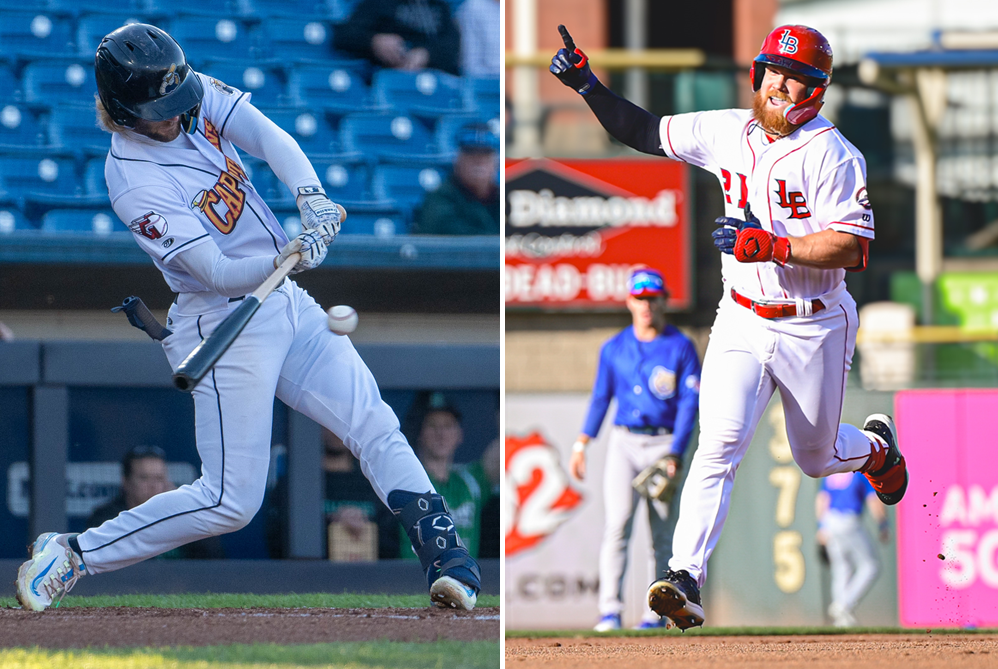
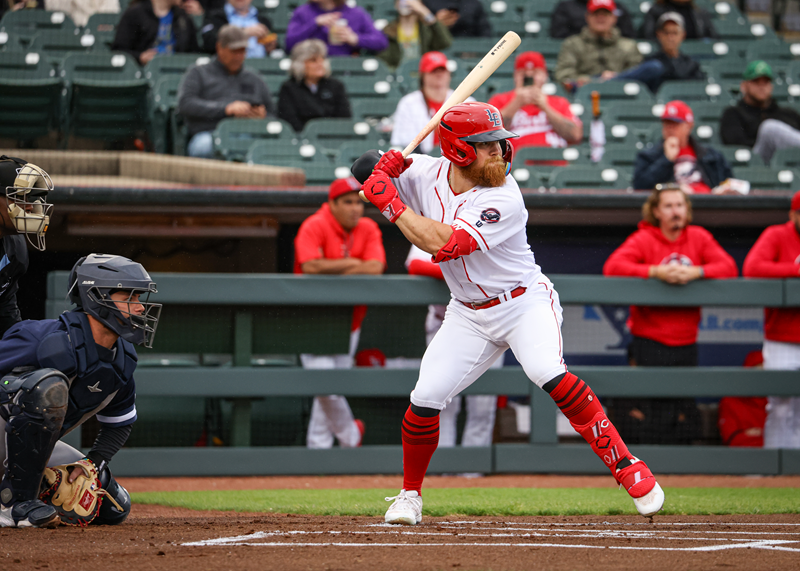
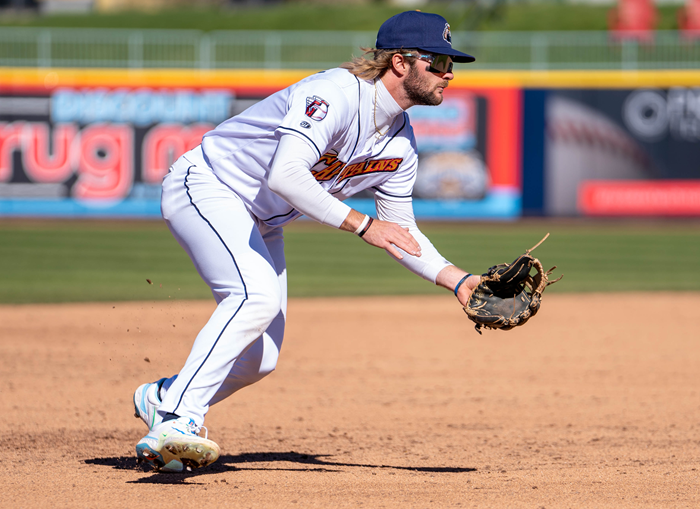
PHOTOS (Top) From left, former Orchard Lake St. Mary’s star Alex Mooney and Saugatuck standout Blake Dunn are succeeding in minor league baseball as they pursue Major League careers. (Middle) Dunn stands in for a pitch playing for the Louisville Bats this season. (Below) Mooney prepares to field a grounder for the Lake County Captains. (Photos courtesy of the Lake County Captains and Louisville Bats; top Dunn photo by Cam Anderson and middle by Anna Rouch.)