

Casting Lines for Future Tournaments
August 12, 2016
By Jack Roberts
MHSAA Executive Director
The MHSAA is best known to the public for the tournaments it conducts to conclude the fall, winter and spring seasons each school year.
These tournaments, the first and largest program of the MHSAA, have survived the Vietnam War, the Korean conflict and two World Wars. They have survived the technology bubble, the housing collapse, the energy crisis and the Great Depression.
MHSAA tournaments existed at the dawn of aviation and at the time of our nation’s lunar landing. Popes, presidents and governors have changed and changed again and again, and MHSAA tournaments roll on year after year.
But the sense of tradition and permanence and inevitability of MHSAA tournaments doesn’t dissuade us from asking questions about our tournaments, even some of the most basic questions. Here are two.
Question #1
I have long been and will always be an advocate for a Ryder Cup format for the MHSAA Golf Finals, and a team tennis approach to the MHSAA Tennis Finals; but 90 years of tradition is hard to overcome. Might this be a more exciting format? Could it be co-ed? Could it reverse the decline in boys tennis participation, and increase girls golf participation? Wouldn’t it be fun to try?
Periodically, the International Olympic Committee requires each of the designated Olympic sports to defend its status, to state its case why the sport should remain a part of the Olympic program. Then, after a series or votes that retain one sport at a time, the IOC drops the sport that makes the weakest case. It does so to make room for one of the previously unlisted sports that makes the best case for inclusion.
This would appear to keep the existing Olympic sports on their toes, and to keep the Olympic movement fresh and reflective of modern trends in sports.
While I would not enjoy the controversy, I can see the potential for some positive results if the MHSAA were to invoke the same policy for determining the 14 tournaments it will provide for girls and the 14 for boys.
This might cause us to consider more deeply what a high school sport should look like, or at least what an MHSAA tournament sport should stand for.
On the one hand, we might be inclined to drop tournaments for those sports that involve mostly non-faculty coaches and non-school venues, or require cooperative programs to generate enough participants to support a team, or resort almost entirely to non-school funding, or cater to individuals more than teams.
Or perhaps this process would cause policymakers to forget traditional thinking and ask: “In this day and age, should we shake off traditional notions of sport and consider more where modern kids are coming from?” That might mean fewer team sports and more individual sports, more “extreme” sports like snowboarding and skateboarding, and more lifetime sports, meaning not just golf and tennis and running sports, but also fishing and even shooting sports.
Currently, MHSAA policy states that the MHSAA will consider sponsorship of a tournament series for any sport which 64 member schools conduct on an interscholastic basis as a result of action by the governing boards of those schools.
Should the only question be how many schools sponsor a sport, or must an activity also have certain qualities and/or avoid certain “defects?” What should an MHSAA tournament sport look like and stand for?
Question #2
Bristling from criticism that his association is a money-grabbing exploiter of children, my counterpart in another state said, “If we were running our programs just to make money, we would do very many things very differently.” I knew exactly what he meant.
Because we care about the health and welfare of students, because we mean what we say that the athletic program needs to maximize the ways it enhances the school experience while minimizing academic conflicts, and because we try to model our claim that no sport is a minor sport when it comes to its potential to teach young people life lessons, we operate our programs in ways that make promoters, marketers and business entrepreneurs laugh, cry or cringe.
If money were the only object, we would seed and select sites to assure the teams that attracted the most spectators had the best chance to advance in our tournaments, regardless of the travel for any team or its fan base. If money were the only object, we would never schedule two tournaments to overlap and compete for public attention, much less tolerate three or four overlapping events. If money were the only object, we would allow signage like NASCAR events and promotions like minor league baseball games.
Those approaches to event sponsorship may not be all wrong; they’re just not all right for us. And we will live with the consequences of our belief system.
During a typical school year, more than 20 percent of the MHSAA’s 2,097 District, Regional and Final tournaments lose money. Not a single site in golf, skiing or tennis makes a single penny. In no sport did every District, Regional and Final site have revenue in excess of direct expenses.
In fact, in only three sports – boys and girls basketball and football – is revenue so much greater than direct expenses overall that it helps to pay for all the other tournaments in which the MHSAA invests.
That’s right: invests. When we present our budget to our board, we talk about the MHSAA’s investment in providing tournament opportunities in all those sports and all those places that cannot sustain the cost of those events on their own. How much is this investment worth to students, schools and society?
These two are core questions that require our focus far in advance of talk about scheduling, site selection, seeding and the myriad matters that too often hijack our time and attention.
After Successful 'Sequel,' Suttons Bay's Hursey Embarking on Next Chapter
By
Tom Spencer
Special for MHSAA.com
July 30, 2024
Thomas Hursey’s story is a Hollywood writer’s dream. He really is the stuff of sequels.
 He could star in a remake of “Hoosiers” – titled in the singular as just “The Hoosier” – or maybe “Against All Odds II” is more fitting.
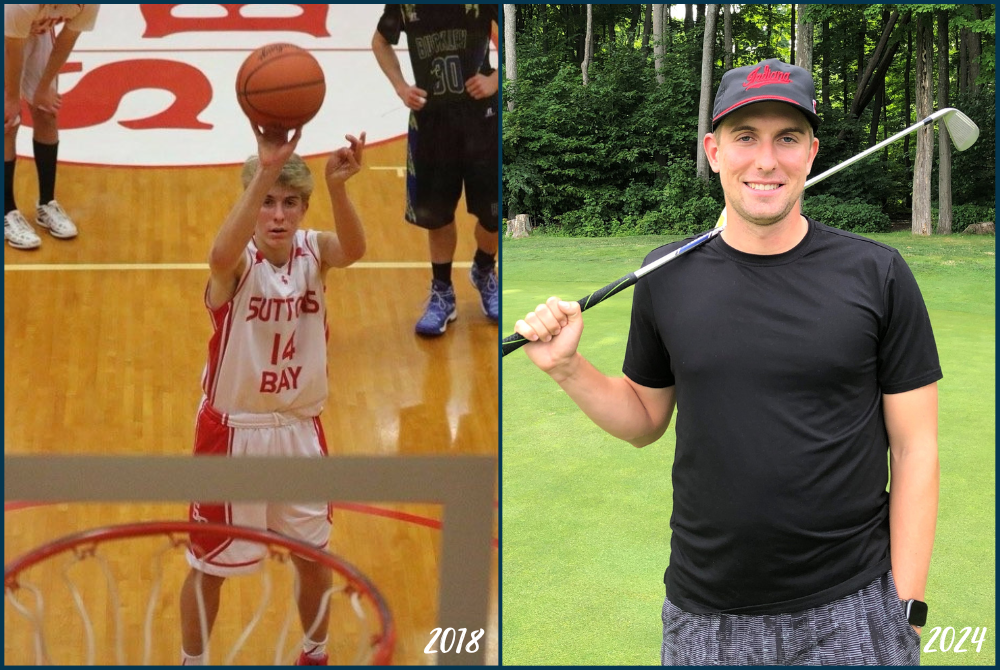
Hursey is a 2018 graduate of Suttons Bay High School. He was in a class of just 30 students. He grew up where there is snow on the ground, many argue, for six months of the year. He never played an Amateur Junior Golf Association tournament. And, he had zero scholarship offers from Division I colleges.
To top it off, basketball was his favorite sport in high school. It still is today.
Hursey, who admits he pretty much hated golf, switched his focus from the basketball court to the links midway through high school. He gave up on playing college basketball despite scoring 1,200 points during his career and achieving all-state status.
As a high school freshman, he helped a team comprised of only senior teammates win the Lower Peninsula Division 4 golf championship. He earned all-state in golf too and did receive a scholarship offer from Division II Ferris State University. He took it and excelled there.
So maybe his movie would be titled “The Bulldog.” Again, as a freshman at FSU, he had only senior teammates – and he was named Great Lakes Intercollegiate Athletic Conference Freshman of the Year.
Hursey went on to pick up individual titles and conference player of the year awards as he led the Bulldogs to GLIAC championships and trips to the NCAA Division II Tournament.
Today, many say Hursey could make a run at the PGA Tour – and they may wonder why he doesn’t. Instead, he is about to join a Philadelphia-based pharmaceutical company and put his science and business background to work.
He has a biology degree from Ferris and a master’s in business from Indiana University. He has no interest in playing an individual sport after his stellar high school team sports career at Suttons Bay. His preference is to work hard with teammates and relish a leadership role similar to the one he had playing for the Norsemen in golf, basketball and tennis and while running cross country.
“I am much more of a team-sport guy,” Hursey explained. “I can’t really get the same motivation when it’s just an individual tournament – I need to be surrounded by team.”
Unlike most Big Ten golfers, professional golf was never really on Hursey‘s mind. Veteran IU golf coach Mike Mayer believes Hursey is capable of continuing his golf career, but respects his decision to take another path.
“Thomas was a gift to us,” Mayer said. “Very truthfully, Thomas Hursey might very well be at the top of the list as a great athlete, and great golfer, but more importantly a great person.
“I have had a lot of great student-athletes and you don’t rank them, but at the same time you know which ones stand out,” Mayer continued. “And Thomas Hursey simply stands out.”
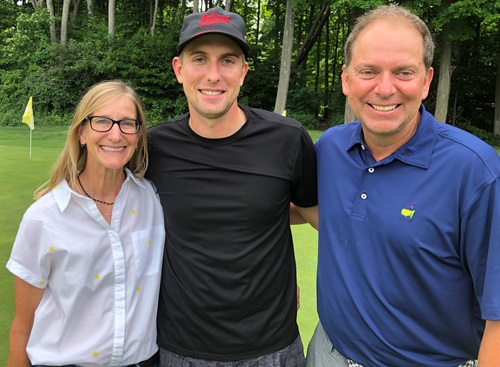
Hursey’s parents are former college athletes, retired teachers and longtime high school sports coaches. His father Todd was his high school coach and is now the golf coach at Traverse City West. His mother Nicki was the Suttons Bay softball coach and coached siblings Laura and Jane on the softball field, where they became all-staters as well. Jane, a 2015 Suttons Bay graduate, was also an all-state basketball player. Laura, a 2020 grad, also starred in volleyball.
Thomas Hursey had a reputation as a nice competitor, and his parents treasure that even more than the success he found in high school and college sports.
“I always, and so did Todd, looked out more and hounded him be humble more than anything,” Nicki said. “He had talent and God-given gifts, but what made me so proud was just the way he acted on the course and the number of parents that come up to me and say what a wonderful son you have.”
Mayer, too, proudly recalls Thomas’ politeness and humility.
“As a coach, that’s at least as equally, if not more than rewarding than winning,” he said.
Mayer admits he secretly wishes Hursey would try pursuing professional golf, but respects his decision to end his golf career while it was still a team sport.
“Thomas Hursey has the athletic ability to play professional golf,” Mayer confirmed. “I fully understand his decision – he is going to be successful in whatever he chooses to do.”
Hursey had four top-20 and two top-10 outings for IU during his last season, including an 18th place finish at the Big Ten Championship. During his career at IU, Hursey was named a Big Ten Distinguished Scholar, a Big Ten Sportsmanship Honoree and to the academic all-Big Ten team.
Hursey’s first love was basketball. He’s a fan of the Indiana Hoosiers program and became quite familiar over the years with Michigan State University coach Tom Izzo and his son, Steven.
 The Izzo connection started when Michigan State was recruiting Dwaun Anderson, a Suttons Bay graduate and the Mr. Basketball Award winner in 2011.
Hursey recalls all the hardest practices in basketball as he hoped to someday play at the college level. He had a tremendous work ethic on the court, and it helped his transition to golf.
Even though golf is the most difficult sport he’s taken on, Hursey mastered it more easily because of his desire to get better and not let anything get in the way of success.
“The chip on my shoulder – the grit I had – I think that helped me get to the next level in golf,” Hursey noted. “I really never felt I was as good as I was – I still don’t think I am.
“People tell me I’m good at golf, and I just don’t believe that because I just have this hunger to get better,” Hursey continued. “I am my biggest critic.”
Hursey quickly added he benefitted from two other critics – his sisters. He’s admitted he believes they possess more athleticism than he does.
“They always pushed me to get better, and they always pushed me to work harder,” he said. “They are kind of no-nonsense people.
“Growing up I never got more encouragement from them as much as I did critiquing,” he continued. “That was huge in terms of molding me.”
Hursey’s accomplishments are not at the top of the minds of his parents and former athletic director.
“I always say I am excited about the things he accomplished, but I am proud of the way he is as a person,” Todd Hursey said. “I am proud of how he is and how he handled himself.”
Retired Suttons Bay athletics director, Doug Periard agrees. He watched Hursey’s work ethic develop early and found him regularly at open gyms. Periard also singled out Hursey’s sportsmanship.
“I cannot think of a discouraging word the young man ever said to a teammate or opponent,” Periard said. “He was able to demonstrate both sportsmanship and leadership in defeat, and also in victory.”
2024 Made In Michigan
July 24: East Kentwood Run Part of Memorable Start on Knuble's Way to NHL, Olympics - Read
July 22: Monroe High Memories Remain Rich for Michigan's 1987 Mr. Baseball - Read
July 17: Record-Setting Viney Gained Lifelong Confidence at Marine City - Read
July 11: High School 'Hoop Squad' Close to Heart as Hughes Continues Coaching Climb - Read
July 10: Nightingale Embarking on 1st Season as College Football Head Coach - Read
June 28: E-TC's Witt Bulldozing Path from Small Town to Football's Biggest Stage - Read
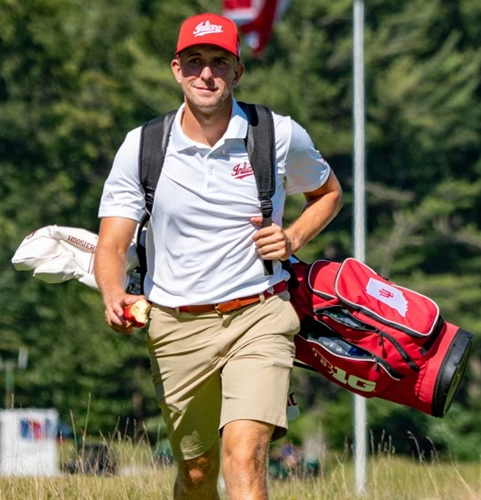
PHOTOS (Top) At left, Suttons Bay's Thomas Hursey prepares to shoot a free throw during his senior season, and at right Hursey remains at home on the golf course. (Middle) Hursey grabs a quick snack during a round while golfing for Indiana. (Below) Hursey, recently, with his parents Nicki and Todd. (Recent photos by Tom Spencer; Indiana and Suttons Bay photos courtesy of the Hursey family.)