

Casting Lines for Future Tournaments
August 12, 2016
By Jack Roberts
MHSAA Executive Director
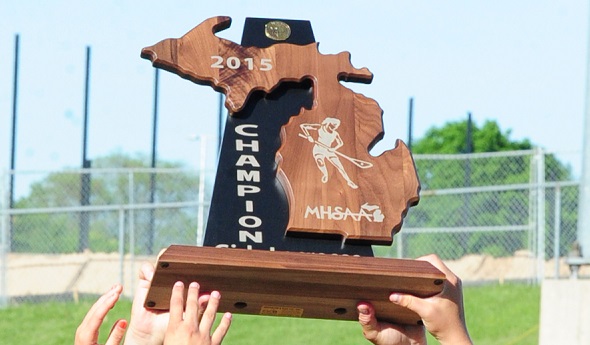
The MHSAA is best known to the public for the tournaments it conducts to conclude the fall, winter and spring seasons each school year.
These tournaments, the first and largest program of the MHSAA, have survived the Vietnam War, the Korean conflict and two World Wars. They have survived the technology bubble, the housing collapse, the energy crisis and the Great Depression.
MHSAA tournaments existed at the dawn of aviation and at the time of our nation’s lunar landing. Popes, presidents and governors have changed and changed again and again, and MHSAA tournaments roll on year after year.
But the sense of tradition and permanence and inevitability of MHSAA tournaments doesn’t dissuade us from asking questions about our tournaments, even some of the most basic questions. Here are two.
Question #1
I have long been and will always be an advocate for a Ryder Cup format for the MHSAA Golf Finals, and a team tennis approach to the MHSAA Tennis Finals; but 90 years of tradition is hard to overcome. Might this be a more exciting format? Could it be co-ed? Could it reverse the decline in boys tennis participation, and increase girls golf participation? Wouldn’t it be fun to try?
Periodically, the International Olympic Committee requires each of the designated Olympic sports to defend its status, to state its case why the sport should remain a part of the Olympic program. Then, after a series or votes that retain one sport at a time, the IOC drops the sport that makes the weakest case. It does so to make room for one of the previously unlisted sports that makes the best case for inclusion.
This would appear to keep the existing Olympic sports on their toes, and to keep the Olympic movement fresh and reflective of modern trends in sports.
While I would not enjoy the controversy, I can see the potential for some positive results if the MHSAA were to invoke the same policy for determining the 14 tournaments it will provide for girls and the 14 for boys.
This might cause us to consider more deeply what a high school sport should look like, or at least what an MHSAA tournament sport should stand for.
On the one hand, we might be inclined to drop tournaments for those sports that involve mostly non-faculty coaches and non-school venues, or require cooperative programs to generate enough participants to support a team, or resort almost entirely to non-school funding, or cater to individuals more than teams.
Or perhaps this process would cause policymakers to forget traditional thinking and ask: “In this day and age, should we shake off traditional notions of sport and consider more where modern kids are coming from?” That might mean fewer team sports and more individual sports, more “extreme” sports like snowboarding and skateboarding, and more lifetime sports, meaning not just golf and tennis and running sports, but also fishing and even shooting sports.
Currently, MHSAA policy states that the MHSAA will consider sponsorship of a tournament series for any sport which 64 member schools conduct on an interscholastic basis as a result of action by the governing boards of those schools.
Should the only question be how many schools sponsor a sport, or must an activity also have certain qualities and/or avoid certain “defects?” What should an MHSAA tournament sport look like and stand for?
Question #2
Bristling from criticism that his association is a money-grabbing exploiter of children, my counterpart in another state said, “If we were running our programs just to make money, we would do very many things very differently.” I knew exactly what he meant.
Because we care about the health and welfare of students, because we mean what we say that the athletic program needs to maximize the ways it enhances the school experience while minimizing academic conflicts, and because we try to model our claim that no sport is a minor sport when it comes to its potential to teach young people life lessons, we operate our programs in ways that make promoters, marketers and business entrepreneurs laugh, cry or cringe.
If money were the only object, we would seed and select sites to assure the teams that attracted the most spectators had the best chance to advance in our tournaments, regardless of the travel for any team or its fan base. If money were the only object, we would never schedule two tournaments to overlap and compete for public attention, much less tolerate three or four overlapping events. If money were the only object, we would allow signage like NASCAR events and promotions like minor league baseball games.
Those approaches to event sponsorship may not be all wrong; they’re just not all right for us. And we will live with the consequences of our belief system.
During a typical school year, more than 20 percent of the MHSAA’s 2,097 District, Regional and Final tournaments lose money. Not a single site in golf, skiing or tennis makes a single penny. In no sport did every District, Regional and Final site have revenue in excess of direct expenses.
In fact, in only three sports – boys and girls basketball and football – is revenue so much greater than direct expenses overall that it helps to pay for all the other tournaments in which the MHSAA invests.
That’s right: invests. When we present our budget to our board, we talk about the MHSAA’s investment in providing tournament opportunities in all those sports and all those places that cannot sustain the cost of those events on their own. How much is this investment worth to students, schools and society?
These two are core questions that require our focus far in advance of talk about scheduling, site selection, seeding and the myriad matters that too often hijack our time and attention.
Constantine Football All-Stater, Wrestling Champ Aiming for Grand Finale
By
Scott Hassinger
Special for MHSAA.com
April 30, 2024
CONSTANTINE – Bennett VandenBerg has earned many accolades over the last four years as a three-sport athlete at Constantine.
 But the awards aren't what the 6-foot-3, 240-pound standout will remember most when reflecting on his memories as an all-state football player, state champion wrestler and record-breaking throwing specialist on the Falcons' track & field squad.
"I'll remember how I represented our school and pushed myself to be the best I could be in each sport that I played," said VandenBerg, who has earned 12 varsity letters.
VandenBerg has evolved into one of the most accomplished athletes in the state this school year as a senior, especially standing out among those from smaller communities.
This past fall he was named first-team Division 5-6 all-state at defensive end in football before winning the Division 3 Individual Finals wrestling title at 285 pounds in early March at Ford Field.
VandenBerg's final goal is to win the discus title at the Lower Peninsula Division 3 Finals on Saturday, June 1, in Kent City to end his Constantine career all-state in all three sports.
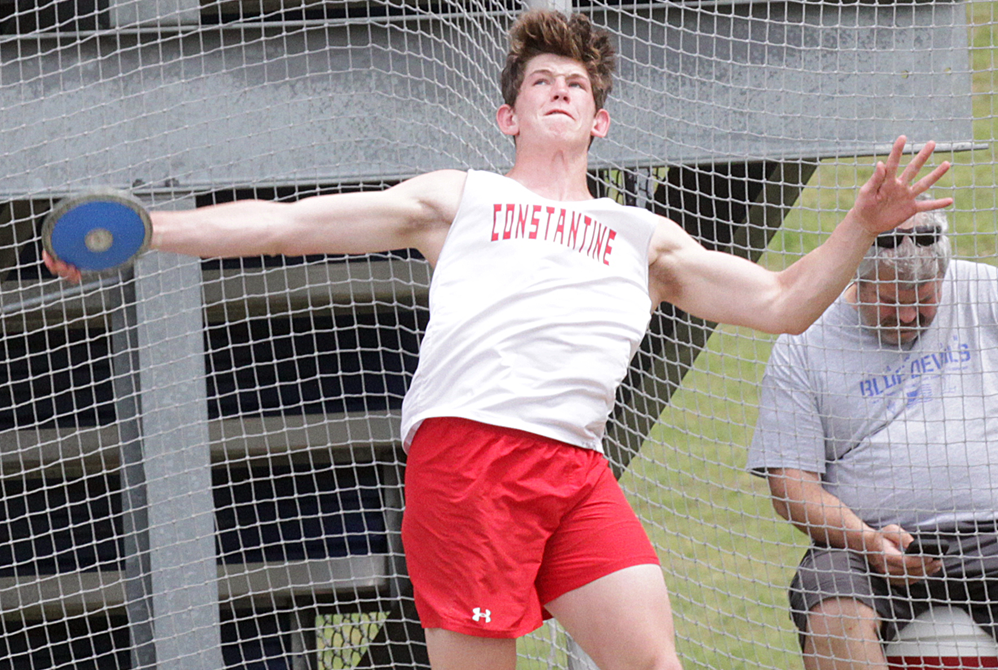
He broke the school record in the discus his junior year with a throw of 158 feet, 1 inch; the previous mark of 156-6 had been held by Doug Polasek since 1986. VandenBerg has eclipsed his school record twice this spring, most recently with a personal-best toss of 170-9 in a Southwestern Athletic Conference double dual meet with Schoolcraft and Kalamazoo Christian. He ranks No. 4 statewide in the event regardless of enrollment division. Lawton junior Mason Mayne at 175-4 is the only Division 3 competitor with a better throw than VandenBerg.
"It's really cool to have your name up on the school record board, but I'd like to make that mark more untouchable before I'm done," VandenBerg said. "My goal is to be a state discus champion. I've put in the necessary work for it. It would be nice to end my career that way."
Kyle Rimer, Constantine's veteran boys track & field coach, is most impressed with VandenBerg's leadership and presence in working with the Falcons' younger athletes.
 "Bennett loves to compete. Ever since he was a freshman, we've also had him on our 400-meter relay team. That's something he really enjoys doing. He's not just a thrower, but a good overall athlete with lots of drive,” Rimer said. “There's a lot of individuality in track & field, but I think he does a great job of leading the younger kids. He has the drive, accountability and technique to achieve his goal of being a state champion in his throwing events.”
VandenBerg is already a two-time Finals placer in the discus, earning sixth as a junior and seventh his sophomore year. He admits being a little disappointed with his distance at the 2023 state meet.
"In that particular event (discus) you need lots of focus and determination because there are a ton of tiny things you can mess up on that affect your throw. To become better you need to be consistent, show up every day and be willing to put in the work," VandenBerg said. "Right now I'm working on my speed in the circle and quickness in my follow-through."
VandenBerg also has been pleased with his improvement this spring in the shot put. He's increased his distance by over five feet and hopes to break the school record in that event as well. John Kampars (1967) holds Constantine's shot put record at 54-8¼, and VandenBerg's personal best is 48-10 in a double-dual meet this season against Parchment and Centreville.
"Shot put is a difficult event. You need power, but your form has to be top-notch – otherwise it's tough to move that 12-pound ball," VandenBerg said. "I would love to qualify for state in both the discus and shot put and be all-state in each. That would be amazing if I could be a state champion in either of those events."
VandenBerg has put in extra work in the offseason with special instruction from Bill Griffey of Next Throw in Plainwell, along with working with Constantine assistant track & field and head football coach Shawn Griffith.
"Bennett puts a lot of time into working on his throwing. He spends a lot of time in the weight room, and he's a bigger kid who is not afraid to be coached and listens to what other people tell him," Griffith said. "We're excited to see what he can do now that we've had warmer weather recently."
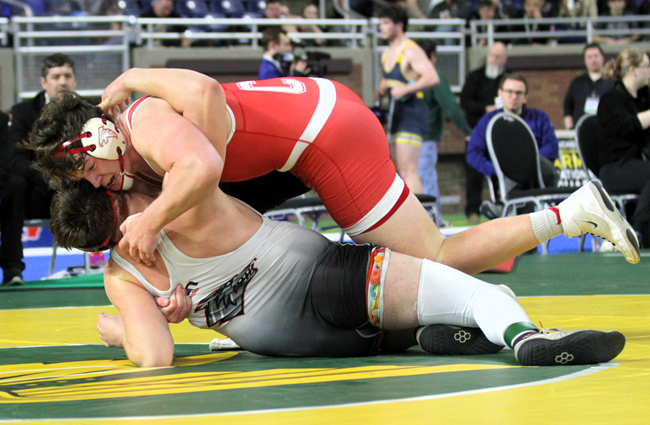
 VandenBerg's motivation this spring follows a tremendous wrestling season that saw him finish 54-0 and capture the 285 championship with a 3-0 win in the title match over Reed City junior Wyatt Spalo.
"I gained 20 pounds of muscle and did everything you need to do to become a better athlete to wrestle the heavyweight division. Winning the title was overwhelming. It was everything I ever wanted, and the first 20 minutes after winning it was relief, especially after losing in the Finals as a junior. I just went into that last match and wrestled smart and confident," VandenBerg said. "My speed and strength gave me an advantage over the bigger heavyweights I faced this year."
Vandenberg, 188-22 with 104 career pins, became the 10th Finals champion in Constantine wrestling history and the first to achieve the feat since Kevin Watkins won a 152-pound crown in 2000.
VandenBerg competed at 189 as a freshman and sophomore. He was a Regional qualifier as a freshman and finished sixth in Division 3 as a sophomore before ending his junior campaign as the Finals runner-up at 215.
"Bennett is a competitor who hates to lose, and if he does he learns from it. He had a lot of good practice partners on the team his first three years, and he wasn't going to be denied after losing in the Finals as a junior," said Constantine wrestling coach Dale Davidhizar Jr.
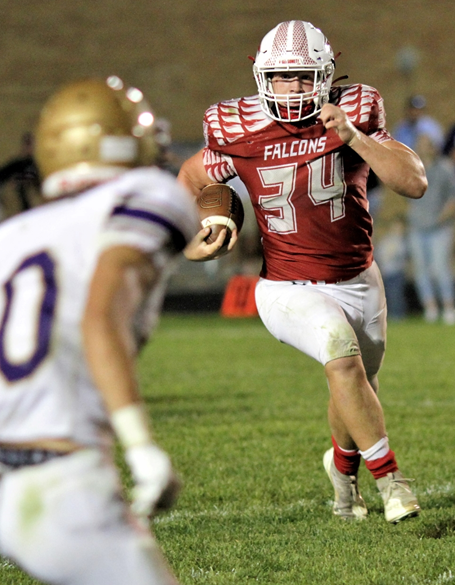
VandenBerg played on Constantine's varsity football team for four years. He got a lot of extra playing time as a freshman when Constantine reached the Division 6 Semifinals during in the COVID-shortened season. He led the Falcons in rushing as a sophomore before switching to tight end as a junior. Out of necessity, VandenBerg returned to lead Constantine in rushing and scoring again as a senior.
"Bennett learned a great deal from the older guys on the team his first three varsity seasons. He learned leadership qualities and is a very unselfish kid who is willing to do what's best for his team," Griffith said.
VandenBerg is most proud of Constantine winning a District crown last fall, especially after his senior class went 0-5-1 as eighth graders. VandenBerg posted 164 solo tackles at defensive end during his final high school season and was Constantine's main offensive weapon with 1,354 yards and 16 touchdowns rushing on 186 carries.
"Winning Districts as seniors in football was a special moment. As eighth graders, we weren't exactly the most athletic team, but we put in the work as we got older to become successful," VandenBerg said.
VandenBerg has been invited to play for the West team at the annual Michigan High School Football Coaches Association's East-West All-Star Game this summer.
College coaches have shown interest in VandenBerg in all three sports, especially football and wrestling. VandenBerg, who carries a cumulative GPA of 3.989 and scored 1110 on his SAT, is weighing his options in athletics but knows he wants to study either ecology or forestry in college.
"I love being outdoors and doing what I love to do," VandenBerg said.
 Scott Hassinger is a contributing sportswriter for Leader Publications and previously served as the sports editor for the Three Rivers Commercial-News from 1994-2022. He can be reached at [email protected] with story ideas for Berrien, Cass, St. Joseph and Branch counties.
PHOTOS (Top) Constantine’s Bennett VandenBerg competes in the discus during a home meet his junior season. (Middle) VandenBerg, top position, battles Wyatt Spalo in their Division championship wrestling match at 285 pounds in March at Ford Field. (Below) VandenBerg (34) carries the football during a 2023 regular-season home game against Schoolcraft. (Photos by Brandon Watson/Sturgis Journal.)