

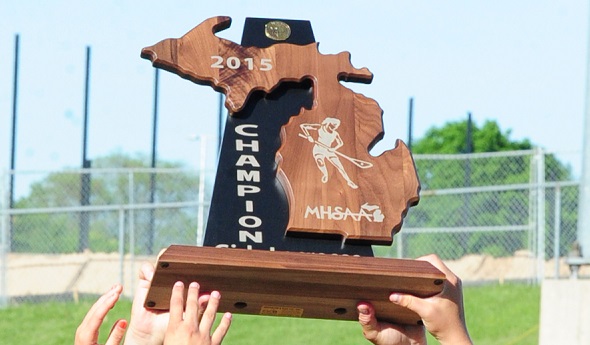
Casting Lines for Future Tournaments
August 12, 2016
By Jack Roberts
MHSAA Executive Director
The MHSAA is best known to the public for the tournaments it conducts to conclude the fall, winter and spring seasons each school year.
These tournaments, the first and largest program of the MHSAA, have survived the Vietnam War, the Korean conflict and two World Wars. They have survived the technology bubble, the housing collapse, the energy crisis and the Great Depression.
MHSAA tournaments existed at the dawn of aviation and at the time of our nation’s lunar landing. Popes, presidents and governors have changed and changed again and again, and MHSAA tournaments roll on year after year.
But the sense of tradition and permanence and inevitability of MHSAA tournaments doesn’t dissuade us from asking questions about our tournaments, even some of the most basic questions. Here are two.
Question #1
I have long been and will always be an advocate for a Ryder Cup format for the MHSAA Golf Finals, and a team tennis approach to the MHSAA Tennis Finals; but 90 years of tradition is hard to overcome. Might this be a more exciting format? Could it be co-ed? Could it reverse the decline in boys tennis participation, and increase girls golf participation? Wouldn’t it be fun to try?
Periodically, the International Olympic Committee requires each of the designated Olympic sports to defend its status, to state its case why the sport should remain a part of the Olympic program. Then, after a series or votes that retain one sport at a time, the IOC drops the sport that makes the weakest case. It does so to make room for one of the previously unlisted sports that makes the best case for inclusion.
This would appear to keep the existing Olympic sports on their toes, and to keep the Olympic movement fresh and reflective of modern trends in sports.
While I would not enjoy the controversy, I can see the potential for some positive results if the MHSAA were to invoke the same policy for determining the 14 tournaments it will provide for girls and the 14 for boys.
This might cause us to consider more deeply what a high school sport should look like, or at least what an MHSAA tournament sport should stand for.
On the one hand, we might be inclined to drop tournaments for those sports that involve mostly non-faculty coaches and non-school venues, or require cooperative programs to generate enough participants to support a team, or resort almost entirely to non-school funding, or cater to individuals more than teams.
Or perhaps this process would cause policymakers to forget traditional thinking and ask: “In this day and age, should we shake off traditional notions of sport and consider more where modern kids are coming from?” That might mean fewer team sports and more individual sports, more “extreme” sports like snowboarding and skateboarding, and more lifetime sports, meaning not just golf and tennis and running sports, but also fishing and even shooting sports.
Currently, MHSAA policy states that the MHSAA will consider sponsorship of a tournament series for any sport which 64 member schools conduct on an interscholastic basis as a result of action by the governing boards of those schools.
Should the only question be how many schools sponsor a sport, or must an activity also have certain qualities and/or avoid certain “defects?” What should an MHSAA tournament sport look like and stand for?
Question #2
Bristling from criticism that his association is a money-grabbing exploiter of children, my counterpart in another state said, “If we were running our programs just to make money, we would do very many things very differently.” I knew exactly what he meant.
Because we care about the health and welfare of students, because we mean what we say that the athletic program needs to maximize the ways it enhances the school experience while minimizing academic conflicts, and because we try to model our claim that no sport is a minor sport when it comes to its potential to teach young people life lessons, we operate our programs in ways that make promoters, marketers and business entrepreneurs laugh, cry or cringe.
If money were the only object, we would seed and select sites to assure the teams that attracted the most spectators had the best chance to advance in our tournaments, regardless of the travel for any team or its fan base. If money were the only object, we would never schedule two tournaments to overlap and compete for public attention, much less tolerate three or four overlapping events. If money were the only object, we would allow signage like NASCAR events and promotions like minor league baseball games.
Those approaches to event sponsorship may not be all wrong; they’re just not all right for us. And we will live with the consequences of our belief system.
During a typical school year, more than 20 percent of the MHSAA’s 2,097 District, Regional and Final tournaments lose money. Not a single site in golf, skiing or tennis makes a single penny. In no sport did every District, Regional and Final site have revenue in excess of direct expenses.
In fact, in only three sports – boys and girls basketball and football – is revenue so much greater than direct expenses overall that it helps to pay for all the other tournaments in which the MHSAA invests.
That’s right: invests. When we present our budget to our board, we talk about the MHSAA’s investment in providing tournament opportunities in all those sports and all those places that cannot sustain the cost of those events on their own. How much is this investment worth to students, schools and society?
These two are core questions that require our focus far in advance of talk about scheduling, site selection, seeding and the myriad matters that too often hijack our time and attention.
Game May Change, But Success Continues as Wilson Nears 800 Coaching Wins
By
Pam Shebest
Special for MHSAA.com
April 16, 2024
SOUTH HAVEN — No dugouts, no outfield fences, $25 bats.
 Things have come a long way since Wilma Wilson took over the coaching reins at her alma mater 35 years ago.
“When I played, we didn’t have fences, we didn’t have dugouts; we had benches,” the South Haven softball coach said. “If you hit a home run, it had to be an in-the-park home run because there were hardly any parks that had any fences.
“It’s come a long way. Now you go to fields that are turfed. I love it. I’m glad to see the change for the girls and to see more emphasis on them playing and being involved.”
With a 791-406 record over her 35 years coaching the Rams softball team, Wilson is closing in on 800 career wins. Her current record puts her 19th among MHSAA coaches and just 16 victories behind former Monroe coach Vince Rossi’s 807 victories.
The Rams are 2-2 on the young season, but started off with a bang — actually three bangs over the right field fence in a one-run squeaker against Paw Paw on March 26.
Although the team has just 11 players, it is stacked with experience. Nine players saw action last season, and the five seniors have three or four years of varsity time.
Those seniors include twins Kamryn and Taylor Holland.
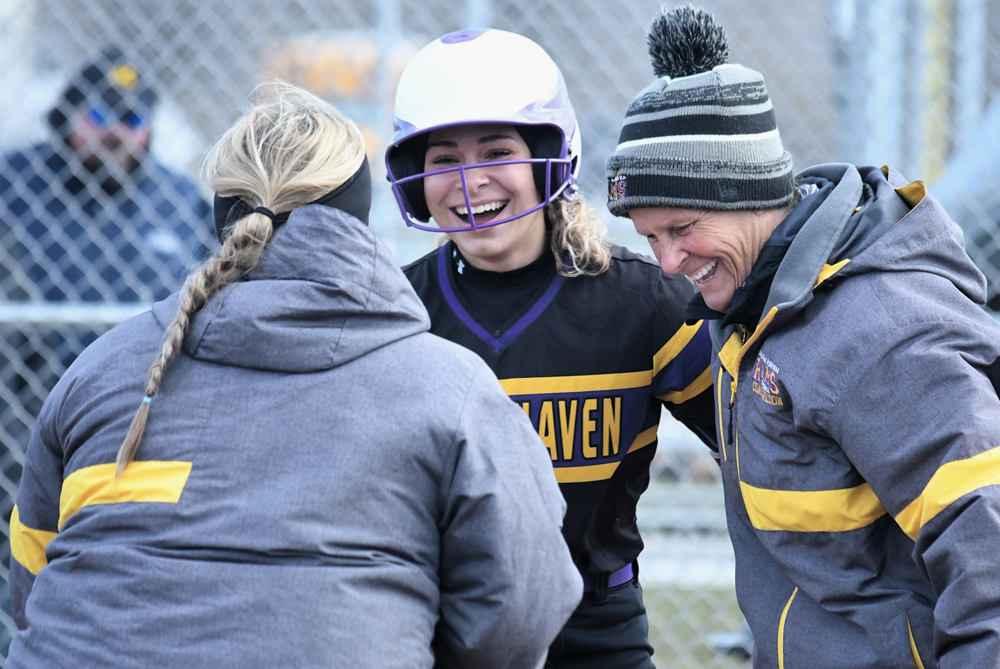
Against Paw Paw, Kamryn hit her first grand slam, a walk-off homer in a 12-11 win.
 “I knew it was going to be close as soon as I saw it,” the third baseman said. “I just kept running and started jumping up and down when I saw it go over.”
She was one of the veterans instrumental in the team’s postseason play last year, as South Haven reached its Division 2 District Final before losing 6-2 to Hamilton.
The Rams are focused on a longer run this year.
“A lot of the girls have been on the same team, and we’ve played together the past three years,” Kamryn said. “We know enough about each other and work good together. Everything clicks.”
Her sister, a shortstop/pitcher, agrees she and her teammates already have solid connections and said Wilson is a big reason.
“I love how much she pushes me,” Taylor Holland said. “She’s always there when you need her. She’ll take you aside if you need anything and always wants us to be our best. I just love that about her, because she loves us on and off the field.”
Wilson does more than work on softball with the players.
“(Last week) I sat down with the girls and had a good heart-to-heart, working through frustrations, trying to help kids maneuver through things in life, whether at school, at home, in the game,” she said.
“That’s a huge part of coaching and what keeps me in it, knowing I can make a difference helping these kids manage life a little bit.”
Continuing the legacy
One of Wilson’s former players who is still very involved in the sport is her daughter, Marlee Wilson, in her first season as Western Michigan University’s head softball coach.
The Broncos won their 20th game of the season Sunday, making Wilson WMU’s winningest first-year softball coach.
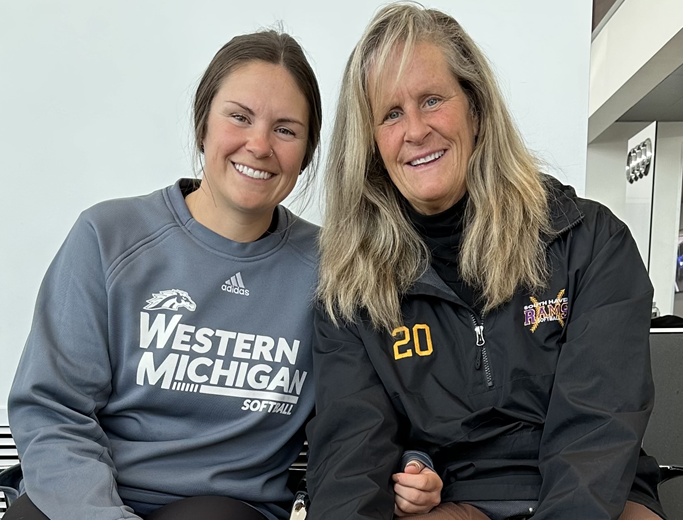 “I coached her when she was small, coached her through high school, coached her in travel ball,” Wilma Wilson said. “She’s a very competitive kid, plays really hard. She has that same love for the game that I do, same drive.”
Marlee Wilson said one important thing she learned from her mom was to make softball fun.
“Practices in high school were always really fun,” she remembered. “It was the best part of the day. I couldn’t imagine it being any other way. (I want to) continue that and also develop the student athletes as people.
“There’s not a huge career in softball like there is in baseball and other sports, so you’re going to play four or five years in college then hopefully be prepared for life after sports, which (Mom) did a really good job with me.”
When she has a chance to talk with high school athletes, Marlee Wilson tells them to have fun and learn the basics of the game.
“That’s huge in high school,” she said. “At the college level, we can tell players who went through really good high school programs or travel programs that have those really good fundamentals or softball IQ.
“(Mom) does a really good job of developing players as a whole so when they get to that level, they understand that part of the game.”
Wilson played softball at WMU from 2014-18 and was a three-time academic all-Mid-American Conference honoree, a 2017 MAC Distinguished Scholar-Athlete and a four-time NFCA All-American Scholar.
Sparking like Sparky
Although Wilma Wilson calls him a “co-coach,” Dave Gumpert considers himself her assistant the last 11 years.
“I respect her many years as being a coach,” he said. “We talk things over, but she makes the final decisions.
“It’s been a really good relationship. She bounces things off me, I bounce things off her. It’s been a good run so far.”
Gumpert, who had a seven-year stint as a major league pitcher for the Detroit Tigers, Chicago Cubs and Kansas City Royals, is the one who good-naturedly calls Wilson “Sparky” — and not because of her sparkling personality.
 “She pretty much lets me run practice, and she walks around,” he said, smiling. “I played for (Tigers manager) Sparky Anderson and that’s what he did. He walked around the outfield, just talking to people and doing all the PR stuff while all the other coaches were getting the work done. So I like to tease her.”
Equipment has been another area of change during Wilson’s tenure.
“The equipment has gone crazy from the technology of bats,” she said. “A bat back in the day would be $20, $25. Now they’re $400.
“If take my school budget and buy balls for the season for both our (varsity and JV) teams and a bat, I’ve used two-thirds of my budget.”
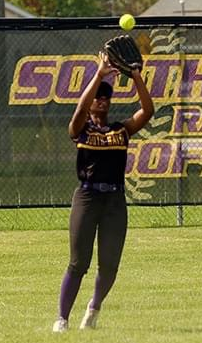
But South Haven is making those bats work. Senior centerfielder Myraql McGee said hitting is among the team’s most noticeable improvements from a year ago.
“Our whole lineup is good power hitters. It doesn’t matter where you are, our lineup is pretty stacked,” said McGee, who will continue her career next season at Missouri Valley College.
“Fielding-wise, we could work on a couple things, but we don’t make as many errors at routine plays as many other teams.”
Other seniors are Sam Beeney and Kayley Gorham, and juniors are Madi Dotson, Grace Strebeck and Molly Verseput. Sophomores are Addison Dekoning and Erin Bos, and they are joined by freshman Ly’Nique Cunningham.
Gumpert was with Wilson when the Rams reached but lost in the Division 2 Final in 2018 and sees some similarities between that and this year’s team.
“Offensively, we had a good team, but I would dare to say this team is as good offensively as that team was,” he said. “It’s going to boil down to how well our pitching does, how well our pitchers progress. If we have the pitching I think we can develop into, I think we’ll be competitive with anybody.”
 Pam Shebest served as a sportswriter at the Kalamazoo Gazette from 1985-2009 after 11 years part-time with the Gazette while teaching French and English at White Pigeon High School. She can be reached at [email protected] with story ideas for Calhoun, Kalamazoo and Van Buren counties.
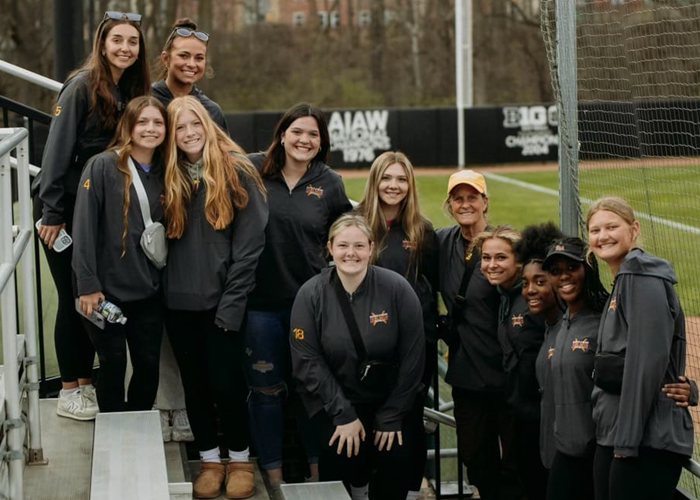
PHOTOS (Top) South Haven softball coach Wilma Wilson, right, welcomes home Kamryn Holland after Holland’s grand slam March 26. (2) The Rams enjoy watching Marlee Wilson’s Western Michigan Broncos this season. (2) Wilson, right, joins daughter Marlee to form an accomplished mother-daughter coaching tree. (4) South Haven senior Myraql McGee settles in under a fly ball. (Top and WMU photos provided by Wilma Wilson, family photo by Pam Shebest, and McGee action photo provided by McGee.)