

Casting Lines for Future Tournaments
August 12, 2016
By Jack Roberts
MHSAA Executive Director
The MHSAA is best known to the public for the tournaments it conducts to conclude the fall, winter and spring seasons each school year.
These tournaments, the first and largest program of the MHSAA, have survived the Vietnam War, the Korean conflict and two World Wars. They have survived the technology bubble, the housing collapse, the energy crisis and the Great Depression.
MHSAA tournaments existed at the dawn of aviation and at the time of our nation’s lunar landing. Popes, presidents and governors have changed and changed again and again, and MHSAA tournaments roll on year after year.
But the sense of tradition and permanence and inevitability of MHSAA tournaments doesn’t dissuade us from asking questions about our tournaments, even some of the most basic questions. Here are two.
Question #1
I have long been and will always be an advocate for a Ryder Cup format for the MHSAA Golf Finals, and a team tennis approach to the MHSAA Tennis Finals; but 90 years of tradition is hard to overcome. Might this be a more exciting format? Could it be co-ed? Could it reverse the decline in boys tennis participation, and increase girls golf participation? Wouldn’t it be fun to try?
Periodically, the International Olympic Committee requires each of the designated Olympic sports to defend its status, to state its case why the sport should remain a part of the Olympic program. Then, after a series or votes that retain one sport at a time, the IOC drops the sport that makes the weakest case. It does so to make room for one of the previously unlisted sports that makes the best case for inclusion.
This would appear to keep the existing Olympic sports on their toes, and to keep the Olympic movement fresh and reflective of modern trends in sports.
While I would not enjoy the controversy, I can see the potential for some positive results if the MHSAA were to invoke the same policy for determining the 14 tournaments it will provide for girls and the 14 for boys.
This might cause us to consider more deeply what a high school sport should look like, or at least what an MHSAA tournament sport should stand for.
On the one hand, we might be inclined to drop tournaments for those sports that involve mostly non-faculty coaches and non-school venues, or require cooperative programs to generate enough participants to support a team, or resort almost entirely to non-school funding, or cater to individuals more than teams.
Or perhaps this process would cause policymakers to forget traditional thinking and ask: “In this day and age, should we shake off traditional notions of sport and consider more where modern kids are coming from?” That might mean fewer team sports and more individual sports, more “extreme” sports like snowboarding and skateboarding, and more lifetime sports, meaning not just golf and tennis and running sports, but also fishing and even shooting sports.
Currently, MHSAA policy states that the MHSAA will consider sponsorship of a tournament series for any sport which 64 member schools conduct on an interscholastic basis as a result of action by the governing boards of those schools.
Should the only question be how many schools sponsor a sport, or must an activity also have certain qualities and/or avoid certain “defects?” What should an MHSAA tournament sport look like and stand for?
Question #2
Bristling from criticism that his association is a money-grabbing exploiter of children, my counterpart in another state said, “If we were running our programs just to make money, we would do very many things very differently.” I knew exactly what he meant.
Because we care about the health and welfare of students, because we mean what we say that the athletic program needs to maximize the ways it enhances the school experience while minimizing academic conflicts, and because we try to model our claim that no sport is a minor sport when it comes to its potential to teach young people life lessons, we operate our programs in ways that make promoters, marketers and business entrepreneurs laugh, cry or cringe.
If money were the only object, we would seed and select sites to assure the teams that attracted the most spectators had the best chance to advance in our tournaments, regardless of the travel for any team or its fan base. If money were the only object, we would never schedule two tournaments to overlap and compete for public attention, much less tolerate three or four overlapping events. If money were the only object, we would allow signage like NASCAR events and promotions like minor league baseball games.
Those approaches to event sponsorship may not be all wrong; they’re just not all right for us. And we will live with the consequences of our belief system.
During a typical school year, more than 20 percent of the MHSAA’s 2,097 District, Regional and Final tournaments lose money. Not a single site in golf, skiing or tennis makes a single penny. In no sport did every District, Regional and Final site have revenue in excess of direct expenses.
In fact, in only three sports – boys and girls basketball and football – is revenue so much greater than direct expenses overall that it helps to pay for all the other tournaments in which the MHSAA invests.
That’s right: invests. When we present our budget to our board, we talk about the MHSAA’s investment in providing tournament opportunities in all those sports and all those places that cannot sustain the cost of those events on their own. How much is this investment worth to students, schools and society?
These two are core questions that require our focus far in advance of talk about scheduling, site selection, seeding and the myriad matters that too often hijack our time and attention.
Johnston Retires as Winningest Coach, Much More to Beaverton Dream He Built
By
Paul Costanzo
Special for MHSAA.com
March 15, 2024
Before Roy Johnston left the court that bears his name for the final time as Beaverton head boys basketball coach on Feb. 23, 1,500-plus fans, family and current and former players had one more chant.
 It wasn’t the name of the coach they all adored after he wrapped up the winningest career in MHSAA basketball history. It wasn’t even the school song, or a slogan.
With Johnston pumping a raised fist, the community chanted “Judy” to honor his wife, who could not be at the game or celebration as she was battling cancer.
It was a fitting tribute to the woman behind the coach who became more than the face of the community, and one last opportunity for those fans to say thank you to her for her own efforts and sacrifices in helping the Beaverton become something pulled straight from the movie screen – the small-town sports tale complete with the iconic coach in the lead role and generations of locals living their dedication by filling the stands for every game.
Judy Johnston passed away this past Saturday, a little more than two weeks after the ceremony that honored her husband. She was 81.
All interviews for this story were completed prior to her passing, but a common theme when talking about Johnston’s 50-year career and importance to Beaverton was that the entire family, specifically Judy, had played a big role.
“His family has put forth an incredible amount of effort into our community,” said former player Brent Mishler. “In basketball and in general.”
Family is at the center of Johnston and Beaverton’s immense success over his 50 years. Not only has he coached multiple generations of several Beaverton families – including three generations of Mishlers – but he’s coached his own children, and grandchildren.
Small town programs often rely on players who have grown up around them and together, and Beaverton has that in spades.
“It was a dream,” former player and Johnston’s co-coach, Shad Woodruff, said of having his son Layk play for Johnston. “I got to play for Roy and be part of all that Beaverton basketball is – it’s not just a sport around here. We have video of (Layk) dribbling a basketball in the gym literally before he could walk. He’s been the little guy that always looked up to (Roy’s grandsons) Spencer Johnston and Carter Johnston, so just to be a part of Beaverton basketball is special.
 “It’s like when your kid gets there, you’re giving your kid to the community for a while and saying, ‘Here you go.’ It’s amazing to watch your son out there, especially in a community like ours. Roy has created this thing with Beaverton basketball where every Friday night, it’s like church. Everybody’s there.”
The numbers behind Johnston’s career, which started in 1966 in Yale, are remarkable. He holds the MHSAA record for wins by a boys basketball coach at 833, the vast majority coming at Beaverton, the program he took over in 1974.
The Beavers won 21 conference titles, 17 District titles and five Regional titles during Johnston’s 50 years, adding a run to the MHSAA Semifinals in 1984.
Just six of Johnston’s seasons ended in records below .500, and in a fitting tribute to their coach, this year’s Beavers scratched and clawed their way to a five-game win streak at the end of the season to ensure his last wouldn’t be No. 7, finishing the year 12-12 with a loss to Beal City in the District Final.
Included in that streak was a 54-45 victory over rival Gladwin on the night Johnston was honored. The Beavers trailed by as many as nine during the second half before rallying to win, led by a 26-rebound performance from 6-foot, 1½-inch senior Reese Longstreth, who Woodruff called the epitome of a Beaverton basketball player.
“I’ve been fortunate to be around Roy for 40 years, and I’ve seen a lot of great wins, especially in that gym,” Woodruff said. “I can’t put anything above that one.”
Layk Woodruff made the final basket in the game, which will forever be the final basket made in Roy F. Johnston Gymnasium during the Johnston era.
“It was super emotional, I’d say, for a bunch of reasons,” Layk Woodruff said of the game. “We felt like it was our responsibility, we had to that game for Roy. It was a rivalry game, last home game of the year – there were a lot of emotions when that game ended. I didn’t even think about (hitting the final shot) until a couple days later. Now that I get to think about it, it’s pretty cool to say that was me. I’ll always remember that.”
One celebration led to another, as Johnston’s retirement ceremony followed the game. A tribute video created by Beaverton graduate Jason Brown, who owns a digital media company, and narrated by longtime Beaverton public address announcer Scott Govitz was played. Govitz admitted to getting choked up at times while recording the video.
“There were a couple times where I did more than one take,” he said.
Govitz was at the center of a massive effort to create the ceremony, with support from athletic director Will Gaudard, school staff and members of the community, including multiple businesses and organizations. Govitz had arranged for special lighting and video screens for the presentation. Special tickets were printed for the night – which also happened to be Beaverton’s Hall of Fame night. Following the video, a spotlight was shone on center court, where a single chair sat, one of Johnston’s vintage red blazers draped over its back.
The more than 100 former players who had come to celebrate their coach each had a glow stick they cracked on, and walked through the darkness to surround the chair.
Then Johnston walked the red carpet – much like his starters have for years when being introduced prior to games – and addressed the crowd.
He didn’t speak for long, but as Johnston so often does, he hit all the right notes, mixing gratitude with humor.
“Gladwin County is a great place to raise a good family,” Johnston said after thanking the traveling contingent from Gladwin.
“I want to thank everyone for a great run. Fifty years. A great run.”
For outsiders, it was a chance to see the softer side of Johnston rather than the man intensely patrolling the sidelines during games. It was a glimpse at the man that handed out suckers before games to every kid in attendance.
 “He belonged on an episode of ‘Grumpy Old Men,’ and he still could play the role,” Govitz said with a laugh. “He would always say, ‘Don’t listen to the way I say it, listen to what I say.’ He just wants you to do things correctly. His players, maybe they didn’t adore it at the time, but they adore it now. Being a part of that program taught them more than basketball skills. … What will happen, once they leave, they find that great respect for it. And, he does things quietly that no one ever knows or sees – helping someone in need, especially the ones in college, checking up on them or sending them some money. That helps build a program and build relationships. He said in his last speech that it’s about getting along with others. If you can’t get along well with others, you can’t get along. That’s what it’s about.”
Mishler echoed that sentiment, and some of the memories that stick out most to the 2002 graduate were when Johnston got after him in his own special way.
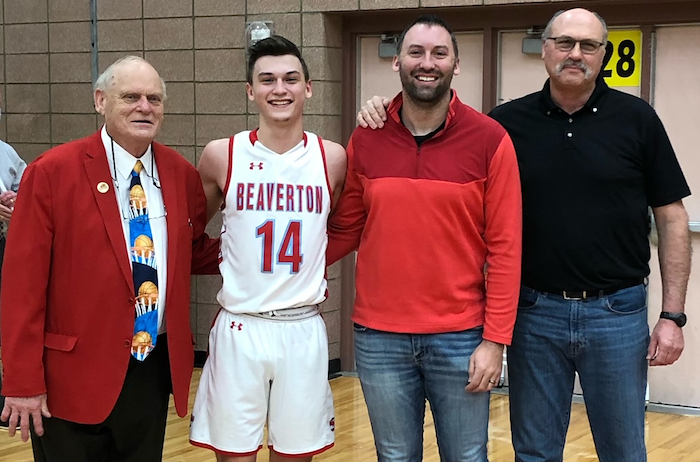
“Playing for him was a privilege,” said Mishler, whose father Steve played for Johnston in the ’70s, and his son Cameron played through 2021. “The life lessons he taught set you up for success in life for the future. ‘You need to hear what I’m saying, not the method I’m saying it.’ That’s so true. Being honest and having expectations, and expecting people to hit those expectations, is not a bad thing.”
After Johnston was done speaking, he knelt down and kissed the floor to say goodbye to the job he’s done for most of his life, and in a way, thank you, to the community he helped create and that he’ll now need more than ever.
“Roy’s good at making you feel like he’s not big on that stuff (being recognized), and he isn’t, but he definitely does appreciate it,” Shad Woodruff said. “He understands how important he is to the community, and that he’s done something really special. He understands what he’s done is a pretty big feat, but he doesn’t talk about it. He doesn’t brag about it.”
 Paul Costanzo served as a sportswriter at The Port Huron Times Herald from 2006-15, including three years as lead sportswriter, and prior to that as sports editor at the Hillsdale Daily News from 2005-06. He can be reached at [email protected] with story ideas for Genesee, Lapeer, St. Clair, Sanilac, Huron, Tuscola, Saginaw, Bay, Arenac, Midland and Gladwin counties.
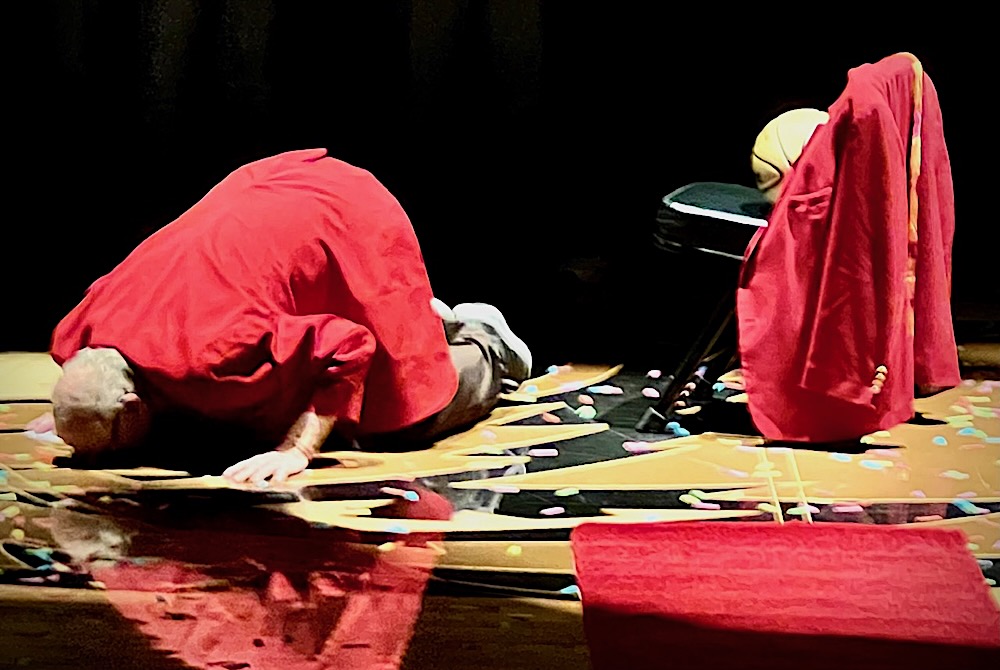
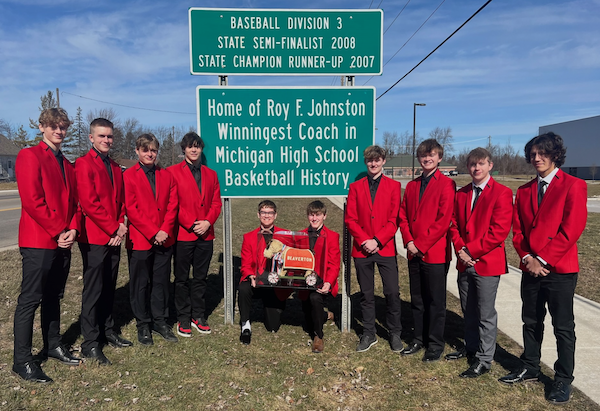
PHOTOS (Top) Beaverton boys basketball coach Roy Johnston kisses the court that bears his name during a celebration of his retirement Feb. 23. (Middle) This season’s team stands at the entrance to town with signs announcing the program and coach’s successes. (Below) Johnston takes a photo with three generations of Mishlers – Cameron, Brent and Steve. (Top photo by Stephanie Johnston.)