

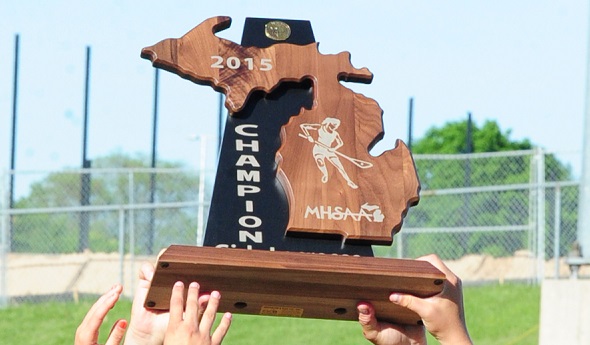
Casting Lines for Future Tournaments
August 12, 2016
By Jack Roberts
MHSAA Executive Director
The MHSAA is best known to the public for the tournaments it conducts to conclude the fall, winter and spring seasons each school year.
These tournaments, the first and largest program of the MHSAA, have survived the Vietnam War, the Korean conflict and two World Wars. They have survived the technology bubble, the housing collapse, the energy crisis and the Great Depression.
MHSAA tournaments existed at the dawn of aviation and at the time of our nation’s lunar landing. Popes, presidents and governors have changed and changed again and again, and MHSAA tournaments roll on year after year.
But the sense of tradition and permanence and inevitability of MHSAA tournaments doesn’t dissuade us from asking questions about our tournaments, even some of the most basic questions. Here are two.
Question #1
I have long been and will always be an advocate for a Ryder Cup format for the MHSAA Golf Finals, and a team tennis approach to the MHSAA Tennis Finals; but 90 years of tradition is hard to overcome. Might this be a more exciting format? Could it be co-ed? Could it reverse the decline in boys tennis participation, and increase girls golf participation? Wouldn’t it be fun to try?
Periodically, the International Olympic Committee requires each of the designated Olympic sports to defend its status, to state its case why the sport should remain a part of the Olympic program. Then, after a series or votes that retain one sport at a time, the IOC drops the sport that makes the weakest case. It does so to make room for one of the previously unlisted sports that makes the best case for inclusion.
This would appear to keep the existing Olympic sports on their toes, and to keep the Olympic movement fresh and reflective of modern trends in sports.
While I would not enjoy the controversy, I can see the potential for some positive results if the MHSAA were to invoke the same policy for determining the 14 tournaments it will provide for girls and the 14 for boys.
This might cause us to consider more deeply what a high school sport should look like, or at least what an MHSAA tournament sport should stand for.
On the one hand, we might be inclined to drop tournaments for those sports that involve mostly non-faculty coaches and non-school venues, or require cooperative programs to generate enough participants to support a team, or resort almost entirely to non-school funding, or cater to individuals more than teams.
Or perhaps this process would cause policymakers to forget traditional thinking and ask: “In this day and age, should we shake off traditional notions of sport and consider more where modern kids are coming from?” That might mean fewer team sports and more individual sports, more “extreme” sports like snowboarding and skateboarding, and more lifetime sports, meaning not just golf and tennis and running sports, but also fishing and even shooting sports.
Currently, MHSAA policy states that the MHSAA will consider sponsorship of a tournament series for any sport which 64 member schools conduct on an interscholastic basis as a result of action by the governing boards of those schools.
Should the only question be how many schools sponsor a sport, or must an activity also have certain qualities and/or avoid certain “defects?” What should an MHSAA tournament sport look like and stand for?
Question #2
Bristling from criticism that his association is a money-grabbing exploiter of children, my counterpart in another state said, “If we were running our programs just to make money, we would do very many things very differently.” I knew exactly what he meant.
Because we care about the health and welfare of students, because we mean what we say that the athletic program needs to maximize the ways it enhances the school experience while minimizing academic conflicts, and because we try to model our claim that no sport is a minor sport when it comes to its potential to teach young people life lessons, we operate our programs in ways that make promoters, marketers and business entrepreneurs laugh, cry or cringe.
If money were the only object, we would seed and select sites to assure the teams that attracted the most spectators had the best chance to advance in our tournaments, regardless of the travel for any team or its fan base. If money were the only object, we would never schedule two tournaments to overlap and compete for public attention, much less tolerate three or four overlapping events. If money were the only object, we would allow signage like NASCAR events and promotions like minor league baseball games.
Those approaches to event sponsorship may not be all wrong; they’re just not all right for us. And we will live with the consequences of our belief system.
During a typical school year, more than 20 percent of the MHSAA’s 2,097 District, Regional and Final tournaments lose money. Not a single site in golf, skiing or tennis makes a single penny. In no sport did every District, Regional and Final site have revenue in excess of direct expenses.
In fact, in only three sports – boys and girls basketball and football – is revenue so much greater than direct expenses overall that it helps to pay for all the other tournaments in which the MHSAA invests.
That’s right: invests. When we present our budget to our board, we talk about the MHSAA’s investment in providing tournament opportunities in all those sports and all those places that cannot sustain the cost of those events on their own. How much is this investment worth to students, schools and society?
These two are core questions that require our focus far in advance of talk about scheduling, site selection, seeding and the myriad matters that too often hijack our time and attention.
Willobee Makes Prediction Come True, Exceeds Seed to Become Champion
By
Drew Ellis
Special for MHSAA.com
March 2, 2024
DETROIT – With a mouthful of blood and a cowboy hat perched on his head, nothing could take away the joy of Gaylord sophomore Zane Willobee.
As the sixth seed in the 157-pound weight class of the Division 2 Individual Finals, not many would have anticipated him walking away with the championship Saturday at Ford Field.
But he did just that.
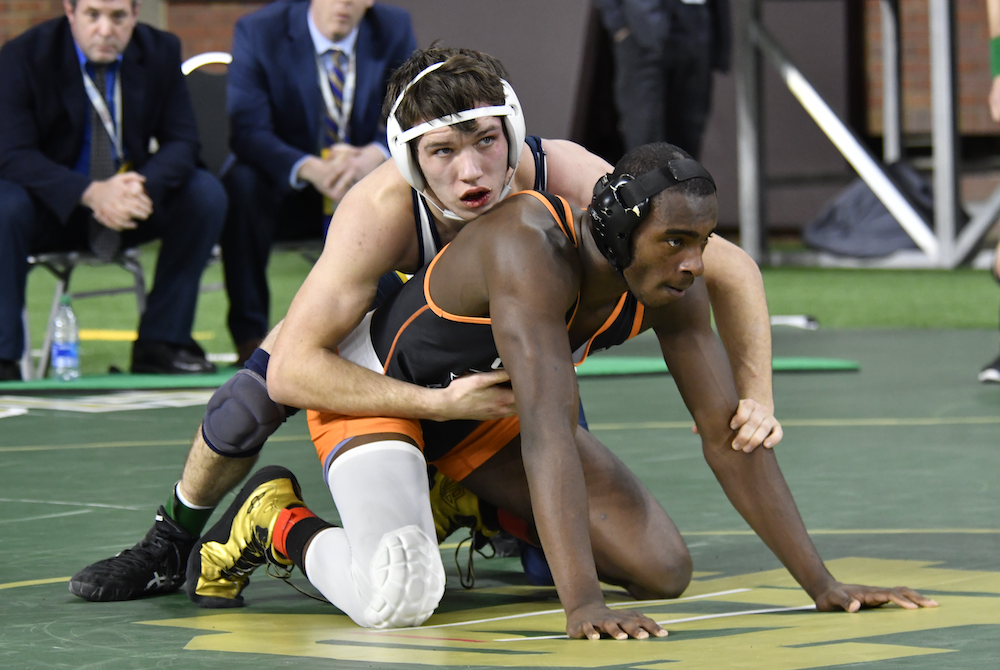
In a physical match, Willobee (29-3) took down Clio’s D’Marion Erlenbeck (28-6) by an 11-5 score to claim his first Finals championship.
“It was a stressful match, but I talked to my coaches before the match and they just stressed to keep my mind calm and give all glory to God,” Willobee said. “When I was out there, I was just trying to stay calm and capitalize on my opportunities. This is an amazing moment and one that I owe to a lot of people.
The Finals matchup at 157 wouldn’t have been one many saw coming as Erlenbeck was the fifth seed up against the sixth-seeded Willobee.
“Since Regionals I had been telling my coaches that it would be me and (Erlenbeck) in the Finals,” Willobee said. “I just knew that is how it would play out. You can’t focus on seeding this time of year. It’s about going out, performing, and having fun.”
The Finals matchup was a rubber match between the two, as each had narrowly defeated the other earlier this season. The difference Saturday was a pair of takedowns and near fall points for Willobee in the second and third periods.
After the match, the two competitors shared an embrace as they congratulated one another on their respective seasons.
“Erlenbeck is a wonderful competitor, and I give all my respect to him,” Willobee said of his opponent. “We’ve had some great matches, and he’s a wonderful competitor and an even better man.”
106
Champion: Jarrett Smith, Lowell, Soph. (39-1)
Major Decision, 15-4, over Cole Cichocki, Lowell, Fr. (26-12)
Smith found his first championship experience to be somewhat bittersweet. The sophomore had to face off with freshman teammate Cichocki for the crown.
Smith piled up six takedowns on his way to a 15-4 victory.
“I wish we could both win. It’s tough. One of us gets the title and one of us doesn’t, but we both worked really hard,” Smith said of wrestling his teammate in the final. “We both deserve it. We kind of thought we might meet up. We are both confident in our abilities, and our coaches have given us the tools to win.”
The two were hotel roommates this weekend and didn’t let the competition ruin their friendship.
“He’s one of my best friends,” Smith said of Cichocki. “He did better as a freshman than I did. You have to give him a lot of props. What he did is really impressive.”
113
Champion: Devan Garcia, Battle Creek Harper Creek, Fr. (47-1)
Major Decision, 12-4, over Cristian Haslem, St. Clair, Soph. (49-1)
Garcia was hoping to be on the offensive in Saturday’s 113-pound final.
Instead, it was his defensive ability that ended up earning him the title.
Garcia stuffed a pair of takedown attempts from Haslem and turned them into near falls as well. That gave him more than enough cushion to win the championship.
“I actually wanted to get in my attacks, but I pretty much scored on all his shots, so that’s the way it works out sometimes,” Garcia said. “I practiced those positions all the time, so I felt ready for them when they happened. To have it happen in the state championship feels great.”
The first stuff came in the first period to help Garcia start off with a 5-0 advantage. Haslem fought back to make it 5-3, but a second stuff from Garcia put him ahead 10-3 in the third.
120
Champion: Carter Cichocki, Lowell, Jr. (28-9)
Decision, 3-2, over Dominic Gumtow, Warren Woods Tower, Jr. (47-3)
After finishing runner-up at 113 pounds last year, Cichocki found himself two minutes from being a state champion.
Leading 3-2 to open the third, Cichocki knew if he could ride out his opponent for two minutes, the elusive title would be his.
Cichocki did just that, staying in control to overcome a 2-0 deficit and take home the championship.
“Things were different this year. Since my freshman year, I’ve tried to just see this as another match. I just stuck to what works for me and what I do best,” Cichocki said of handling the pressure of the third period. “It feels good to be a champion.”
126
Champion: Ricardo Saenz, Bloomfield Hills Brother Rice, Jr. (49-3)
Decision, 7-1, over Jaron Bensinger, Gaylord, Soph. (38-2)
Saenz wasn’t going to leave any doubt. The Bloomfield Hills Brother Rice junior shot out of a cannon to start the 126-pound final, scoring a takedown in the opening seconds of the bout.
From there, Saenz controlled Bensinger most of the way.
“I just kept telling myself that (Bensinger) wasn’t ready, and I was doing that to get myself motivated,” Saenz said. “I was thinking about starting the match like that all day and all season. I’ve been preparing for this moment, and I wasn’t going to let it get past me. It feels amazing to have it come to fruition.”
After taking a 2-1 lead through the first, Saenz rode out Bensinger in the second and then scored a reversal in the third with near fall points to cap off the title.
132
Champion: Jackson Blum, Lowell, Jr. (35-1)
Fall (4:54) over Trenden Bashore, DeWitt, Jr. (38-1)
Blum finds himself on the verge of being a four-time Finals champion, as the Lowell junior collected his third title with a third-round pin.
Blum recorded 11 takedowns in the match before securing a pin while ahead 23-9.
“I knew that my pace is really high, so I knew if I kept it on him, I would just keep getting to him more and more,” Blum said. “It was a tough first period, but I just trusted in my ability and stuck to the plan.”
Blum was the 112-pound champion as a freshman and the 120-pound champion as a sophomore.
138
Champion: Tee Ward, Freemont, Sr. (53-1)
Decision, 3-1, over Landon Thomas, St. Joseph, Jr. (48-1)
With the 138-pound championship bout tied 1-1 and a blood stoppage allowing Ward to get a break, he got into the music.
“We had a little bit of a break, and the song in the background just got me rolling,” Ward said.
Ward would come out of the stoppage and scored a takedown with 28 seconds remaining to go up 3-1. Ward then rode out Thomas to collect his first championship.
“I knew I had to get that takedown and ride things out from there. With five seconds left, I felt him sprawl out, and that was the best feeling of my life,” Ward added. “There’s so many emotions, but this is the best.”
144
Champion: Owen Segorski, Lowell, Jr. (34-6)
Decision, 5-1, over Jeffrey Miller, Jackson Northwest, Soph. (47-3)
Segorski had been on both ends of being in a state final. He was the 125-pound champion as a freshman, but then finished runner-up at 138 pounds as a sophomore.
This time around, the junior came back much more confident and it showed in a 5-1 win.
Segorski scored takedowns in each of the first two rounds and never let Miller get in any offense.
“It feels really good,” Segorski said of adding a second title. “I thought I should have won it last year, but I just didn’t perform and let the pressure get to me. It’s difficult to repeat, there’s a lot of pressure and it feels like you have to win. But, to be able to come back this year, I felt a lot more confident and I knew I was the better wrestler.”
150
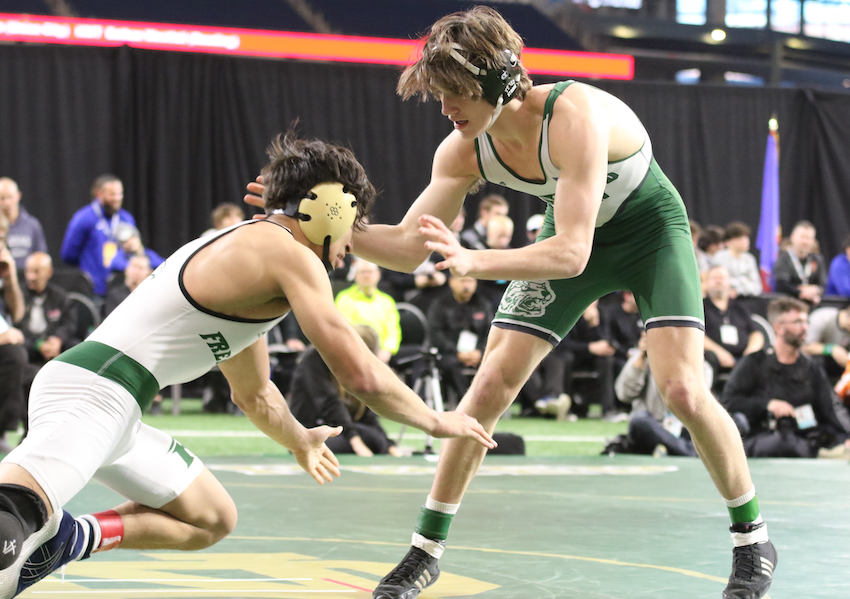
Champion: Lane Button, Wayland, Jr. (48-0)
Decision, 4-2, over Fabian Facundo, Freeland, Jr. (45-1)
A battle of two undefeated wrestlers came down to the final minute.
Button tried to push a hard pace in the 150-pound final, and it paid off with a takedown with 1:05 remaining in the third. The takedown was enough to push Button to the title.
“I was pacing (Facundo) out the whole time, and I knew I was going to get it,” Button said of the match-winning takedown. “As soon as things got neutral, I knew I was going to get it.”
“This means a lot to me. I put a lot into it,” Button said of going unbeaten. “I quit football just to focus on wrestling, and the work paid off.”
165
Champion: Nathan Dobson, Greenville, Sr. (41-4)
Decision, 5-4, over Harrison Meekhof, Allendale, Sr. (45-4)
Dobson knew the key to beating Meekhof based on previous matchups – he had to get more takedowns.
Dobson managed to do that in the 165-pound final, scoring takedowns in the second and third periods to hold off Meekhof and win the championship.
“I just knew I needed to get takedowns today. Every time it’s me and (Meekhof), it’s a takedown battle. I knew if I got the takedowns, I would get the victory,” Dobson said. “It’s the craziest thing I have ever felt. I can’t even dream this. It’s amazing.”
175
Champion: Kendall Drake, Holly, Sr. (50-2)
Decision, 7-4, over Derek Badgley, Mason, Sr. (40-3)
Drake had never placed at the Finals prior to Saturday; now he is a champion.
The senior overcame a 3-0 deficit to pick up a 7-4 win.
“Last year I got hurt in Districts, but all I have ever wanted was to win this tournament,” Drake said. “All summer I was practicing five days a week, going against the best guys I could find. I wanted to be confident in myself, so when this day came, I knew I could win this match.”
Drake nearly scored the opening takedown of the match but was ruled out of bounds. However, he didn’t let that get to him and worked his way to three takedowns in the victory.
“It didn’t matter, I was going to be ready to overcome any obstacles that came in my way,” Drake said of the slow start. “I wasn’t going to let anything dictate the match but myself.”
190
Champion: Ty Bensinger, Gaylord, Sr. (37-1)
DQ, over Easton Phipps, Goodrich, Sr. (27-1)
The 190-pound final in Division 2 didn’t end the way anyone wanted.
Phipps, the 2023 champion, led 1-0 in the second period when he picked up Bensinger to get him to the ground. However, Bensinger ended up landing on his head and the match was immediately stopped, as Bensinger went unconscious briefly according to his coach.
Medical staff on site checked on Bensinger and ruled he couldn’t continue. That led to Phipps being disqualified, giving the title to the Gaylord senior.
“These two have wrestled many times, and it’s always been a close match. (Phipps) certainly didn’t do it intentionally, it was just an unfortunate accident,” Gaylord coach Jerry LaJoie said.
215
Champion: Logan Demarest, Bay City John Glenn, Sr. (44-1)
Decision, 3-2, over Case Johnson, Greenville, Jr. (52-3)
Staying active and staying on the move is what allowed Demarest to come away with the 215-pound title Saturday.
After giving up a takedown to Johnson in the second period, Demarest fought his way to an escape to cut the lead to 2-1.
To open the third, Demarest did the same, earning an escape to even the match at 2-2. Then he kept the pressure on and forced a stalling point to be called in his favor, which proved to be the difference.
“I’ve got family and friends that have supported me all the way. They are the ones that got me here,” Demarest said of the title. “I was thinking about them and just kept doing whatever I could to keep pushing the pace.”
285
Champion: James Mahon, Goodrich, Jr. (44-3)
Decision, 9-8, over Parker Williams, Zeeland East, Sr. (46-3)
There were a lot of fireworks in the 285-pound final, as Mahon fought off Williams, 9-8.
Williams had a 5-0 advantage on the 2023 champion in the first period, but Mahon fought back to even things up at 5-5.
The match would be tied 7-7 in the third before Mahon dug deep and scored a takedown with 31 seconds remaining that proved to be the difference.
“I knew I could take him down. I knew I needed something, and I found it,” Mahon said of the late takedown. “It’s a really cool feeling (to repeat). There was a lot of pressure, and I’m almost glad it’s over.”
PHOTOS (top) Gaylord’s Zane Willobee, left, and Clio’s D’Marion Erlenbeck ready for the restart of their match at 157 pounds Saturday. (Middle) Wayland’s Lane Button, right, works against Freeland’s Fabian Facundo in the 150-pound title match. (Click for more from High School Sports Scene.)