

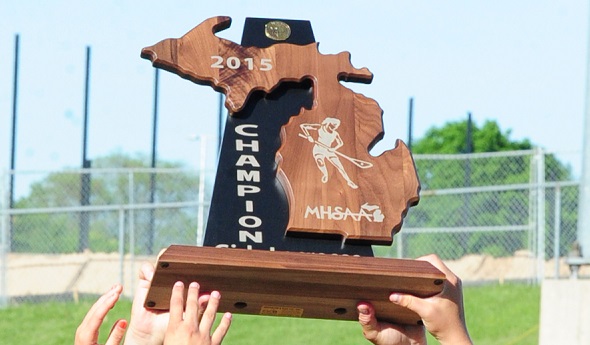
Casting Lines for Future Tournaments
August 12, 2016
By Jack Roberts
MHSAA Executive Director
The MHSAA is best known to the public for the tournaments it conducts to conclude the fall, winter and spring seasons each school year.
These tournaments, the first and largest program of the MHSAA, have survived the Vietnam War, the Korean conflict and two World Wars. They have survived the technology bubble, the housing collapse, the energy crisis and the Great Depression.
MHSAA tournaments existed at the dawn of aviation and at the time of our nation’s lunar landing. Popes, presidents and governors have changed and changed again and again, and MHSAA tournaments roll on year after year.
But the sense of tradition and permanence and inevitability of MHSAA tournaments doesn’t dissuade us from asking questions about our tournaments, even some of the most basic questions. Here are two.
Question #1
I have long been and will always be an advocate for a Ryder Cup format for the MHSAA Golf Finals, and a team tennis approach to the MHSAA Tennis Finals; but 90 years of tradition is hard to overcome. Might this be a more exciting format? Could it be co-ed? Could it reverse the decline in boys tennis participation, and increase girls golf participation? Wouldn’t it be fun to try?
Periodically, the International Olympic Committee requires each of the designated Olympic sports to defend its status, to state its case why the sport should remain a part of the Olympic program. Then, after a series or votes that retain one sport at a time, the IOC drops the sport that makes the weakest case. It does so to make room for one of the previously unlisted sports that makes the best case for inclusion.
This would appear to keep the existing Olympic sports on their toes, and to keep the Olympic movement fresh and reflective of modern trends in sports.
While I would not enjoy the controversy, I can see the potential for some positive results if the MHSAA were to invoke the same policy for determining the 14 tournaments it will provide for girls and the 14 for boys.
This might cause us to consider more deeply what a high school sport should look like, or at least what an MHSAA tournament sport should stand for.
On the one hand, we might be inclined to drop tournaments for those sports that involve mostly non-faculty coaches and non-school venues, or require cooperative programs to generate enough participants to support a team, or resort almost entirely to non-school funding, or cater to individuals more than teams.
Or perhaps this process would cause policymakers to forget traditional thinking and ask: “In this day and age, should we shake off traditional notions of sport and consider more where modern kids are coming from?” That might mean fewer team sports and more individual sports, more “extreme” sports like snowboarding and skateboarding, and more lifetime sports, meaning not just golf and tennis and running sports, but also fishing and even shooting sports.
Currently, MHSAA policy states that the MHSAA will consider sponsorship of a tournament series for any sport which 64 member schools conduct on an interscholastic basis as a result of action by the governing boards of those schools.
Should the only question be how many schools sponsor a sport, or must an activity also have certain qualities and/or avoid certain “defects?” What should an MHSAA tournament sport look like and stand for?
Question #2
Bristling from criticism that his association is a money-grabbing exploiter of children, my counterpart in another state said, “If we were running our programs just to make money, we would do very many things very differently.” I knew exactly what he meant.
Because we care about the health and welfare of students, because we mean what we say that the athletic program needs to maximize the ways it enhances the school experience while minimizing academic conflicts, and because we try to model our claim that no sport is a minor sport when it comes to its potential to teach young people life lessons, we operate our programs in ways that make promoters, marketers and business entrepreneurs laugh, cry or cringe.
If money were the only object, we would seed and select sites to assure the teams that attracted the most spectators had the best chance to advance in our tournaments, regardless of the travel for any team or its fan base. If money were the only object, we would never schedule two tournaments to overlap and compete for public attention, much less tolerate three or four overlapping events. If money were the only object, we would allow signage like NASCAR events and promotions like minor league baseball games.
Those approaches to event sponsorship may not be all wrong; they’re just not all right for us. And we will live with the consequences of our belief system.
During a typical school year, more than 20 percent of the MHSAA’s 2,097 District, Regional and Final tournaments lose money. Not a single site in golf, skiing or tennis makes a single penny. In no sport did every District, Regional and Final site have revenue in excess of direct expenses.
In fact, in only three sports – boys and girls basketball and football – is revenue so much greater than direct expenses overall that it helps to pay for all the other tournaments in which the MHSAA invests.
That’s right: invests. When we present our budget to our board, we talk about the MHSAA’s investment in providing tournament opportunities in all those sports and all those places that cannot sustain the cost of those events on their own. How much is this investment worth to students, schools and society?
These two are core questions that require our focus far in advance of talk about scheduling, site selection, seeding and the myriad matters that too often hijack our time and attention.

Referee Camaraderie: Bloopers, 'Nerding' Out, Lots of Laughs Create Powerful Bond
By
Pam Shebest
Special for MHSAA.com
February 13, 2024
KALAMAZOO — When it comes to blooper highlights, four MHSAA hockey officials don’t hesitate to share their miscues.
 One of them, Bob Corak, even has his pratfalls set to music on an internet site called Zebras with Pucks.
Laughter is the sound of the day when the four gather every Tuesday after their yoga class at Nisker’s Char-Grill & Slap Shot Hockey Bar in Kalamazoo.
The camaraderie between Corak, Corey Butts, Nick Schrippa and Nat Swanson is evident, but the tone gets more serious once the talk turns to officiating.
“We’ve all played, we’ve all coached to some extent, but officiating is just what speaks to us,” Schrippa said. “That’s our niche.
“Every player on the ice has a fan in the stands. Every player on the ice has support on the bench. We’re the only support we have in the arena. We’re the only ones we can lean on. We’re kind of on an island.”
Most times the friends are part of different four-man crews made up of two referees and two linesmen for South Central High School Hockey League games. But that just gives them more to talk about when they get together on Tuesdays.
 “We spend an hour every Tuesday with Bob’s wife (Susan) just kicking the crap out of us and then come to (Nisker’s) to debrief,” Schrippa said. Susan Corak runs Be Well Yoga and Fitness in Kalamazoo.
"We never talk about the workout. Somebody will bust out a phone and we’ll go over a video and we’ll talk about a situation, talk about rule differences,” he continued. “We are nerds to the nth degree, and that’s just how we’re wired.”
Yoga is a good way to keep in shape, the four friends agree.
“I’m a little older than most of the referees I meet,” said Corak, who retired after 35 years with Pfizer in information technology. "It keeps me limber, keeps me in shape to an extent, not a lot of cardio but the strength is there that we get from yoga, especially the core, plus injury prevention.
“If I’m not skating, I’m officiating or I’m working the books for the association (Kalamazoo Ice Hockey Officials Association).”
Corak assists in the scheduling, billing, etc., leading Schrippa to quip: “Remember when Bob said he did information technology? We take full advantage of that. He is, in fact, the glue that holds a lot of our shenanigans together. He really is.”
Referees vs. Linesmen
Butts and Corak prefer wearing the referees’ armbands, while Schrippa and Swanson like working the lines.
“’I’m a smaller guy,” said Butts, who has been officiating for 14 years. “Linesmen typically tend to be 6-foot-5. When you’re smaller than most of the players, it doesn’t work out well.
“I like the freedom to be able to get out of the way. It’s a high traffic area as a linesman.”
When not spending evenings officiating, Butts is the penalty box timekeeper for the ECHL Kalamazoo Wings home games. His day job as a third-party examiner for the state of Michigan means he gives driving tests, and that leads to some interesting conversations.
“I’ve given most of (the players) their driver’s licenses,” he said. “I’ve had a group of players in the middle of a high school hockey game, getting ready to drop the puck at the start of the third period, and they’re trying to schedule a driver’s test for the next day. I’m like, ‘Guys, not now. Talk to me after work.’”
 Swanson is the newest of the quartet, moving to the area three years ago from Syracuse, N.Y., where he started officiating at age 11.
He is a pilot in the U.S. Air Force International Guard in Battle Creek flying MQ-9 Reaper Drones.
“I like refereeing better (than being a linesman) because I like managing the game and look at the big picture,” Swanson said. “Sometimes it’s great to be a linesman because they get to communicate with the players, crack jokes and sometimes throw the referee under the bus, ‘Yeah, I agree that was a terrible call. But you’ve got to move on.’”
All four also officiate college and youth hockey, which can lead to a dilemma.
“Those are all different rule books, so we don’t have to know just one set of rules,” Schrippa said. “None of them are what you see on TV.
“While we have a couple hundred people in the building who are yelling at us that we got it wrong because that’s what they saw on ESPN, that’s not how it works. So not only do we have to know the rules, we have to know the differences in the rules.”
With mentorship programs available, some current prep players are also officials for younger leagues.
“They’re learning, we’re teaching them,” Corak said. “We have games with them as officials, then we’ll officiate their games when they play for their schools.”
Swanson added: “I think that makes them better players because they understand the rules, where they can bend rules and where they can’t.”
 That is what led Schrippa to officiating.
“(Late referee) Mike Martin was officiating a game and pulled me aside,” he said. “I was 22 years old and he asked if I wanted to become a ref.
“‘(Heck) you’ve broken all the rules,’ he told me. ‘You probably know most of them already. He wasn’t wrong. I talked to a couple friends who had done it, and they talked me into doing it 29 seasons ago. I fell in love with it.”
Fun with bloopers
All four laugh as they regale each other with their funniest and most embarrassing moments.
For Schrippa, it was the college game where he made his refereeing debut.
“I was given the rookie lap,” he said. “I was jazzed. I came out of the gate, turned left, went around the back of the net, got to the blue line, caught a toe pick and Supermanned, slid from the blue line to the top of the next faceoff circle and was soaked because the ice hadn’t set yet.
“I got a standing ovation from the few hundred fans that were in the rink. Both my linesmen were doubled over laughing. It was a very cold first period.”
Something similar happened to Swanson.
 “I was taking a hot lap, not seeing they’ve got a carpet out for somebody, hitting the carpet and Supermanning,” he recalled. “Then having a linesman watch you do it as there’s a few hundred people in the stands and give a big washout sign.”
Butts and Swanson had moments that actually delayed the start of a game.
For Butts, “I forgot my pants because I washed them separate and my wife had to bring them to me, and we could not start the game until my pants arrived,” he said, while the others laughed and nodded in agreement.
Swanson actually found himself at the wrong rink one time.
“I’m like, ‘Where is everybody?’” he said. “My phone starts ringing. ‘Hey dude, game starts in 15 minutes. You going to be here? Uh, yes, in 20.’’’
The four agree most officials go through highs and lows, funny times and embarrassing times, and that’s one thing that brings them all together.
“What’s unique about what we do is I could meet another official from Sweden tomorrow who I’ve never met before, and within minutes we’ve already got that relationship,” said Schrippa, who is the Southwest Michigan communications representative for the Michigan Department of Transportation (MDOT).
“That’s something we all share, we all know that feeling, we all understand that bond and it just takes a second. It’s so neat, it’s powerful.”
 Pam Shebest served as a sportswriter at the Kalamazoo Gazette from 1985-2009 after 11 years part-time with the Gazette while teaching French and English at White Pigeon High School. She can be reached at [email protected] with story ideas for Calhoun, Kalamazoo and Van Buren counties.
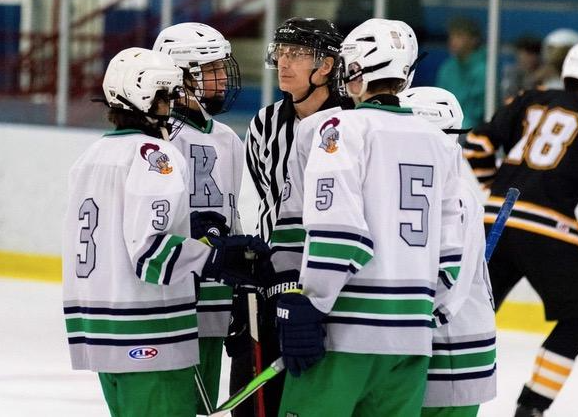
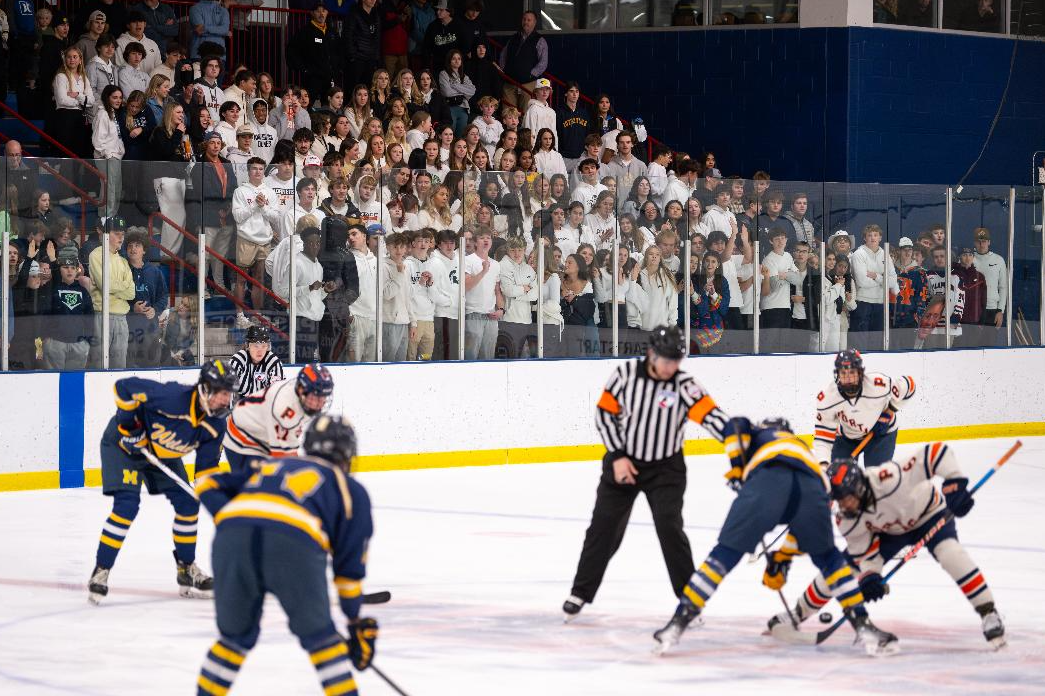
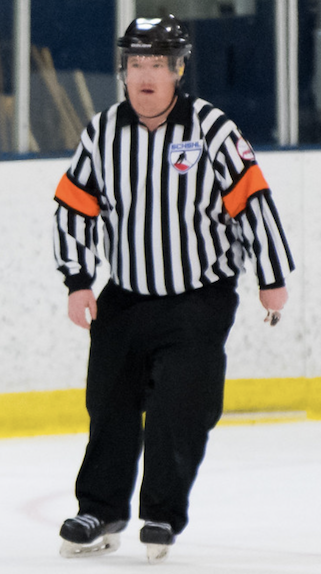
PHOTOS (Top) MHSAA hockey officials, from left: Nick Schrippa, Bob Corak, Nat Swanson and Corey Butts get together recently for one of their weekly hangouts. (2) Schrippa makes a call. (3) Corak, center, confers with a group of players. (4) Swanson prepares to drop the puck. (5) Butts monitors the game action. (Top photo by Pam Shebest; following photos provided by respective officials.)