

Casting Lines for Future Tournaments
August 12, 2016
By Jack Roberts
MHSAA Executive Director
The MHSAA is best known to the public for the tournaments it conducts to conclude the fall, winter and spring seasons each school year.
These tournaments, the first and largest program of the MHSAA, have survived the Vietnam War, the Korean conflict and two World Wars. They have survived the technology bubble, the housing collapse, the energy crisis and the Great Depression.
MHSAA tournaments existed at the dawn of aviation and at the time of our nation’s lunar landing. Popes, presidents and governors have changed and changed again and again, and MHSAA tournaments roll on year after year.
But the sense of tradition and permanence and inevitability of MHSAA tournaments doesn’t dissuade us from asking questions about our tournaments, even some of the most basic questions. Here are two.
Question #1
I have long been and will always be an advocate for a Ryder Cup format for the MHSAA Golf Finals, and a team tennis approach to the MHSAA Tennis Finals; but 90 years of tradition is hard to overcome. Might this be a more exciting format? Could it be co-ed? Could it reverse the decline in boys tennis participation, and increase girls golf participation? Wouldn’t it be fun to try?
Periodically, the International Olympic Committee requires each of the designated Olympic sports to defend its status, to state its case why the sport should remain a part of the Olympic program. Then, after a series or votes that retain one sport at a time, the IOC drops the sport that makes the weakest case. It does so to make room for one of the previously unlisted sports that makes the best case for inclusion.
This would appear to keep the existing Olympic sports on their toes, and to keep the Olympic movement fresh and reflective of modern trends in sports.
While I would not enjoy the controversy, I can see the potential for some positive results if the MHSAA were to invoke the same policy for determining the 14 tournaments it will provide for girls and the 14 for boys.
This might cause us to consider more deeply what a high school sport should look like, or at least what an MHSAA tournament sport should stand for.
On the one hand, we might be inclined to drop tournaments for those sports that involve mostly non-faculty coaches and non-school venues, or require cooperative programs to generate enough participants to support a team, or resort almost entirely to non-school funding, or cater to individuals more than teams.
Or perhaps this process would cause policymakers to forget traditional thinking and ask: “In this day and age, should we shake off traditional notions of sport and consider more where modern kids are coming from?” That might mean fewer team sports and more individual sports, more “extreme” sports like snowboarding and skateboarding, and more lifetime sports, meaning not just golf and tennis and running sports, but also fishing and even shooting sports.
Currently, MHSAA policy states that the MHSAA will consider sponsorship of a tournament series for any sport which 64 member schools conduct on an interscholastic basis as a result of action by the governing boards of those schools.
Should the only question be how many schools sponsor a sport, or must an activity also have certain qualities and/or avoid certain “defects?” What should an MHSAA tournament sport look like and stand for?
Question #2
Bristling from criticism that his association is a money-grabbing exploiter of children, my counterpart in another state said, “If we were running our programs just to make money, we would do very many things very differently.” I knew exactly what he meant.
Because we care about the health and welfare of students, because we mean what we say that the athletic program needs to maximize the ways it enhances the school experience while minimizing academic conflicts, and because we try to model our claim that no sport is a minor sport when it comes to its potential to teach young people life lessons, we operate our programs in ways that make promoters, marketers and business entrepreneurs laugh, cry or cringe.
If money were the only object, we would seed and select sites to assure the teams that attracted the most spectators had the best chance to advance in our tournaments, regardless of the travel for any team or its fan base. If money were the only object, we would never schedule two tournaments to overlap and compete for public attention, much less tolerate three or four overlapping events. If money were the only object, we would allow signage like NASCAR events and promotions like minor league baseball games.
Those approaches to event sponsorship may not be all wrong; they’re just not all right for us. And we will live with the consequences of our belief system.
During a typical school year, more than 20 percent of the MHSAA’s 2,097 District, Regional and Final tournaments lose money. Not a single site in golf, skiing or tennis makes a single penny. In no sport did every District, Regional and Final site have revenue in excess of direct expenses.
In fact, in only three sports – boys and girls basketball and football – is revenue so much greater than direct expenses overall that it helps to pay for all the other tournaments in which the MHSAA invests.
That’s right: invests. When we present our budget to our board, we talk about the MHSAA’s investment in providing tournament opportunities in all those sports and all those places that cannot sustain the cost of those events on their own. How much is this investment worth to students, schools and society?
These two are core questions that require our focus far in advance of talk about scheduling, site selection, seeding and the myriad matters that too often hijack our time and attention.
Martin Caps Frantic Final Minutes with Unforgettable Comeback at Superior Dome
By
Jason Juno
Special for MHSAA.com
November 18, 2023
MARQUETTE --- Martin had it easy last year, at least from a stress and anxiety standpoint.
Sure, the 8-Player Division 1 Final was competitive in the first half, but Martin went on to win the championship game by 50 points, hardly anything to sweat too much about.
But this year?
Oh goodness.
Martin took possession of the ball on its own 15-yard-line with 1:15 on the clock and trailing by two scores, 26-14, to an Indian River Inland Lakes team determined to win its first Finals title on the football field.
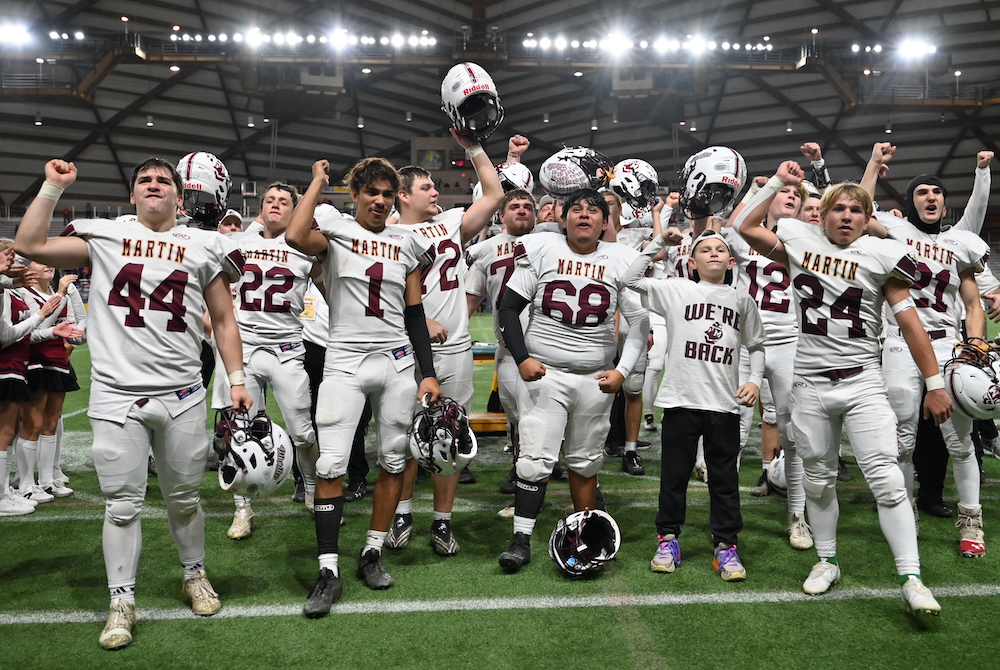
And Martin won. A state title game for the ages, the Clippers claimed it 30-26 to repeat as champions despite also trailing 20-0 to start the fourth quarter.
It was still a 20-point margin, 26-6, when the Bulldogs scored what seemed to be the insurance points they needed with 6:26 left.
“It’s amazing,” Martin coach Brad Blauvelt said. “I’m not gonna lie – doubt creeps into your head when it’s 20-6, they’re driving down the field, they’re running the clock. … We made plays, we made plays when it counted the most.”
Inland Lakes built its big lead with a stout red zone defense – Martin got there on every one of its possessions but didn’t cash in until the final quarter – and a four-touchdown day from junior quarterback Aidan Fenstermaker.
It was the first Finals appearance for Inland Lakes, which had its two winningest seasons over the last three years. Coach Travis Meyer’s message to the team after such a heartbreaking loss was about focusing on getting here – no easy feat itself – and about the upperclassmen guiding the rest of the team so that their run of success isn’t complete.
 “No one in the state, based on any rankings, based on any newspaper articles, based on anything really, expected us to do what we did,” Meyer said. “And then even the ones that weren’t totally shocked that we were here didn’t think it was going to be a four-point game. Regardless of when the points were scored, that’s still a four-point game, that’s a hell of a state championship. That could have gone lots of different ways, and I don’t think anybody really expected us to give them a shot.”
They certainly did that. Martin, though, had an epic response.
The Clippers scored quickly, going 70 yards in a minute and a half, with Haylen Buell’s one-yard touchdown run pulling the Clippers within 26-14 with 4:54 left.
The Bulldogs recovered the Martin onside kick attempt and marched right into the red zone on the ensuing drive. But they turned it over on downs with 1:33 left.
That meant Martin had to go 85 yards just to pull within one possession with the clock even more daunting than the distance.
It took them a minute. The Clippers capped the drive as Taegan Harris caught a 10-yard scoring pass from Gavin Meyers with 33 seconds to go. The conversion pass made it 26-22.
Everything came down to the onside kick by sophomore Ben Romero. The bouncing ball went off at least two Inland Lakes players before Martin’s Mike Branch recovered it.
Martin had tried an onside kick after its previous two scores as well, but this was the only one that worked.
“They timed it perfect,” Meyer said. “That kid has a heck of an onside kick, it gets there at the same time as his kids. Whether you’re ready for it, whether you’ve got your best athletes there or not, that’s hard to do, especially on a stage like this, in that moment. That is hard on anybody, even the pros.”
The Clippers took over at their 45 with 32 ticks on the clock. Before long they were at the 21.
Meyers looked to pass, scrambled and then ran 21 yards for the touchdown with five seconds remaining.
“It was a pass play, trying to get it to Abe (Dykstra),” Meyers said. “The middle opened up, and I just took off.”
He said he was just hoping to get out of bounds, with the clock running down, but he was able to get in the end zone.
“We thought we could keep them out for two more plays,” Meyer, the Bulldogs’ coach, said. “We lost contain somewhere there around the edge.”
 The unfathomable score: 30-26 after the conversion.
Martin lost a lot of seniors from last year, including three all-staters. The Clippers didn’t win their conference, and they fell to 2-2 early in the year with losses to Bridgman and Gobles. They haven’t lost since, though, winning nine straight games with a young team.
“It’s nice to be able to leave a legacy,” said Harris, a senior. “Last year, we had a pretty stacked group of guys. We had three of our star players injured this season, it wasn’t looking good, 2-2, then we won, what, nine, eight straight? … It feels really good.”
Meyers, who threw for 216 yards and ran for 142 on Saturday, filled in for one of those all-state graduates quite well, J.R. Hildebrand.
“He’s a damn good football player,” Blauvelt said of Meyers. “And he’s grown a bunch. Halfway through the year, he started moving in the pocket, keeping his eyes downfield. You saw it today, right, he kept his eyes downfield.”
After a scoreless first quarter, Inland Lakes scored twice during the second quarter. The Bulldogs took over for the final drive of the half at their own 12 with 3:05 remaining. They went for it on 4th-and-6 at their own 31 and again on 4th-and-6 at the 47. They converted both and were rewarded with a touchdown as time expired. Despite being pressured, Fenstermaker hit Jacob Willey in the corner of the end zone for a 24-yard touchdown pass that put Inland Lakes up 14-0 at the half.
Meyer said his team punted once this year and once last year.
“We don’t put a ton of time into punting,” he said. “So when the best we can do is maybe get off a 25-yard punt and they return it 10 yards before we cover it, we figured that was only 15 yards of field position anyway, so we might as well give ourselves a shot. It was playing the odds. Maybe people don’t like that logic, but we like to play aggressively. We like to see what we can do.”
They built the lead to 20-0 late in the third quarter as Martin came up empty on all four of its drives, even though every one of them got into the red zone.
“It was very frustrating,” Blauvelt said. “We saw on film, they stopped Pickford (in the Semifinal) inside the red zone multiple times, they tightened up when they got in there. We shot ourselves in the foot in the first half. But we moved the ball consistently, but yeah, that was a little frustrating. We had some good drives, and we just couldn’t punch them in.”
It just wasn’t as frustrating as the finish was for the Bulldogs.
Inland Lakes senior Payton Teuthorn said getting to this point was what they wanted since youth football.
“We made it here. We just couldn’t finish,” he said.
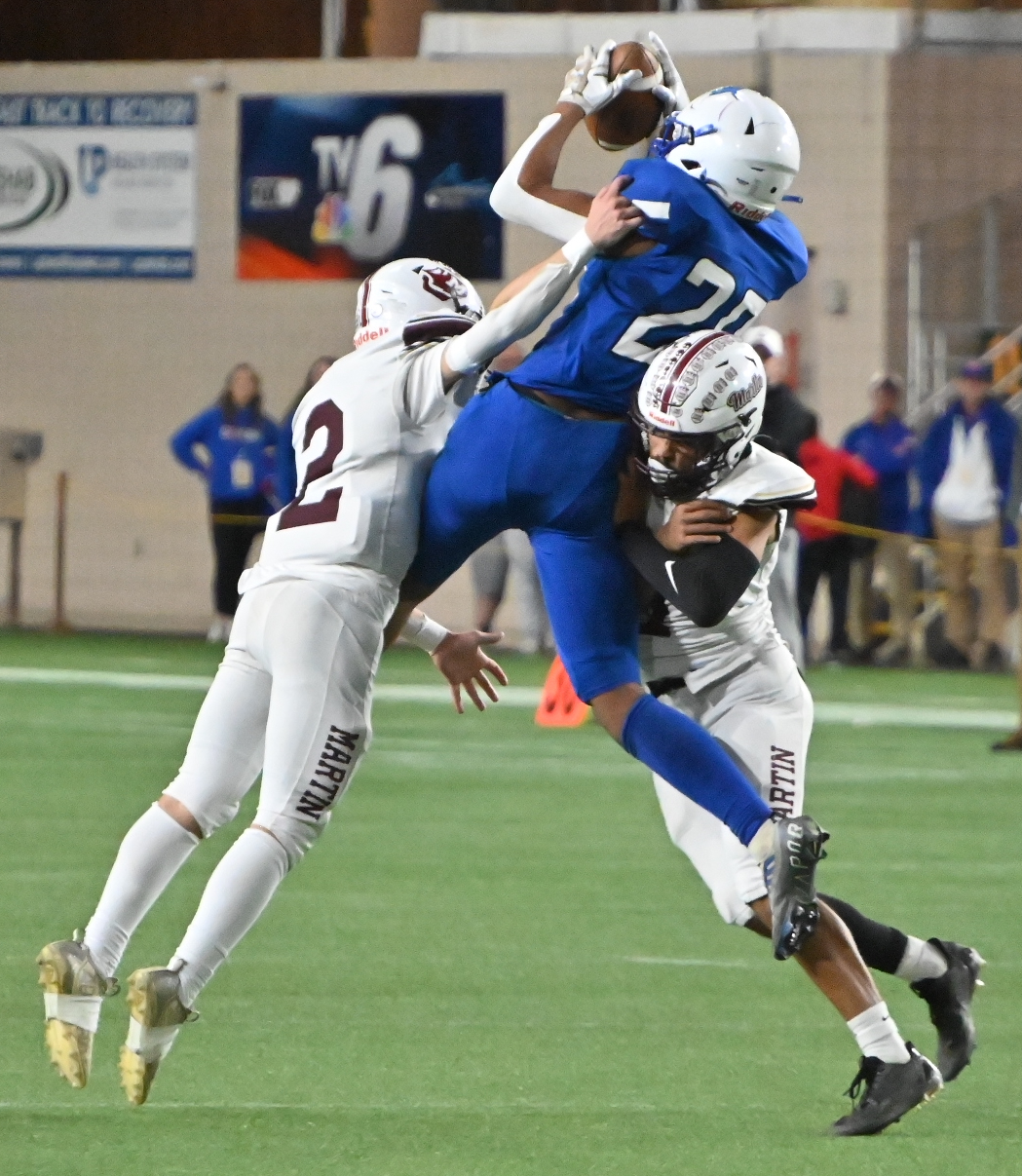
PHOTOS (Top) Martin players celebrate with their fans Saturday the program’s second-straight 8-Player Division 1 championship at Superior Dome. (Middle) Martin quarterback Gavin Meyers charges toward the end zone on the way to scoring the game-winning touchdown. (Below) Inland Lakes’ Andre Bradford (20) pulls in a catch as two Martin defenders converge including Bryer Watson (2). (Click for more photos by Cara Kamps.)