

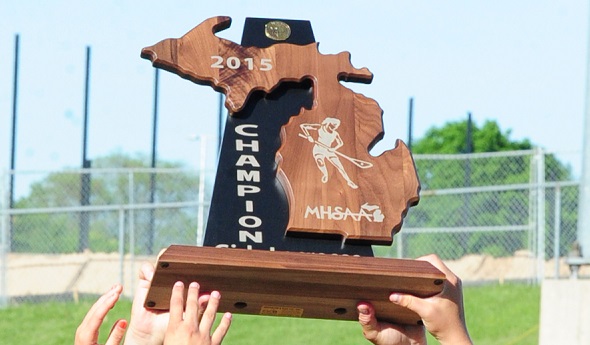
Casting Lines for Future Tournaments
August 12, 2016
By Jack Roberts
MHSAA Executive Director
The MHSAA is best known to the public for the tournaments it conducts to conclude the fall, winter and spring seasons each school year.
These tournaments, the first and largest program of the MHSAA, have survived the Vietnam War, the Korean conflict and two World Wars. They have survived the technology bubble, the housing collapse, the energy crisis and the Great Depression.
MHSAA tournaments existed at the dawn of aviation and at the time of our nation’s lunar landing. Popes, presidents and governors have changed and changed again and again, and MHSAA tournaments roll on year after year.
But the sense of tradition and permanence and inevitability of MHSAA tournaments doesn’t dissuade us from asking questions about our tournaments, even some of the most basic questions. Here are two.
Question #1
I have long been and will always be an advocate for a Ryder Cup format for the MHSAA Golf Finals, and a team tennis approach to the MHSAA Tennis Finals; but 90 years of tradition is hard to overcome. Might this be a more exciting format? Could it be co-ed? Could it reverse the decline in boys tennis participation, and increase girls golf participation? Wouldn’t it be fun to try?
Periodically, the International Olympic Committee requires each of the designated Olympic sports to defend its status, to state its case why the sport should remain a part of the Olympic program. Then, after a series or votes that retain one sport at a time, the IOC drops the sport that makes the weakest case. It does so to make room for one of the previously unlisted sports that makes the best case for inclusion.
This would appear to keep the existing Olympic sports on their toes, and to keep the Olympic movement fresh and reflective of modern trends in sports.
While I would not enjoy the controversy, I can see the potential for some positive results if the MHSAA were to invoke the same policy for determining the 14 tournaments it will provide for girls and the 14 for boys.
This might cause us to consider more deeply what a high school sport should look like, or at least what an MHSAA tournament sport should stand for.
On the one hand, we might be inclined to drop tournaments for those sports that involve mostly non-faculty coaches and non-school venues, or require cooperative programs to generate enough participants to support a team, or resort almost entirely to non-school funding, or cater to individuals more than teams.
Or perhaps this process would cause policymakers to forget traditional thinking and ask: “In this day and age, should we shake off traditional notions of sport and consider more where modern kids are coming from?” That might mean fewer team sports and more individual sports, more “extreme” sports like snowboarding and skateboarding, and more lifetime sports, meaning not just golf and tennis and running sports, but also fishing and even shooting sports.
Currently, MHSAA policy states that the MHSAA will consider sponsorship of a tournament series for any sport which 64 member schools conduct on an interscholastic basis as a result of action by the governing boards of those schools.
Should the only question be how many schools sponsor a sport, or must an activity also have certain qualities and/or avoid certain “defects?” What should an MHSAA tournament sport look like and stand for?
Question #2
Bristling from criticism that his association is a money-grabbing exploiter of children, my counterpart in another state said, “If we were running our programs just to make money, we would do very many things very differently.” I knew exactly what he meant.
Because we care about the health and welfare of students, because we mean what we say that the athletic program needs to maximize the ways it enhances the school experience while minimizing academic conflicts, and because we try to model our claim that no sport is a minor sport when it comes to its potential to teach young people life lessons, we operate our programs in ways that make promoters, marketers and business entrepreneurs laugh, cry or cringe.
If money were the only object, we would seed and select sites to assure the teams that attracted the most spectators had the best chance to advance in our tournaments, regardless of the travel for any team or its fan base. If money were the only object, we would never schedule two tournaments to overlap and compete for public attention, much less tolerate three or four overlapping events. If money were the only object, we would allow signage like NASCAR events and promotions like minor league baseball games.
Those approaches to event sponsorship may not be all wrong; they’re just not all right for us. And we will live with the consequences of our belief system.
During a typical school year, more than 20 percent of the MHSAA’s 2,097 District, Regional and Final tournaments lose money. Not a single site in golf, skiing or tennis makes a single penny. In no sport did every District, Regional and Final site have revenue in excess of direct expenses.
In fact, in only three sports – boys and girls basketball and football – is revenue so much greater than direct expenses overall that it helps to pay for all the other tournaments in which the MHSAA invests.
That’s right: invests. When we present our budget to our board, we talk about the MHSAA’s investment in providing tournament opportunities in all those sports and all those places that cannot sustain the cost of those events on their own. How much is this investment worth to students, schools and society?
These two are core questions that require our focus far in advance of talk about scheduling, site selection, seeding and the myriad matters that too often hijack our time and attention.
Freeland's Hansen Smashes Longstanding Record, FHE Claims 1st Finals Victory
November 4, 2023
BROOKLYN — On the same day Rockford’s Dathan Ritzenhein set a course record at Michigan International Speedway that has never been approached, Kurtis Marlowe of Richland Gull Lake had a performance that was overshadowed.
But Marlowe’s winning time of 15:02.5 in the MHSAA Lower Peninsula Division 2 Finals in 2000 also stood the test of time.
Until Saturday.
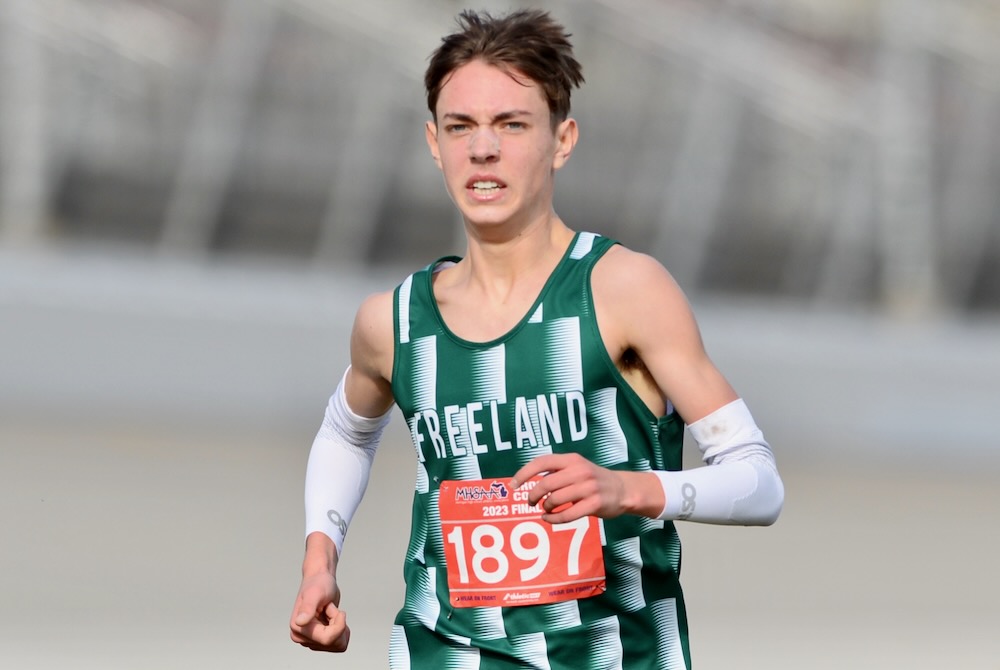
Freeland junior TJ Hansen eclipsed the Division 2 record with his winning time of 14:52.8. Runner-up Solomon Kwartowitz of Bloomfield Hills Cranbrook Kingswood also nearly broke the previous record, finishing in 15:03.3.
Even though it was apparent from earlier races Saturday that perfect conditions made fast times possible, Hansen didn’t set out to break Marlowe’s record.
“No, my goal was to go out and win,” he said. “Play strategy from the front, let others do the work, then just push it. Whatever time I got, I was gonna get. I knew it was going to take a time like that to win it today.
 “I usually run close to a (personal record) every year at this meet. It’s one of my favorite courses. It’s definitely unique here at the speedway, so I really like the course, I really like to run it.”
Hansen went through the mile mark tied for 11th in 4:54.3, but you could’ve thrown a blanket over the top 12 runners at that point.
It was a three-man race between Hansen, Kwartowitz and 2022 champion Connell Alford of Chelsea when they reached the two-mile mark in 9:46.
Hansen made sure there would be no drama coming down the stretch.
“I was just trying to stay calm, let them do the work, just sit back,” he said. “When I needed to go, I was gonna go. My goal was to stay relaxed.”
Kwartowitz had no complaints with his race.
“It felt really smooth,” he said. “It was great. I didn’t get a chance to race these guys a bunch this year. I did at Spartan (Invitational, in September). I was really hoping to end it with a victory.”
The boys Division 2 team championship was a toss-up between four teams for the second year in a row, with Ada Forest Hills Eastern coming out on top with 134 points. Pinckney was second with 156, East Grand Rapids third with 175 and Allendale fourth with 176.
Last year, 32 points separated the top four teams.
Junior Henry Dixon led Forest Hills Eastern, placing sixth in 15:16.0. Senior Liam Hinman was 29th, senior Brendan Hoving was 30th, senior Cooper Jacobsen was 38th and junior Tyler Endres was 82nd.
It was the first MHSAA championship for Forest Hills Eastern, which had a program-best finish of fourth in 2007.
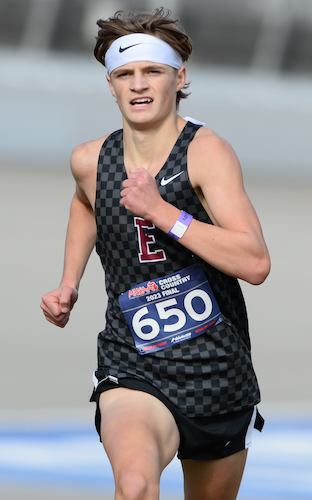
PHOTOS (Top) Freeland's TJ Hansen approaches the finish of his record run Saturday at MIS. (Middle) Henry Dixon sets the pace for Forest Hills Eastern's first team championship. (Photos by Dave McCauley/RunMichigan.com.)