

Casting Lines for Future Tournaments
August 12, 2016
By Jack Roberts
MHSAA Executive Director
The MHSAA is best known to the public for the tournaments it conducts to conclude the fall, winter and spring seasons each school year.
These tournaments, the first and largest program of the MHSAA, have survived the Vietnam War, the Korean conflict and two World Wars. They have survived the technology bubble, the housing collapse, the energy crisis and the Great Depression.
MHSAA tournaments existed at the dawn of aviation and at the time of our nation’s lunar landing. Popes, presidents and governors have changed and changed again and again, and MHSAA tournaments roll on year after year.
But the sense of tradition and permanence and inevitability of MHSAA tournaments doesn’t dissuade us from asking questions about our tournaments, even some of the most basic questions. Here are two.
Question #1
I have long been and will always be an advocate for a Ryder Cup format for the MHSAA Golf Finals, and a team tennis approach to the MHSAA Tennis Finals; but 90 years of tradition is hard to overcome. Might this be a more exciting format? Could it be co-ed? Could it reverse the decline in boys tennis participation, and increase girls golf participation? Wouldn’t it be fun to try?
Periodically, the International Olympic Committee requires each of the designated Olympic sports to defend its status, to state its case why the sport should remain a part of the Olympic program. Then, after a series or votes that retain one sport at a time, the IOC drops the sport that makes the weakest case. It does so to make room for one of the previously unlisted sports that makes the best case for inclusion.
This would appear to keep the existing Olympic sports on their toes, and to keep the Olympic movement fresh and reflective of modern trends in sports.
While I would not enjoy the controversy, I can see the potential for some positive results if the MHSAA were to invoke the same policy for determining the 14 tournaments it will provide for girls and the 14 for boys.
This might cause us to consider more deeply what a high school sport should look like, or at least what an MHSAA tournament sport should stand for.
On the one hand, we might be inclined to drop tournaments for those sports that involve mostly non-faculty coaches and non-school venues, or require cooperative programs to generate enough participants to support a team, or resort almost entirely to non-school funding, or cater to individuals more than teams.
Or perhaps this process would cause policymakers to forget traditional thinking and ask: “In this day and age, should we shake off traditional notions of sport and consider more where modern kids are coming from?” That might mean fewer team sports and more individual sports, more “extreme” sports like snowboarding and skateboarding, and more lifetime sports, meaning not just golf and tennis and running sports, but also fishing and even shooting sports.
Currently, MHSAA policy states that the MHSAA will consider sponsorship of a tournament series for any sport which 64 member schools conduct on an interscholastic basis as a result of action by the governing boards of those schools.
Should the only question be how many schools sponsor a sport, or must an activity also have certain qualities and/or avoid certain “defects?” What should an MHSAA tournament sport look like and stand for?
Question #2
Bristling from criticism that his association is a money-grabbing exploiter of children, my counterpart in another state said, “If we were running our programs just to make money, we would do very many things very differently.” I knew exactly what he meant.
Because we care about the health and welfare of students, because we mean what we say that the athletic program needs to maximize the ways it enhances the school experience while minimizing academic conflicts, and because we try to model our claim that no sport is a minor sport when it comes to its potential to teach young people life lessons, we operate our programs in ways that make promoters, marketers and business entrepreneurs laugh, cry or cringe.
If money were the only object, we would seed and select sites to assure the teams that attracted the most spectators had the best chance to advance in our tournaments, regardless of the travel for any team or its fan base. If money were the only object, we would never schedule two tournaments to overlap and compete for public attention, much less tolerate three or four overlapping events. If money were the only object, we would allow signage like NASCAR events and promotions like minor league baseball games.
Those approaches to event sponsorship may not be all wrong; they’re just not all right for us. And we will live with the consequences of our belief system.
During a typical school year, more than 20 percent of the MHSAA’s 2,097 District, Regional and Final tournaments lose money. Not a single site in golf, skiing or tennis makes a single penny. In no sport did every District, Regional and Final site have revenue in excess of direct expenses.
In fact, in only three sports – boys and girls basketball and football – is revenue so much greater than direct expenses overall that it helps to pay for all the other tournaments in which the MHSAA invests.
That’s right: invests. When we present our budget to our board, we talk about the MHSAA’s investment in providing tournament opportunities in all those sports and all those places that cannot sustain the cost of those events on their own. How much is this investment worth to students, schools and society?
These two are core questions that require our focus far in advance of talk about scheduling, site selection, seeding and the myriad matters that too often hijack our time and attention.
Preview: MIS Set to Host Next Wave of Boys Cross Country Champions
By
Geoff Kimmerly
MHSAA.com senior editor
November 3, 2023
The podium at Saturday’s Lower Peninsula Boys Cross Country Finals could welcome a host of new champions.
Division 4 is assured of a new team title winner, with 2022 champion Wyoming Potter’s House Christian running in Division 3. Anticipation is likely high for Ada Forest Hills Eastern in Division 2 and Traverse City St. Francis in Division 3 among others as well, as they are ranked No. 1 in their respective divisions and seeking their first championships in this sport.
There will be at least three new individual champions, with last year’s Division 2 pacesetter Connell Alford of Chelsea the only one running again. But he is part of an elite group who have emerged this fall, and there’s more on many of those and other team contenders below.
The "season bests" list referred to frequently is a ranking list of every runner's best time this season, maintained by Athletic.net. The day’s first race, Division 4 girls, begins at 9:30 a.m.; click here for the full schedule and ticket information. Additionally, all eight races Saturday at MIS will be streamed live and viewable with subscription on MHSAA.tv.
Division 1
Reigning champion: Northville
2022 runner-up: Traverse City Central
2023 top-ranked: 1. Brighton, 2. Northville, 3. Grand Haven.
While Northville won last season’s championship, Brighton won in 2021 and 2019, and they’ve matched up multiple times this season with Northville notably claiming the Kensington Lakes Activities Association championship race but Brighton winning the early-season Spartan Invitational Elite race on a tie-breaker. Brighton is paced by senior Tyler Langley, who finished 24th last season and has the 17th-fastest season-best time in Division 1 this fall, while Northville follows senior Brendan Herger and junior Ethan Powell, who finished third and 28th, respectively, at last season’s Final – and both have top-15 times on the season bests list this year. Grand Haven was 11th last season behind individual runner-up Seth Norder, who finished just 1.63 seconds off the lead, and he has the fastest time in Division 1 this fall of 14:48.2 run to win the Allendale Regional.
Individuals: Jenison junior Seth Connor was right behind Norder at Allendale and has the second-fastest season best in Division 1 with a 14:54 from that day. He should make a big jump from 34th a year ago. Six more runners join Norder and Herger from last season’s top 20, with New Baltimore Anchor Bay senior Thomas Westphal fourth last year and eighth on this year’s season bests list, and Romeo junior Vincent Guaresimo back after finishing eighth and sitting 12th among the season bests. Dexter senior Brandon Anderson has the third-fastest season best in Division 1 and was 12th last season, and Battle Creek Lakeview senior Aiden Moore is tenths of a second behind him this fall after finishing 21st at last year’s Final. A big Finals debut is anticipated from Ann Arbor Pioneer freshman Kamari Ronfeldt, who owns the fifth-fastest season best in Division 1 and won his Regional. Joining him and Norder among Regional champs were Bay City Western senior Noah Selvaraj (20th at last year’s Final), Moore, Anderson, Herger, Milford sophomore Kyle O’Rourke, Troy senior Vishvaa Ravishankar and Westphal.
Division 2
Reigning champion: East Grand Rapids
2022 runner-up: Chelsea
2023 top-ranked: 1. Ada Forest Hills Eastern, 2. Allendale, 3. Pinckney.
This might be the toughest race to forecast of the entire Finals day. East Grand Rapids won last season with its top five finishing between 28th-46th, and three Pioneers sit among the top 23 on the Division 2 season bests list this fall as the team enters ranked No. 4. Forest Hills Eastern is seeking its first championship and finished 21 points better than EGR at their Regional at Grand Rapids South Christian after placing fifth at last year’s Final but graduating the third-place runner. Allendale is seeking its first championship since 1999 and was 11th a year ago with five underclassmen leading the way, and Pinckney is seeking its first Finals team title since 2007 and was third last year. The Pirates have three runners among the top 26 on the season bests list including senior Evan Loughridge, who finished 10th a year ago. Chelsea has finished runner-up the last two seasons and returns individual champion Connell Alford but graduated its next three placers from last season.
Individuals: Graduated seniors made up most of the top 10 last season, but elite runners return from that group to contend again. Freeland junior TJ Hansen finished fifth at last year’s Final and has posted the fastest boys time in the state this fall, regardless of division, of 14:46.3. Alford (15:06.2) ranks fourth overall regardless of division in addition to being second-best in D2. Loughridge has the third-fastest season best, and Bloomfield Hills Cranbrook Kingswood senior Solomon Kwartowitz checks in at No. 11 this season after finishing ninth at last year’s Final. Marshall junior Jack Bidwell is fourth on the season bests list as he looks to jump from 30th in 2022, and EGR senior Alex Thole sets the pace for the reigning champ, having finished 33rd last year but entering this weekend with the fifth-fastest season-best time in Division 2. Bidwell, Hansen, Loughridge, Alford, Fremont senior Sean Pettis, Holland senior Noah Lambers, Plainwell junior Henry Cox, Haslett senior Nate Carmody and Macomb Lutheran North senior Brewer Slay won Regional titles.
Division 3
Reigning champion: Hart
2022 runner-up: Traverse City St. Francis
2023 top-ranked: 1. Traverse City St. Francis, 2. Pewamo-Westphalia, 3. Grand Rapids Covenant Christian.
After finishing second to first-time team champion Hart last year, St. Francis is looking to improve on its best Finals finish with its first championship as well. The Gladiators return four of their top six from that race including junior Josh Slocum, who was 23rd individually and sits 14th on the Division 3 season bests list with junior Leo Swager ranking eighth and four more St. Francis runners between 23-37th. Pewamo-Westphalia senior Collin Farmer has run the second-fastest season best in Division 3, 15:29.3, after finishing 26th a year ago and will try to lead the Pirates from 12th last season to their first title since 2016 in Division 4. Covenant Christian returns four runners from last year’s fourth-place finish, with junior Levi Kamps the top placer back and 20th on the season bests list. Last season’s Division 4 champion Potter’s House is ranked No. 11.
Individuals: Led by four-time Finals champion Hunter Jones, seniors took the top five spots individually last season – and a freshman has the top time in the division this fall. Hart’s Robert Jazwinski II has run a 15:23.9 to set that pace for the reigning team champion, which graduated two top-12 individual finishers. Four top-10 finishers from 2022 return: Kent City senior Samuel Martini (sixth), Bloomingdale senior Jaden Barnes (seventh), Central Montcalm sophomore Gage Hoffman (ninth) and Dansville junior Theodore Davis (10th). Clare senior Brad White was 17th a year ago and sits third on the season bests list for this fall, followed by Onsted junior Mitchell Hiatt and St. Louis senior Ben March – the latter after finishing 15th at last year’s Final. White, Farmer, March, Davis, Reed City junior August Rohde (18th in 2022), Potter’s House senior Jackson Rodriguez, Olivet senior Lucas Hopkins, Jackson Lumen Christi junior Isaiah Dinverno and Flat Rock sophomore Jacob Stanislawski won Regional titles. Rodriguez finished third in Division 4 last season and has the 12th-fastest season best in Division 3.
Division 4
Reigning champion: Wyoming Potter’s House Christian
2022 runner-up: Johannesburg-Lewiston
2023 top-ranked: 1. Hillsdale Academy, 2. Mason County Eastern, 3. Holland Calvary.
With Potter’s House running in Division 3, a new champion is guaranteed – and both Mason County Eastern and Holland Calvary are seeking their first team titles in this sport, while Hillsdale Academy is running for its second after earning its first in 2021. Hillsdale Academy was fourth a year ago with just one senior, and four runners return including 12th-place senior Thomas Holm and 13th-place junior Reece Poole. They rank 11th and 18th, respectively, on the Division 4 season bests list this fall. Mason County Eastern has two runners among the top 30 on that list, led by junior Alex Tyndall, who sits ninth and should make a big jump from 54th at last year’s Final, where MCE finished seventh as a team. Holland Calvary was 14th last season with its five top runners in eighth grade and followed by a sophomore and freshman. Five of those seven will run this weekend.
Individuals: Potter’s House placed the top three runners last season and four of the top 11, and with several more seniors running fast only five of last year’s top 20 will join this race again Saturday. Holm and Poole are two, joined by Vestaburg senior Owen Patton (eighth), Johannesburg-Lewiston senior Blake Fox (16th) and Three Oaks River Valley sophomore Landon Rogers (17th). Patton has the fastest time in Division 4 this fall, 15:36.9, followed on the season bests list by Mesick freshman Kyle Redman, Maple City Glen Lake junior Colebrook Sutherland, Bear Lake/Onekama senior Kaden Forward and Pentwater senior Abe VanDuinen. Redman, Patton, Holm, Johannesburg-Lewiston senior Malaki Gascho, Muskegon Western Michigan Christian junior Matthias Morse, Kalamazoo Hackett Catholic Prep sophomore Marek Butkiewicz, Genesee senior Connor Rouse, Harbor Beach sophomore Brody Karg and Royal Oak Shrine Catholic sophomore Abenezer Cerone won Regional titles.
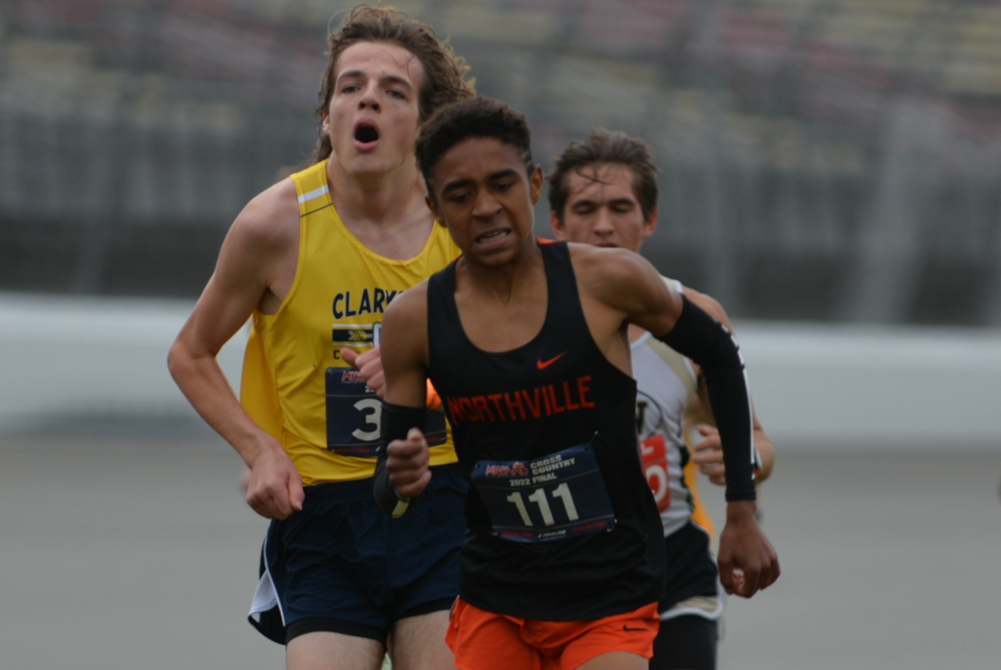
PHOTO Northville’s Ethan Powell (111) leads a pack toward the finish of last season’s Lower Peninsula Division 1 Final at Michigan International Speedway. (Click for more from RunMichigan.com.)