

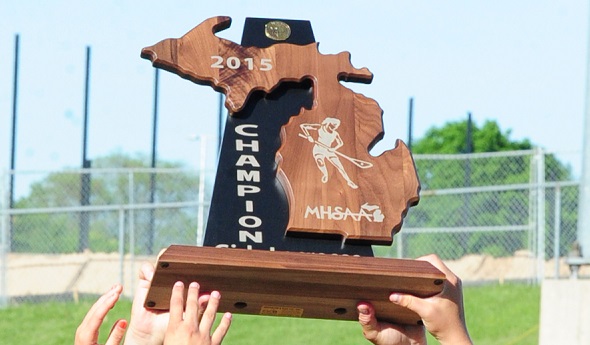
Casting Lines for Future Tournaments
August 12, 2016
By Jack Roberts
MHSAA Executive Director
The MHSAA is best known to the public for the tournaments it conducts to conclude the fall, winter and spring seasons each school year.
These tournaments, the first and largest program of the MHSAA, have survived the Vietnam War, the Korean conflict and two World Wars. They have survived the technology bubble, the housing collapse, the energy crisis and the Great Depression.
MHSAA tournaments existed at the dawn of aviation and at the time of our nation’s lunar landing. Popes, presidents and governors have changed and changed again and again, and MHSAA tournaments roll on year after year.
But the sense of tradition and permanence and inevitability of MHSAA tournaments doesn’t dissuade us from asking questions about our tournaments, even some of the most basic questions. Here are two.
Question #1
I have long been and will always be an advocate for a Ryder Cup format for the MHSAA Golf Finals, and a team tennis approach to the MHSAA Tennis Finals; but 90 years of tradition is hard to overcome. Might this be a more exciting format? Could it be co-ed? Could it reverse the decline in boys tennis participation, and increase girls golf participation? Wouldn’t it be fun to try?
Periodically, the International Olympic Committee requires each of the designated Olympic sports to defend its status, to state its case why the sport should remain a part of the Olympic program. Then, after a series or votes that retain one sport at a time, the IOC drops the sport that makes the weakest case. It does so to make room for one of the previously unlisted sports that makes the best case for inclusion.
This would appear to keep the existing Olympic sports on their toes, and to keep the Olympic movement fresh and reflective of modern trends in sports.
While I would not enjoy the controversy, I can see the potential for some positive results if the MHSAA were to invoke the same policy for determining the 14 tournaments it will provide for girls and the 14 for boys.
This might cause us to consider more deeply what a high school sport should look like, or at least what an MHSAA tournament sport should stand for.
On the one hand, we might be inclined to drop tournaments for those sports that involve mostly non-faculty coaches and non-school venues, or require cooperative programs to generate enough participants to support a team, or resort almost entirely to non-school funding, or cater to individuals more than teams.
Or perhaps this process would cause policymakers to forget traditional thinking and ask: “In this day and age, should we shake off traditional notions of sport and consider more where modern kids are coming from?” That might mean fewer team sports and more individual sports, more “extreme” sports like snowboarding and skateboarding, and more lifetime sports, meaning not just golf and tennis and running sports, but also fishing and even shooting sports.
Currently, MHSAA policy states that the MHSAA will consider sponsorship of a tournament series for any sport which 64 member schools conduct on an interscholastic basis as a result of action by the governing boards of those schools.
Should the only question be how many schools sponsor a sport, or must an activity also have certain qualities and/or avoid certain “defects?” What should an MHSAA tournament sport look like and stand for?
Question #2
Bristling from criticism that his association is a money-grabbing exploiter of children, my counterpart in another state said, “If we were running our programs just to make money, we would do very many things very differently.” I knew exactly what he meant.
Because we care about the health and welfare of students, because we mean what we say that the athletic program needs to maximize the ways it enhances the school experience while minimizing academic conflicts, and because we try to model our claim that no sport is a minor sport when it comes to its potential to teach young people life lessons, we operate our programs in ways that make promoters, marketers and business entrepreneurs laugh, cry or cringe.
If money were the only object, we would seed and select sites to assure the teams that attracted the most spectators had the best chance to advance in our tournaments, regardless of the travel for any team or its fan base. If money were the only object, we would never schedule two tournaments to overlap and compete for public attention, much less tolerate three or four overlapping events. If money were the only object, we would allow signage like NASCAR events and promotions like minor league baseball games.
Those approaches to event sponsorship may not be all wrong; they’re just not all right for us. And we will live with the consequences of our belief system.
During a typical school year, more than 20 percent of the MHSAA’s 2,097 District, Regional and Final tournaments lose money. Not a single site in golf, skiing or tennis makes a single penny. In no sport did every District, Regional and Final site have revenue in excess of direct expenses.
In fact, in only three sports – boys and girls basketball and football – is revenue so much greater than direct expenses overall that it helps to pay for all the other tournaments in which the MHSAA invests.
That’s right: invests. When we present our budget to our board, we talk about the MHSAA’s investment in providing tournament opportunities in all those sports and all those places that cannot sustain the cost of those events on their own. How much is this investment worth to students, schools and society?
These two are core questions that require our focus far in advance of talk about scheduling, site selection, seeding and the myriad matters that too often hijack our time and attention.
Another 1st-Time Opportunity Awaits as Hart Continues Memorable Playoff Run
By
Tom Kendra
Special for MHSAA.com
November 1, 2023
HART – When Hart High School constructed a new trophy case last year, football coach Joe Tanis was given the job of organizing it.
 Talk about adding insult to injury.
Tanis found a home for all 67 of the trophies in the new display case – including District, Regional and state championship trophies from every sport under the sun, from cross country to wrestling to bowling. Every sport, that is, except for football.
“We have a chance to do something very special this Friday night,” Tanis, in his third year as Hart’s head coach, told his huddled team at the end of Monday’s practice. “We have a chance to add the first football trophy to that trophy case.”
Hart (9-1), which qualified for the football playoffs for the first time in school history and became the final Muskegon-area school to earn a playoff berth, then picked up its first playoff win Friday, 44-22, over Kent City in a Division 6 District Semifinal in front of 2,000 fans at Hart.
“Winning a playoff game felt amazing,” said senior quarterback and safety Connor Edwards. “It was so cool to look out at the crowd and see it packed all the way to the concession stand. I’ve never seen that before.”
The Pirates will now play for a coveted District championship trophy this Friday night at Reed City.
“I grew up watching Hart football and never have we ever had a good football team,” said senior cornerback and running back Austin Martinez. “The coolest part is that our grade, since we were little kids playing Bucs football, said we were going to turn it around and now we’re doing it.
“Our team is just a bunch of aggressive guys that don’t back down from anyone.”
 Hart’s football woes go back decades, and many in the town of 2,126 located about 30 miles north of Muskegon were starting to wonder if their Pirates would ever win on the gridiron. In fact, one must understand the depths of despair the Hart football program has endured to appreciate the current level of euphoria.
Before Tanis’s arrived in 2021, the Pirates had won a total of 12 football games over the previous 10 years, with their last winning season coming with a 5-4 mark in 1997.
Tanis’ tenure started off in typical Hart fashion at 2-5, but his team won its final two games in 2021, leading into a 6-3 season last fall and 9-1 this year.
“We have celebrated on 17 of our last 21 Friday nights,” Tanis said.
Hart’s football turnaround is the final piece of the puzzle to complete the school’s amazing sports renaissance.
Hart won five consecutive Finals titles in girls cross country from 2017 to 2021, the boys cross country team won the school’s first boys team championship last fall, girls track has captured back-to-back Finals titles, competitive cheer took fourth in Division 4 last spring, girls basketball made it to the 2023 Division 3 Semifinals and boys basketball finished 20-0 last regular season – winning the school’s first boys basketball conference title in 60 years.
Football started its turnaround with the arrival of Tanis and defensive coordinator Jacob Tumele in 2021 – a coaching duo which has worked tirelessly recruiting, getting kids in the weight room and, as Tanis readily admits, getting a big boost with the realignment of the West Michigan Conference.
The WMC broke into two divisions in 2021, with a larger-school Lakes division featuring powers Oakridge, Whitehall and Montague, and Hart settling into a much more favorable schedule in the smaller-school Rivers division. The Pirates took second in the Rivers this fall, with their only loss coming at the hands of unbeaten North Muskegon.
Tanis also preached an “all-in” mentality, starting with himself.
Tanis, a Grandville native whose last head coaching job before Hart stretched seven years at Muskegon Orchard View, bought a house on Pirate’s Way leading into the town’s academic campus.
“One of the conditions of this job was that I had to move into town,” explained the 41-year-old Tanis. “Well, to get to my driveway, you first have to pull into the school driveway, so I can’t get any closer. And we absolutely love it.”
All five members of the Tanis family could easily walk to school each day. Joe is the dean of students at the high school, wife Jilanna works in the district’s central business office located in the early elementary building, his two youngest kids are in the elementary school and his oldest child is at the middle school.
“There is a Tanis in all four of the buildings,” Tanis said with a smile.
On the field, Tanis dug back into football’s past to find Hart’s new offense – the single wing, which features a direct center snap to one of the three backs, a quarterback who blocks more than he throws and an unbalanced line to create mismatches at the point of attack.
Hart, which starts seven seniors on both sides of the ball, is averaging 49 points per game during its current five-game winning streak.
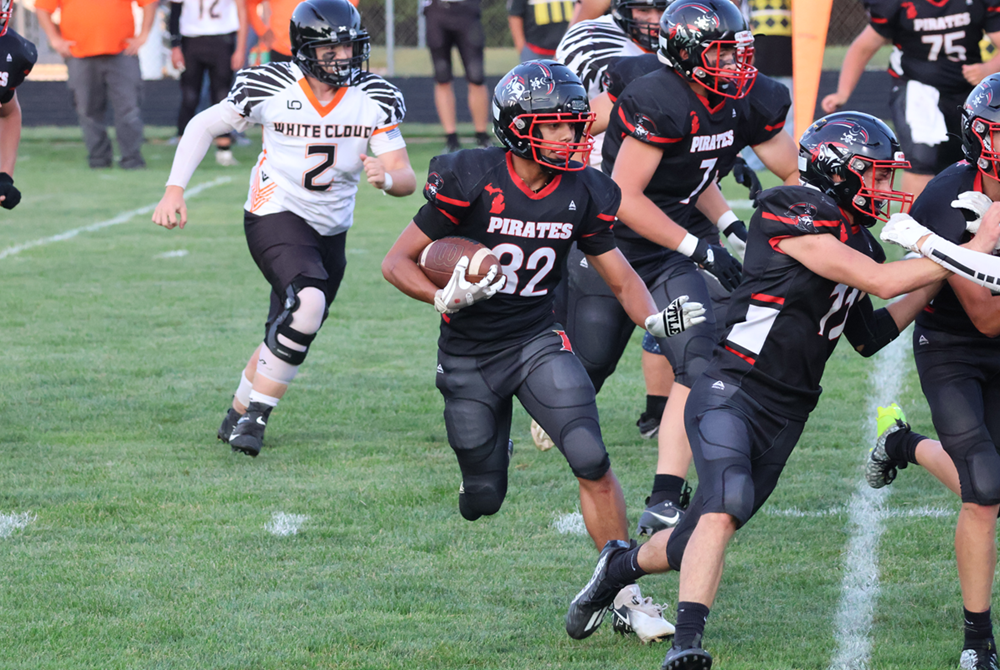
Senior Joseluis Andaverde (known to all his teammates as “Beast Mode”) is the most dangerous offensive weapon with 185 carries for 1,537 yards and 19 TDs. His primary blocker is Edwards, the quarterback, who has rushed for 756 yards and 12 touchdowns while completing 11-of-35 passes for 267 yards, five TDs and one interception.
Five of the Pirates’ six starters on the offensive line are seniors, with the exception of standout sophomore Hollis Rockwell at center – which is a critically important position in the single-wing offense.
Tanis feels the unique offense really benefits his team in the playoffs, when teams have only one week to prepare for it.
That being said, Tanis knows his undersized and inexperienced playoff team will be the underdog this week at Reed City, a perennial playoff team which came within one point of advancing to Ford Field last season, losing 13-12 to Negaunee in a Division 6 Semifinal.
“The major appeal of taking this job was having the opportunity to do things that have never been done here before,” said Tanis. “We have done some of those things, and hopefully there are more to come.
“You have to change the way the kids think, and we’ve done that. Now these kids think of themselves as winners.”
 Tom Kendra worked 23 years at The Muskegon Chronicle, including five as assistant sports editor and the final six as sports editor through 2011. E-mail him at [email protected] with story ideas for Muskegon, Oceana, Mason, Lake, Oceola, Mecosta and Newaygo counties.
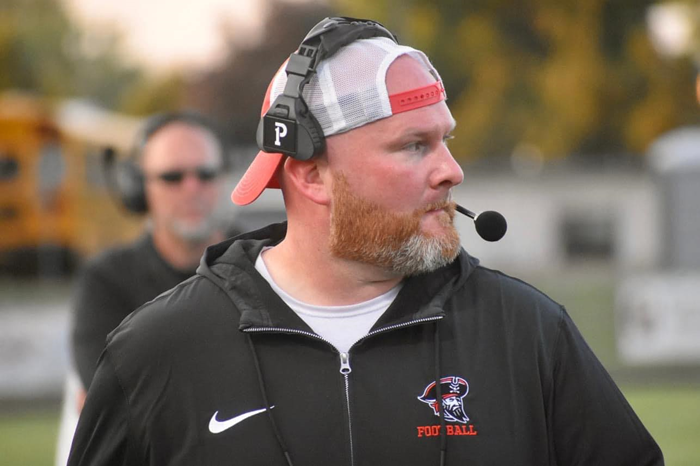
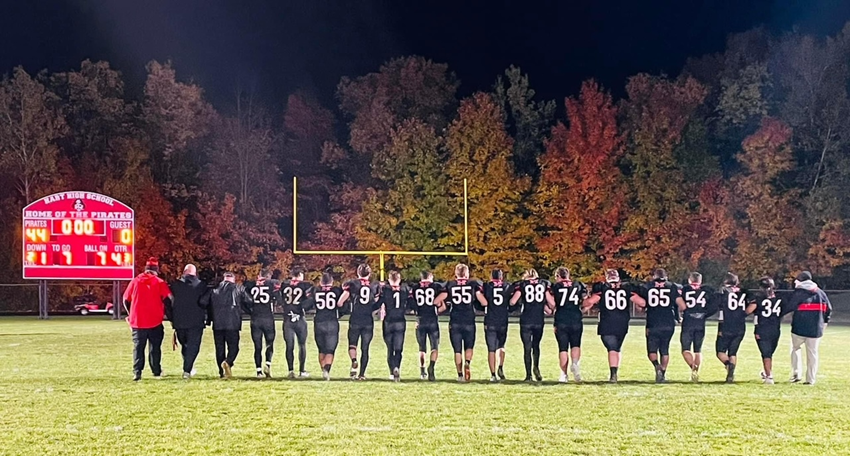
PHOTOS (Top) Senior tailback Joseluis Andaverde runs the ball in a game against White Cloud on Aug. 31. (Middle) Hart coach Joe Tanis, in his third year, has led the Pirates to a 9-1 record thus far and the school's first-ever playoff victory on Oct. 27 against Kent City. (Below) Hart's senior football players and their coaches take a final walk off the field after defeating Ravenna, 44-0, on Oct. 20 in the final regular-season home game. (Photos by Harriet Kidder.)