

Casting Lines for Future Tournaments
August 12, 2016
By Jack Roberts
MHSAA Executive Director
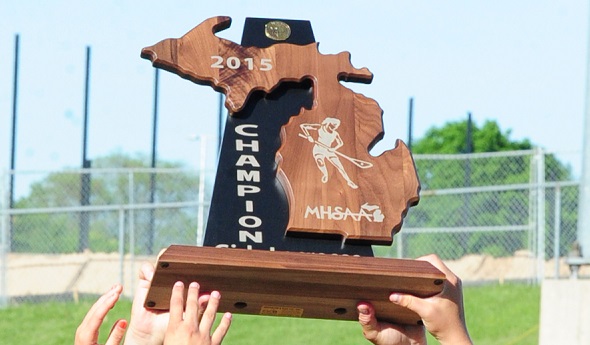
The MHSAA is best known to the public for the tournaments it conducts to conclude the fall, winter and spring seasons each school year.
These tournaments, the first and largest program of the MHSAA, have survived the Vietnam War, the Korean conflict and two World Wars. They have survived the technology bubble, the housing collapse, the energy crisis and the Great Depression.
MHSAA tournaments existed at the dawn of aviation and at the time of our nation’s lunar landing. Popes, presidents and governors have changed and changed again and again, and MHSAA tournaments roll on year after year.
But the sense of tradition and permanence and inevitability of MHSAA tournaments doesn’t dissuade us from asking questions about our tournaments, even some of the most basic questions. Here are two.
Question #1
I have long been and will always be an advocate for a Ryder Cup format for the MHSAA Golf Finals, and a team tennis approach to the MHSAA Tennis Finals; but 90 years of tradition is hard to overcome. Might this be a more exciting format? Could it be co-ed? Could it reverse the decline in boys tennis participation, and increase girls golf participation? Wouldn’t it be fun to try?
Periodically, the International Olympic Committee requires each of the designated Olympic sports to defend its status, to state its case why the sport should remain a part of the Olympic program. Then, after a series or votes that retain one sport at a time, the IOC drops the sport that makes the weakest case. It does so to make room for one of the previously unlisted sports that makes the best case for inclusion.
This would appear to keep the existing Olympic sports on their toes, and to keep the Olympic movement fresh and reflective of modern trends in sports.
While I would not enjoy the controversy, I can see the potential for some positive results if the MHSAA were to invoke the same policy for determining the 14 tournaments it will provide for girls and the 14 for boys.
This might cause us to consider more deeply what a high school sport should look like, or at least what an MHSAA tournament sport should stand for.
On the one hand, we might be inclined to drop tournaments for those sports that involve mostly non-faculty coaches and non-school venues, or require cooperative programs to generate enough participants to support a team, or resort almost entirely to non-school funding, or cater to individuals more than teams.
Or perhaps this process would cause policymakers to forget traditional thinking and ask: “In this day and age, should we shake off traditional notions of sport and consider more where modern kids are coming from?” That might mean fewer team sports and more individual sports, more “extreme” sports like snowboarding and skateboarding, and more lifetime sports, meaning not just golf and tennis and running sports, but also fishing and even shooting sports.
Currently, MHSAA policy states that the MHSAA will consider sponsorship of a tournament series for any sport which 64 member schools conduct on an interscholastic basis as a result of action by the governing boards of those schools.
Should the only question be how many schools sponsor a sport, or must an activity also have certain qualities and/or avoid certain “defects?” What should an MHSAA tournament sport look like and stand for?
Question #2
Bristling from criticism that his association is a money-grabbing exploiter of children, my counterpart in another state said, “If we were running our programs just to make money, we would do very many things very differently.” I knew exactly what he meant.
Because we care about the health and welfare of students, because we mean what we say that the athletic program needs to maximize the ways it enhances the school experience while minimizing academic conflicts, and because we try to model our claim that no sport is a minor sport when it comes to its potential to teach young people life lessons, we operate our programs in ways that make promoters, marketers and business entrepreneurs laugh, cry or cringe.
If money were the only object, we would seed and select sites to assure the teams that attracted the most spectators had the best chance to advance in our tournaments, regardless of the travel for any team or its fan base. If money were the only object, we would never schedule two tournaments to overlap and compete for public attention, much less tolerate three or four overlapping events. If money were the only object, we would allow signage like NASCAR events and promotions like minor league baseball games.
Those approaches to event sponsorship may not be all wrong; they’re just not all right for us. And we will live with the consequences of our belief system.
During a typical school year, more than 20 percent of the MHSAA’s 2,097 District, Regional and Final tournaments lose money. Not a single site in golf, skiing or tennis makes a single penny. In no sport did every District, Regional and Final site have revenue in excess of direct expenses.
In fact, in only three sports – boys and girls basketball and football – is revenue so much greater than direct expenses overall that it helps to pay for all the other tournaments in which the MHSAA invests.
That’s right: invests. When we present our budget to our board, we talk about the MHSAA’s investment in providing tournament opportunities in all those sports and all those places that cannot sustain the cost of those events on their own. How much is this investment worth to students, schools and society?
These two are core questions that require our focus far in advance of talk about scheduling, site selection, seeding and the myriad matters that too often hijack our time and attention.
Three Rivers Follows Past Standout to League Title, with More Historic Hopes
By
Scott Hassinger
Special for MHSAA.com
October 31, 2023
THREE RIVERS – Megan Jergens was a sophomore outside hitter when Three Rivers won its last Wolverine Conference volleyball title in 2013.
 Ten years later, Jergens has the Wildcats sitting back on top of the league standings again as she winds down her first season as head coach.
Three Rivers (40-9-2) reclaimed the long-awaited honor with a 6-1 record sharing the crown with Edwardsburg and Otsego.
The latest championship, along with a couple of individuals on the team who have sketched their name into the MHSAA record book, has created a ton of excitement entering this week's Division 2 District tournament at Paw Paw.
Three Rivers, No. 8 in the final Michigan Interscholastic Volleyball Coaches Association poll, won its District-opening match Monday defeating Paw Paw 25-8, 25-20, 25-3. The Wildcats are scheduled to face Dowagiac in a District semifinal match at 7 p.m. Wednesday.
Jergens, Three Rivers' junior varsity mentor the last four seasons, was hired in April to replace former coach Lauren Cholometes.
A solid summer of conditioning and attendance at a couple of camps helped put the building blocks in place for a successful season in Three Rivers.
Expectations have been high with six returning seniors and a couple of underclassmen who play key roles.
Jergens’ biggest concerns initially when she took the reins of the program were how to get a large group of returning seniors the best experience possible while being highly competitive.
"We have a lot of potential with this group and many phenomenal athletes. The main question was how can we take full advantage of this and put it to good use," Jergens said.
Three Rivers' preseason goals were similar to those at all schools with conference, District, Regional and state title hopes.
"Those are everybody's goals, but you have to set little ones to accomplish the bigger ones. It just doesn't happen overnight," Jergens said. “Here at Three Rivers, we are blessed to have a phenomenal weight room that's open four days during the summer. Except for our dead periods, all of our girls were in there lifting every day. There was a big emphasis on our summer workouts. They understand that anything we accomplish has to be earned; it's not just given to them.”
Three Rivers attended the Aquinas Summer Slam which features some of the state's elite teams. The Wildcats also spent a few days at the Ferris State University Camp.
"Playing in those summer scrimmages really helped prepare us for our early-season matches. It allowed us to get off to a much quicker start against some of the better teams in our league," Jergens said.
 Besides a rigorous league schedule, Three Rivers competed against several Division 1 schools in weekend tournaments at Gull Lake, the Cereal City Classic in Battle Creek and the Williamston Tournament, where the Wildcats finished first.
"Those kind of tournaments make us work hard for every point, but in the long run it makes us a much better team," Jergens added. “Our practices are extremely competitive because of the personnel we have on this team. Our bench players would be starters at a lot of other schools. We have 14 players on the roster because their attitudes have been really positive. These girls really embrace their individual roles."
Three Rivers has three seniors who have started on varsity since their sophomore season. They are senior middle hitter Jenna Southland, along with right-side hitter Allie McGlothlen and defensive specialist Aliza Munro.
Southland, a 6-foot-2 returning third-team all-stater, leads Three Rivers in kills with 619, a .356 hitting percentage, 99 blocks, 223 digs and 59 aces. This year she has made MHSAA record books lists with 30 kills in a single match, along with most kills in a season (619) and career kills (1,438). She has committed to play at the Division II level at Hillsdale College next fall.
"Our attacking is solid because we have strong hitters all around who know where to place the ball. I feel like our determination has been a big factor as well," Southland said. "I've improved a great deal on my court vision, knowing where my blockers are and talking to the other hitters."
McGlothlen also has been a consistent performer for Three Rivers at right-side hitter. She has 223 kills, 326 digs, 35 aces and 64 blocks.
"Both Jenna and Allie play all-around for us and are powerhouse hitters. We really look to both of them for a lot of contributions," Jergens said. "All of our senior class are strong leaders on and off the court. That kind of leadership can't be taught, and I'm really thankful for that."
McGlothlen also has raised some interest from college coaches with her ability.
"Winning conference and raising that banner was really exciting and special. We worked very hard to get there," McGlothlen said. "We know we always have to be aggressive at the net even with how good our defense is."
Munro, the Wildcats' No. 1 libero, has 526 digs to go with 25 aces.
"Aliza runs our defense. She's a phenomenal serve-receive passer who keeps us steady in the back row," Jergens said.
Munro will continue her playing career the next four years for Spring Arbor University, an NAIA school.
"We never give up on any balls, and our back row communicates very well. We can be down a couple sets, regroup and come back and win," Munro said.
Lending additional power at the net is senior middle/right-side hitter Arabella Mangold. She has 258 kills, a .240 hitting percentage, 302 digs, 64 blocks and 28 aces.
"Arabella has been a real positive influence on our team. We switched her to middle hitter this year, and I couldn't ask for a better person than her in that role," Jergens said.
Sophomore Miley Southland, Jenna's younger sister, has run the offense to near perfection from her setter's spot as a second-year starter. She has 1,179 assists to go with 78 kills, 33 blocks and 46 aces. She registered an MHSAA record 46 assists in a match against Sturgis, then later surpassed that with 56 against Otsego.
Three Rivers runs a fast-paced offense with various options of attack.
"We run multiple plays that Miley can choose from, and she does a nice job of setting up our offense," Jergens said.
The Southlands also happen to be the younger sisters of Three Rivers' head coach.
 "Coaching them (Jenna and Miley) is a special dynamic that I'm very thankful for. I am eight and 10 years older than them so we've never been super close, but this has allowed us to have that sister dynamic back,” Jergens said. “They respect me as a coach, so it doesn't really feel like I'm out there coaching my sisters. I look at it as a privilege, and I wouldn't trade that experience for anything.”
Jenna Southland is thankful for the chance to bond with her older sister.
"I love playing for Megan. She pushes me and knows what I need as a player, and I know I can trust her," Jenna Southland said.
Miley is equally ecstatic about playing for her oldest sister.
"It's a lot of fun playing for my older sister. We have real good chemistry, and she knows when to push me and when to back off a little," Miley Southland said. "I feel encouraged by my teammates, and I've really improved on my connection with the hitters. I see the court much better and know where to set the ball."
Seniors Lanie Glass and Maddie O'Hara have played significant roles as well for Three Rivers.
Glass has 99 kills, 37 aces, 114 digs and 24 blocks at outside hitter, while O'Hara sports totals of 114 kills, 74 digs and 22 blocks at left-outside hitter.
Jergens has coached most of her players on her varsity roster, since they played for her at the JV level or on her club teams.
"These girls have had me as a coach for a long time. That's made the coaching transition much easier for them since I took over," Jergens said. “I feel like we have a special relationship because they know me inside and out and what my expectations of them are. There is a mutual respect between us.”
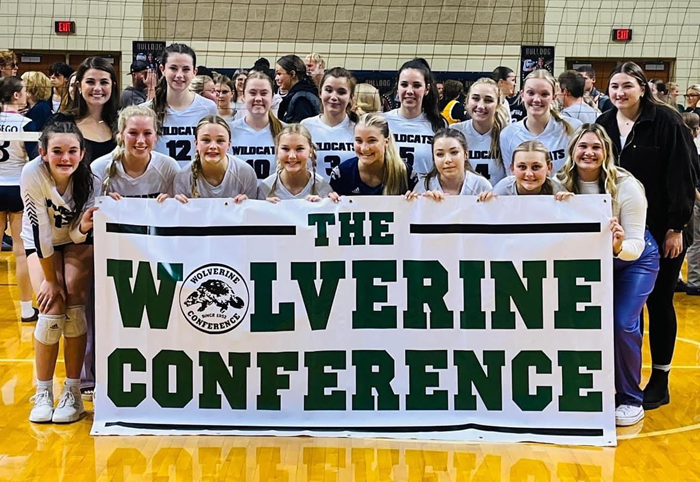
Three Rivers' league title was just the third in school history in volleyball, joining those won in 2012 and 2013.
Should Three Rivers win its District, the Wildcats would get a possible rematch with Otsego in the Regional. Otsego edged Three Rivers in the final league match 25-20, 25-23, 25-23, 25-16, 20-18.
Three Rivers’ longest postseason run in this sport came in 2021, when the Wildcats reached the Regional Final before falling to Niles.
"Winning league has been a full-circle moment for us because volleyball isn't a sport that Three Rivers has necessarily been a powerhouse in. We have a standout conference where we have multiple teams that play at a high level," Jergens said.
“This team is really special, and they know they are special. I'm really excited to see what we can do in Districts.”
 Scott Hassinger is a contributing sportswriter for Leader Publications and previously served as the sports editor for the Three Rivers Commercial-News from 1994-2022. He can be reached at [email protected] with story ideas for Berrien, Cass, St. Joseph and Branch counties.
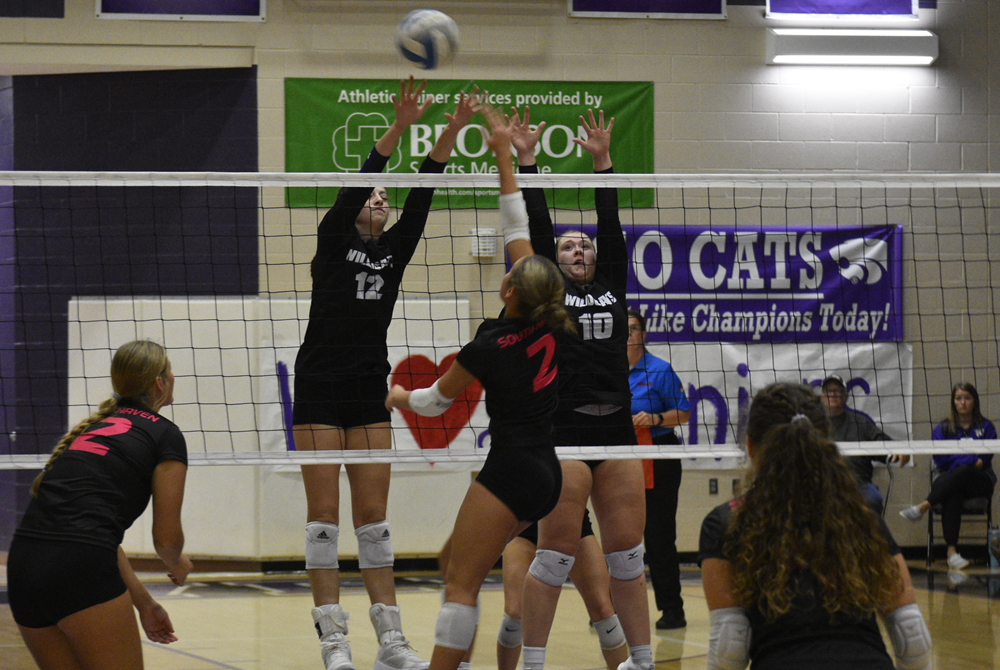
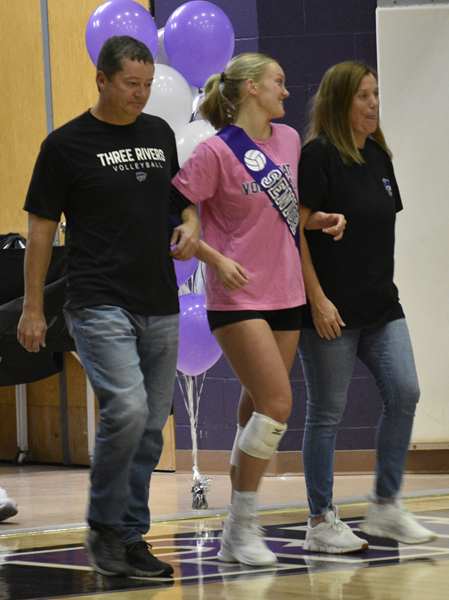
PHOTOS (Top) Seniors Jenna Southland (12) and Madelyn O'Hara combine at the net to block a kill attempt by a South Haven player. (Middle) Senior Allie McGlothlen is escorted by her parents Jon and Kristine McGlothlen on Parent's Night at Three Rivers prior to that match. (Below) Three Rivers varsity volleyball players and their coaches celebrate their first Wolverine Conference title since 2013 after a recent match at Otsego. (Top and middle photo by Scott Hassinger. Below photo courtesy of Three Rivers’ athletic department.)