

Casting Lines for Future Tournaments
August 12, 2016
By Jack Roberts
MHSAA Executive Director
The MHSAA is best known to the public for the tournaments it conducts to conclude the fall, winter and spring seasons each school year.
These tournaments, the first and largest program of the MHSAA, have survived the Vietnam War, the Korean conflict and two World Wars. They have survived the technology bubble, the housing collapse, the energy crisis and the Great Depression.
MHSAA tournaments existed at the dawn of aviation and at the time of our nation’s lunar landing. Popes, presidents and governors have changed and changed again and again, and MHSAA tournaments roll on year after year.
But the sense of tradition and permanence and inevitability of MHSAA tournaments doesn’t dissuade us from asking questions about our tournaments, even some of the most basic questions. Here are two.
Question #1
I have long been and will always be an advocate for a Ryder Cup format for the MHSAA Golf Finals, and a team tennis approach to the MHSAA Tennis Finals; but 90 years of tradition is hard to overcome. Might this be a more exciting format? Could it be co-ed? Could it reverse the decline in boys tennis participation, and increase girls golf participation? Wouldn’t it be fun to try?
Periodically, the International Olympic Committee requires each of the designated Olympic sports to defend its status, to state its case why the sport should remain a part of the Olympic program. Then, after a series or votes that retain one sport at a time, the IOC drops the sport that makes the weakest case. It does so to make room for one of the previously unlisted sports that makes the best case for inclusion.
This would appear to keep the existing Olympic sports on their toes, and to keep the Olympic movement fresh and reflective of modern trends in sports.
While I would not enjoy the controversy, I can see the potential for some positive results if the MHSAA were to invoke the same policy for determining the 14 tournaments it will provide for girls and the 14 for boys.
This might cause us to consider more deeply what a high school sport should look like, or at least what an MHSAA tournament sport should stand for.
On the one hand, we might be inclined to drop tournaments for those sports that involve mostly non-faculty coaches and non-school venues, or require cooperative programs to generate enough participants to support a team, or resort almost entirely to non-school funding, or cater to individuals more than teams.
Or perhaps this process would cause policymakers to forget traditional thinking and ask: “In this day and age, should we shake off traditional notions of sport and consider more where modern kids are coming from?” That might mean fewer team sports and more individual sports, more “extreme” sports like snowboarding and skateboarding, and more lifetime sports, meaning not just golf and tennis and running sports, but also fishing and even shooting sports.
Currently, MHSAA policy states that the MHSAA will consider sponsorship of a tournament series for any sport which 64 member schools conduct on an interscholastic basis as a result of action by the governing boards of those schools.
Should the only question be how many schools sponsor a sport, or must an activity also have certain qualities and/or avoid certain “defects?” What should an MHSAA tournament sport look like and stand for?
Question #2
Bristling from criticism that his association is a money-grabbing exploiter of children, my counterpart in another state said, “If we were running our programs just to make money, we would do very many things very differently.” I knew exactly what he meant.
Because we care about the health and welfare of students, because we mean what we say that the athletic program needs to maximize the ways it enhances the school experience while minimizing academic conflicts, and because we try to model our claim that no sport is a minor sport when it comes to its potential to teach young people life lessons, we operate our programs in ways that make promoters, marketers and business entrepreneurs laugh, cry or cringe.
If money were the only object, we would seed and select sites to assure the teams that attracted the most spectators had the best chance to advance in our tournaments, regardless of the travel for any team or its fan base. If money were the only object, we would never schedule two tournaments to overlap and compete for public attention, much less tolerate three or four overlapping events. If money were the only object, we would allow signage like NASCAR events and promotions like minor league baseball games.
Those approaches to event sponsorship may not be all wrong; they’re just not all right for us. And we will live with the consequences of our belief system.
During a typical school year, more than 20 percent of the MHSAA’s 2,097 District, Regional and Final tournaments lose money. Not a single site in golf, skiing or tennis makes a single penny. In no sport did every District, Regional and Final site have revenue in excess of direct expenses.
In fact, in only three sports – boys and girls basketball and football – is revenue so much greater than direct expenses overall that it helps to pay for all the other tournaments in which the MHSAA invests.
That’s right: invests. When we present our budget to our board, we talk about the MHSAA’s investment in providing tournament opportunities in all those sports and all those places that cannot sustain the cost of those events on their own. How much is this investment worth to students, schools and society?
These two are core questions that require our focus far in advance of talk about scheduling, site selection, seeding and the myriad matters that too often hijack our time and attention.
Oxford Golfers Excel, Continue to Heal with 1st League Title, Finals Debut
By
Ray Hill
Michigan Interscholastic Golf Coaches Association
October 18, 2023
It was 49 degrees, cloudy, and drizzly Monday when five Oxford High School girls golf team members pulled into the parking lot at Metamora Golf and Country Club. They popped open the backs of their cars and rooted around for the right combination of hats, hoodies, gloves and rain gear. There were no complaints about the weather as the fivesome strolled down the first fairway of an empty course giggling and sharing stories from the day at school.
They were in their happy place.
Oxford coach Gretchen Gabler, 56, has worked for nine years to create a happy, safe place for her golfers. Bad weather, bad bounces, bad scores are not going to break their spirit – they’ve seen more than most their age, and have developed a mentality to deal with adversity and stay focused on the important things in life, says their coach.
And, aside from a few sprinkles, cold fingers, and searching for that missing floppy rain hat in the bottom of the golf bag, overcoming adversity has not been an issue this fall for the Wildcats. Gabler’s team is enjoying the most successful season in the program’s 28-year history. Oxford won the Oakland Activities Association White championship, and qualified for the Lower Peninsula Division 1 Finals – both first-time happenings for the program. The Wildcats, No. 8 in the current Michigan Interscholastic Golf Coaches Association Division 1 state rankings, will tee it up Friday and Saturday at Forest Akers West.
“It’s so nice to see (success) for those girls and Gretchen,” said Clarkston coach Lezlie Hallman, who has had a front-row seat watching the rise of Oxford girls golf. “My hat is off to them. They’ve earned everything this year. Gretchen goes above and beyond with those girls, and has worked hard to strengthen our league. Everyone loves her, and her girls. They cheer hard for everyone else on the golf course, and now my girls couldn’t be happier for them; I’m happy for the school – the whole community needs this kind of school success.”
This team’s success is a feel-good story for many after the November 2021 shooting that killed four and injured seven at Oxford High School.
 “The shooting is not who we are, but something that happened to us,” Gabler said. “After the shooting, I told the parents ‘I don’t care if we ever win a game – I just want these girls to heal.’ So when I see them smile and giggle and laugh, it’s an amazing sign that they have carried forward.”’
They’ve smiled, giggled, and laughed this season, but they’ve also won.
This fall Oxford won five 18-hole events with five more top-five finishes. They have set school 9- and 18-hole scoring records (307 and 163). They’ve gone from league doormats to league champions over the last three years.
“We are definitely a close-knit team that has really come together since the shooting,” said senior Ellie Gieselman. “Since (the shooting) we’ve tried to play more for our school than for ourselves.”
Last year, Gieselman said, her team appreciated the support, but grew weary of the sympathetic looks when they showed up at events. And then they started carding low numbers.
“That’s happening a lot less now that we’re not at the bottom – people see us now more for how much game we have,” Gieselman said with a proud smile.
It’s been a long climb to the top for the Wildcats. Gabler was a stay-at-home married mom of two adult children when she took the program reins in 2014. She took up the game herself in her 30s and was an Oxford golf mom when her daughter played.
Knowing she wasn’t going to shape swings like a teaching professional, she focused on what she could do.
“In my first few years, I was teaching kids how to hold a club and swing and read greens,” she said. “I knew we weren’t in the same place as other schools in the league, but I knew we could be the team that knows the rules, counts all our strokes, plays with sportsmanship, and has fun.”
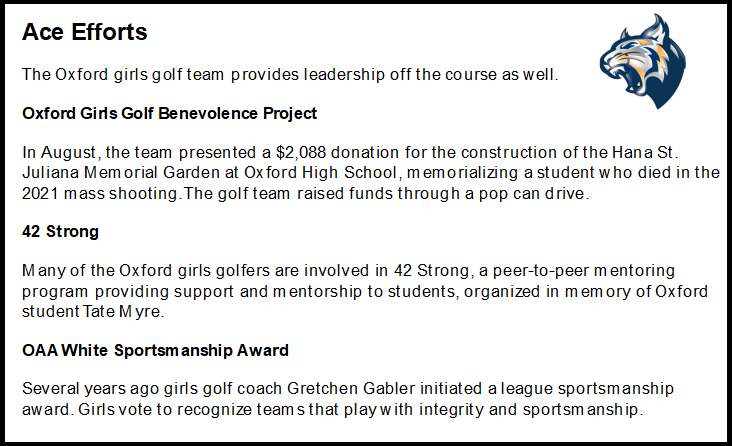
Those foundational principles, combined with Gabler’s enthusiasm, changed everything for the program. She soaked up every detail from the MHSAA Coaches Advancement Program classes for new coaches, asked veteran coaches for advice, begged friends and neighbors to encourage their daughters to play golf, and used social media to promote her girls golf program among Oxford-area moms. She guarantees a positive experience for all and refuses to make cuts. Gabler has team bonding events at her home, is visible at all school events, and can tell you each of her team member’s colleges of choice and future dream jobs.
She has an active team page on Facebook and an Instagram account where team members interview each other, competitors, and generally just have fun. The team has grown in size from 8 in 2014 to 30 in 2023.
Oxford golf parent Cari Yankee has five daughters, three of whom have played golf, including senior Lexie. Her twin eighth graders plan to join the squad next year.
“Gretch really loves these girls,” Yankee said. “She is fostering a love of golf, and she makes it a heck of a lot of fun. She never lets them get down on themselves and is so patient with them. She is a wonderful mentor, and as a parent, I never have to worry about the kids because I know how much she really cares for them and loves them. Ask anyone who has played for her, and you won’t find anyone who has a bad word about Gretch. She’s special.”
Gabler considered stepping down as coach a couple of years ago. The COVID-19 pandemic and the death of a former team member deeply impacted her. It was the hugs and support from the girls that brought her back for the 2021 season.
“I just couldn't walk away from those girls. And I’m really glad I didn’t quit because I wouldn’t have been there for them during the shooting, and for this fun season,” Gabler said.
During the 2021 shooting, she texted every member of her team, asking if they were physically safe. They were. In the days after, she arranged a Zoom meeting for the girls with a trauma counselor who worked with survivors of the 2018 Parkland, Fla., school shooting. Their emotional recovery became her primary focus, as she worked to provide them a safe zone where they could talk about the tragedy, or just play golf and have fun.
The team grew closer, Gabler saw healing taking place, and she began to notice something special about these girls.
“This group is different,” Gabler said. “They’re not just great athletes, they are great young women; they are kind, they are Godly – they’re just really good people. Being associated with them has been a great honor.”
The core group playing at the Finals consists of seniors Ellie Gieselman, Ella Flores, Keira Billis, Gabi Wait, and sophomore Katie Pill.
“We knew this season would be special,” Billis said. “We had a good team last year, and everyone worked hard over the summer to get better. We came out and won the first tournament of this season, and knew it was a great sign. And now, we’re off to states.”
Gabler is excited for the girls, and hopes they play well, but won’t be focused on the scoreboard. She simply wants the girls to revel in the moment, perform as well as they can, and just be kids.
Watching them walk side-by-side down the fairway on a cold, drizzly afternoon, Gabler said “Those girls care very much for each other, and for life. They have an understanding about life that many people cannot grasp because they have not faced their own mortality like these girls did at age 16. They are mature beyond their years, and yet they are still kids just having fun.”
Having fun in a safe, happy place, and developing the skills to help succeed in life – it’s what high school athletics is all about.
Ray Hill is a recently retired teacher from East Jackson High School who has done freelance writing for 40 years. He has also coached golf at East Jackson for 27 years and serves as public relations director for the Michigan Interscholastic Golf Coaches Association.
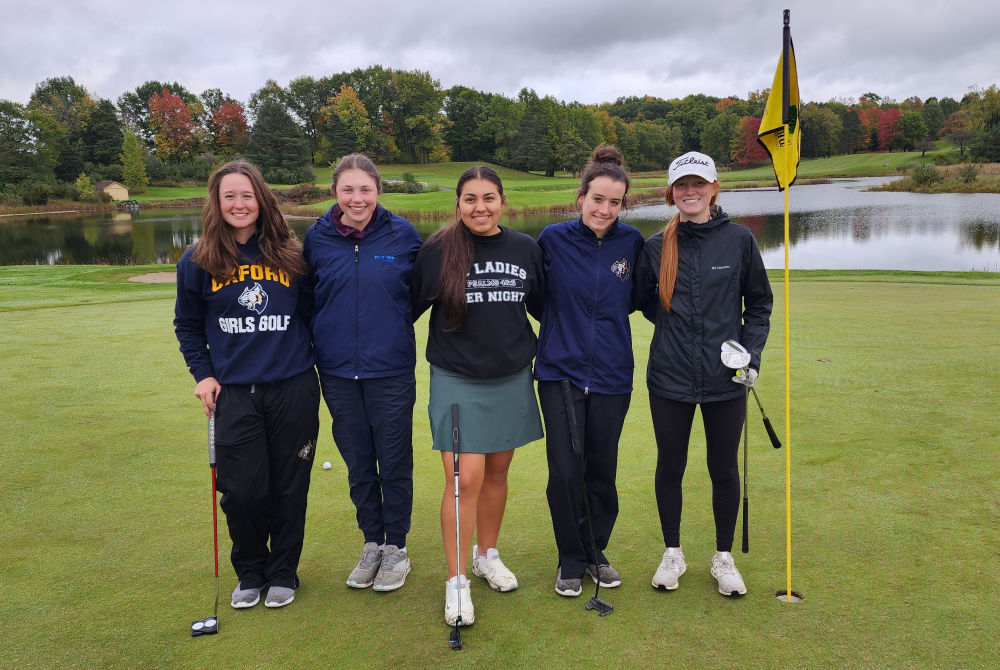
PHOTO From left: Oxford golfers Gabi Wait, Ellie Gieselman, Ella Flores, Keira Billis and Katie Pill. (Photo provided by the Michigan Interscholastic Golf Coaches Association.)